
68% of B2B marketing leaders are dissatisfied with the buyer personas their teams built. Not because personas are a bad idea. Because most of the ones sitting in company Notion pages and slide decks describe the wrong things.
The standard buyer persona tells you a person’s job title, rough age range, and a list of “goals and pain points” that could apply to almost anyone in that role. It describes who your buyer is. It says almost nothing about why they’re buying right now, who else is involved in the decision, or what actually pushed them to start looking.
Those three gaps are the real reason most buyer personas collect dust. This article is about closing them.
Most B2B Deals Involve 13 Stakeholders But Your Persona Maps One
Here’s the first structural problem. Most buyer persona frameworks assume a single decision-maker. You build a profile of your ideal champion. The Marketing Director. The Head of Sales. The VP of Ops. Then you optimize all your content and messaging for that one person.
The average B2B purchase now involves 13 internal stakeholders. Gartner puts the number at 6-10 for mid-market software deals. And each of those people arrives at the final decision with 4-5 pieces of independent research they’ve already done on their own.
📊 By the Numbers
A research found that 86% of B2B purchases stall at some point in the process. The most common reason isn’t a competitor. It’s that one stakeholder’s concerns weren’t addressed before the deal reached the finish line.
Your champion loved the pitch. Someone in IT had unanswered security questions. Someone in finance never got a proper ROI breakdown. The deal didn’t die because you targeted the wrong person. It died because you only targeted one person.

The implication for your B2B buyer persona work is significant. You’re not building one profile. You’re building a buying committee map. That means you need at least three personas for most B2B deals: the champion (who initiates and advocates), the economic buyer (who controls budget and ultimately signs), and the blocker. The blocker is typically IT, legal, or security. The person who introduces last-minute friction. For larger deals, add a user persona and a procurement contact.
This doesn’t mean you need a 30-page persona document for every role. It means that when you’re planning content and messaging, you ask: who else is in the room when our champion presents internally? What do those people care about? What would make them say no?
Most of the decision-making in B2B happens in conversations you’re not part of. Your champion forwards your content to stakeholders you’ll never meet, and those people form opinions based on what they find. The brands that win are usually the ones that made it easy for the champion to argue the case internally. Not just the ones that gave the champion a great demo.
Trigger Events Beat Demographics Every Time
Here’s the second problem. Even when companies do persona research, they focus on customer demographics and psychographic data. Who their buyers are as people. What they almost never research is the specific moment that made someone start looking for a solution.
Two Marketing Directors with identical profiles will behave completely differently depending on what triggered their search. Same age, same company size, same title. One just had the worst quarter of her career and needs to show the CEO a plan. One just hired a new boss who’s skeptical of the whole marketing function. One just watched a competitor’s campaign blow up on LinkedIn and feels behind. Same persona. Wildly different emotional state, urgency level, and decision criteria.
💡 Quick Tip
The single best interview question for uncovering trigger events: “Walk me through what was happening at your company in the 30 days before you started looking for a solution like ours.” Most marketers never ask this. The answers will rewrite your messaging.
That triggering event is more predictive of buying behavior than any demographic variable. It determines how fast they’ll move, how much they’ll pay, and what proof they need before they’ll commit. In persona development, this is sometimes called the “trigger moment.” You’re researching the circumstances that create urgency. Not just the traits of the person experiencing it.
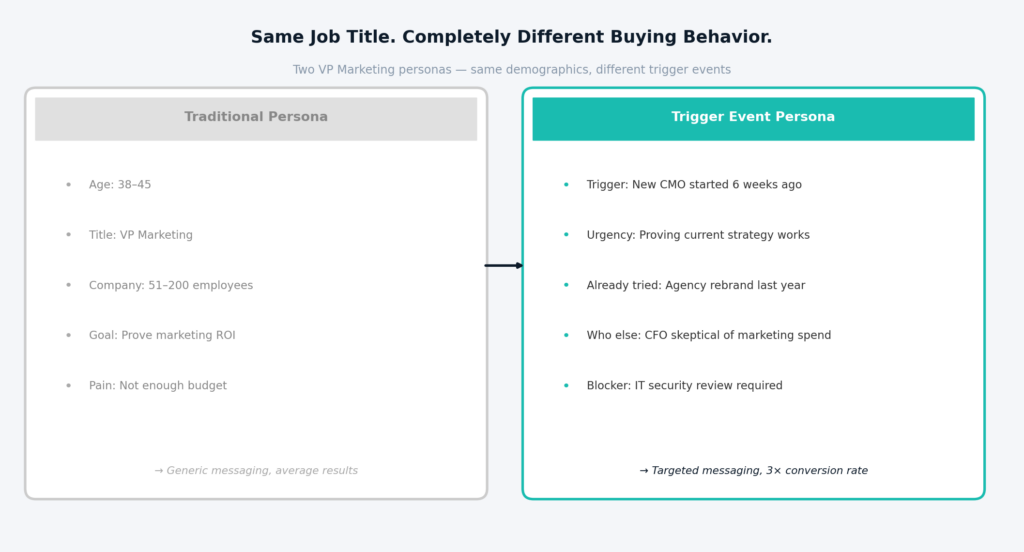
Common trigger events in B2B marketing include a leadership change that shifts priorities, a failed campaign or quarter that creates pressure, a competitor move that makes the team feel exposed, or a new product launch that surfaces a capability gap.
Once you know the 2 or 3 trigger events that most commonly precede a purchase, you can build content that speaks directly to people in those situations. An email that opens with “Just switched CMOs and rebuilding your strategy from scratch?” will convert at a completely different rate than one that leads with a generic benefit statement.
This also changes which questions you ask in customer research. Instead of “What are your goals?” (which produces answers too generic to use), you ask: “What was the tipping point that made you actually do something about this?” and “If you hadn’t moved forward, what would have had to be different?” Those two questions will tell you more about your buyer’s psychology than 10 pages of demographic data.
Understanding how companies structure their talent acquisition process shows the same principle in action. The trigger that finally makes a company act on a hire (someone quit, a project stalled, a key role sat empty for months) is more predictive than any description of the “ideal” candidate profile.
3 Research Sources Worth Your Time
Most companies do one type of audience research: they interview a handful of happy customers and call it done. Happy customers will tell you what they liked about working with you. They won’t tell you what almost made them choose someone else, what internal pushback they faced, or what they tell colleagues when you’re not listening.
Here are the three research methods that surface what happy customer interviews miss.

Win/Loss Interviews: Your Most Underused Data Source
Win/loss interviews are conversations with people who evaluated your product and made a decision. Either for you or against you. Talking to people who chose a competitor is uncomfortable. It’s also the most valuable customer research most companies never do.
People who said no to you will tell you exactly what your messaging failed to address, which competitor framed the problem better, and what concern your champion couldn’t overcome internally. That’s persona gold. A single conversation with a lost deal will surface objections you didn’t know existed and customer pain points your content has never addressed.
Run 3 to 5 win/loss interviews every quarter. Ask lost deals: “What made you go with [competitor]?” and “What would have had to be different for you to choose us?” Ask won deals: “What almost made you go with someone else?” The answers will rewrite your personas faster than any survey.
Scheduling those interviews live across timezones is usually what kills the practice. Voxpopme replaces that with asynchronous video responses, one prompt, ten recorded answers, often back the same day, and AI-generated themes and sentiment scoring on top, so a quarter’s worth of win/loss work doesn’t depend on lining up calendars.
⚠️ Common Mistake
Only interviewing customers who stayed. Churned customers and lost deals hold the most honest feedback you’ll ever get. The reason most companies avoid these conversations is the same reason they’re so valuable: they’re uncomfortable. Set up a quarterly call with 3 churned customers. What you hear will be harder to listen to and more useful to act on than 20 glowing success stories.
Watering Hole Research: Where Your Buyers Talk Honestly
Your ideal customers have places where they talk to each other without a vendor in the room. Subreddits. Industry Slack communities. LinkedIn comment threads under posts about common frustrations. The 3-star and 4-star reviews on G2 and Capterra. Not the 5s, which are too promotional, and not the 1s, which are often outliers.
These conversations are your market research goldmine because people say what they actually think. Search Reddit for your category keywords. Read the comment threads where your persona complains, asks for recommendations, or debates which approach is better. Look at the job descriptions your target companies are posting. They reveal exactly what problems the company is trying to solve right now and what skills they feel they’re missing.
One hour of watering hole research gives you more authentic language for your messaging than an entire quarter of internal brainstorming. You’re not mining for sentiment. You’re mining for exact phrases your buyers use to describe their own problems.
Understanding global talent acquisition dynamics follows the same principle. The most honest picture of what candidates and hiring managers want comes from where they talk when vendors aren’t listening.
AI-Assisted Persona Stress-Testing
This one is new and genuinely useful. 48% of B2B buyers now use AI tools to research software solutions, and 98% of those users say AI is impactful in their process. That means your persona’s information-gathering behavior has fundamentally shifted. They’re getting pre-formed answers before they ever visit your site or talk to a rep.
But AI also gives you a new way to pressure-test personas before you spend money on them. Take your best current persona document and use it as a system prompt for an AI model. Then ask that AI to roleplay as that persona and respond to your homepage headline, your email subject lines, your demo request form copy. Where does it push back? What questions does it ask that your messaging doesn’t answer?
This isn’t a replacement for real customer interviews. It’s a fast, cheap stress-test that surfaces gaps before you run a campaign. Done in an afternoon, it’s worth more than a week of internal creative reviews.
📌 Key Takeaway
The three research methods worth your time: win/loss interviews (talk to people who said no), watering hole research (find where your buyers talk honestly without vendors), and AI stress-testing (roleplay your persona against your messaging). Most companies do none of these. Any one of them will change what goes into your persona docs.
The Persona You’re Not Building
Every persona framework talks about who to target. Almost none of them talk about who to specifically not target. That’s a significant omission. The wrong customers cost you real money.

A negative persona is a profile of the buyer who looks like a good fit, converts at a reasonable rate, and then quietly becomes a liability. They’re more expensive to support. They churn faster. They generate negative word-of-mouth and toxic reviews. And because they looked good at the top of the funnel, your sales and marketing teams keep bringing in more of them.
For lead generation and pipeline efficiency, negative personas are often the highest-leverage thing you can build. They don’t just tell you who to avoid. They tell you how to redesign your messaging so you attract fewer wrong-fit people in the first place.
Build your negative persona from your actual data. Look at your highest-churn customers. Your lowest NPS cohorts. The accounts that took the most support time. The deals that closed but created internal chaos. Find the common attributes. Not just customer demographics, but the circumstances they were in when they bought, the expectations they showed up with, and the way they described their problem during the sales process.
Then ask: are we inadvertently attracting these people with our current messaging? Are there promises in our content that the wrong buyer hears differently than the right buyer? This is one of the most concrete ways to improve customer segmentation without changing your product or pricing.
How To Actually Activate Personas
The reason most buyer personas fail isn’t the research. It’s that nobody knows what to do with the document once it exists.
Turn your content calendar into a situation map, not a topic list. Most content calendars are organized by subject. Personas let you organize by circumstance. Instead of “we’re publishing about email marketing,” you’re publishing for “the Marketing Director three weeks after a new CMO started, trying to prove the current strategy is working.” That specificity in editorial targeting changes content performance dramatically. It’s what content personalization actually looks like in practice.
Virtual assistant tools and workflow software are most useful when designed around specific job situations, not generic use cases. The same is true for content.
Give your sales team one-pagers, not 12-page documents. A sales persona one-pager has two columns. Left is the persona’s world: trigger event, top 3 concerns, what they’ve already tried. Right is your positioning: how you address each concern, proof points, how to handle the most common objection. Reps will use it. Nobody reads a 12-page document before a discovery call.
Build persona-based lead scoring into your CRM. If your best-fit buyer shows up as a VP-level marketing leader at a 50 to 250-person SaaS company who just had a leadership change, those signals should be reflected in how you score leads. Job title is visible. Company size is in the firmographic data. Recent leadership changes show up in LinkedIn activity.
Build the criteria once and let the system surface the right ones. Talent acquisition tools work the same way. You’re not manually reviewing every profile. You’re building the filter so the right candidates surface automatically.
Stress-test personas every 6 months against your closed-won data. Pull your last 50 deals. Map the buyers against your current persona documents. How many actually match? What patterns show up in the deals that converted fastest? What’s different about the ones that stalled? Personas drift from reality faster than teams realize, especially in fast-moving categories.
📌 Key Takeaway
Activation is where most persona projects fail. The document exists. Nobody uses it. Fix this by turning personas into specific operational tools: a lead scoring model, a sales one-pager, a content calendar brief organized by situation. The persona is the input. The output should be decisions your team makes differently tomorrow.
The Fast Path To A Persona That Works
If you’re starting from zero or rebuilding, here’s the fastest route to something your team will actually use.
Start with 8 to 10 customer interviews, split between your best customers and 3 to 4 people who chose a competitor instead. Ask trigger event questions, not demographic questions. Focus on circumstances, not characteristics.
Then spend one hour in the watering holes: your category’s subreddit, the top 20 G2 reviews in the 3 to 4 star range, and 5 LinkedIn comment threads on posts about problems in your space. Write down exact phrases people use to describe their problems.
Open an AI model. Paste in what you’ve learned. Ask it to roleplay as your persona and respond to your homepage headline and your most-used email subject line. Note where the objections show up that your messaging doesn’t answer.
You now have more useful persona intelligence than most companies build in a year. Structure it into a one-page document: trigger events at the top, buying committee map second, top 3 concerns and your response to each third. Put it in front of your marketing and sales teams. Then go test it against reality.
Outsourcing statistics consistently show that the companies winning on market insight aren’t the ones with the most resources. They’re the ones that move fastest on what they learn. A lean, interview-based persona process beats an expensive, assumption-heavy research project every time. Build the thing. Put it in front of real feedback. Fix what breaks.