
Most businesses have no idea what it actually costs them to get a new customer. They spend money on ads, content, sales teams, and software. But when you ask “what’s your customer acquisition cost?” you get a blank stare.
That’s a problem. Because if you don’t know your cost per acquisition, you can’t tell if your growth is profitable or just expensive.
This guide breaks down exactly how to calculate your customer acquisition cost, what good CAC looks like in your industry, and five practical ways to bring it down without cutting corners.
What Is Customer Acquisition Cost (And Why Should You Care)?
Customer acquisition cost is the total amount you spend to win a new customer. It includes everything from paid advertising and sales salaries to the software tools your marketing team uses every day.
Here’s why it matters: a company spending $500 to acquire customers worth $400 is growing itself into bankruptcy. And this happens more often than you’d think. According to ProfitWell, CAC has increased by roughly 60% over the last five years across most B2B industries.
That relationship between cost and value is what separates companies that scale from companies that stall.
📖 What is Customer Acquisition Cost?
Customer acquisition cost (CAC): The total sales and marketing costs required to earn a new customer over a specific period. This includes ad spend, team salaries, software tools, content production, and any other expense tied to bringing in new business.
How to Calculate Your Customer Acquisition Cost
The CAC formula is straightforward. Take your total sales and marketing spend for a given period and divide it by the number of new customers you acquired during that same period.
CAC = Total Sales & Marketing Costs / New Customers Acquired
So if you spent $50,000 on sales and marketing last quarter and acquired 200 new customers, your CAC is $250.
Simple enough. But most companies mess up the calculation by leaving out costs that should be included. Here’s what to factor in:
- People costs: Salaries, commissions, and benefits for your sales and marketing teams
- Ad spend: Every dollar going to Google Ads, Meta, LinkedIn, or any paid advertising platform
- Software and tools: Your CRM, email platform, analytics tools, marketing automation, and site management platforms
- Content production: Blog posts, videos, design work, and freelancer costs
- Overhead allocation: Office space, equipment, and other shared costs attributed to sales and marketing
The mistake most teams make? They only count ad spend. That gives you a misleadingly low number and hides the real cost of growth.
💡 Quick Tip
Calculate CAC monthly AND quarterly. Monthly numbers catch problems early. Quarterly numbers smooth out the noise from seasonal spikes or one-time campaigns. Track both and compare them side by side.
Break Down CAC by Channel
A blended CAC number is useful, but it doesn’t tell you where to put your next dollar. You need to know the cost per acquisition for each of your acquisition channels separately.
When you track CAC by channel, you quickly see which sources deliver customers efficiently and which ones burn cash. When you track CAC by channel, you quickly see which sources deliver customers efficiently and which ones burn cash.
A team that builds strong talent acquisition analytics uses this same principle. They track cost per hire by source to find what actually works.
Here’s how a typical channel breakdown might look:
| Channel | Monthly Spend | New Customers | CAC | Verdict |
| Google Ads | $15,000 | 45 | $333 | Needs optimization |
| Content/SEO | $8,000 | 60 | $133 | Strong performer |
| LinkedIn Ads | $6,000 | 12 | $500 | Too expensive |
| Referrals | $2,000 | 35 | $57 | Best ROI |
| Email Marketing | $3,000 | 28 | $107 | Solid |
That LinkedIn Ads column? It looks completely different from the blended average. Without the breakdown, you’d never know you were paying $500 per customer from one channel while organic acquisition through content was delivering them at $133.
📊 By the Numbers
Companies that track CAC by channel grow 15-25% faster than those that only track a blended number. The reason is simple: they can shift budget from underperforming channels to winners in real time. (Source: First Page Sage, 2025 CAC Benchmark Report)
What’s a Good CAC? Industry Benchmarks for 2026
“Good” CAC depends entirely on your industry, business model, and what each customer is worth to you over time. A $500 CAC is terrible for a $20/month subscription product. But it’s a steal if your average customer generates $10,000 in revenue.
That said, benchmarks give you a useful starting point. Here’s what average CAC looks like across industries:
SaaS companies typically spend $150-$300 per customer. E-commerce businesses run much leaner at $30-$60. Healthcare and telecom companies often pay over $300 because of longer sales cycles and heavy regulation.

Your real benchmark isn’t the industry average. It’s your own CAC trend over time. If it’s climbing quarter over quarter, that’s a signal to investigate. If it’s steady or declining while growth continues, you’re in good shape.
The same principle applies whether you’re hiring for a startup or scaling an enterprise sales team. Knowing what “normal” costs look like keeps your expectations grounded.
⚠️ Common Mistake
Don’t compare your CAC to companies in a different stage of growth. Early-stage startups almost always have higher CAC because they’re still figuring out product-market fit and their marketing ROI hasn’t compounded yet. Compare yourself to companies of similar size and maturity.
The Metric That Makes CAC Meaningful: LTV to CAC Ratio
CAC in isolation is just a number. It becomes useful only when you compare it to customer lifetime value. LTV tells you how much revenue per customer you can expect over the entire relationship.
The LTV to CAC ratio is the single most important growth metric for any subscription or recurring revenue business. It answers one question: are you spending the right amount to acquire customers?
Here’s how to read your ratio:
- 1:1 ratio: You’re spending a dollar to make a dollar. After operating costs, you’re losing money on every customer.
- 2:1 ratio: You’re barely profitable. One bad quarter and margins disappear.
- 3:1 ratio: This is the sweet spot. You earn $3 for every $1 spent on acquisition. Healthy enough to reinvest in growth.
- 5:1 or higher: You might be underinvesting. There’s room to spend more on your acquisition strategy and grow faster.
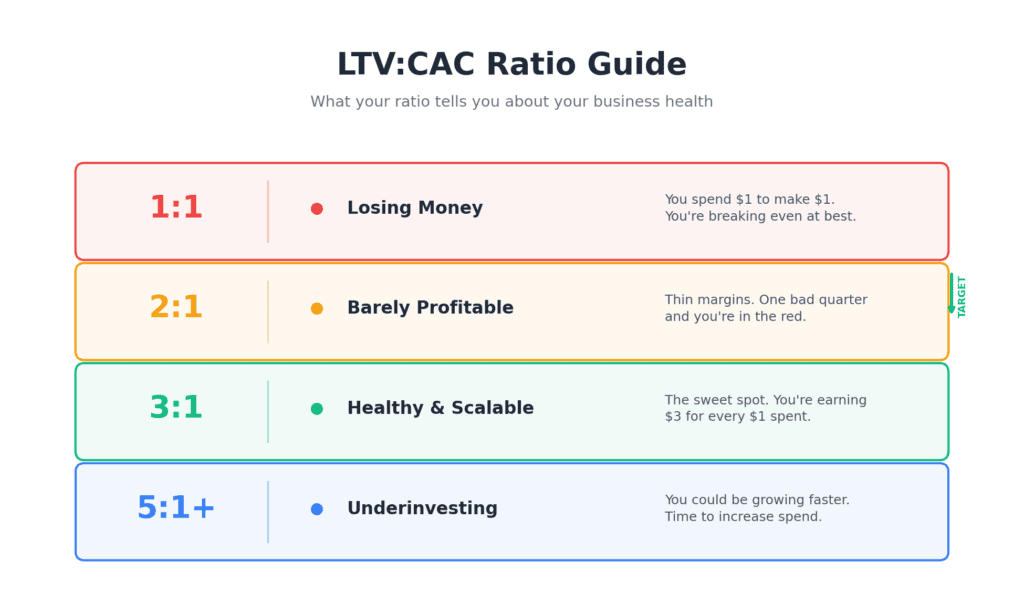
Most SaaS metrics experts agree that 3:1 is the target. Below that, your unit economics don’t work. Above 5:1, you’re leaving growth on the table.
The companies that successfully attract top employees and build great sales teams tend to land in that 3:1 to 4:1 range. They invest enough to grow aggressively without bleeding cash.
🎯 Pro Insight
Calculate LTV using actual cohort data, not averages. Look at customers acquired 12, 18, and 24 months ago and measure their real revenue. Average LTV calculations often overcount because they include your best customers alongside ones who churned after month two.
Understanding Your CAC Payback Period
CAC payback period tells you how long it takes to recoup your acquisition investment. If you spend $300 to acquire a customer who pays $50/month, your payback period is 6 months.
This is one of the most underused growth metrics in most companies. And it matters because cash flow determines whether you can actually afford to grow.
Here’s why: if your payback period is 18 months but you’re trying to grow 3x this year, you need massive upfront capital. Every new customer costs money for a year and a half before they become profitable.
Shorter payback periods mean faster reinvestment. You get your money back sooner, which means you can pour it into acquiring the next batch of customers.

The benchmark? For most businesses, under 12 months is solid. Under 6 months is excellent. Over 18 months starts to get risky unless you have strong funding or very low customer churn.
Companies that focus on reducing their payback period often find that streamlining their talent acquisition process helps cut costs. Faster onboarding of sales reps means faster time to revenue.
📌 Key Takeaway
Your CAC payback period is a better health check than CAC alone. A company with high CAC but a 4-month payback period is in better shape than one with low CAC and a 20-month payback. Speed of return matters more than absolute cost.
5 Ways to Reduce Your Customer Acquisition Cost

Now for the part everyone actually wants. Here are five practical approaches to cost optimization that work across industries.
Improve Your Conversion Rate
This is the highest-leverage move you can make. If you double your conversion rate, you cut your CAC in half without spending an extra dollar on traffic.
Start with your landing pages. Test headlines, form lengths, and calls to action. Even small improvements compound fast. A page converting at 3% instead of 2% means 50% more customers from the same ad spend.
Look at your entire funnel, not just the top. Many companies lose potential customers between signup and activation. Fixing your customer onboarding flow can recover revenue you’re already paying for.
The same logic applies to building an effective talent acquisition strategy. Optimizing each step of the hiring funnel makes the whole process more efficient.
Double Down on Organic Acquisition
Paid advertising is fast but expensive. Organic channels like content marketing and SEO cost more upfront but compound over time. A blog post that ranks well keeps bringing in customers for years at zero incremental cost.
The math is clear. If you spend $2,000 writing an article that brings in 20 customers per month for two years, that’s $2,000 / 480 customers = $4.17 per customer. Try getting that from Google Ads.
Build a content engine that targets keywords your buyers actually search for. Focus on bottom-of-funnel terms where people are ready to make a decision, not just top-of-funnel awareness content.
Launch a Referral Program
Referred customers cost 25-50% less than customers acquired through paid channels. They also tend to stick around longer and spend more.
The reason is trust. When a friend or colleague recommends something, the buying decision is almost already made. You’re not convincing anyone from scratch. You’re just confirming a recommendation they’ve already received.
Keep the program simple. Offer value to both the referrer and the new customer. Track results rigorously. And make it embarrassingly easy to share. If it takes more than two clicks to refer someone, you’ll lose most participants.
💡 Quick Tip
Time your referral asks carefully. The best moment is right after a customer experiences a clear win with your product. That’s when satisfaction is highest and they’re most likely to spread the word organically.
Retention Beats Acquisition (Almost Every Time)
Acquiring a new customer costs 5-7x more than keeping an existing one. So one of the fastest ways to improve your unit economics is to reduce customer churn.
Every customer you retain is one you don’t have to replace. And replacement means paying full acquisition cost again for someone new.
Focus on the first 90 days. That’s when most churn happens. Strong customer onboarding, proactive support, and early value delivery make the difference between a customer who stays for years and one who cancels in month two.
Companies that invest in talent acquisition and retention understand this balance well. Keeping your best people is almost always cheaper than finding new ones.
Shorten Your Sales Cycle
Every extra week in your sales cycle adds cost. Your sales team is spending time on deals that haven’t closed. Your marketing campaigns are nurturing leads that are sitting in limbo. That’s money.
Map your sales process and find the bottlenecks. Where do deals stall? What questions come up repeatedly that could be answered earlier? What objections could you address in your marketing before the prospect even talks to sales?
Self-serve options, better demo experiences, and transparent pricing all reduce friction. The goal is to get qualified buyers from “interested” to “signed” as fast as possible.
Using the right talent acquisition tools can speed up hiring just like streamlined sales tools speed up deal closure. Automation handles the repetitive work so your team focuses on high-value conversations.
How to Track CAC Effectively
Knowing your CAC is step one. Tracking it consistently and making decisions from the data is where the real value lives.
Here’s what to monitor:
- Blended CAC (monthly and quarterly): Your overall cost to acquire a customer across all channels
- Channel-specific CAC: The cost per channel so you can shift budget to winners
- CAC payback period: How long until each customer becomes profitable
- LTV to CAC ratio: Whether your acquisition investment generates healthy returns
- CAC trend line: Is it going up, down, or staying flat over time?
The companies that track these growth metrics religiously are the ones that catch problems before they become expensive.
If you’re managing outsourcing cost savings or evaluating whether to outsource certain functions, tracking CAC by team structure gives you hard data to make that decision.
| Metric | What It Tells You | Review Frequency |
| Blended CAC | Overall acquisition efficiency | Monthly |
| Channel CAC | Where to spend your next dollar | Monthly |
| LTV:CAC ratio | Long-term business health | Quarterly |
| Payback period | Cash flow sustainability | Quarterly |
| CAC trend | Direction of efficiency | Monthly |
⚠️ Common Mistake
Don’t optimize CAC in a vacuum. Slashing your marketing budget will reduce CAC in the short term, but it’ll tank your pipeline three months from now. The goal is cost optimization that maintains or improves customer quality, not cost cutting that sacrifices growth.
Your Next Step
You don’t need to overhaul everything at once. Pick the one area where you know you’re leaking money. Maybe it’s a paid channel with terrible returns. Maybe it’s a conversion rate that’s been stuck at 1% for months. Maybe you don’t even know your CAC yet.
Start there. Calculate the number. Then make one improvement. Track the result. And repeat.
The companies that win aren’t the ones with the lowest CAC. They’re the ones who know their numbers, make smart adjustments, and keep getting a little better every quarter.