
96% of website visitors leave without giving you their name or email.
That’s not a traffic problem. That’s a funnel problem.
This guide breaks down every sales funnel stage so you know exactly what each prospect needs to move forward.
What Is a Sales Funnel?
A sales funnel is the path people take from discovering your business to becoming a customer.
The funnel shape exists because not everyone who finds you will buy. Many enter at the top. Fewer make it to the bottom.
When you understand your conversion funnel, you can see exactly where you’re losing people. Maybe your talent acquisition process attracts plenty of candidates, but they disappear before interviews.
The funnel shows you where to focus.
📖 What is a Sales Funnel?
A visual map of the customer journey from first awareness to final purchase. It narrows at each stage because some prospects naturally drop off along the way.
The 5 Core Sales Funnel Stages

Every sales process follows the same pattern. Here’s what happens at each stage.
Stage 1: Awareness
Strangers discover your business exists. They have a problem. They’re searching for answers. They just found you.
They’re not ready to buy. They might not even understand their problem yet.
Your job: be helpful and memorable.
Top of funnel content works here. Blog posts. Social media. Videos. Answer their questions without selling anything.
Someone searching “how to hire remote employees” isn’t ready to sign up for recruitment services. But if your article genuinely helps, they’ll remember you later.
💡 Quick Tip
72% of buyers trust educational content more than promotional content. Solve their problem first. The sale comes later.
Stage 2: Interest
Now they’re paying attention. They’ve consumed your content. They want more.
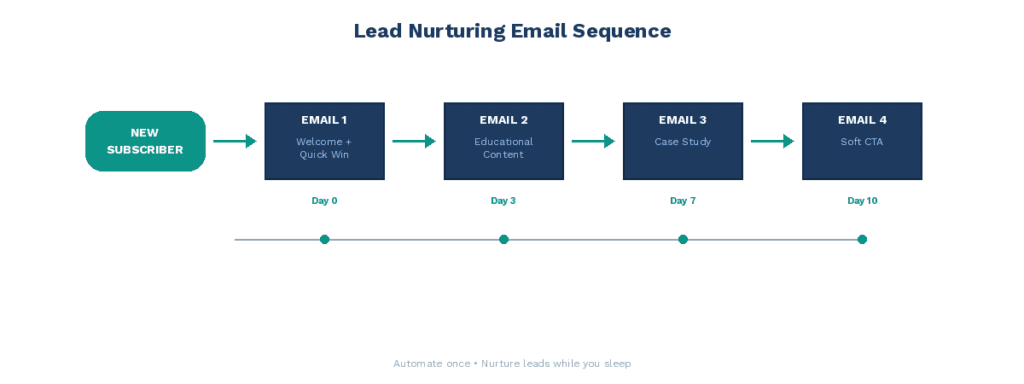
This is where lead nurturing begins.
They might subscribe to your newsletter. Download a guide. Follow you on social media. They’re saying “I want to hear more.”
The problem? Most businesses take hours to respond. By then, the lead has moved on. Studies show responding within 5 minutes dramatically improves your odds of qualifying a lead. Wait longer and those odds drop by 80%. If you’re running Facebook or Instagram lead ads, something like LeadSync can push those to your inbox in under a minute. Not essential, but speed matters more than people think.
The middle of funnel is tricky. Push too hard and they disappear. Stay passive and they forget you.
Content that works: email sequences, case studies, webinars. You’re building trust. Your talent acquisition strategy content fits perfectly here.
Stage 3: Consideration
Prospects actively evaluate options. They’ve decided they need a solution. Now they’re figuring out which one.
This is prospect qualification territory.
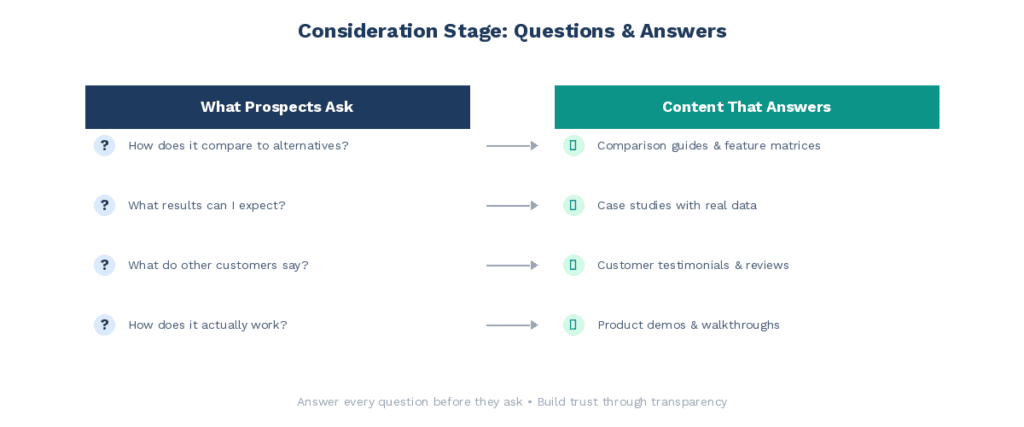
Not everyone is a good fit. That’s okay. Help the right people see why you’re their best choice.
| Content Type | Purpose | Best Format |
| Case studies | Show real results | Stories with data |
| Comparison guides | Position against alternatives | Side-by-side tables |
| Product demos | Show how it works | Video walkthroughs |
| Customer reviews | Build social proof | Specific testimonials |
The buyer journey slows here. People take time comparing. Make comparison easy.
📊 By the Numbers
Prospects consume an average of 13 pieces of content before buying. Most of that happens during consideration. Your depth of expertise wins or loses the deal here.
Not all of that content has to live on your site. Editorial.link gets you featured in comparison articles and industry roundups where prospects are actively evaluating options. Being mentioned by a trusted third party carries more weight than anything you could say about your product or service.
Stage 4: Decision
Moment of truth. They’ve narrowed options. They need a reason to choose you.
This is bottom of funnel territory.
What moves people now? Risk reduction.
Free trials. Money-back guarantees. Clear pricing. Easy cancellation. These reduce fear of making a wrong choice.
The purchase decision often comes down to small details. How easy is it to start? How fast can they see results?
Your talent sourcing tools content should address these concerns directly. Don’t make prospects hunt for answers.
⚠️ Common Mistake
Don’t hide pricing. 76% of B2B buyers want pricing on the website. Hidden pricing doesn’t create urgency. It sends prospects to transparent competitors.
Stage 5: Purchase and Retention
The purchase isn’t the end. It’s the beginning of a new relationship.
First impressions after purchase matter enormously.
Great post-purchase experiences include welcome sequences, quick wins that build confidence, and easy access to support.
Retention feeds back into your funnel. Happy customers become referral sources. They provide testimonials. They reduce your customer acquisition costs over time.
The best funnels are circular. Customers at the bottom become advocates who bring new prospects to the top.
How to Build a Funnel That Converts
Understanding stages is one thing. Building a working funnel is another.
Start by mapping your current customer journey. How do people find you? What do they do before buying? Where do they drop off?
If you don’t have this data, your analytics setup needs attention first. You can’t optimize what you can’t measure.
Next, create content for each stage.
Most businesses have plenty of bottom of funnel content. Pricing pages. Feature lists. Demo requests.
They’re missing everything else.
| Funnel Stage | Content Goal | Example Content |
| Awareness | Attract attention | Blog posts, social, podcasts |
| Interest | Build relationship | Email courses, guides |
| Consideration | Enable comparison | Case studies, demos |
| Decision | Reduce risk | Trials, guarantees, pricing |
| Retention | Ensure success | Onboarding, support |
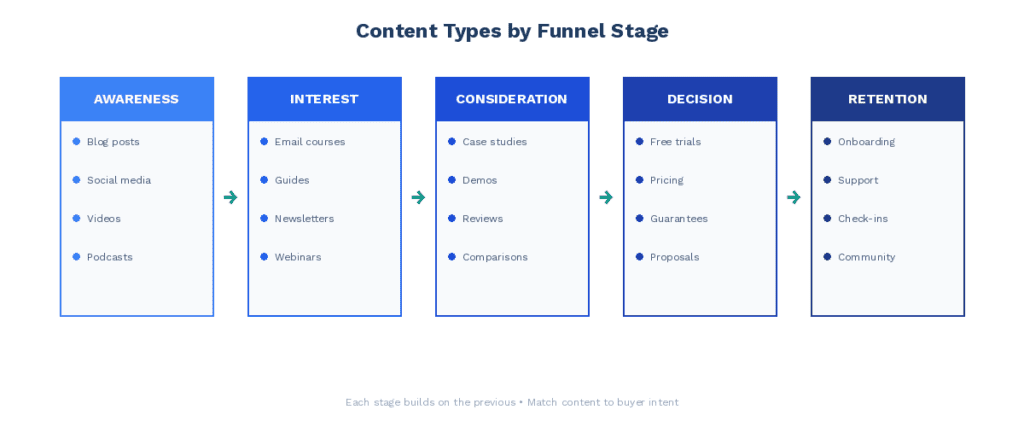
Then connect the stages. Each piece of content should lead naturally to the next.
Blog post offers a guide. Guide invites to webinar. Webinar offers a demo.
This is funnel optimization in practice. You’re removing friction.
🎯 Pro Insight
The highest-converting funnels have 3-5 touchpoints between stages. One blog post rarely converts to a buyer. But a blog post → guide → email sequence → case study? That journey builds real trust.
Fixing Funnel Leaks

Every funnel has leaks. The question is whether you know where yours are.
Top of funnel: Is lead generation working? If traffic stays flat, your awareness content isn’t reaching enough people. Consider diversifying channels or improving your talent acquisition management approach.
Middle of funnel: What percentage of visitors become leads? Industry benchmarks: 2-5% for B2B. Below 1%? Your interest stage content isn’t compelling enough.
Bottom of funnel: What’s your lead conversion rate? If leads are interested but not buying, your decision stage content is missing something.
Common fixes:
- Simplify forms that ask too many questions
- Add social proof where objections arise
- Create urgency with genuine deadlines
- Make the next step ridiculously obvious
💡 Quick Tip
Add exit intent surveys to high-traffic pages. Ask one question: “What stopped you from moving forward?” The answers reveal exactly where your messaging fails.
Mistakes That Kill Your Funnel
Jumping straight to the sale. Someone visits for the first time and sees “Buy Now” immediately. They don’t know you. They don’t trust you. Slow down.
Treating all leads the same. A prospect downloading a beginner’s guide needs different nurturing than someone requesting pricing. Your global talent acquisition approach should segment based on behavior.
Ignoring post-purchase. Acquiring a new customer costs 5-25x more than keeping one. Yet most funnels stop when payment processes.
Content without clear next steps. Every piece of content should answer: “What should they do next?” If you don’t tell them, they do nothing.
📌 Key Takeaway
Your funnel is only as strong as its weakest stage. A brilliant awareness strategy means nothing if consideration content fails to differentiate you. Audit each stage independently.
Making Your Funnel Work
The sales funnel stages aren’t complicated. Awareness. Interest. Consideration. Decision. Purchase.
What separates 2% conversion from 10%? Intentional engineering at every stage.
Start with one stage. Audit your content. Identify gaps. Fill them. Move to the next.
Your funnel doesn’t need to be perfect. It needs to exist. Most competitors don’t have one at all.