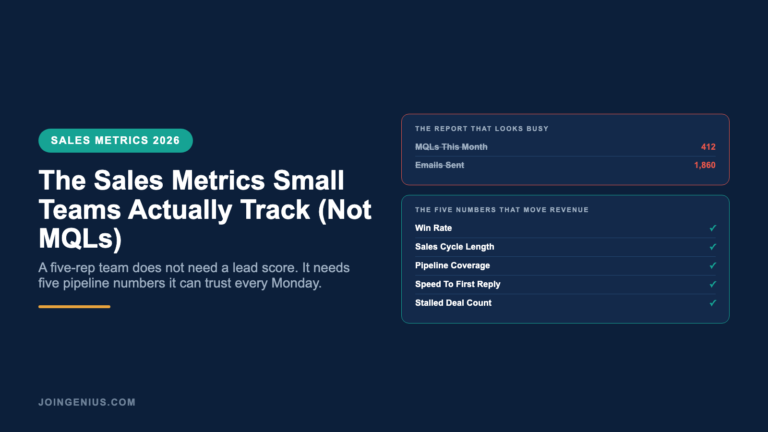
The Monday meeting at a five-person B2B sales team usually starts with a marketing slide. MQLs are up 30 percent. Email opens are steady. Then the founder asks why the quarter is 20 percent behind, and nobody in the room has an answer that comes from data.
Marketing-qualified leads were built for large teams with a separate marketing function and a lead scoring model to feed. A small team has neither. It has a handful of reps and a few dozen open deals. It also has a founder who needs to know which of those deals will close.
This post covers why the MQL report misleads small teams and the five pipeline numbers to track instead. It also covers the reason those numbers are usually wrong, and the 20-minute Monday review that keeps them honest.
Why MQLs Tell A Small Team Almost Nothing
An MQL measures interest. It counts people who downloaded a guide or opened three emails. For a team that closes 15 deals a quarter, the gap between a download and a signed contract is where all the real work happens, and the MQL count says nothing about it.
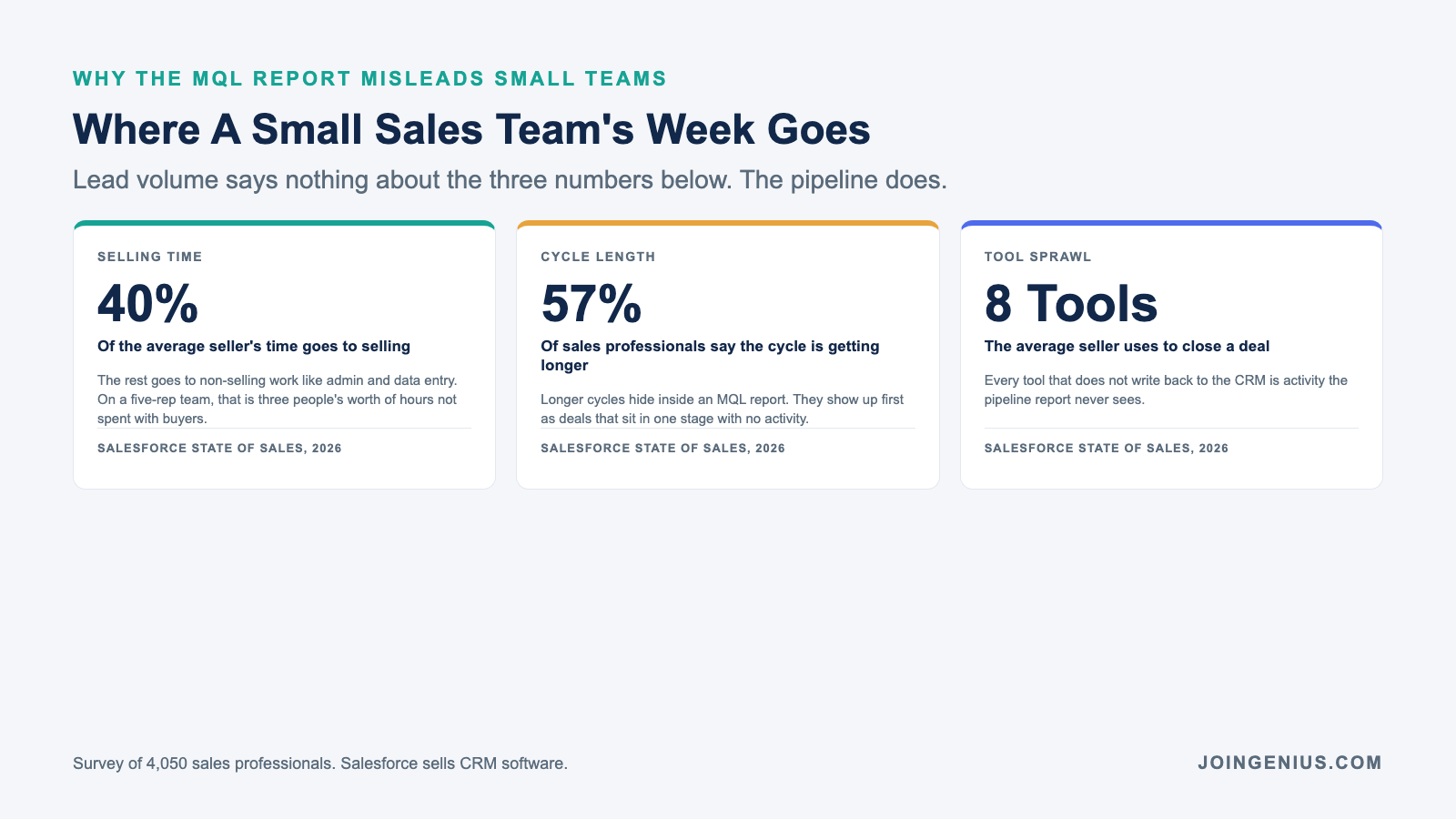
The bigger problem is time. Salesforce’s 2026 State of Sales report, a survey of 4,050 sales professionals, found that the average seller spends 40 percent of their time selling. The rest goes to work like admin and data entry. On a five-rep team, that is roughly three people’s worth of hours a week that never reach a buyer.
Cycles are also getting longer. The same Salesforce research reports that 57 percent of sales professionals say the sales cycle is getting longer. It also finds sellers use an average of eight tools to close a deal. Salesforce sells CRM software, so read these figures with that in mind. The direction still matches what most small teams see. Deals take longer, and the activity behind them is scattered across tools.
The Five Metrics Small Teams Actually Track
Metric one is win rate. It counts deals won as a share of deals that reached a real sales conversation, measured on a rolling 90 days. It is the single best read on whether the team is talking to the right buyers with the right pitch.
Metric two is sales cycle length. It measures the median days from first meeting to closed won. If the cycle stretches, find the stage where deals now sit longer. That stage is almost always where the fix is.
Metric three is pipeline coverage. It compares open pipeline to the remaining target for the quarter. A small team with a 20 to 25 percent win rate generally needs three to four times coverage. Below that, the quarter is decided before it starts.
Metric four is speed to first reply. It measures the time from an inbound inquiry to the first human response. For a small team this is the cheapest metric to improve, and one of the most overlooked.
Metric five is stalled deal count. It counts open deals with no logged activity in 21 days. Each stalled deal is either a follow-up somebody forgot or a loss nobody has admitted yet. Both are worth knowing on Monday.
Why The Numbers Are Wrong When The CRM Is Updated By Hand
All five metrics depend on one thing. Activity has to be in the CRM. A stalled deal count only works if the email a rep sent on Thursday shows up as activity. Speed to first reply only works if the reply is logged.
On most small teams it is not. Reps update the CRM on Friday afternoon from memory, or before the Monday meeting. Meetings get logged without notes. New contacts from a buyer’s email thread never get added at all. The pipeline report then shows deals as stalled when they are active, and shows them active when nobody has talked to the buyer in a month.
The fix is to take manual entry out of the loop. A B2B sales CRM like Salesflare fills in contact details from email signatures and logs emails and meetings to the right deal automatically. The five metrics then come from what reps actually did that week, not from what they remembered to type in.
That is also how the selling time comes back. Every hour a rep does not spend on data entry is an hour on a call with a buyer. That is the number the 40 percent figure above is really about.
MQL Reporting Versus Pipeline Reporting On The Same Team
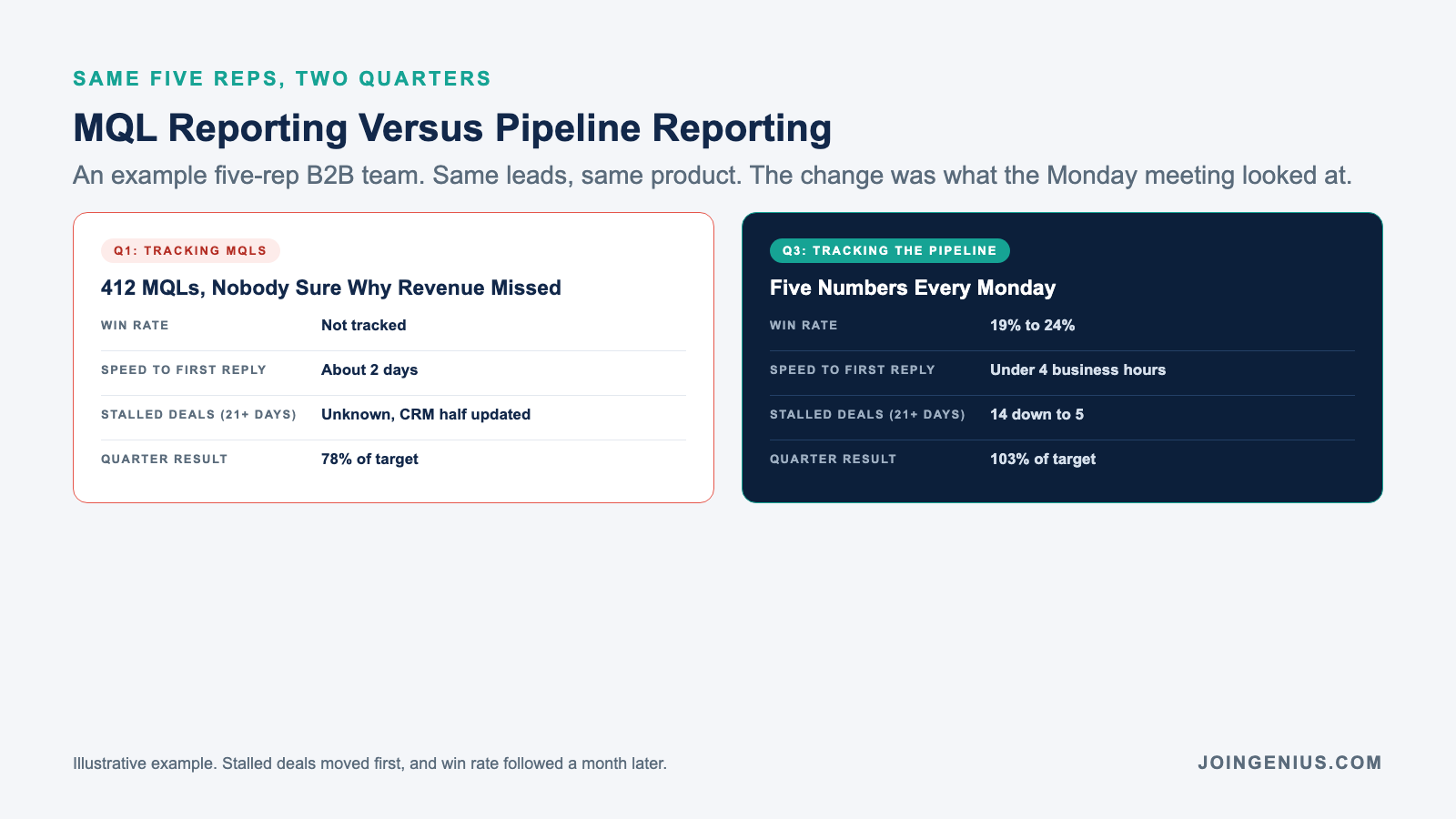
Here is an illustrative example. A five-rep B2B team spends its first quarter reporting on MQLs. The quarter shows 412 MQLs. Win rate is not tracked. The median first reply to an inbound inquiry takes about two days. Nobody can say how many deals have stalled, because the CRM is only half updated. The team finishes at 78 percent of target.
By the third quarter the team has switched its Monday meeting to the five pipeline metrics, with activity captured automatically. Win rate moves from 19 to 24 percent. First replies go out in under four business hours. Stalled deals drop from 14 to five, and the team finishes at 103 percent of target.
The number that moved first was the stalled deal count. Win rate followed about a month later, once those deals either closed or were cleared out of the pipeline.
The 20-Minute Monday Pipeline Review
The meeting that replaces the MQL report takes 20 minutes and has one owner. It runs straight from the CRM, not from a spreadsheet someone rebuilt on Sunday night.
Minutes zero to five cover stalled deals. Every open deal with no activity in 21 days gets a next step and a date, or it gets marked closed lost. Minutes five to ten cover speed to first reply, and any lead still waiting gets an owner before the meeting ends.
Minutes ten to 15 cover pipeline coverage. If coverage is under three times the remaining target, prospecting time goes on the calendar this week. The last five minutes cover win rate and cycle length on a rolling 90 days, looking for one stage where deals now sit longer than they used to.
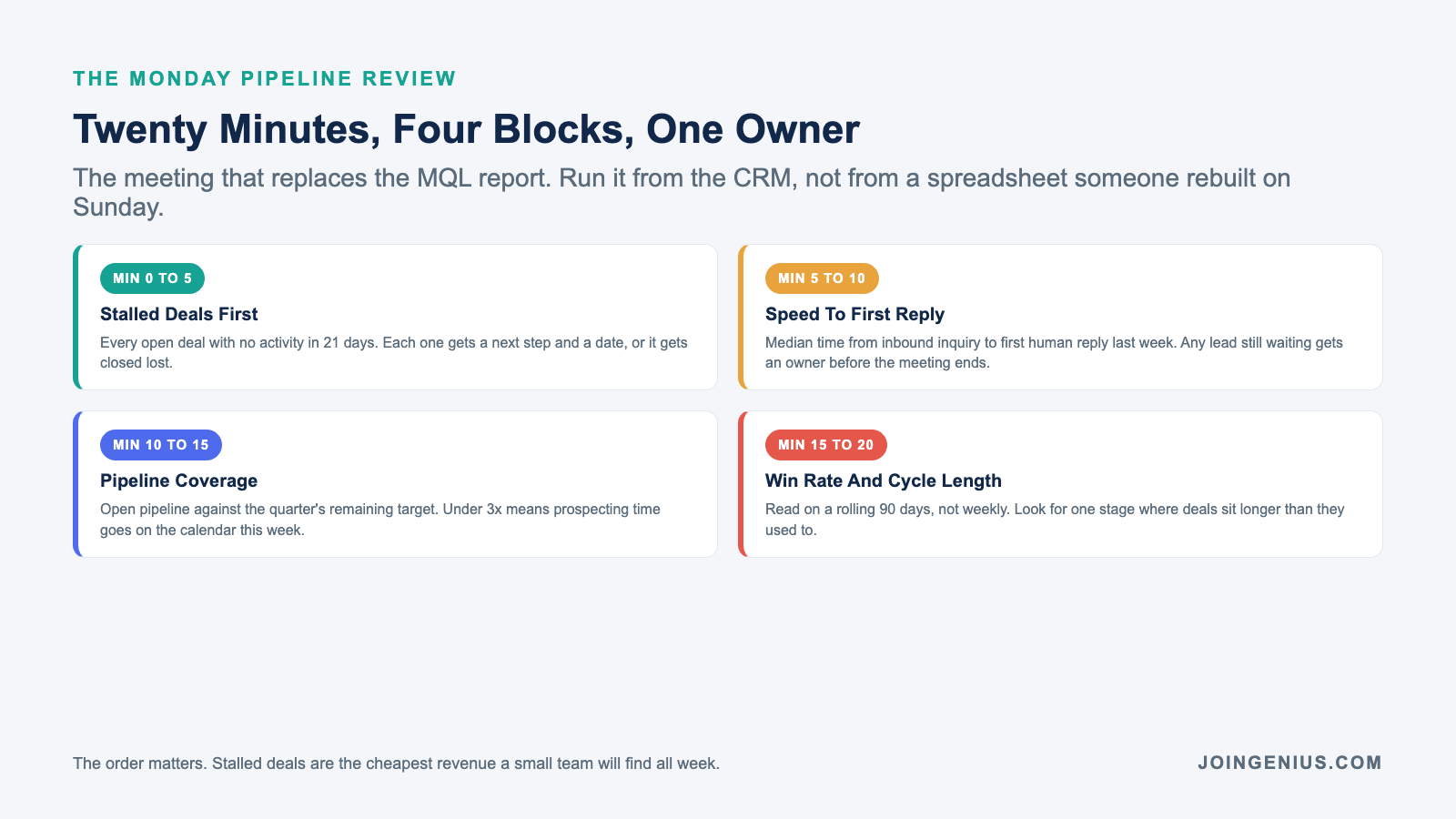
The order matters. Stalled deals are the cheapest revenue a small team will find all week. If you are hiring a sales lead to run this meeting, put these five metrics into your interview rubric for the role.
Hire Reps Who Sell To The Number
The small teams that hit their number are rarely the ones with the most leads. They are the ones whose reps know their win rate and their stalled deals by Monday morning, and who spend the week with buyers instead of in the CRM.
The people who run those teams are expensive to hire. The US Bureau of Labor Statistics counts 650,100 sales manager jobs in 2025, with 4 percent growth projected through 2035. The median wage was $148,270 in May 2025.
Genius hires top one percent sales and sales operations talent from the Philippines and LATAM at roughly 80 percent less than local comp. There are no monthly fees, and every placement comes with a six month replacement guarantee.
We screen candidates on the pipeline metrics described on this page before they reach you. That means you meet reps who will ask about your win rate in week one, rather than report another month of MQLs.