
Only 16% of sales reps hit their annual quota. That’s down from 53% just 10 years earlier.
The biggest reason? Most sales teams are winging it. They rely on tribal knowledge, scattered Google Docs, and whatever the last person who quit happened to leave behind.
A sales playbook fixes that. It takes what your best reps already know and turns it into a system everyone can follow. Reps who follow a documented sales process ramp 50% faster than those who don’t. And teams with proper sales enablement hit 49% win rates compared to 42.5% without it.
This guide breaks down exactly what goes into a playbook that your sales reps will actually open, how to build one in 7 steps, and how to keep it from gathering dust on a shared drive.
What a Sales Playbook Actually Is (And What It Isn’t)
A sales playbook is a single resource that outlines your entire sales process. It covers who you sell to, how you sell, what you say, and how you handle the curveballs.
But here’s what most people get wrong. They think it’s a training manual. It’s not.
A training manual teaches concepts. A playbook gives your sales team the exact actions to take in specific situations. Think of it like this: a training manual explains what a zone defense is. A playbook tells you which play to run when you’re down by 3 with 2 minutes left.
The best playbooks are living documents. They change when your market changes, when competitors launch new features, and when your top performers discover something that works.
📖 What is a Sales Playbook?
A sales playbook is a comprehensive guide that documents your sales methodology, buyer personas, messaging scripts, objection handling tactics, competitive intelligence, and measurable KPIs. It turns your best reps’ instincts into a repeatable system the entire team can follow.
Why Your Sales Team Needs a Playbook (The Data Is Clear)
Sales reps spend only 30% of their time actually selling. The rest goes to admin work, data entry, and searching for the right email template or pricing sheet. A playbook cuts that wasted time dramatically by putting everything in one place.
But the performance gap is what really stands out.

Teams without a defined process miss quota roughly 60% of the time, according to Harvard Business Review. That’s not a small gap. It’s the difference between a growing company and one that’s constantly replacing underperforming reps.
And it’s getting harder. Sales cycles have grown 32% longer since 2021. The average B2B deal now involves 5 decision-makers. Your reps can’t hold all of that complexity in their heads. They need a system.
📊 By the Numbers
55% of B2B leaders say they’re facing more competitive deals than 2 years ago, but rate their own team’s competitive selling effectiveness at just 3.8 out of 10. A playbook closes that gap.
Here’s what a playbook impacts most:
| Metric | Without Playbook | With Playbook | Improvement |
| Quota attainment | ~40% | ~65% | +62% |
| New rep ramp time | 6+ months | ~3 months | 50% faster |
| Win rate | 42.5% | 49% | +15% |
| Forecast accuracy | ~55% | ~78% | +42% |
The companies that invest in building (and maintaining) their playbooks don’t just see better numbers. They see more consistency. And consistency is what makes a sales strategy scalable.
If you’re looking to build a talent acquisition strategy that complements your sales goals, getting your playbook right is step one.
The 7 Components Every Sales Playbook Needs
There’s no point building a 50-page document nobody reads. Focus on these 7 sections and you’ll cover 90% of what your reps need.

1. Buyer Personas That Go Beyond Demographics
Most buyer personas read like a dating profile. “Marketing Manager Mary, 35, lives in Austin, likes yoga.”
That’s not useful for a sales call.
Your playbook personas should answer the questions your reps actually need:
- What problem keeps this person up at night?
- What does their buying process look like?
- Who else is involved in the decision?
- What objections will they raise?
- What proof do they need to say yes?
Build 3-5 personas based on your talent acquisition analytics and deal history. Include real quotes from customer interviews when possible. Your reps should be able to read a persona and immediately know how to adjust their pitch.
💡 Quick Tip
Interview your customer success team. They hear what buyers actually cared about after the deal closed. That’s gold for building personas your sales reps can use in real conversations.
2. A Clear Sales Process Map
Map every stage of your sales cycle from first touch to closed deal. For each stage, document:
- The specific actions reps should take
- Which tools to use
- What qualifies a deal to move forward
- Time benchmarks (how long should each stage take?)
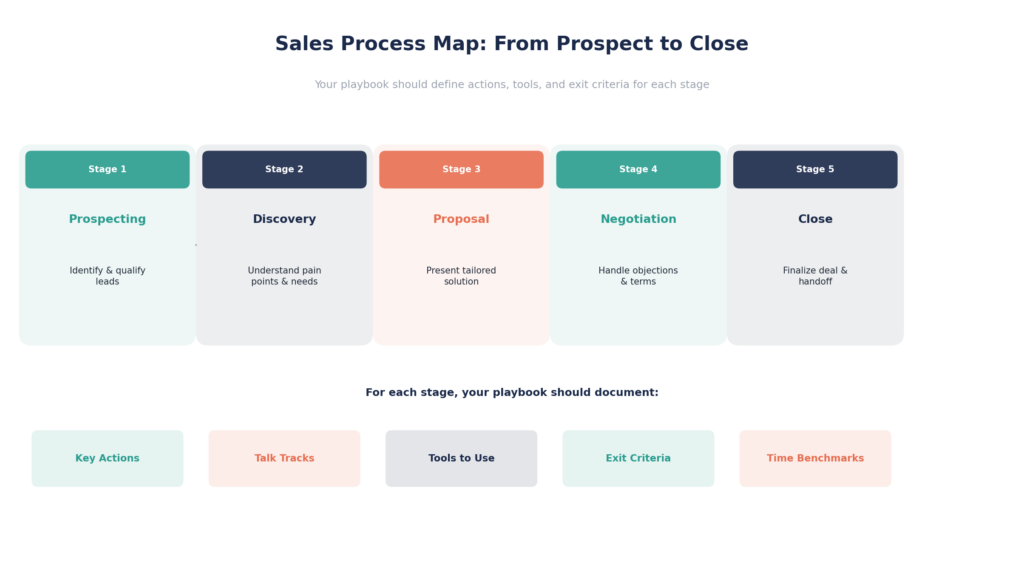
This is where lead qualification criteria matter most. A clear process keeps deals from sitting in pipeline limbo for months.
3. Messaging Scripts and Talk Tracks
Your reps need to know what to say. Not word-for-word scripts that sound robotic, but flexible frameworks they can adapt.
Build messaging for every scenario:
- Cold outreach (email and phone)
- Discovery calls
- Product demos
- Follow-up sequences
- Executive-level conversations
The best talk tracks start with the customer’s problem, not your product’s features. Lead with “here’s what we’re seeing in your industry” instead of “let me tell you about our platform.”
4. Objection Handling Scripts That Sound Human
Every sales team hears the same 10-15 objections on repeat. “Your price is too high.” “We’re already using a competitor.” “Not the right time.”
Document each common objection alongside:
- Why the prospect says this (the real reason, not the surface-level excuse)
- 2-3 response frameworks
- Real examples of how top performers handled it
- When to push back vs. when to walk away
⚠️ Common Mistake
Don’t write objection responses that sound like legal disclaimers. “I understand your concern, and I want to assure you that our solution provides significant ROI…” Nobody talks like that. Write the way your best rep actually speaks.
5. Competitive Battle Cards
Markets are getting tougher. Your reps need to know exactly how you stack up against each competitor and what to say when a prospect brings them up.
For each competitor, include:
- Their strengths (be honest)
- Their weaknesses (be specific)
- Your differentiators
- Landmine questions: questions your reps can ask that highlight the competitor’s blind spots
- Proof points: case studies or data that show where you win
This is competitive selling at its core. If your reps walk into a deal blind to the competition, they’ll lose to whoever shows up more prepared.
Companies that invest in talent sourcing tools and competitive intelligence consistently outperform those that don’t.
6. Sales Plays for Every Scenario
Sales plays are the tactical recipes inside your playbook. Each one handles a specific situation with step-by-step actions.
Build plays for:
- Prospecting into a new account
- Re-engaging a stalled deal
- Upselling an existing customer
- Competing against a specific rival
- Handling an inbound lead from a webinar or content download
Each play should include the trigger (what kicks it off), the actions (what to do), and the expected outcome. This framework keeps reps from overthinking and helps with pipeline management at every stage.
🎯 Pro Insight
Your best plays will come from your top performers. Set up a 30-minute interview with each one. Ask: “Walk me through the last deal you closed. What did you do at each stage?” Record it, transcribe it, and turn it into a play.
7. Your CRM Is the Home Base
A playbook that lives in a PDF nobody opens is useless. The best teams build their playbook directly into their CRM system.

Dynamic playbooks built into your CRM can:
- Surface the right messaging based on deal stage
- Prompt reps with discovery questions during calls
- Track which plays lead to the highest win rates
- Update in real time as you learn what works
94% of businesses report a boost in sales productivity after implementing a CRM, and 81% of sales leaders say AI integration is critical for reducing manual work. Your playbook and your CRM should be the same thing.
If your team includes remote staff or virtual assistants, a CRM-integrated playbook is especially important. It keeps everyone aligned regardless of location or time zone.
How To Build Your Playbook In 5 Steps (Without Losing Your Mind)
You don’t need to build the perfect playbook on day one. Start with the minimum viable version and iterate.
Step 1: Audit what exists. Collect every email template, call script, objection response, and competitive doc your team already uses. You’ll be surprised how much is already floating around.
Step 2: Interview your top 3 performers. Ask them what they do differently. Record the conversations. This is your content goldmine.
Step 3: Map your sales process. Document the stages, actions, and exit criteria. Keep it to 5-7 stages max.
Step 4: Build the first version. Start with buyer personas, your process map, and the top 5 objection responses. That’s enough to make an immediate impact on sales training and onboarding.
Step 5: Put it where reps already work. If they live in your CRM, build it there. If they’re on Slack all day, create a searchable channel. The best playbook is the one your team actually uses.

The entire onboarding process changes when you have a solid playbook. New hires go from shadowing for weeks to running their own discovery calls within days.
Keep It Alive (Or Watch It Die)
A static playbook starts dying the moment you publish it. Markets shift. Competitors launch new features. Your pricing changes. The plays that worked last quarter might not work this quarter.
| Update Trigger | Action | Frequency |
| Lost deal review | Update objection handling | Weekly |
| New competitor feature | Refresh battle cards | As needed |
| Quarterly business review | Audit full playbook | Quarterly |
| New product launch | Add new messaging + plays | At launch |
| New hire feedback | Simplify confusing sections | Monthly |
Set a calendar reminder. Once a quarter, review your playbook with your sales managers and your top 2-3 reps. Ask: “What’s outdated? What’s missing? What actually helped you close a deal this quarter?”
Teams that track their hiring and sales performance analytics alongside playbook updates see the clearest ROI.
💡 Quick Tip
Create a dedicated Slack channel or shared doc where reps can flag outdated playbook content in real time. This turns your entire team into playbook editors and keeps the content fresh between formal reviews.
Build The Playbook Your Team Deserves
Here’s the bottom line. A sales playbook isn’t a one-time project. It’s an operating system for how your team sells.
Start with the 7 components above. Build the minimum viable version. Put it where your reps already work. And commit to updating it every quarter.
The teams that do this consistently are the ones hitting quota while everyone else is wondering why their sales strategy isn’t working. Your reps are already doing the hard work of closing deals. Give them a system that makes it easier.