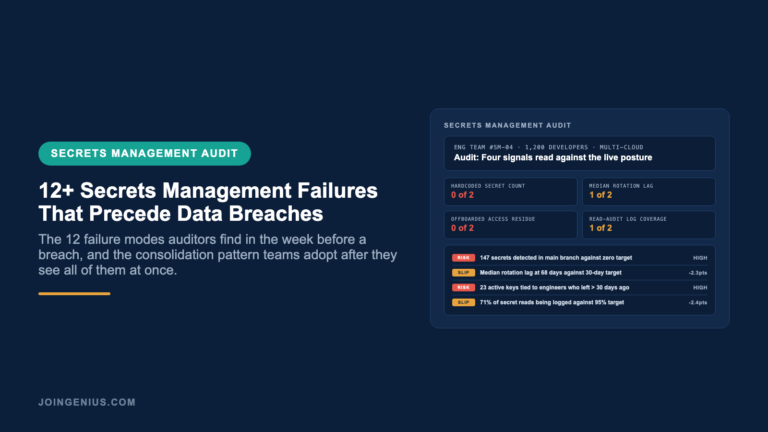
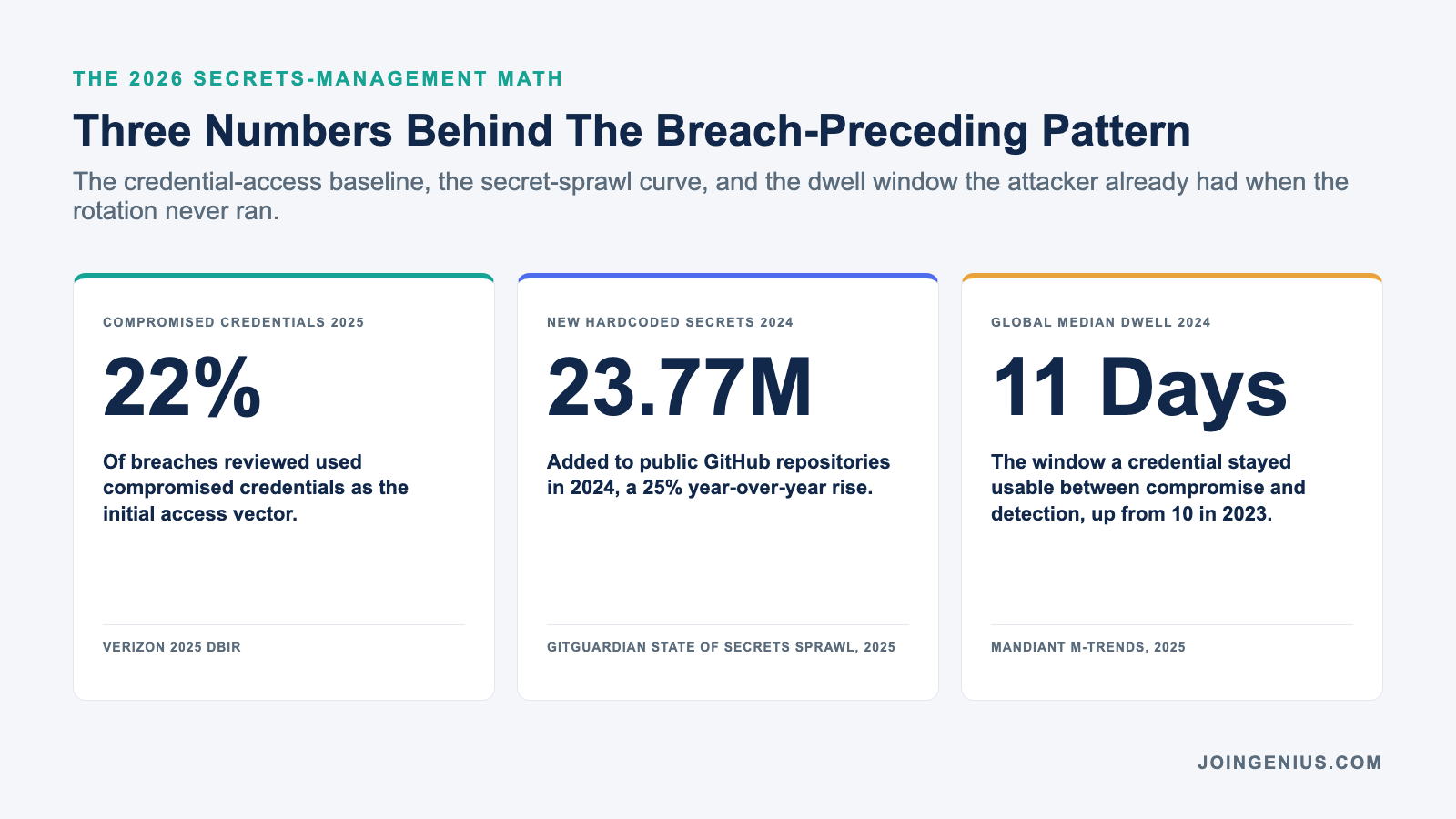
A data breach in 2026 does not usually start with a zero-day. It starts with a secret somebody checked into a repo or forgot to rotate when an engineer changed teams. The Verizon 2025 DBIR found that 22 percent of breaches use compromised credentials as the initial access vector, which means a quarter of the breach column is already a secrets-management failure. The software engineer shipping the next build is the last line between a secret that stays scoped and one that becomes a breach. This guide covers 12 failure modes that precede a breach, and the pattern teams adopt after they see all of them.

1. Hardcoded Secrets In Source Code
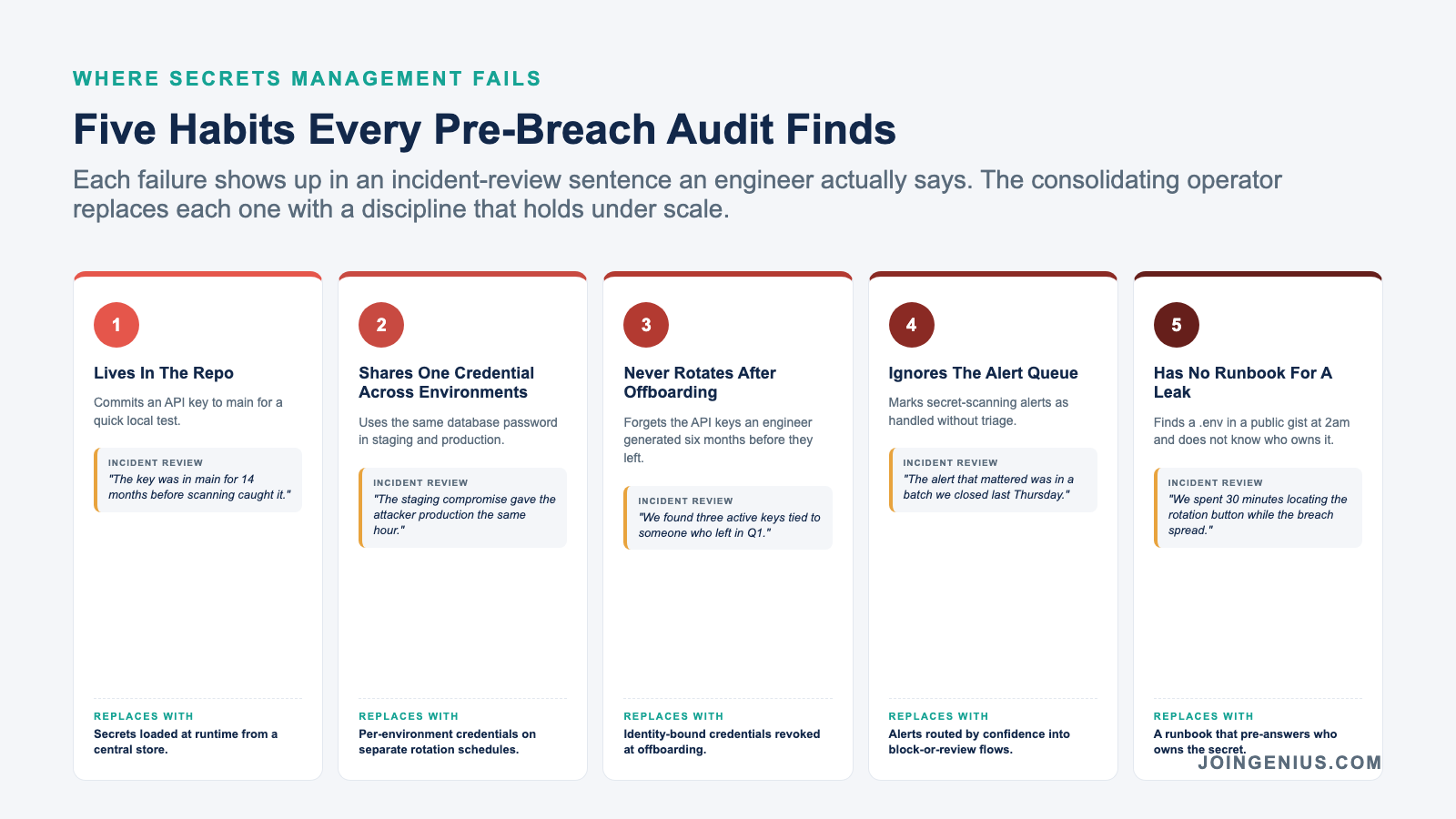
The first failure is the oldest one. An API key gets typed into a config constant for a quick local test, then committed to main because the pre-commit hook was not in place.
The GitGuardian State of Secrets Sprawl 2025 scanned 1.4 billion commits across 69.6 million public GitHub repositories and found 23.77 million new hardcoded secrets added in 2024, a 25 percent rise over 2023.
A secret in main is a public secret the moment the repo flips public or a fork lands outside the organization. Rotation is not optional at that point; it is the only path back to safe.
2. Secrets In .env Files Committed To Repos
The second failure wears a disguise. The .env file is supposed to stay out of git, but one hurried commit on a Friday afternoon and the entire production environment is now searchable in git history forever.
The fix is not a bigger .gitignore. The fix is removing the secret from the engineer’s local machine in the first place, loading values from a central store at runtime so there is nothing in .env to leak. A rewrite of history still leaves the secret on the forks.
3. Secrets Shared In Chat And Ticket Threads
The third failure is social. A database password lands in a Slack DM because the new hire needed it before lunch. A webhook secret ends up in a Jira comment so the QA team can test the integration. Neither message gets deleted.
Chat and ticket tools are optimized for search, not secrecy. The secret sits there, indexed, accessible to every current and former employee with history access. One compromised account turns the archive into a credential drop.
The deletion habit does not solve it either. The retention policy on most chat tools preserves deleted messages for compliance. The only safe assumption is that anything shared once is accessible forever by anyone with legal-hold access.
4. Rotation Policy That Never Runs
The fourth failure is the one every audit checks for and nobody enforces. A 90-day rotation policy exists in Confluence. The script that was supposed to run it broke in 2024 and never got replaced.
The Mandiant M-Trends 2025 report found the global median dwell time after a breach rose to 11 days in 2024, up from 10 in 2023. The attacker had 11 days to use a credential that nobody had rotated.
5. One Shared Credential Across Environments
The fifth failure saves five minutes and costs a month of incident response. Staging and production use the same database password because the deploy script was copy-pasted. A compromise in staging is a compromise in production, and the blast radius ignores the firewall rule that was supposed to keep them separated.
A devops engineer rebuilding this flow starts by giving each environment its own credential and its own rotation schedule. The staging key is cheap to rotate on every deploy. The production key rotates on a schedule the audit log can verify.
Separation of credentials is the cheapest reliability move the team can make. It costs minutes to set up and prevents the blast radius nobody models until it detonates.
6. Team-Wide Logins Instead Of Per-User Access
The sixth failure hides in the shared vault entry everyone pulls from. A single admin password used by six engineers is a password nobody rotates after an engineer leaves, because rotating it means telling the other five to update their local flow.
Per-user access breaks that sharing pattern. Each engineer gets their own credential bound to their identity, revoked the moment they offboard. The rotation question gets answered by the identity provider, not a Slack channel.
7. Offboarded Engineers With Access That Never Expired
The seventh failure is the quietest. An engineer leaves on good terms. HR runs the offboarding checklist. The checklist checks the laptop return and the badge deactivation but never audits the API keys the engineer generated six months earlier.
The system administrator owning offboarding needs to see every active credential the departing engineer touched, not just the ones issued through the IdP. A secrets platform that tracks who created what is the only way to answer that question in under an hour.
8. No Audit Log On Secret Reads
The eighth failure reveals itself after the breach. The team discovers the secret was used, but cannot answer who read it last or from which IP range. The forensic timeline stops at the perimeter log and goes dark at the secret store.
The data analyst pulled into the investigation needs a per-read log that correlates to identity. A secrets platform without read-level logging is a system that lets a breach look like noise. The audit log is not a compliance checkbox. It is the timeline every post-incident review depends on.
9. CI Pipelines With Overbroad Secret Scopes
The ninth failure lives in the CI config. A pipeline that needs one AWS key for S3 uploads gets injected with the entire production credential set, because the template was written once and never scoped down. A compromised build runner inherits everything the pipeline can reach.
Scope tightening is a ten-minute change nobody prioritizes until the postmortem. The fix is per-job credentials, scoped to the minimum action the job needs, with no inheritance from parent pipelines.
A pipeline token with full-cloud scope is the same as a hardcoded admin password that happens to rotate. The scope reduction converts a worst-case compromise into a contained one.
10. Default Or Weak Secrets In Container Images
The tenth failure ships in the image itself. A container baked with a default admin password, or an API key hardcoded into the Dockerfile for a dev convenience, becomes production-ready the moment the image gets tagged latest. Every host pulling the image inherits the weakness.
Image scanning catches some of this but not all. A secret that gets injected at build time and discarded from the final layer still shows up in the intermediate layer cache, which is not what most scanners are looking at.
11. Ignored Secret-Scanning Alerts
The eleventh failure is a dashboard problem. A secret-scanning tool fires 40 alerts a week. The security engineer triages the first five and dismisses the rest because the signal-to-noise ratio has not been tuned.
The alert that mattered was in the ignored pile. The fix is not more alerts. It is routing high-confidence detections into a block-the-commit flow and low-confidence ones into a weekly review, so the queue never grows past what one person can read in an hour.
12. No Incident Response Plan When A Secret Leaks
The twelfth failure shows up at 2 am on a Saturday. A screenshot of a .env file lands in a public gist. The on-call engineer cannot find the runbook or answer who owns the secret, and spends 30 minutes figuring out where the rotation button even lives.
The runbook needs to pre-answer three questions. Which secret is this. Who owns it. What is the rotation command. A team that cannot answer those in five minutes is a team learning the answers while the breach is still spreading.
13. No Shared Definition Of What Counts As A Secret
The thirteenth failure is the definitional one. One team calls a Slack webhook a configuration value and keeps it in a repo. Another team calls it a secret and locks it behind rotation. A credential that two teams disagree on is a credential rotation that never happens, because the team that owns it does not think it needs to.
The fix is a one-page policy that defines a secret as any value whose exposure would require a rotation. Anything that passes that test goes behind the secrets manager. Anything else stays in the config file where it belongs.
What Teams Do After They See The Pattern
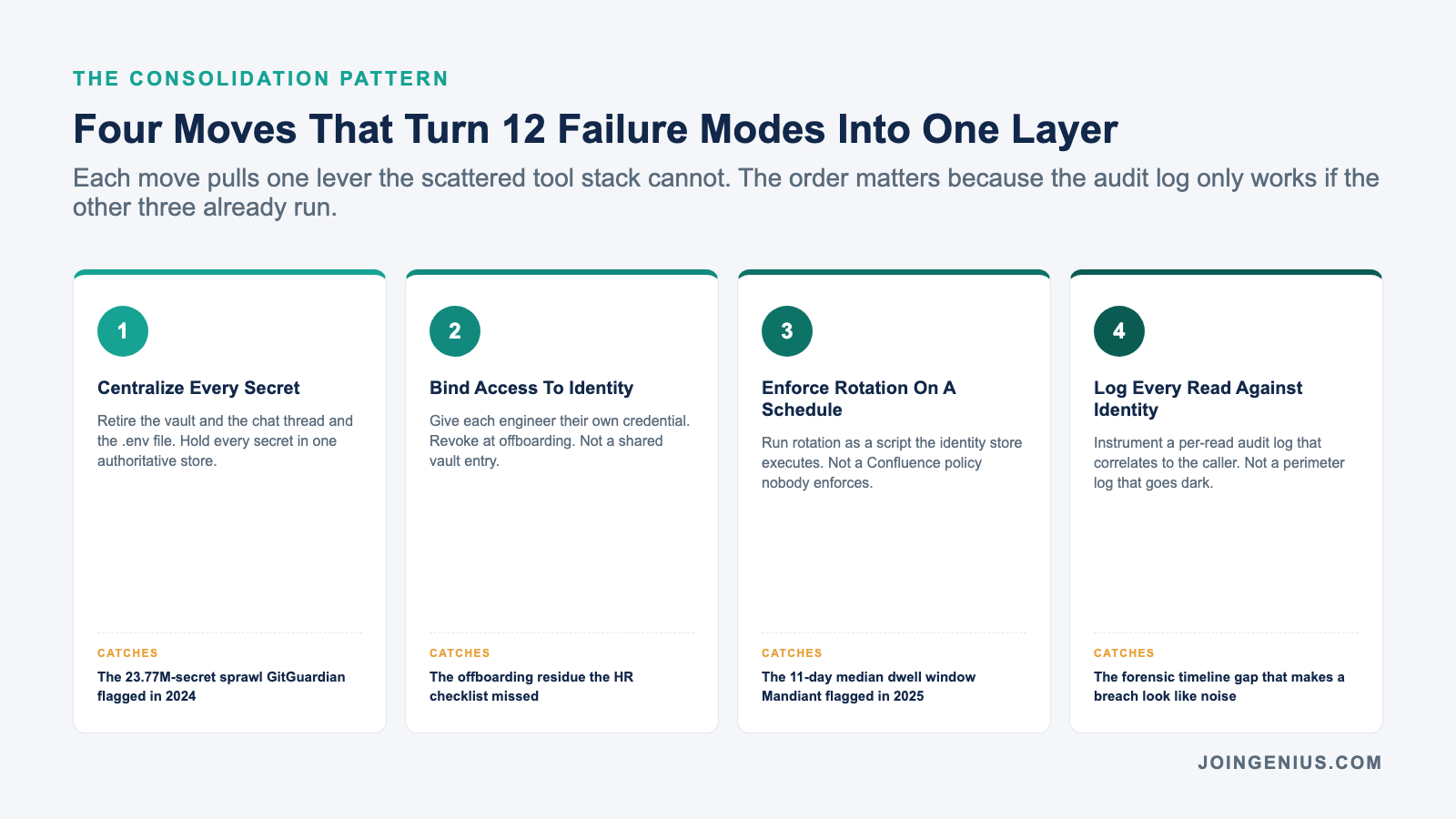
A team that sees all 12 failures in one audit week has the same realization. The gaps are not 12 separate problems. They are one problem solved 12 different ways by 12 different people. Rotation lives in one tool. Access control in another. Audit logging in a third.
Platforms like Doppler’s secrets manager centralize every one of these failure modes behind a single rotation and access-control layer, so the next hire does not inherit the same gaps as the last one.
The pattern break is the consolidation. A single system holds the secret and rotates it on a schedule. Access lives against identity. Every read lands in one audit trail. The 12 failure modes close as one layer, not as 12 separate tickets the next engineer inherits.
Conclusion
A breach in 2026 is not graded on how the attacker got in. It is graded on how many of the 12 failure modes the team had open when the attacker arrived.
Teams that run the audit and consolidate the pattern scale the next product launch without inheriting a historical breach surface. That team is scaling on talent built for the role, which is where Genius comes in.