How to source crowdsourced testers without more QA hires is the question most engineering leaders ran into by mid-2026. Release cycles outpaced headcount, and the device matrix kept growing every quarter.
Budgets moved to AI and platform work, QA teams stayed flat, and managed crowdtesting became the pattern most teams quietly adopted to keep ship dates intact. It is now a line item on most 2026 engineering budgets.
This piece explains what crowdsourced testing actually is, what it is not, how to pick a platform without buying a slide deck, and where to fold a crowd into a working QA pipeline. The goal: more coverage, same headcount, no release slippage.
The Headcount Wall QA Teams Keep Hitting
QA has been a flat line on the org chart for most of a decade. Product grew, platform grew, security grew, QA stayed the same. The gap between what shipped and what got tested kept widening, and the fix most teams reach for first is the one that does not work.
What Understaffed Actually Means
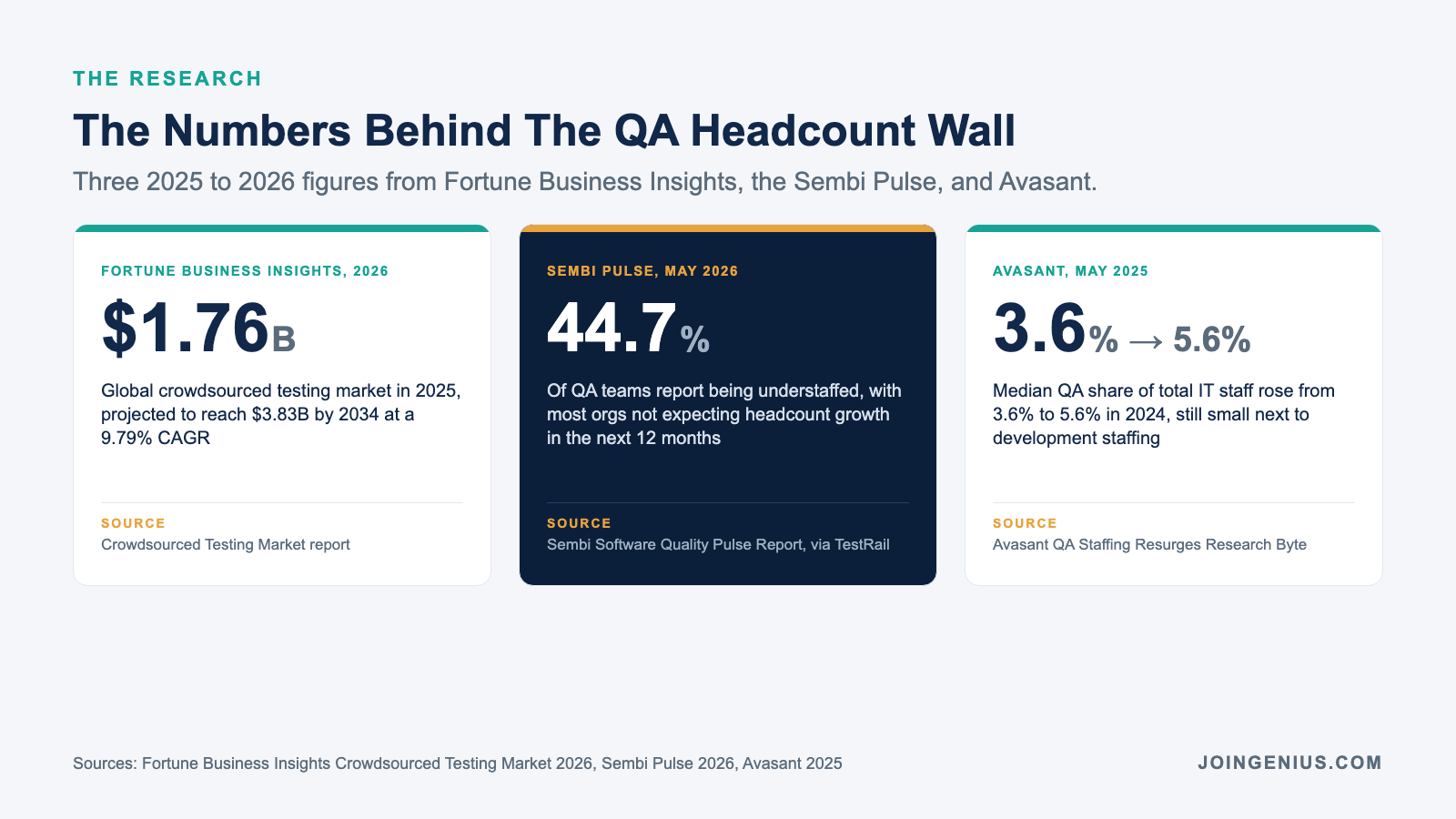
The Sembi 2026 Software Quality Pulse Report surveyed nearly 4,000 QA and engineering professionals and found 44.7 percent of QA teams report being understaffed, with most organizations not expecting headcount growth in the next 12 months. That is not a budget problem. It is a structural one.
The work expanded. The team did not. Hiring one more SDET does not close the gap between 8 testers and a product with 40 engineers shipping weekly.
Why Hiring More Testers Stopped Working
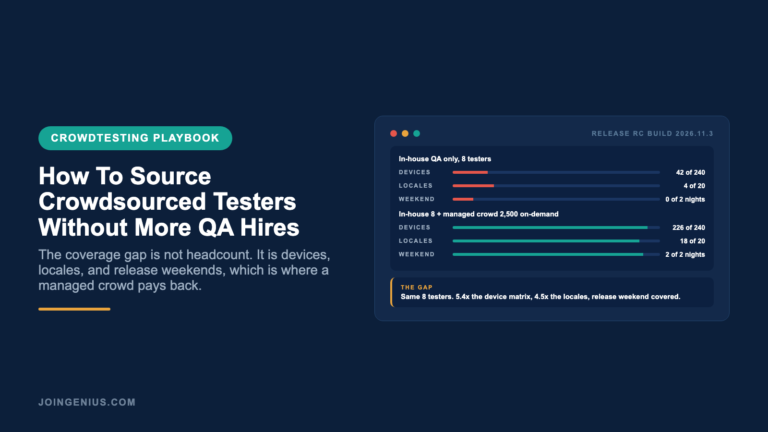
The gap is not about bodies. It is about coverage breadth: devices, locales, payment methods, accessibility scenarios, and real network conditions. A full-time hire is good at one part of that, not all of it.
And the hire takes 90 to 120 days to be useful. Mobile teams building for 20 Android versions on 200 device types cannot wait a quarter. For how to actually bring in the ones you do hire, see how to hire QA automation engineers who understand testing.
Where The Budget Is Actually Going
AI, platform, and security took the 2025 and 2026 headcount budget. QA got the tooling line instead, which is the quiet signal that leadership expects coverage to come from a vendor, not a req. The question is which vendor pattern fits.
Avasant’s May 2025 Research Byte reported median QA share of IT staff rose from 3.6 percent to 5.6 percent in 2024, which sounds like growth but is still small next to development and platform staffing, and still below what modern testing scope requires.
What Crowdsourced Testing Is (And What It Is Not)
Crowdsourced testing is a managed network of vetted testers running real sessions on real devices, under a program owner who scopes the work, routes the testers, and consolidates the findings. It is a program, not a tool.
Managed Crowd vs Freelancer Platform
A managed crowd ships a test plan, a device matrix, and a report. A freelancer platform ships names and a messaging thread, and the coordination falls on the in-house QA lead. The second model looks cheaper in the quote and usually is not, once the hidden coordination cost is counted.
The gap between the two shows up on the first release weekend, when a freelancer platform cannot guarantee a specific device, a specific locale, or a specific time window.
Where Crowd Testers Beat Internal QA
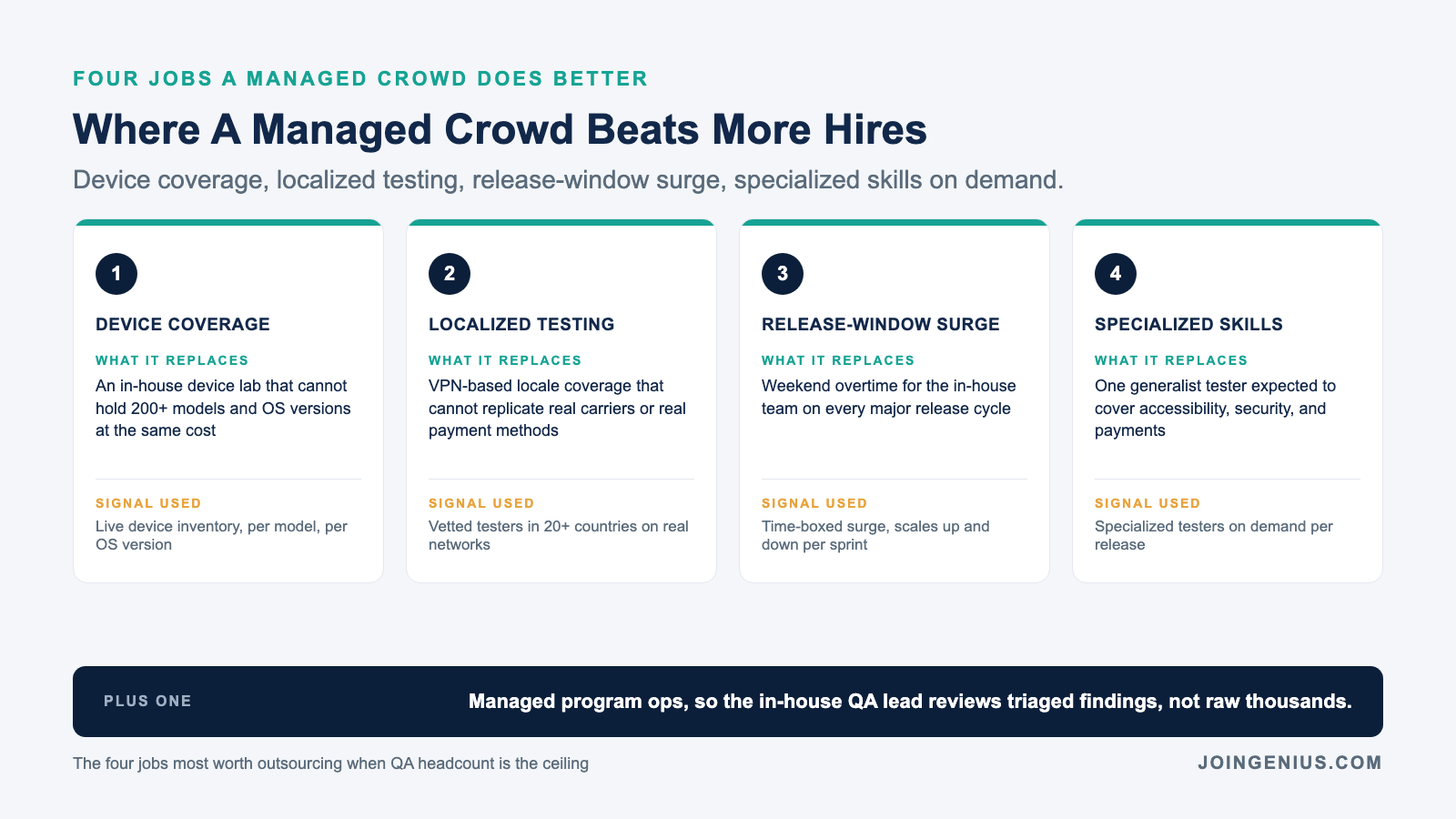
Real devices in real locations, under real carrier networks, with real payment methods. An in-house lab can simulate some of this. It cannot cover 20 countries, 200 devices, and 15 payment flows in one weekend.
Crowd testers also run a release at night and on weekends, which is when most mobile apps actually get used. That window is where most of the in-house QA shortfall shows up.
The Fortune Business Insights 2026 report valued the global crowdsourced testing market at $1.76 billion in 2025, projected to reach $3.83 billion by 2034 at a 9.79 percent CAGR. The spend is growing because coverage scales with product, not with headcount.
Where Internal QA Still Wins
Anything that touches your codebase deeply: automated test design, framework maintenance, CI test infrastructure, risk-based prioritization. These are not crowd jobs. They are core engineering jobs that live inside the team.
Crowd testers find bugs. Internal QA designs the system that keeps bugs out. The two are complements, not substitutes. For the broader testing pattern, see why local cloud testing finds bugs production never shows.
Picking A Crowdtesting Platform
The pitch deck is not the product. The things that separate a real platform from a staffing broker are the program ops, the device inventory, and the SLA on triage. Score vendors on those three, not on logos.
What To Score Vendors On
Four categories matter: tester vetting, device coverage, program ops (project managers, triage, deduplication), and reporting integration with Jira, Azure DevOps, or your bug tracker. A vendor that is strong on two and weak on two becomes an internal coordination tax after the first release.
Ask for the exact device matrix for your target locale, in writing, before the commercial conversation. If the answer is a sales call, the inventory is probably not there.
Where Applause Fits
Applause fully managed crowdtesting services combine the world’s largest testing community with AI and automation to help enterprises scale testing without adding QA headcount. For teams that need a device matrix across 200+ device types, a managed project manager, and a triage layer that feeds Jira directly, that bundle is the one most commonly compared in enterprise RFPs.
The decision is not Applause versus hiring one more SDET. It is a managed crowd program versus a freelancer platform, and the managed option is the one that holds through a release weekend.
What To Pilot Before You Commit
Run a 2-week paid pilot on one real release, scoped to one platform and two locales. Measure three things: number of unique high-severity bugs found, median time to triage, and the percent of findings that survived your team’s dedup pass.
If the pilot cannot produce 3 high-severity bugs your team did not find, the program is not the right fit for your product. If it produces 10, the math works.
How To Fold Crowd Testers Into Your Current Workflow
The common failure mode is dropping a crowd layer on top of a QA process that was not ready for one. The crowd finds more bugs than the team can triage, triage backs up, and the program gets labelled as noise after three sprints.
Where To Insert Them In The Pipeline
Two spots work: late in the release candidate cycle (after automated tests pass) and in post-release production monitoring (for the first 72 hours). Both are time-bounded. Both have clear exit criteria.
Running a crowd on every sprint from day one is a mistake. The ROI shows up at release gates, not at daily commits. For the architecture context, see scalable app architecture: the 2026 playbook.
Managing The Hand-Off
The in-house QA lead owns the test plan. The vendor PM owns execution and first-pass triage. A shared Slack channel and a joint standup once per release is enough coordination, more than that is overhead the program cannot absorb.
Write down who signs off on severity, who rejects duplicates, and who reopens an issue. If these are ambiguous, the program drifts in 4 weeks.
Reporting And Triage
The vendor should deliver findings with reproduction steps, screenshots, video, device info, and OS version, all in the tracker, not in a PDF. If triage is manual, the program will not scale past 2 releases.
For teams already running Playwright or similar, the crowd layer runs alongside, not instead. See Playwright test failure analysis for how automated findings get reconciled with human ones.
Six Signs Your QA Team Needs Crowd Testers Now
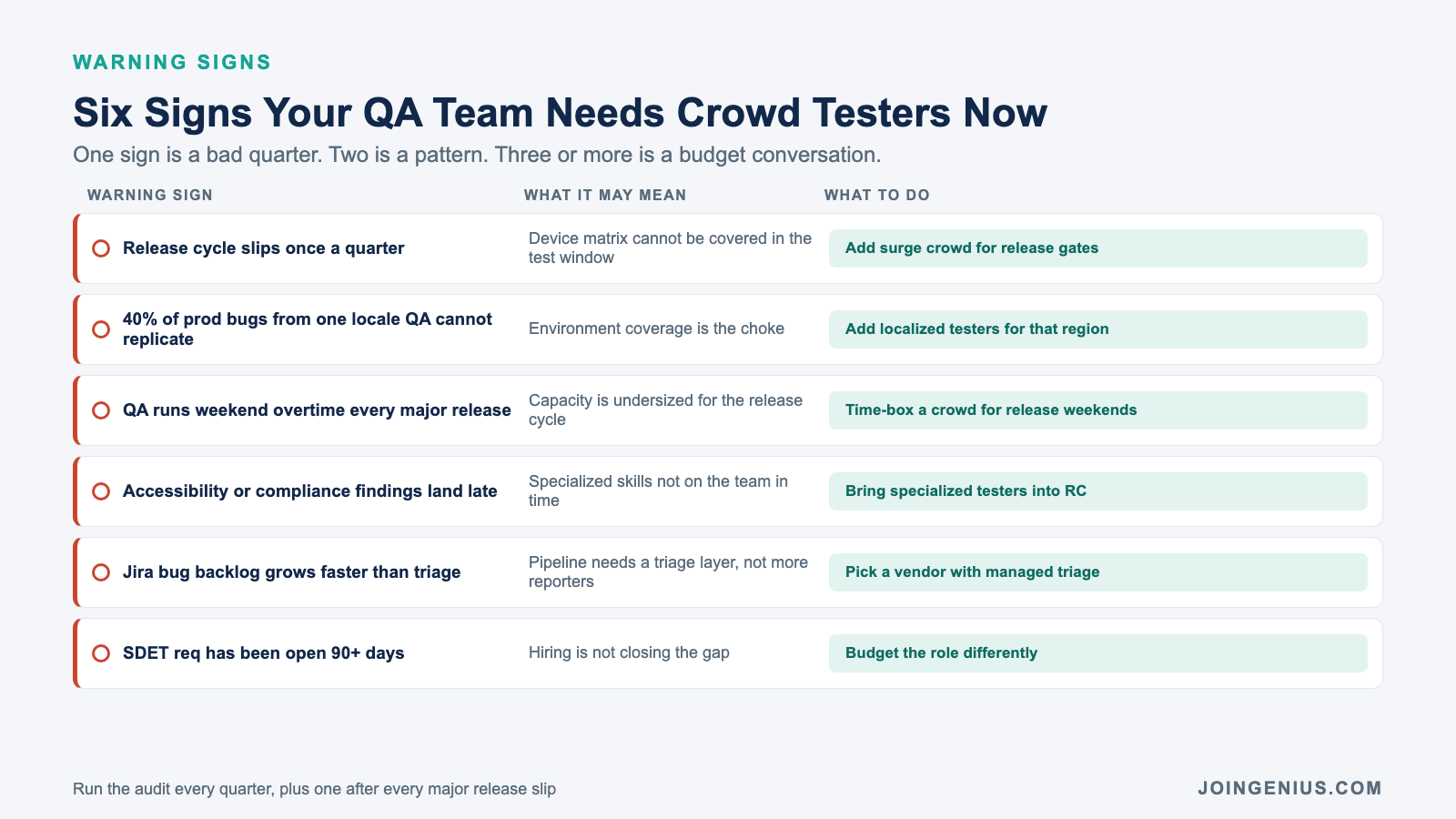
These six show up in every QA retro that ends with a release slip or a weekend fire drill. One is a bad quarter. Two is a pattern. Three or more is a signal the budget conversation should happen before the next release, not after it.
| Warning Sign | What It Usually Means | What To Do About It |
|---|---|---|
| Release slips once a quarter on device coverage | Matrix cannot be covered in the test window | Add surge crowd for release gates |
| 40% of prod bugs from one locale QA cannot replicate | Environment coverage is the choke | Add localized crowd for that region |
| QA runs weekend overtime on every major release | Capacity is undersized for the release cycle | Time-box a crowd for release weekends |
| Accessibility or compliance findings land late | Specialized skills not on the team in time | Bring specialized crowd testers into RC |
| Jira backlog grows faster than triage | Pipeline needs a triage layer, not more reporters | Pick a vendor with managed triage |
| SDET req open 90+ days | Hiring is not closing the gap | Budget the role differently |
Any two of the six on a release is a signal the current QA model has run out of room. Three or more is a budget conversation with finance that is cheaper to have before the next RC date, not after.
The 90-Day Rollout Plan
Week 1 to 2: scope the pilot and freeze the device matrix. Week 3 to 6: run the pilot on one real release, measure the three pilot metrics. Week 7 to 10: write the SOP for crowd findings, pick the Jira project and severity rules. Week 11 to 12: expand to the second platform and second locale.
What To Stop Doing
Stop running crowd testing on every sprint. Stop treating the vendor PM as a vendor contact; treat them as part of the release team. Stop asking for one more SDET req when the gap is coverage breadth, not depth.
Conclusion
Crowdsourced testers close the coverage gap more QA hires cannot, because the gap is breadth of devices, locales, and real network conditions, not depth of code. Score vendors on program ops, device matrix, and triage SLA. Run a 2-week paid pilot. Fold the crowd into the release gate, not the daily sprint.
The teams that do this ship on time with the same headcount. For more on scaling engineering teams, visit Genius.