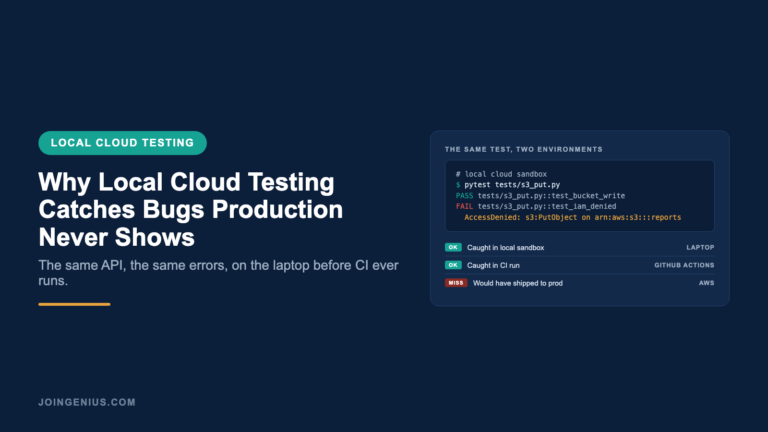
A test suite that passes in CI and then breaks in production is not a mystery. The mystery is why teams keep paying for it. Most cloud bugs show up at the AWS boundary that only exists in production. Local cloud testing runs those services on a laptop before the code ships.
We cover what local cloud testing means in 2026 and why production logs miss the bug. We go into where pipelines break and how to add emulation to an AWS pipeline. We finish with who should own it. If you are also hiring developers to own this work, the list doubles as an interview rubric.
What Local Cloud Testing Actually Means In 2026
The term covers a wider surface now than it did a few years ago. Local cloud testing used to mean a mock of a single service. Today it means the whole AWS or Snowflake surface running on a container on the engineer’s machine.
Running The Cloud API On A Laptop
A modern local cloud environment answers the same API calls the real cloud answers. S3, DynamoDB, Lambda and SQS respond with the response shapes and error codes production returns. Your application code does not know the difference. Your tests exercise the real paths instead of a hand-written stub that drifts from the API.
The container runs on the laptop during development and inside the CI runner on every PR. The same test file passes in both places or fails in both places. There is no third environment that behaves differently from the first two.
Why This Replaced The Mock
Mocks were cheap to write. They were also the main reason production found bugs that CI missed. When a mock returns success for an S3 put that the real service rejects, the test is useless.
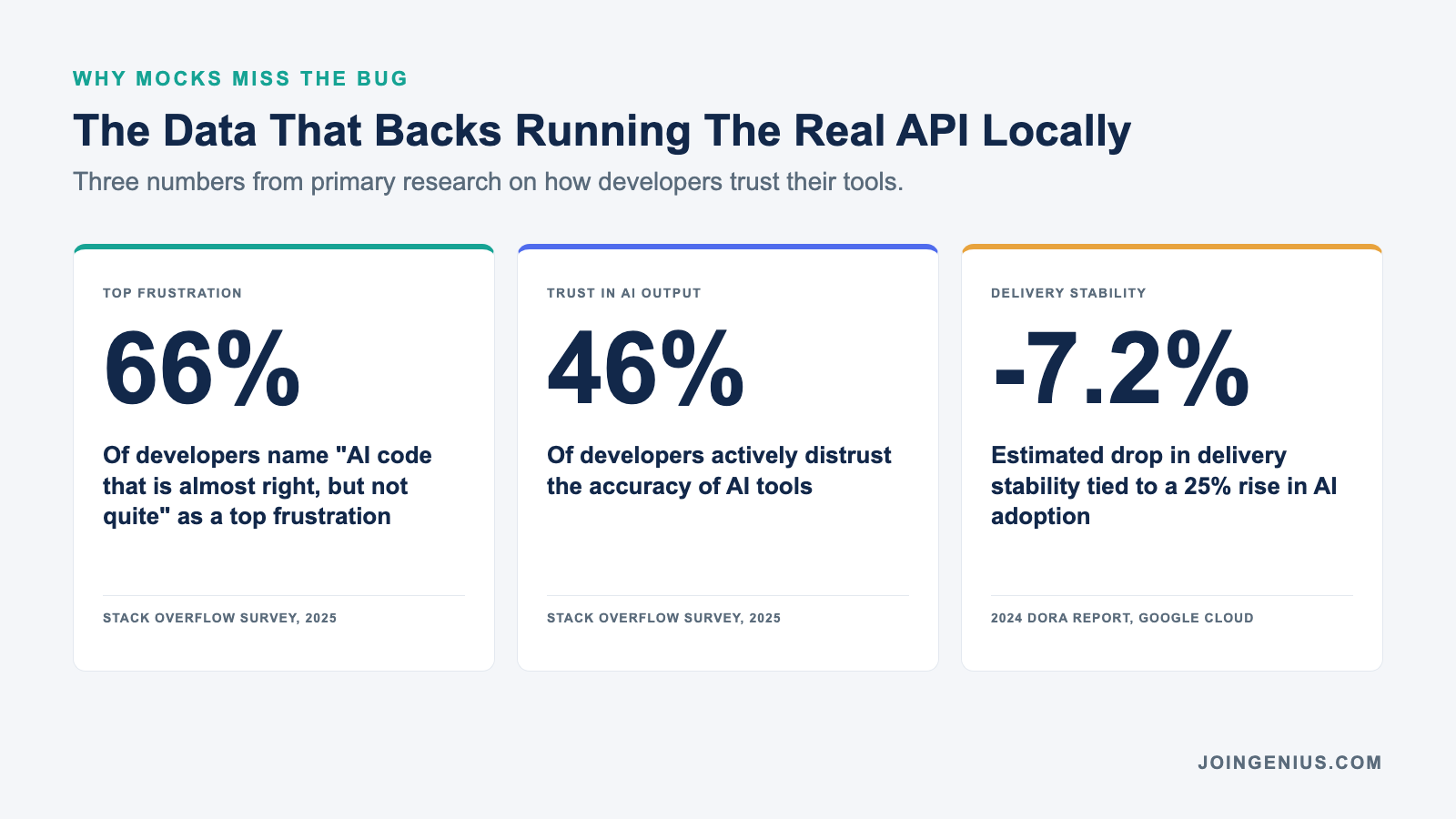
The 2025 Stack Overflow Developer Survey of about 49,000 developers found that 66 percent name “AI solutions that are almost right, but not quite” as a top frustration. That frustration is the same shape as a mock that is almost right. The fix is to run the real API locally, not to write a better mock around it.
Why Production Logs Miss The Bug That Broke You
Teams often assume production observability will catch anything local testing missed. It will not. The failure modes below are the ones production logs quietly hide, which is why they survive for months before an outage finally surfaces them.
The Replay Problem
A production trace shows what happened once. It cannot show what would have happened under a slightly different payload. Local testing can replay the same request a thousand times with small variants until a boundary condition breaks. That is the test that catches the bug a trace never will.
The replay is also cheap. One container, one test file, a few seconds of CPU on the laptop. The equivalent chaos test in production takes a change management meeting and a window nobody wants to own.
Permissions And IAM Get Masked By Admin Roles
Most production runtimes execute with broader IAM than any end user. A service account can write to a bucket the user cannot. The policy bug sits in the code path, but it only fires once a real user with a least-privilege role triggers it.
Local emulation runs the policy engine the same way production does, so the test fails on the laptop. That is the only place a policy bug is cheap to fix.
Timing Bugs Only Appear Under Real Service Latency
DynamoDB and SQS both have retry semantics tests rarely exercise. A request that fires before the preceding write has propagated looks fine in a unit test.
In production it drops a record once a week and nobody notices for a quarter. Local cloud testing with the real client library and real backoffs catches that pattern. It also lets you inject latency on purpose, so the test proves the retry works and is not just lucky.
Where Pipelines Usually Break Without Local Emulation
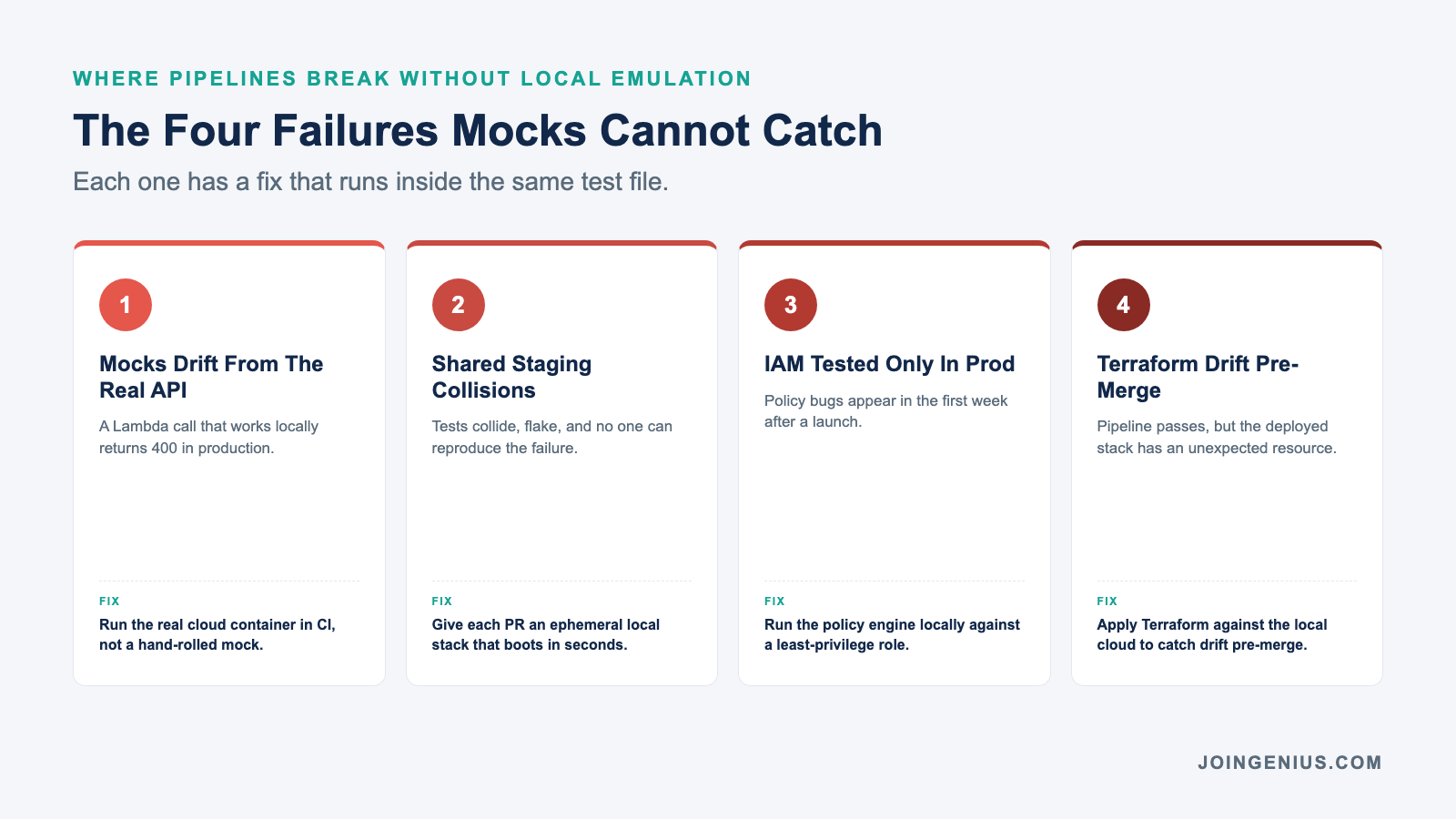
Every team we talk to has hit at least two of the issues below. None of them are about the pipeline being bad. They are about the pipeline testing something that is not quite the production surface.
| Failure | What It Looks Like | What To Do Instead |
|---|---|---|
| Mocks drift from the real API | A Lambda call that works locally returns 400 in prod | Run the real cloud container in CI, not a hand-rolled mock |
| Shared staging environments | Tests collide, flake, and nobody can repro the failure | Give each PR an ephemeral local stack that boots in seconds |
| IAM tested only in prod | Policy bugs appear the first week after launch | Run the policy engine locally against a least-privilege role |
| Infrastructure drift from Terraform | The pipeline passes, but the deployed stack has an unexpected resource | Apply Terraform against the local cloud to catch drift pre-merge |
The macro trend is not kind to teams that skip this step. Google Cloud’s 2024 DORA report, dated October 23, 2024, found that a 25 percent rise in AI adoption is associated with an estimated 7.2 percent reduction in delivery stability. Throughput fell 1.5 percent in the same model.
More AI in the pipeline means more generated code that mocks do not catch. That is the bet every team is now making whether they named it or not. The counterweight is a test environment that matches production closely enough to fail the bad code before a reviewer has to spot it by eye.
How To Add Local Cloud Testing To An AWS Pipeline
You do not need a six month migration to start. Teams that get value fast add local cloud testing in the places production failures already cost them, then expand from there.
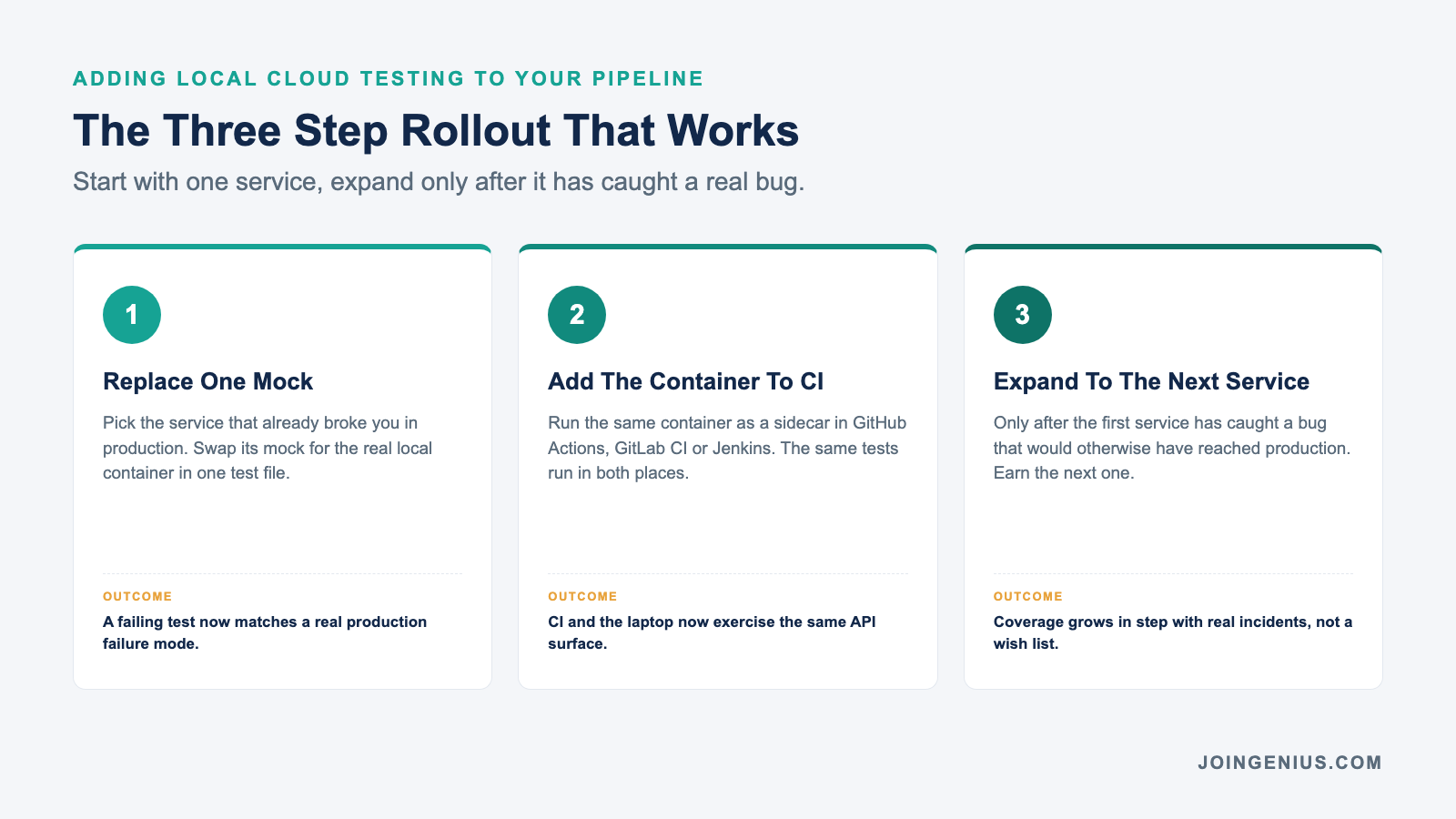
The Three Steps That Work
- Start with one service that already broke in production. Replace its mock with the real local container in one test file.
- Add the same container to CI as a sidecar or step. The same tests then run in both places with no extra plumbing.
- Expand to the next service when the first one has caught a bug that would otherwise have reached production.
What To Pick And Where It Fits
Pick a tool that runs the same API surface as the cloud you deploy to. A CI/CD testing tool such as LocalStack runs AWS and Snowflake services in a container on the developer laptop and inside GitHub Actions, GitLab CI or Jenkins. The company reports more than 1,500 customer organizations and 400 million Docker pulls on its CI/CD page.
LocalStack has a free Hobby tier for non-commercial use and paid plans priced per license. It is still a vendor tool, so the fit depends on which AWS services your pipeline exercises and whether your team wants the extra features of the paid tiers.
The emulation is also not perfect for every edge of every service. The right test for fit is to run your own highest-risk integration path against it first, then decide whether the delta between local and production is small enough to rely on.
If the debate at your company is between adding this tooling or adding more engineers, our guide on how to outsource software development covers that tradeoff in more depth.
Who Should Own Local Cloud Testing Inside Your Team
Ownership of this work is the piece that gets skipped most often. A local testing setup without a named owner rots within two releases. The role does not have to be dedicated, but it does have to be assigned.
The Owner Profile That Works
A senior backend or platform engineer is usually the right owner. They decide which services deserve local coverage and which ones do not. They keep the container images up to date and run the quarterly review of what broke in production that local tests should have caught. They do not have to write every test.
Compensation Anchors For The Hire
Backend and platform engineers sit inside the broader software developer category. The US Bureau of Labor Statistics puts the median wage for software developers at $135,980 in May 2025. It projects employment to grow 10 percent from 2025 to 2035, with 1,717,800 jobs across the field in 2025. The page was last modified August 27, 2026.
That growth rate is why time to hire still matters here. A strong platform engineer with real cloud testing experience is in short supply and in demand across both product and infra teams.
If you need help running the search, an engineering recruitment agency can source candidates, and our post on how to hire LATAM developers covers remote options at lower comp without giving up on technical depth.
Conclusion
Treat local cloud testing as part of the deploy pipeline, not an extra. Pick one service that already broke you, run it locally in CI, and expand from there. Two months in, your production incidents around that surface stop. Add the next service when the first one has caught at least one bug that would otherwise have shipped.
Teams that run the real cloud API in their tests catch the bugs production never shows, and they do it before a reviewer has to notice. That is the whole case for the practice, and it is why the mock-only pipeline is already out of date.
Here at Genius, we place the senior backend and platform engineers who own this work. We source top one percent engineering talent from the Philippines and LATAM at roughly 80 percent less than local comp. There are no monthly fees, and every placement comes with a six month replacement guarantee. Talk to Genius about your next platform hire.