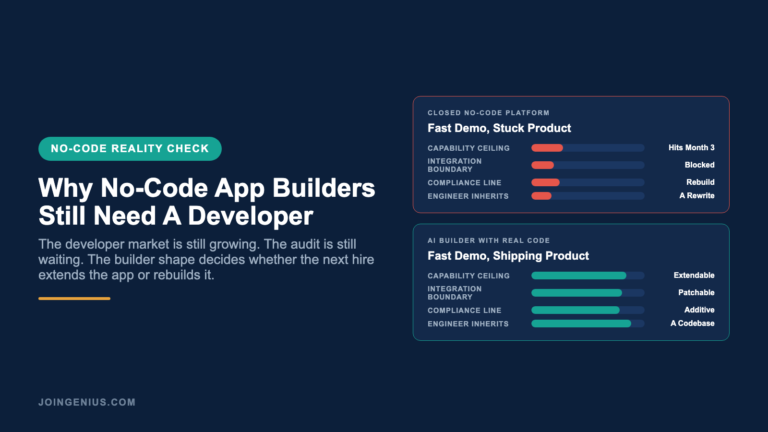
The no-code pitch is that anyone can ship an app without writing a line of code. For the first version that pitch holds. A founder describes the app. The builder produces an iPhone app that is in the App Store by Friday. Then the first real user asks for the one feature the platform cannot express. Or the audit asks who owns the code. Or the next release needs a payment integration the builder does not support. The question stops being “can we build this without a developer” and becomes “when did we need one,” and the honest answer is almost always earlier than the team thought.
The right question for a founder or operator in 2026 is not whether no-code replaces developers. It is which no-code shape survives the first ceiling you will hit and which one forces a rewrite when the shape of the app outgrows the drag-and-drop canvas. Modern development workflows have put a usable app in reach of anyone who can describe one, but they have not removed the day the project needs an engineer. This piece is about where that day shows up and the platform-shape move that keeps the project alive when it does.
The Developer Market Looks Nothing Like The No-Code Narrative
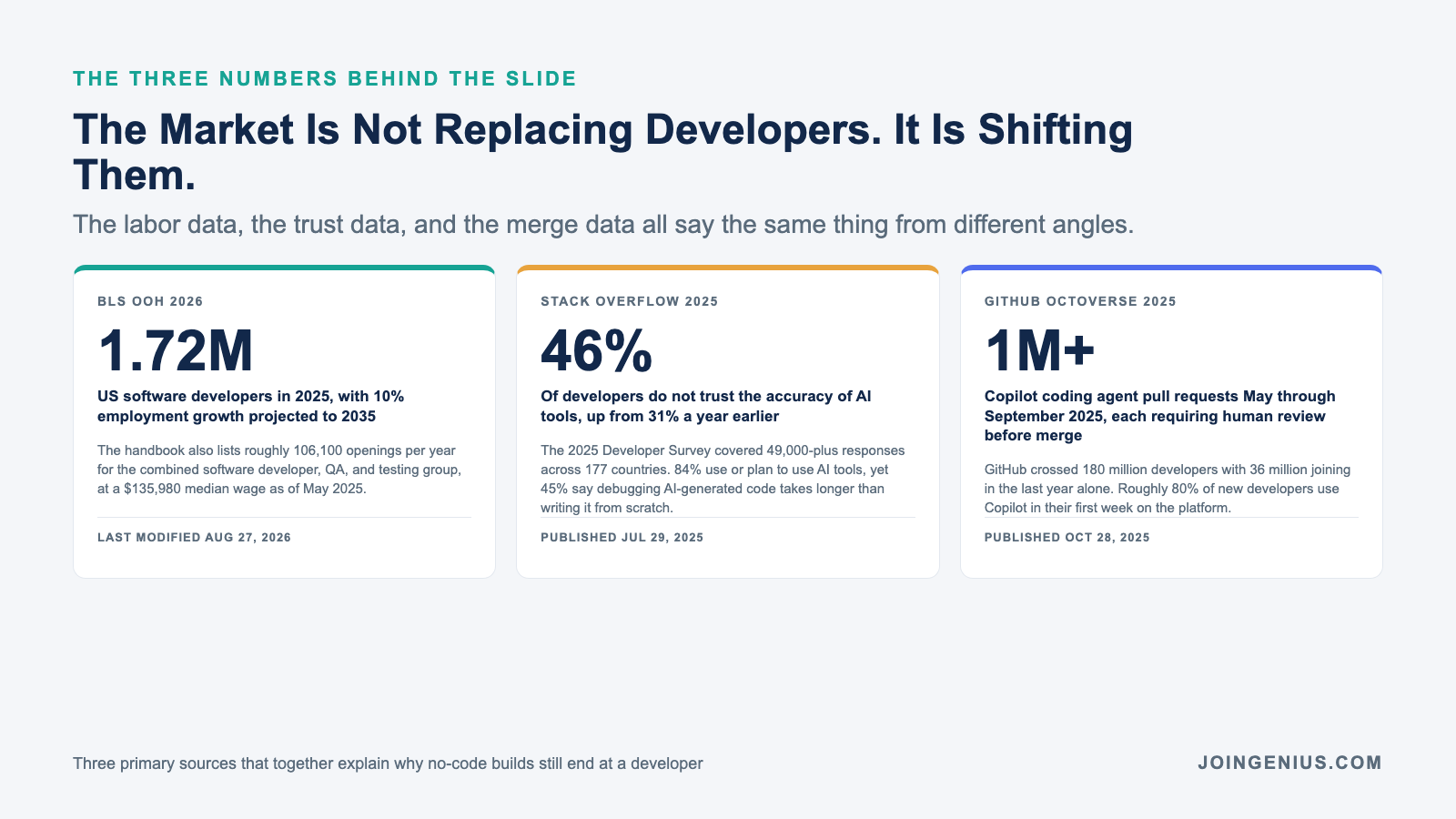
The US Bureau of Labor Statistics Occupational Outlook Handbook for Software Developers, Quality Assurance Analysts, and Testers lists about 1,717,800 US software developers in 2025 and projects 10% employment growth from 2025 to 2035. The group’s combined roles have roughly 106,100 openings per year over the decade and a $135,980 median annual wage as of May 2025. The headcount is expanding and the median is near the top of the BLS table. If no-code were actually replacing developers at the rate the pitch implies, those numbers would be sliding. They are not.
Developer Demand Is The Opposite Of Collapsing
A 10% growth projection over the next decade is nearly twice the all-occupation average. That is the number the BLS runs at a point when every AI app builder on the market is claiming to turn non-coders into shippers. Both facts are true at once. More apps are being built without developers and more developers are being hired to finish them.
The $135,980 Median Says The Market Is Pricing The Ceiling
If a drag-and-drop platform could take a real app from zero to production with zero engineering, the median developer wage would be sliding. It is near the top of the BLS table instead. The market is paying exactly what it would pay if no-code gets you to version one and an engineer gets you to version two.
The Narrative Says No-Code Replaces Developers. The Numbers Say It Shifts Them
Developers are not getting replaced. They are moving from writing the first version to extending the first version, from building boilerplate to building the parts the no-code tool cannot express. The seat changed. The seat did not go away. Any founder planning around “no developers ever” is planning against the labor-market data.
What Actually Separates A Shippable No-Code App From One That Needs A Developer
Three forces compound each other. Any one of them is survivable. Hitting two at once is where the project stalls.
The Capability Ceiling Is Where The App’s Real Workflow Lives
Every no-code platform has a vocabulary. The platform expresses what its primitives support. If the app’s real workflow sits inside that vocabulary, the build is fast and the result is maintainable. If the real workflow sits just past it, the team ends up stacking workarounds on workarounds until the app is held together by duct tape. The ceiling is not a bug in the tool. It is the shape of the tool.
The Integration Boundary Is Where The Platform Stops And Your Business Starts
Most real apps need to talk to a payment processor or a CRM the business already uses. If the platform offers a first-class connector, the build stays no-code. If it does not, the team is either writing custom code or shipping a worse version of the feature. The integration boundary decides whether no-code is a platform or a prototype tool for your specific business.
The Compliance And Security Line Is Where The Audit Decides Whether You Shipped Or Only Demoed
An app that handles sensitive data is not done at feature parity. It is done at audit parity. If the platform cannot show how data is stored and who can access it, the app passes a demo and fails an audit. The compliance line is where many no-code builds quietly convert into rebuilds, because the engineering work to make an app audit-ready was never the part no-code was going to do for you.
Stack Overflow’s 2025 Developer Survey, published July 29, 2025 against 49,000-plus responses from 177 countries, found that 84% of developers now use or plan to use AI tools in their workflow (up from 76% in 2024). 46% say they do not trust the accuracy of AI tools (up from 31% a year earlier) and 45% report that debugging AI-generated code is more time-consuming than writing it from scratch. Adoption is nearly universal. Trust is sliding in the other direction, and the people doing the debugging are the developers you were told you would not need.
The Lever Most Teams Miss
Pick An AI App Builder That Hands You Real Code When The Ceiling Shows Up
Before you lock in another drag-and-drop platform where the output is a black box the engineering team cannot touch, move the first version to an AI app builder like Vibecode that generates a real native Swift iPhone app or a React Native app you can hand to a developer the moment the ceiling shows up. For founders and operators who do not code, that means the first shippable version comes out in a week and the second version is an engineer extending real code rather than rebuilding the app from zero on a different platform. The handoff is additive rather than a rewrite, and the project survives the first feature the no-code tool refused to express.
The point is not that an AI app builder removes the developer. The point is that the shape of its output decides whether the developer joins the project or inherits a graveyard. A platform that produces production-grade code lets the engineer start where the ceiling hit. A platform that produces a black box forces the engineer to start where the founder started, which is version one. One of those outcomes keeps the roadmap moving. The other resets the clock.
GitHub’s Octoverse 2025 report, published October 28, 2025, found that GitHub now has 180 million-plus developers with 36 million joining in the last year alone. Roughly 80% of new developers on the platform use Copilot in their first week. Between May and September 2025, the Copilot coding agent created more than one million pull requests and every one of them required a human developer review before merge. AI is drafting the code. Developers are still owning the merge. If the builder you picked does not produce code a developer can review, the merge is where the project dies.
What Day 180 Looks Like When You Get It Right
The difference between the two approaches shows up at the six-month review, which is also the moment the founder finds out whether the no-code decision was a shortcut or a detour.
The Before Version
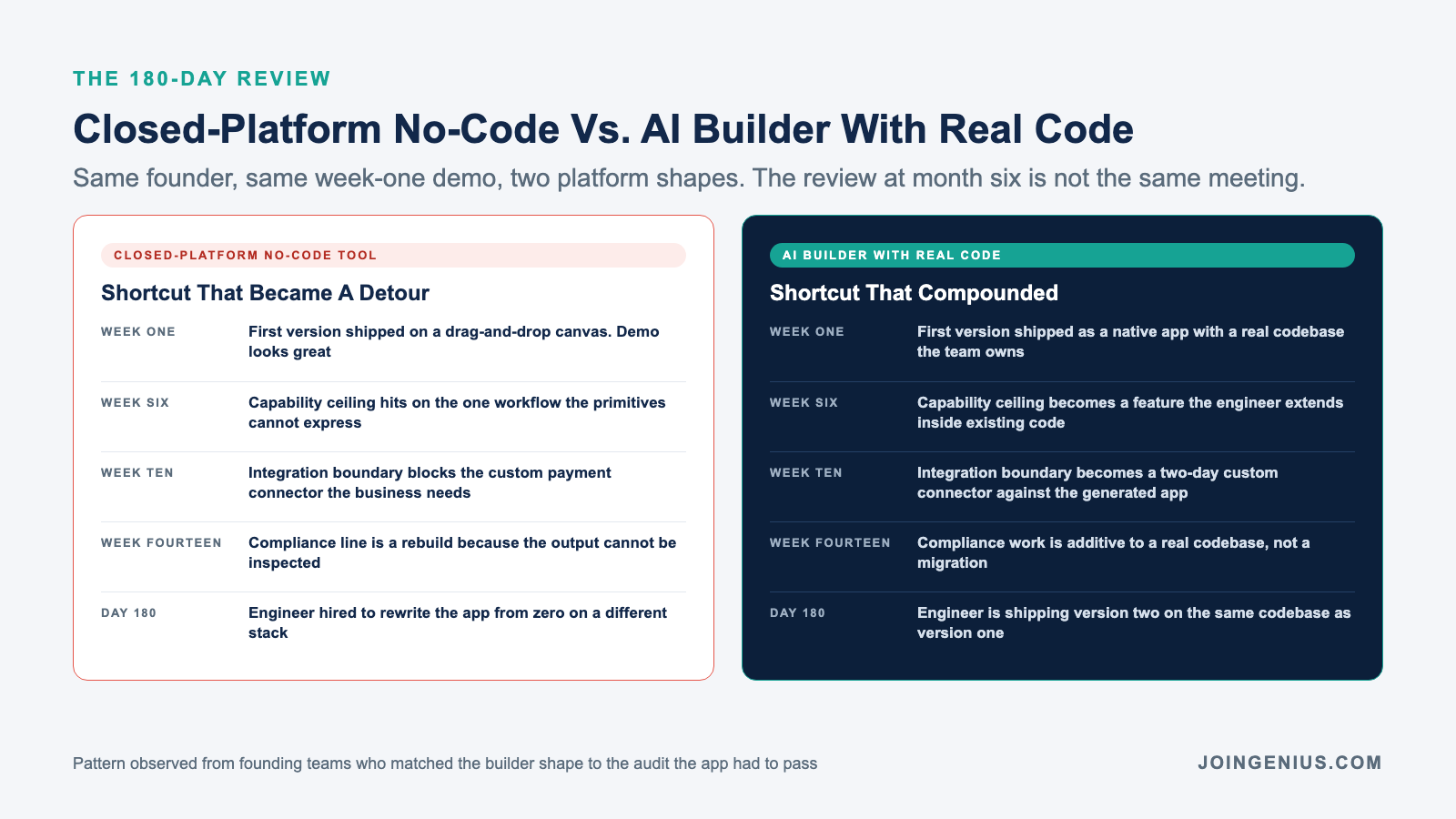
In the before version the team ships the first app in a week on a closed-platform no-code tool. Week six the team hits the first capability ceiling. Week ten the team hits the first integration boundary. Week fourteen the team hits the compliance line, and the only path forward is to hire an engineer who then explains the second version is faster to rebuild than to extend, because the platform’s output cannot be touched. The next quarter’s plan is a rewrite on a different stack, which means the no-code shortcut cost four months and still ended at the engineer. Low morale at work sits highest on founding teams who shipped fast and then had to rebuild from zero.
The After Version
In the after version the team ships the first app in a week on an AI builder that produces real native code. Week six the team hits the first capability ceiling and the engineer the founder brings in extends the existing codebase instead of starting one. Week ten the integration boundary becomes a two-day custom connector written against the generated code rather than a rebuild. Week fourteen the compliance work is additive to a real codebase instead of a migration to a new one. The day-180 review is about shipping the next feature rather than paying for the last mistake.
A Four-Move Playbook For Shipping With No-Code Without Painting Yourself Into A Corner
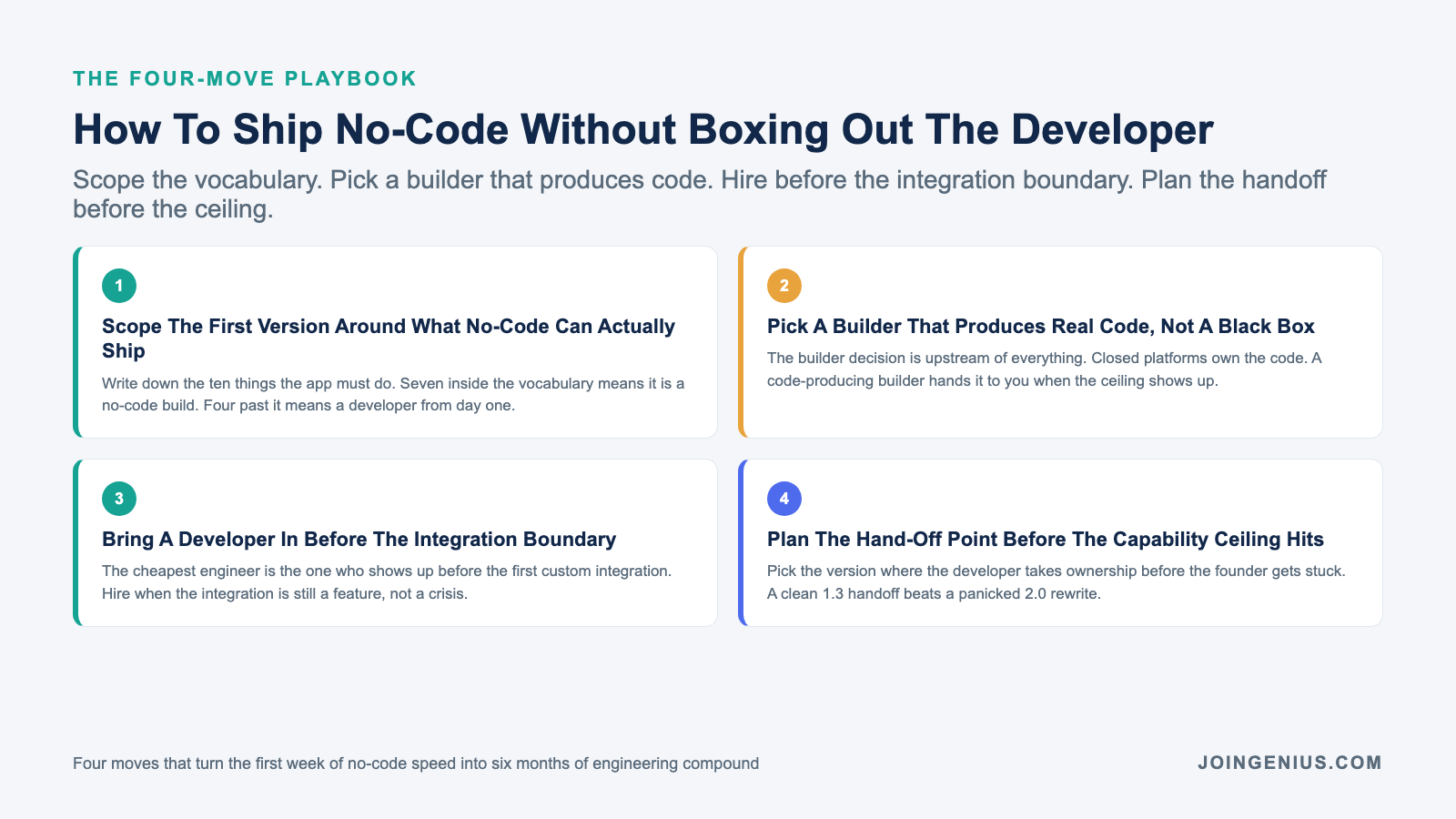
The four moves in order.
1. Scope The First Version Around What No-Code Can Actually Ship
Before you pick a tool, write down the ten things the app actually needs to do in its first release. If seven or more sit inside the vocabulary of a no-code platform, the build is a no-code build. If four or more sit just past it, the build needs a developer from day one. The scoping conversation is the cheapest step in the project and the one most teams skip.
2. Pick A Builder That Produces Real Code, Not A Black Box
The builder decision is upstream of everything else, because it decides whether an engineer can ever pick up what the founder started. A closed-platform no-code tool owns the code. An AI app builder that generates a native app hands you the code. Which one you pick decides whether the first hire extends version one or rebuilds it.
3. Bring A Developer In Before The Integration Boundary, Not After
The cheapest engineer is the one who shows up before the first custom integration, not after. Hire the developer when you can still describe the integration as a feature rather than as a crisis. A structured hiring process matters more on the first engineering hire than on the fifth, because the first one inherits whatever you shipped.
4. Plan The Hand-Off Point Before The Capability Ceiling Hits
Pick the version where the developer takes ownership before the founder gets stuck. A clean hand-off at version 1.3 beats a panicked one at version 2.0, because the engineer is extending a codebase whose shape they can still change. What you plan for is what you survive.
The playbook is in the image below.
The One-Page Check Before The Next No-Code Project
Before you commit to a no-code tool for a real app, ask one question. If the capability ceiling and the integration boundary both hit in month three, is the output of the tool something a developer can extend or something a developer has to replace?
If the answer is extend, the no-code decision was a shortcut. If the answer is replace, the no-code decision was a detour that cost you the first three months. Pick a builder whose output answers the first version of the question, then let the developer start where the ceiling hit instead of where the founder started. The next app you ship against that check will reach version two on the same codebase as version one. The next app you ship against a closed-platform demo will reach version two on a rewrite and a new engineering bill.
Conclusion
No-code is not a replacement for engineering. It is a faster start to a project that still ends at an engineer, and the only question is whether the engineer inherits a codebase or inherits a wall. Scope the first version around the vocabulary. Pick a builder that produces real code. Bring the developer in before the integration boundary. Plan the hand-off before the capability ceiling. Then let the first week of no-code speed become the first six months of engineering compound, not the first six months of engineering rewrite.
We built Genius so founders and operators shipping fast on an AI app builder can staff the engineering extension their roadmap needs, without expanding the local headcount their budget cannot support. We place the top 1% of software engineering and product talent from the Philippines and Latin America, at around 80% less than comparable local hires. The relationship stays direct, with no monthly agency fees and a 6-month replacement guarantee on every placement. If the next engineering hire is the one who finally turns the no-code app into a shipping product, see how we source and place the engineering talent that compounds.