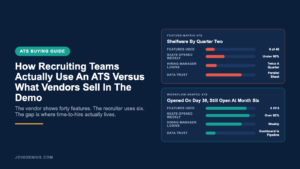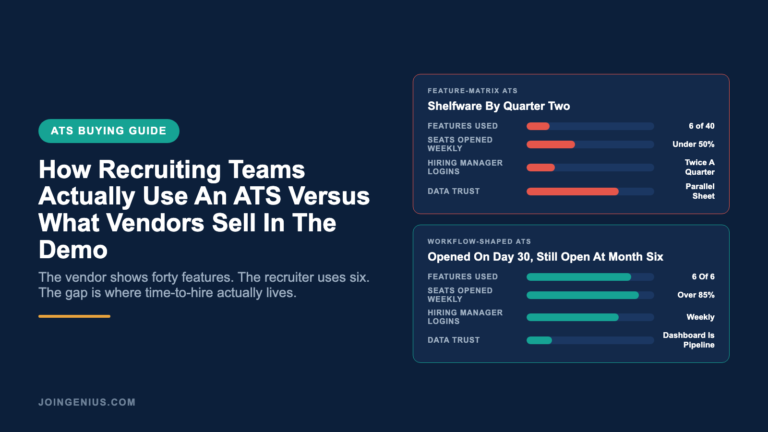
Most ATS buying cycles end with a seat count sized against the demo and a daily workflow sized against six features. The vendor deck shows forty-plus modules and an AI panel on every screen. The recruiter uses the pipeline board and the email template, plus the scheduler and the scorecard. A candidate search gets opened a few times a day, and whatever the hiring manager asks for in Slack rounds out the work. The gap between those two pictures is where time-to-hire actually lives, and it is the gap most RFPs do not measure.
The right ATS question is not which platform has the most features. It is which platform the recruiting team actually opens on day 30, and whether the features they use match the features the vendor priced them on. Modern hiring workflows have cut time to hire sharply, but speed does nothing if the tool itself is scored against a feature matrix no one on the recruiting team wrote. This piece is about what the real daily workflow looks like and where the demo-to-usage gap costs the most, plus the one platform-shape move that reliably closes it.
The ATS Market Looks Nothing Like The ATS Demo
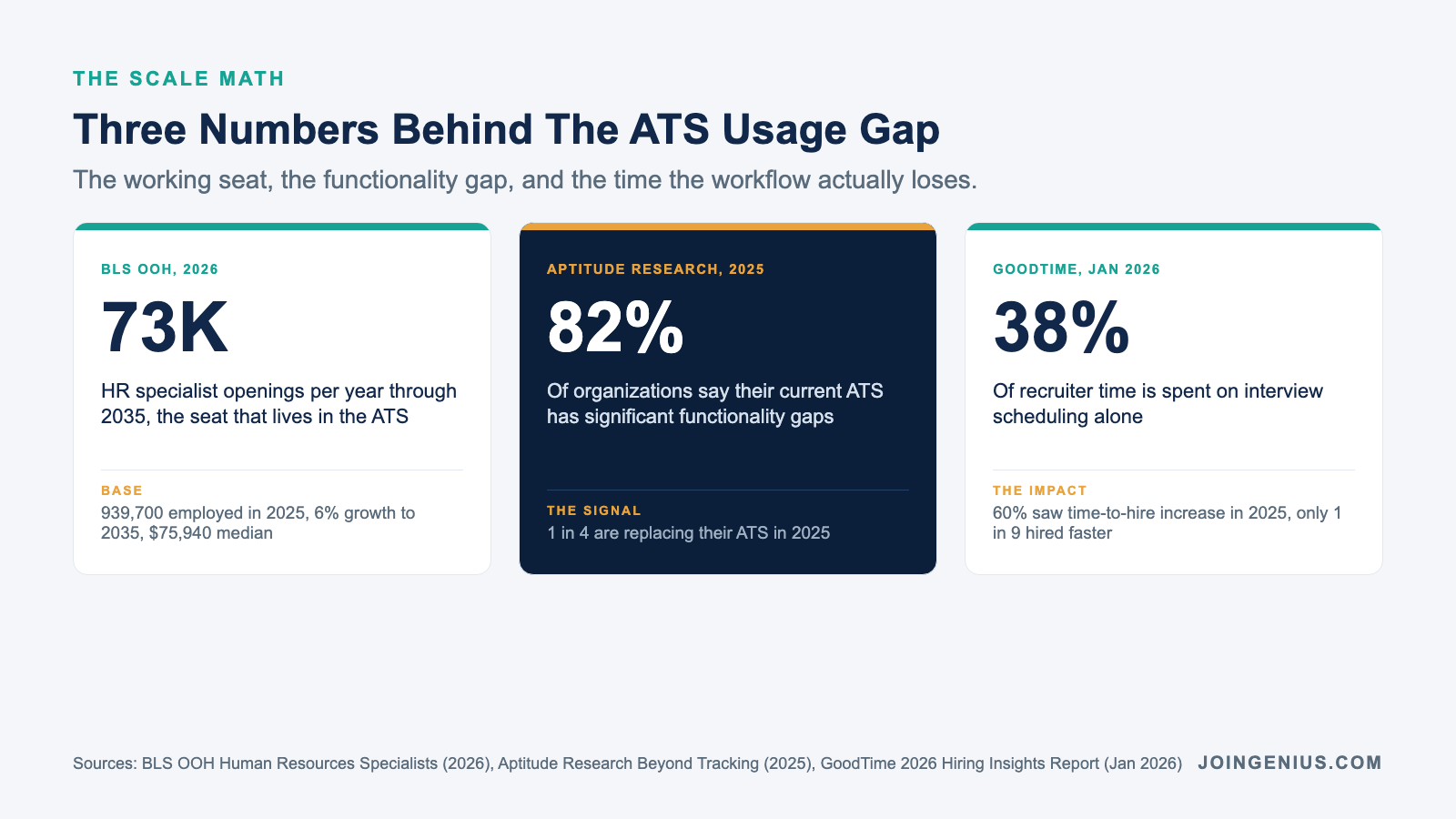
The US Bureau of Labor Statistics Occupational Outlook Handbook for Human Resources Specialists lists about 939,700 US HR specialists in 2025 and projects 6% employment growth from 2025 to 2035, with about 73,700 openings per year at a $75,940 median wage as of May 2025. Most of those openings are the people who sit inside an ATS all day, which makes the ATS buying decision a direct lever on the productivity of roughly a million working seats. The recruiter workflow is not a niche. It is the daily work of the function.
The Demo Is Built For Procurement, Not Recruiting
The feature matrix is written for a buyer who scores against a checklist and a procurement team that scores against vendor comparisons. The recruiter who will live in the tool for forty hours a week is rarely in the room when the shortlist gets cut. The result is a stack sized for a scoring sheet, not a workflow.
The Workflow Is Built For Six Tasks, Not Forty
Every recruiting team converges on the same six daily tasks. Pipeline movement and candidate outreach come first. Scheduling and scorecard capture come next. Hiring manager updates and a search over past candidates round it out. The other thirty-four modules in the vendor stack get opened in the first month and forgotten by the third.
The Bill Is Sized For Both
Seat pricing is anchored to the full feature surface even when the team uses a sixth of it. The spread between paid seats and opened seats is the shelfware tax, and it compounds every renewal cycle.
What Actually Separates A Real ATS Workflow From The Demo Version
Three forces compound each other, and any one of them would be a buying mistake. The three together produce renewal cycles where the team quietly asks for something lighter.
The Click Path Decides The Day 30 Mix
A recruiter on a feature-dense ATS spends their day on form fields and tab switching. A recruiter on a workflow-dense ATS spends their day on candidate conversations and hiring manager alignment. The daily work mix is a click-path decision made in the UX, not a performance outcome measured at the quarterly review.
The Integration Shape Decides Whether The Tool Is Opened At All
If the ATS does not plug into Slack and the calendar the recruiter already uses, plus the inbox they already live in, the team routes work around it. Once the work routes around the tool, the data in the tool stops being trustworthy, and the dashboard the leader is reading is not the state of the pipeline.
The Onboarding Cost Decides Whether Hiring Managers Stay Engaged
Hiring managers will open an ATS they can learn in one session. They will not open one they have to be trained on twice. The tool shape decides whether the review loop runs inside the system or ends up in a parallel spreadsheet the recruiter has to reconcile every Friday.
Aptitude Research’s 2025 report Beyond Tracking: The Evolution of the ATS in an Intelligent and Agentic Era found that 82% of organizations say their current ATS has significant functionality gaps and only 22% believe their ATS alone can support true talent transformation. Nearly half of enterprise companies are managing more than one ATS platform, and one in four companies are replacing their ATS in 2025. The buying signal is loud. Teams are not asking for more features. They are asking for a tool shape that matches what they actually do.
The Lever Most Teams Miss
Standardize The Team On The Six Features They Actually Use
Before you renew more seats on the bloated stack, move the recruiting team to a lean applicant tracking system like Polymer that puts the pipeline board and the candidate conversation on the same screen the recruiter already opens first, rather than a feature matrix built for the buying committee. For high-growth teams, the platform plugs into Slack and the calendar the recruiter already lives in. Hiring managers stay engaged because they can learn the whole tool in one session, which makes the scorecard conversation measurably faster and the pipeline data measurably cleaner.
The point is not that a lean ATS replaces a legacy stack for every org. The point is that the ATS you can actually open on day 30 is a very different and much more useful tool than the one you bought on day one against a feature matrix no one on the recruiting team wrote. The recruiter workflow reads as candidate work with light admin overhead, not admin work with a side of candidates, and the teams who hit their req targets are the ones who picked for the first shape.
GoodTime’s 2026 Hiring Insights Report, based on an independent survey of more than 500 US talent acquisition leaders and published January 27, 2026, found that 60% of organizations saw time-to-hire increase in 2025 while only one in nine hired faster, and that recruiters now spend 38% of their time on interview scheduling alone. Teams using automated or AI-driven scheduling were 1.6 times more likely to hit near-perfect hiring-goal attainment. The business-impact signal lines up with the tool-shape signal. When the tool does not fit the workflow, the pipeline slows and the goals miss.
What Day 180 Looks Like When You Get It Right
The difference between the two approaches shows up at the day 180 review, which is also the moment leadership finds out whether they bought the right ATS.
The Before Version
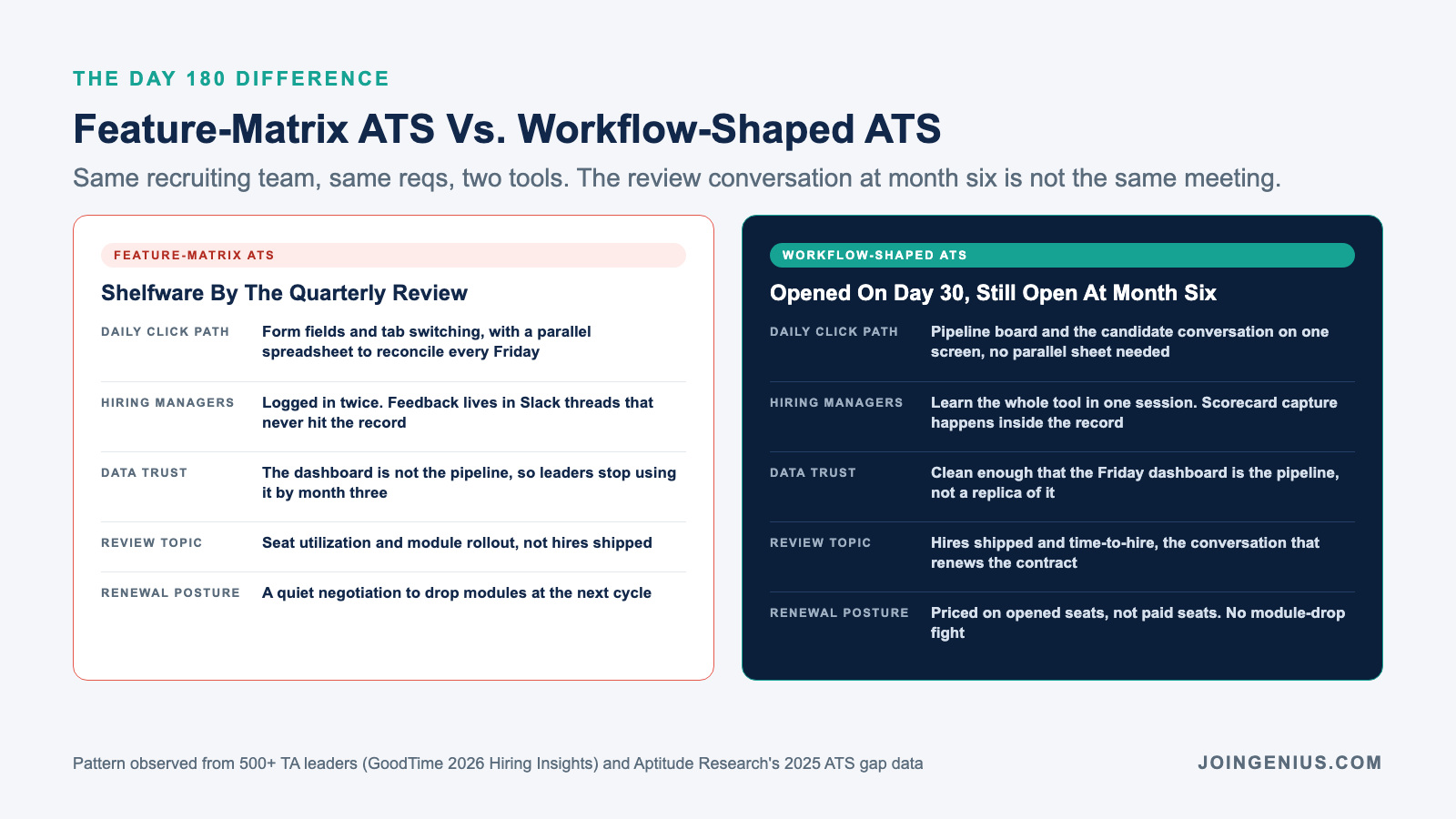
In the before version, the recruiting team has spent six months reconciling pipeline data between the ATS and a parallel spreadsheet. Hiring managers have logged in twice, and their feedback lives in Slack threads that never make it into the candidate record. The review conversation is about seat utilization and feature rollout rather than hires shipped. The renewal cycle is a quiet negotiation about which modules to drop, which puts the team back in the same buying decision they just made. Low morale at work often sits highest on recruiting teams whose tool spends more of their day than their candidates do.
The After Version
In the after version, the recruiting team has spent six months on the work only a recruiter should own. Candidate conversations come first. Hiring manager alignment on the scorecard comes second. Keeping the pipeline data clean enough that the Friday dashboard is trustworthy comes third. The review conversation is about hires shipped and time-to-hire, which is the conversation that renews the contract without a seat-count fight.
A Four-Move Playbook For Picking The Right ATS
The four moves in order.
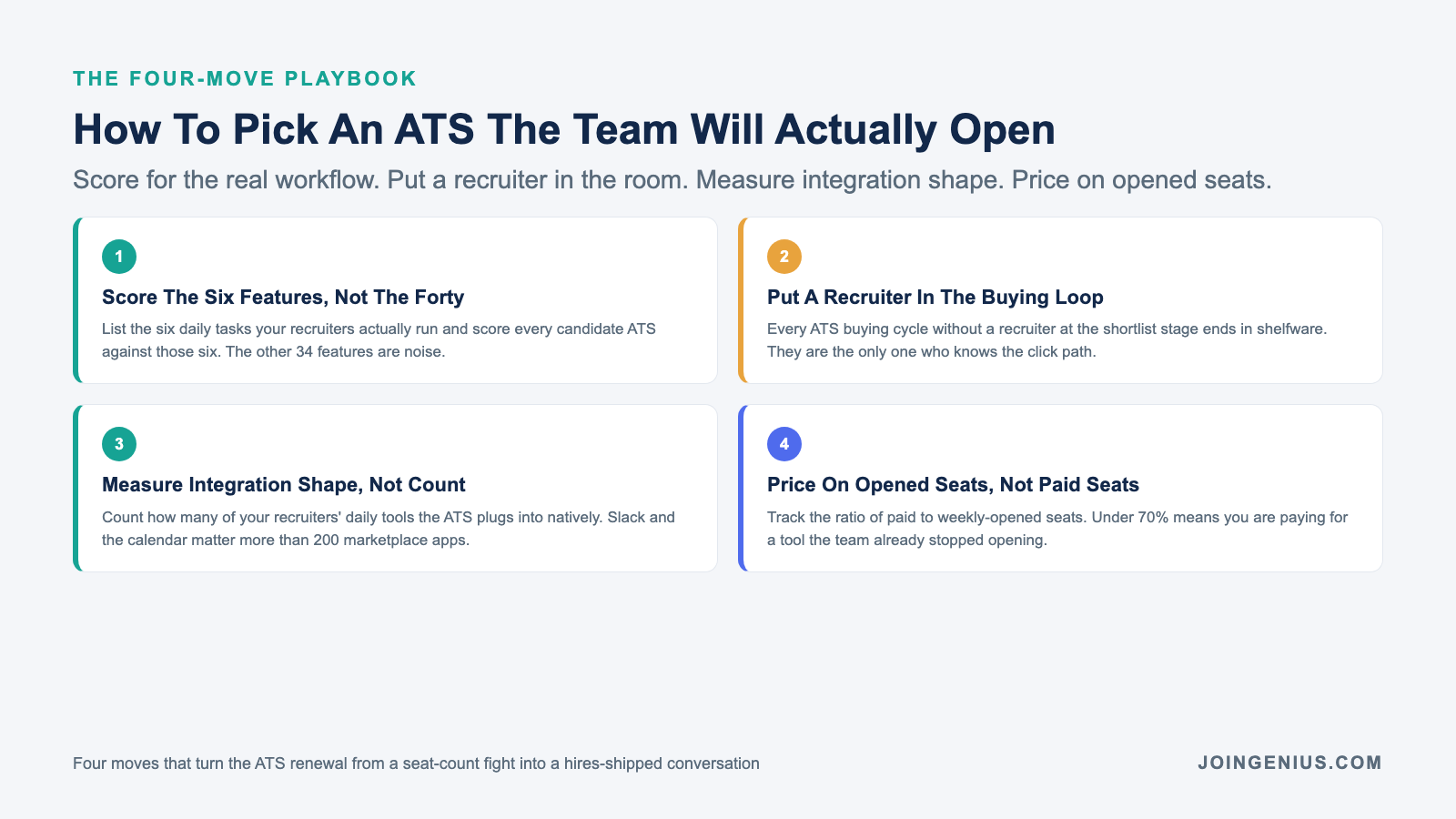
1. Score The Six Features, Not The Forty
Before you open the vendor shortlist, list the six daily tasks your recruiters actually run and score every candidate ATS against those six. The other thirty-four features are noise unless the team is already running them, and even then most of them should not be renewed at full seat price.
2. Put A Recruiter In The Buying Loop Before Procurement
Every ATS buying cycle without a recruiter in the room at the shortlist stage ends in shelfware. The recruiter is the only person who can tell the room what the daily click path actually feels like after the first week, so put them in the room on day one. A structured hiring process is worth zero if the tool it runs on was chosen without the person who lives in it.
3. Measure Integration Shape, Not Integration Count
Count how many of your recruiters’ daily tools the ATS plugs into natively, not how many integrations the vendor claims in the deck. Slack and the calendar the recruiter already uses matter more than a marketplace of two hundred one-off connectors.
4. Price On Opened Seats, Not Paid Seats
Track the ratio of paid seats to seats opened weekly in your current ATS before you renew. If the ratio is under 70%, you are paying for a tool the team already stopped opening, and the renewal is an opportunity to move to a tool shape that fits the real workflow.
The playbook is in the image below.
The One-Page Check Before You Renew
Before you renew the next ATS contract, ask one question. If you moved the recruiting team to a tool scoped against the six features they actually use and priced against the seats that actually open weekly, would the renewal conversation still be about dropping modules?
If the answer is no, the stack was never the problem. The shape was. Fix the shape by moving the team to an ATS scoped against the real workflow, then renew against the work the recruiter actually does. The tool you buy against that question will stay open past day 30 and the data inside it will stay clean past month six, and the hiring managers will stay engaged past the first review cycle. The tool you buy against the feature matrix will be the one you renegotiate at the next renewal.
Conclusion
ATS buying is a workflow problem that most teams misdiagnose as a feature-coverage problem, and the misdiagnosis costs a shelfware renewal and a recruiter team that works around the tool instead of inside it. Score the six features. Put a recruiter in the room. Measure integration shape. Price on opened seats. Then buy the tool you actually need, which is the one the recruiting team opens on day 30, not the one that wins the demo.
We built Genius so operators can staff the recruiting and operations work their ATS surfaces, without expanding the local headcount their budget cannot support. We place the top 1% of recruiting and operations talent from the Philippines and Latin America, at around 80% less than comparable local hires. The relationship stays direct, with no monthly agency fees and a 6-month replacement guarantee on every placement. If the next recruiter you add is the one who finally makes the ATS stay open past day 30, see how we source and place the recruiting talent that compounds.