Service teams lose people for many reasons, and pay is only one of them. Restaurant, retail and hotel staff often learn their hours late, see them change and have little say over when they work. A shift-swap culture, where staff can trade shifts through a clear and fair process, is one way to give some of that control back without leaving the floor short.
This guide explains why swap culture may reduce turnover in service teams. It covers what research says about unstable schedules, why control may matter more than flexibility, how to set swap rules that protect coverage, how fairness fits in and how to measure the effect. It ends with a table of warning signs. We found no study that isolates shift swaps as a cause of lower turnover, so the argument rests on related research on schedule instability and control. It is general information, and results will differ by team and by local scheduling law.
What the Research Says About Unstable Schedules
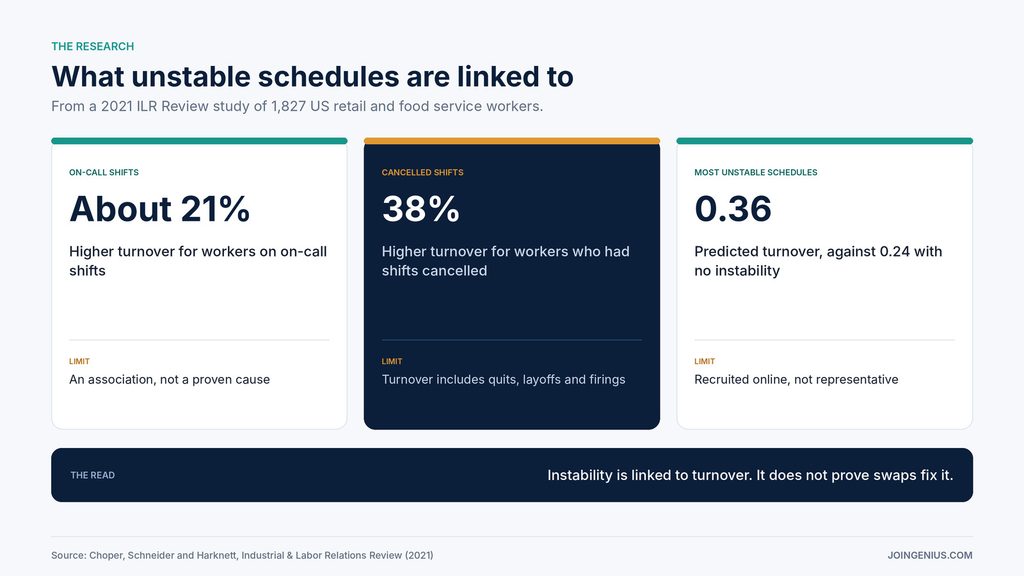
The strongest independent evidence we found is about instability, not swaps. Joshua Choper, Daniel Schneider and Kristen Harknett published a study in the Industrial & Labor Relations Review in December 2021, using the Shift Project panel of 1,827 hourly workers in US retail and food service. Workers on on-call shifts were about 21% more likely to leave their job, and workers who had shifts cancelled had a 38% higher rate. Those facing three to five kinds of schedule instability had a predicted turnover probability of 0.36, against 0.24 for those facing none.
The authors also tested why. About 89% of the gap for the most affected group ran through four factors: job satisfaction, work-family conflict, financial strain and supervisor fairness. Job satisfaction alone accounted for about 45%. The sample was recruited through Facebook ads, so it is not representative, and the mediation analysis is not causal. Turnover also combines quits, layoffs and firings. The result is a strong association, not proof. Staff retention is easier to read once you track it; the guide to employee retention rate explains how.
Why Control May Matter More Than Flexibility
Notice what those four factors have in common. They are about whether work fits a person’s life and whether it feels fair. A swap gives a worker a way to fix a clash, such as a childcare gap or an exam, without quitting or calling out. That is control, and the research suggests control and predictability are what stabilise work.
A randomised trial with the retailer Gap points the same way. Researchers including Joan Williams, Susan Lambert and Saravanan Kesavan ran a study in 28 stores from November 2015 to August 2016. Managers in 19 randomly chosen stores gave workers more stable schedules. Median sales rose 7% and labour productivity rose 5%, according to the University of Chicago summary.
Lambert said stable schedules improved retention among more senior staff, but the article calls this preliminary and gives no figures. The study covered one retailer in two metro areas, the Gap helped fund it and experimental stores could modestly add payroll hours. A 2025 qualitative study in BMC Nursing by Hannah Barker, Peter Griffiths and Chiara Dall’Ora found managers linking accommodation of staff preferences with better attendance and retention, but it reports no turnover rates and does not study swaps.
None of these studies tests swaps directly. The sensible reading is that swaps may help by giving control, and that how you run them matters. The difference between turnover and other exits is worth getting right; see turnover vs attrition.

Swaps as a Release Valve: Giving Staff Control Without Losing Coverage
Turnozo, which sells scheduling software with swap features, makes the practical case. Its founder’s post on how bad scheduling makes good employees quit lists not allowing shift swaps and ignoring availability preferences among the mistakes that push people out. It argues that when the same people always get the worst shifts, they leave, and that the aim is “making sure the burden is shared”. It also says software does not fix anything by itself and that how you use it does. Its FAQ attributes a figure about unstable schedules to the Shift Project without a link, so we rely on the published paper above instead.
These are vendor claims. Turnozo’s pages show no data that swaps cut turnover, and its claim that unpredictable schedules are the number one silent reason people leave has no source. A separate Turnozo post on swap policy says staff with an easy, approved way to trade shifts are less likely to call out, but its 15 to 20% absenteeism figure is also unsourced. Read the argument as plausible and consistent with the independent research, not as proven. Keep an eye on absenteeism rate alongside turnover when you test it.
Rules That Keep Swaps From Causing Chaos
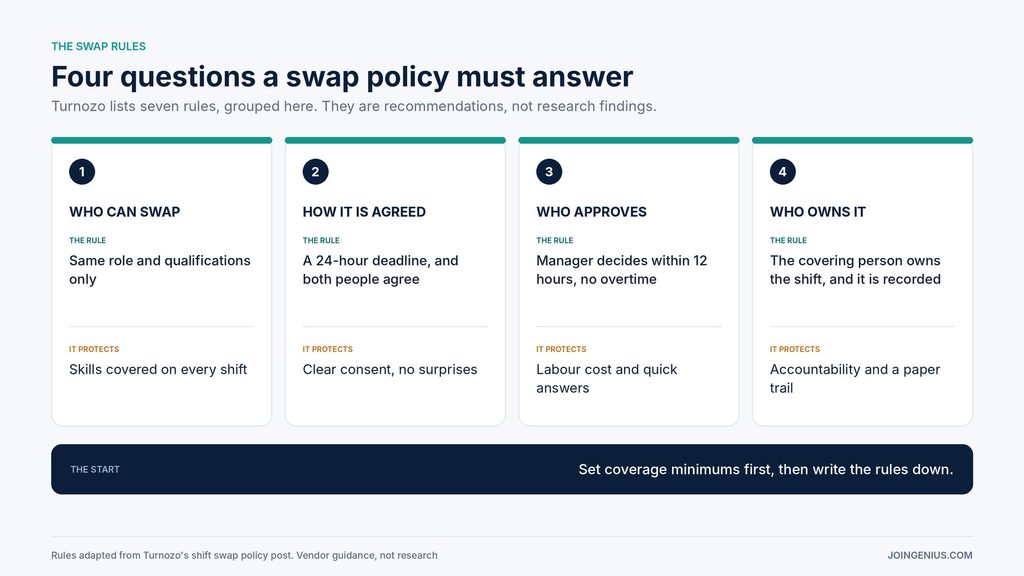
Swaps without rules can create gaps, overtime and arguments. Turnozo’s swap policy post lists seven rules, and they are a reasonable starting point. They are recommendations, not research findings.
Group them by the question each answers. Who can swap: only people with the same role and qualifications. How it is agreed: a request deadline, such as at least 24 hours before the shift, and agreement from both people. Who approves: a manager with a time limit, such as 12 hours before auto-approval, and no swap that creates overtime. Who owns the result: the covering employee owns the shift once approved, and the swap is recorded through the official process.
The same Turnozo guidance warns against informal swaps by text message, where requests get lost, and suggests starting with fixed shifts plus swaps before moving to self-scheduling. Set coverage minimums first so that a swap can never leave a shift short. A smart scheduling system can enforce the rules, but the rules need to be written down first.
Fairness: Who Gets the Worst Shifts
Supervisor fairness is one of the four factors in the ILR study, and it accounted for about 16% of the total effect. A swap system can make fairness visible, or it can hide favouritism. If only a few staff get approvals, or the same people always take the unpopular shifts, swaps may deepen the problem they were meant to solve.
Publish the rules, apply them to everyone and review who is swapping and who is covering. Share undesirable shifts evenly, as Turnozo recommends, and make sure newer staff can use swaps as easily as long-serving ones. Fair treatment also connects to wider engagement; the guide to employee engagement examples has practical ideas.
Measure Whether It Works
Because no study isolates swaps, test the idea in your own team. Choose a period, such as a quarter. Record turnover, callouts and the number of swaps per team before and after you introduce the rules, and note anything else that changed, such as pay or hours. A small team will show noisy results, so avoid reading too much into one month.
Add qualitative checks. Stay interview questions can show whether control over shifts is something staff value, and exit interview questions can show whether scheduling came up when people left. If swaps are used heavily but turnover does not move, look at other drivers, such as notice periods, cancelled shifts and pay.
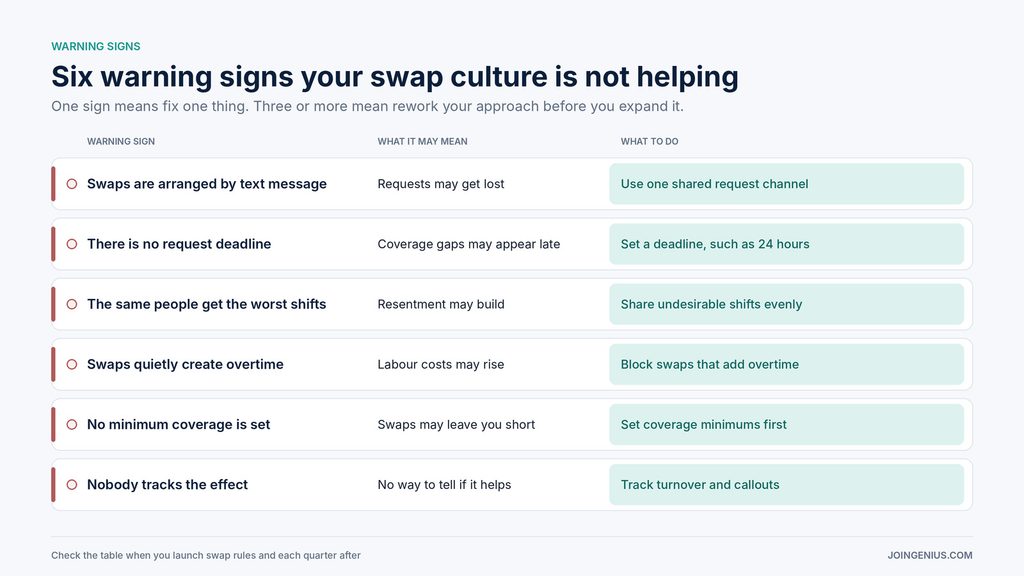
Warning Signs Your Swap Culture Is Not Helping, and What to Do About Each
Check this table when you launch swap rules and again each quarter. One sign means fix one thing. Three or more mean pause and rework your approach before you expand it.
Give Staff Control, Keep Coverage
Shift swaps are not a proven cure for turnover. They are a practical way to give service staff some control over their time, which the research links to the things that keep people in a job. Write clear rules, apply them fairly, protect coverage and measure the result. If turnover and callouts fall, you have your own evidence.