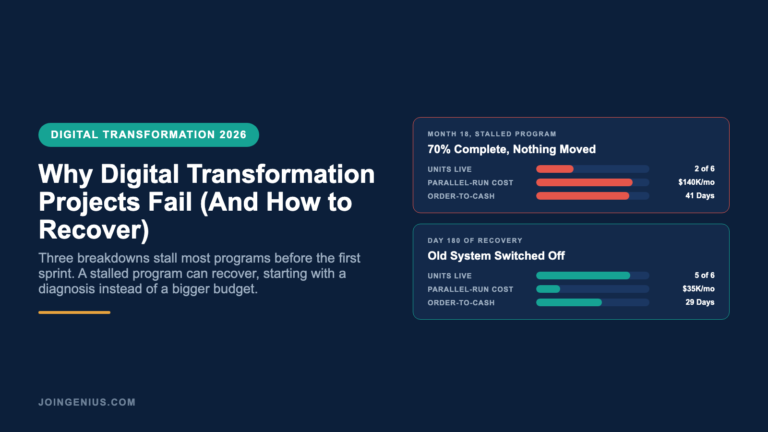
Every operations leader who signed off on a transformation program two years ago knows the meeting that comes around month 18. The new platform is live in two business units. The other four are still running the old system in parallel. The steering committee deck says the program is 70 percent complete. The finance team says the cost savings have not shown up anywhere.
The reason is rarely the technology. Three specific breakdowns show up in nearly every transformation that stalls past its first year, and each one was set in motion before the first sprint started. The good news is that a stalled program is recoverable, as long as the recovery starts with a diagnosis rather than a bigger budget.
This post walks through the three breakdowns, the layer where most stalled programs actually get stuck, and the four-move recovery plan that gets a program back on a measurable track.
The Three Breakdowns Behind A Stalled Digital Transformation
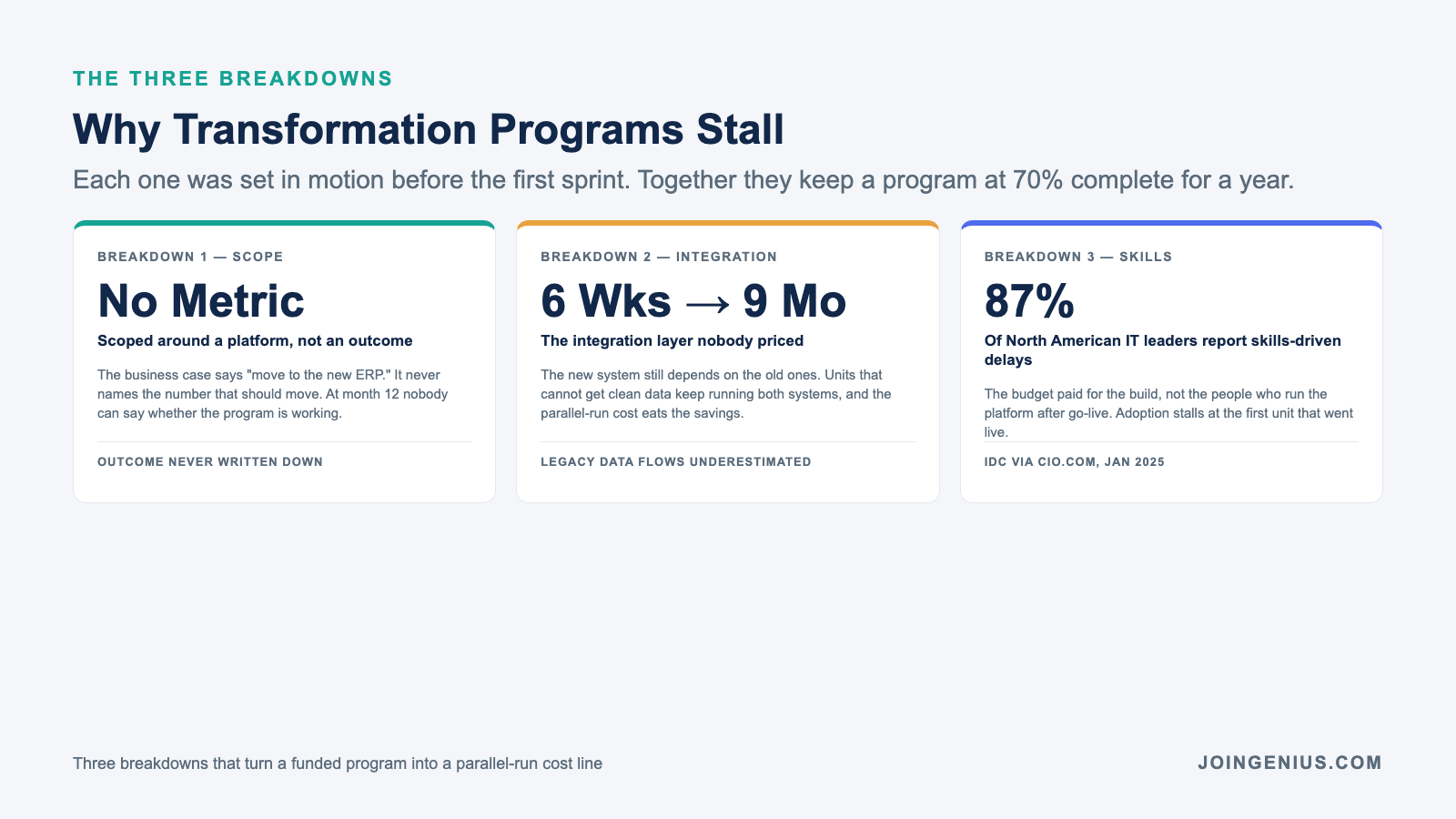
Breakdown one is a program scoped around a platform instead of an outcome. The business case says “move to the new ERP” or “launch the customer portal.” It never names the number that should move, such as order-to-cash days or cost per ticket. When month 12 arrives and the platform is live but the number has not moved, nobody can say whether the program is working, because nobody wrote down what working meant.
Breakdown two is the integration layer that nobody priced. The new system has to read from and write to the old ones. The customer record lives in three places, and the inventory data comes from a warehouse system that predates everyone on the project. Integration work that was estimated at six weeks runs for nine months. Every business unit that cannot get clean data out of the new system keeps running the old one, and the parallel-run cost eats the savings.
Breakdown three is the team that has to run the new system after go-live. The program budget paid for the build. It did not pay for the people who would own the platform once the implementation partner rolled off. The internal team was never hired or trained for the new stack, so adoption stalls at the first unit that went live. The remaining units wait for a support model that never arrives.
The third breakdown is already showing up in the survey data. CIO.com’s January 2025 report on IDC research finds that 87 percent of North American IT leaders say their digital transformation work is delayed by a lack of IT skills. The figure is 60 percent in Asia and 54 percent in Europe. Of the North American delays, 32 percent run five to ten months behind. IDC is an analyst firm that also sells advisory services, and the figures should be read with that in mind.
Why The Steering Committee Deck Says The Program Is On Track
The dashboard that hides the stall is the milestone tracker. A transformation program reports progress as a percent of milestones delivered. Go-live in two units counts as two milestones. The tracker reads 70 percent complete, and the steering committee approves the next phase.
The gap between reported progress and real results is wide. Bain’s April 2024 survey of more than 400 executives found that 88 percent of business transformations fail to achieve their original ambitions. The same research found that programs with a dedicated Chief Transformation Officer captured 24 percent more of their planned value. Bain sells transformation consulting, so the survey should be read with that in mind.
The surface metric that hides this is percent complete. A program that has delivered 14 of 20 milestones reads to the board the same way whether the business outcome has moved or not. The number that matters is the outcome metric the program was funded to change, and in most stalled programs that number is not on the deck at all.
The operations leader who knows this difference asks for two reports before approving the next phase. The first is the outcome metric by business unit, split into units on the new system and units still on the old one. The second is the parallel-run cost, which shows how much the company is paying to keep both systems alive while adoption stalls.
The Recovery Layer Where Stalled Programs Get Back On Track
The quiet place where most stalled programs are stuck is the gap between the platform that was delivered and the legacy systems it still depends on. The new system is live, but it cannot fully replace the old ones until the data flows between them are rebuilt and the remaining units can move over without losing a working day.
Recovering that layer usually takes a partner who has done modernization and integration work across many legacy estates, not just the original implementation. A digital transformation company like OrangeMantra can take on the application modernization and integration work that was underestimated in the first plan. That lets the internal team stay focused on adoption in the units that are already live.
The partner closes the integration gap. The internal team owns the outcome metric. Splitting the work that way is what turns a stalled program back into a measurable one, because the two problems that stalled it are no longer competing for the same people.
Fixing the recovery layer is the highest return move a stalled program can make. It does not require restarting the program or picking a new platform. It requires naming the outcome metric, pricing the integration work honestly, and putting an owner on the platform after go-live.
Day Zero Versus Day 180 On A Recovered Program
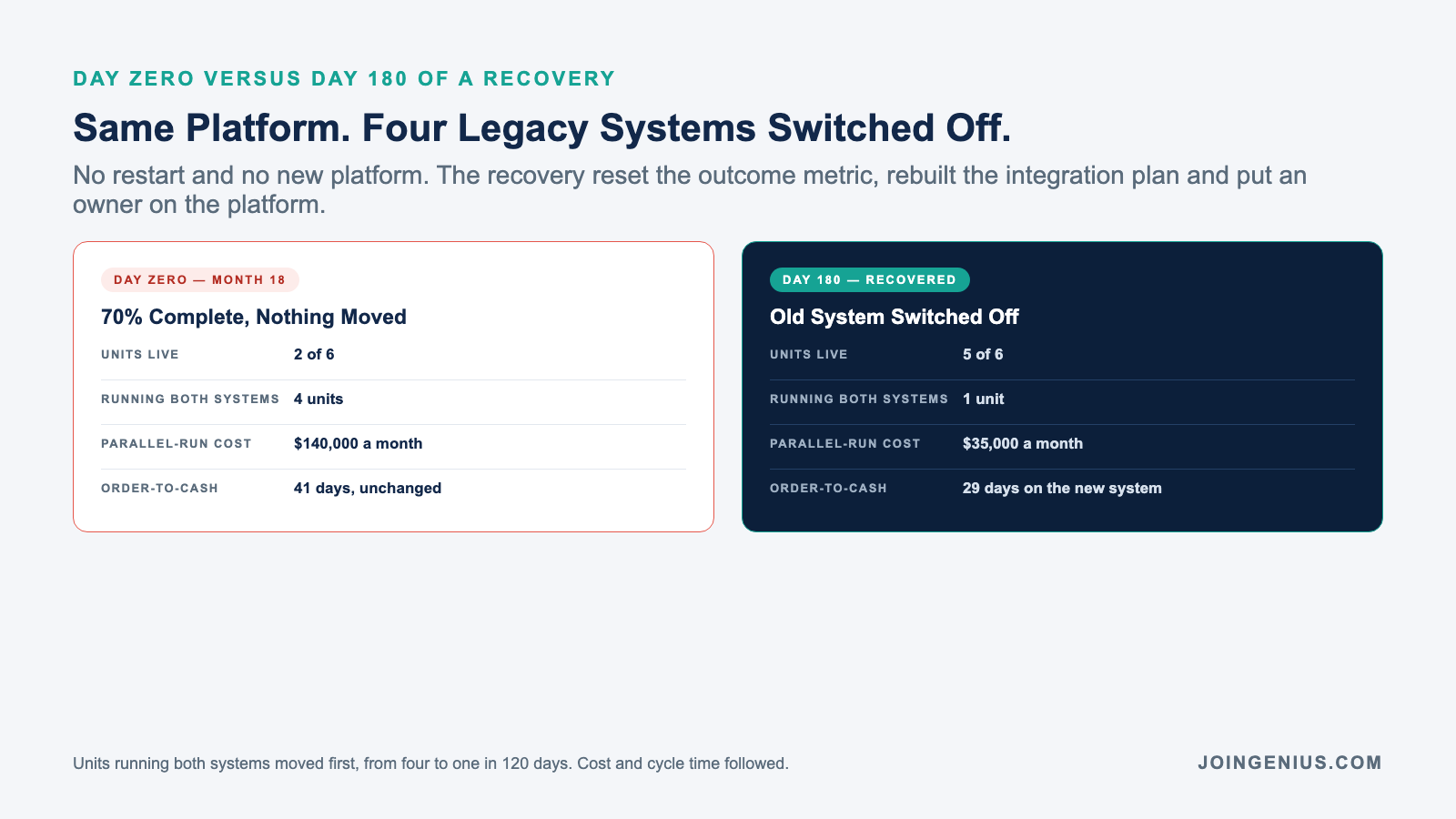
The before picture is the one most stalled programs share. Month 18 of a planned 24-month program. Two of six business units are live on the new platform. The other four run the legacy system in parallel. Parallel-run cost is $140,000 a month. Order-to-cash, the metric the program was meant to improve, has not moved from 41 days. The milestone tracker reads 70 percent complete.
The after picture at day 180 of the recovery looks different on every metric. The integration backlog has been rebuilt with an external modernization partner. Five of six units are live and the legacy system has been switched off for four of them. Parallel-run cost is down to $35,000 a month. Order-to-cash is down to 29 days in the units on the new system.
The number that changed first was the count of business units still running both systems. It dropped from four to one inside the first 120 days, and the cost and cycle-time numbers moved on the lag of that one.
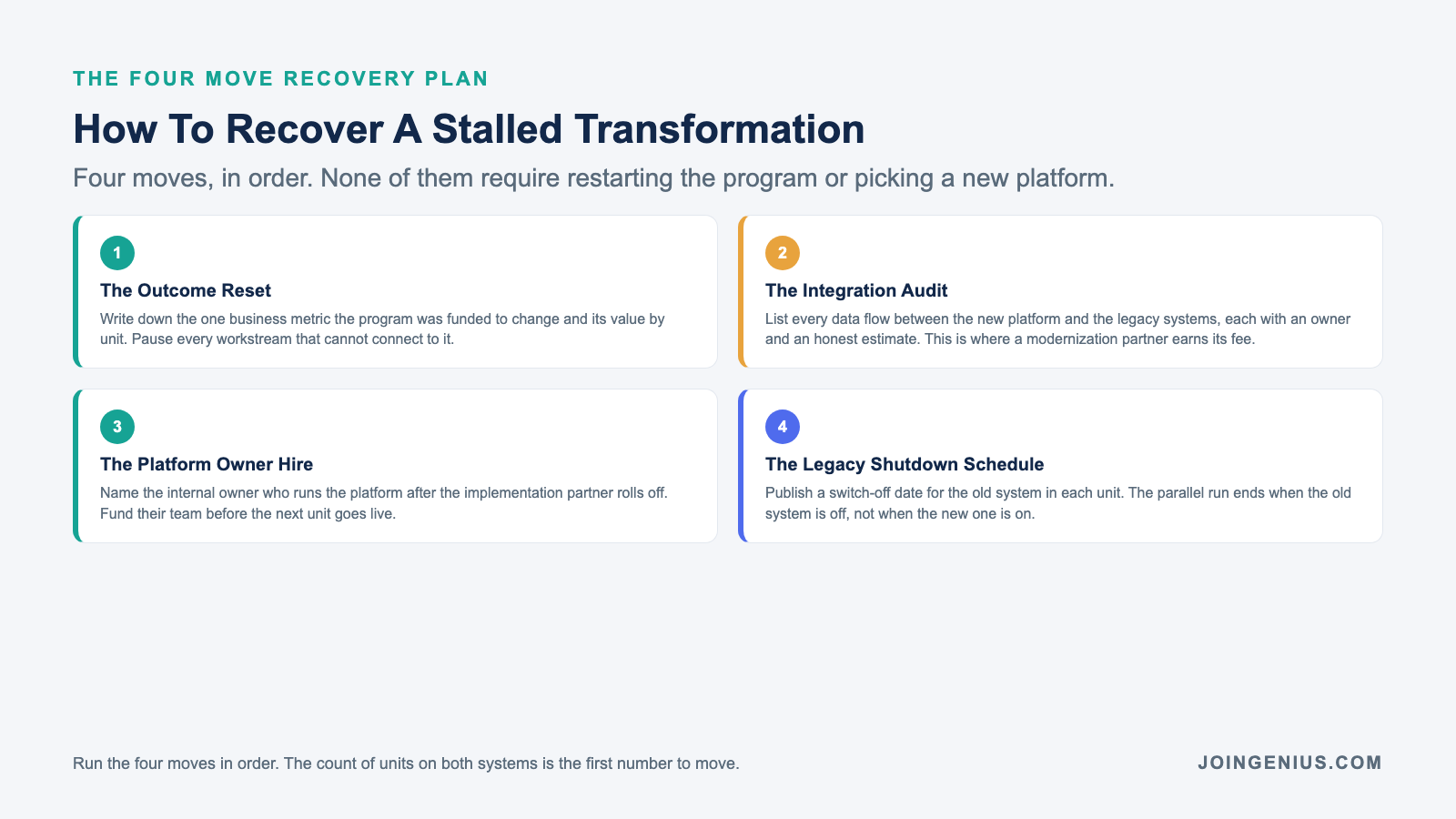
The Four-Move Recovery Plan
Move one is the outcome reset. Before any new work is approved, write down the one business metric the program was funded to change and its current value by unit. Every workstream that cannot connect to that metric is paused. Most stalled programs free up a quarter of their budget in this step alone.
Move two is the integration audit. List every data flow between the new platform and the legacy systems, with an owner and an honest estimate for each one. This is the step where an outside modernization partner earns its fee, because the first estimate was the one that broke the program.
Move three is the platform owner hire. Name the internal person who will own the platform after the implementation partner rolls off, and fund the team they need before the next unit goes live. Adoption follows the support model, not the go-live date.
Move four is the legacy shutdown schedule. Put a date on switching off the old system for each unit and publish it. The parallel run ends when the old system is turned off, not when the new one is turned on.
The Weekly Five Metric Check For A Program In Recovery
The replacement for the milestone tracker is a weekly five metric read owned by the program lead. The point is to show whether the recovery is working before the next steering committee, not after.
Metric one is the outcome metric by business unit. Metric two is the number of units still running both systems. Metric three is parallel-run cost per month.
Metric four is open integration items against their estimates, which shows early whether the integration plan is slipping again. Metric five is active users on the new platform as a share of the users it was built for.
Scan these five every Monday and flag the two biggest moves before the program sync. The conversation changes from “how many milestones did we hit” to “which unit is still on the old system and why.” Build this into your interview rubric for the program lead role.
Hire Program Leads Who Can Run A Recovery
The transformation programs that recover are the ones that stopped reporting milestones and started reporting the outcome they were funded to change. They are the ones that priced the integration work honestly the second time. They are the ones with a program lead who owns the platform after go-live as well as the build.
The hiring window is tight. The US Bureau of Labor Statistics counts 685,800 computer and information systems manager jobs in 2025, with 16 percent growth projected through 2035 and a median wage of $175,140 as of May 2025. That is a seller’s market for the program lead who can run a transformation recovery.
Genius hires top one percent technology, program management and operations talent from the Philippines and LATAM at roughly 80 percent less than local comp. There are no monthly fees and the placement comes with a six month replacement guarantee.
We screen on the four recovery moves described on this page before any candidate reaches a hiring manager, so your sourcing funnel brings you program leads who will name the outcome metric in week one rather than report another milestone in month 18.