
You have a .NET project to build, and every option feels like a tradeoff. Local developers are expensive. Your in-house team is maxed out. And deadlines are already breathing down your neck. This scenario plays out across startups and enterprise teams alike. That is why more and more companies are turning to .NET offshore development services as a strategic advantage.
This quick starter guide gives you a clear, practical roadmap to launch your .NET offshore development journey from setting goals and budgeting to finding the right partner and avoiding common pitfalls.
.NET Offshore Development Services: A Quick Look
| Key Insight | |
|---|---|
| Cost Savings | 40-70% reduction compared to local hiring, with rates from $15-50/hour globally |
| Talent Access | AI coding assistants are increasing productivity by 55%, cloud-native .NET development |
| Technology Trends | AI coding assistants are increasing productivity by 55% |
| Market Growth | 11% annual growth through 2025, with Latin America growing at 12.7% CAGR |
| Risk Mitigation | 65% of companies now use multi-location strategies to reduce dependency |
| Setup Timeline | 2-4 weeks for partner selection, 1-2 weeks team onboarding |
| ROI Impact | 25% faster time-to-market, reduced operational overhead |
Your Next Must-Read Blogs
🌟 How To Work Efficiently With Agile Offshore Software Development
🔥 Offshore Android Development: A Complete Beginner’s Guide
💯 Offshoring Types: Clear Side-By-Side Comparison + Use Cases
What Are .NET Offshore Development Services?

.NET offshore development services refer to hiring external development teams located in other countries to build, maintain, or upgrade applications using Microsoft’s .NET framework. These services include:
- Custom .NET Application Development: Build enterprise-grade applications using the latest .NET 6/7/8 frameworks, leveraging cross-platform capabilities and modern architectural patterns.
- ASP.NET Web Applications: Create scalable web solutions with ASP.NET Core, implementing microservices architectures, and cloud-native designs.
- Mobile Development: Use .NET MAUI (formerly Xamarin) for cross-platform mobile applications that share business logic across iOS and Android.
- Legacy System Migration: Modernize outdated applications to current .NET versions, often involving complex data migrations and architecture updates.
- Cloud Integration: Implement Azure, AWS, or Google Cloud solutions with .NET, including containerization with Docker and Kubernetes orchestration.
- AI/ML Integration: Incorporate machine learning capabilities using ML.NET and Azure Cognitive Services into existing applications.
5 Key Benefits Of .NET Offshore Development Services
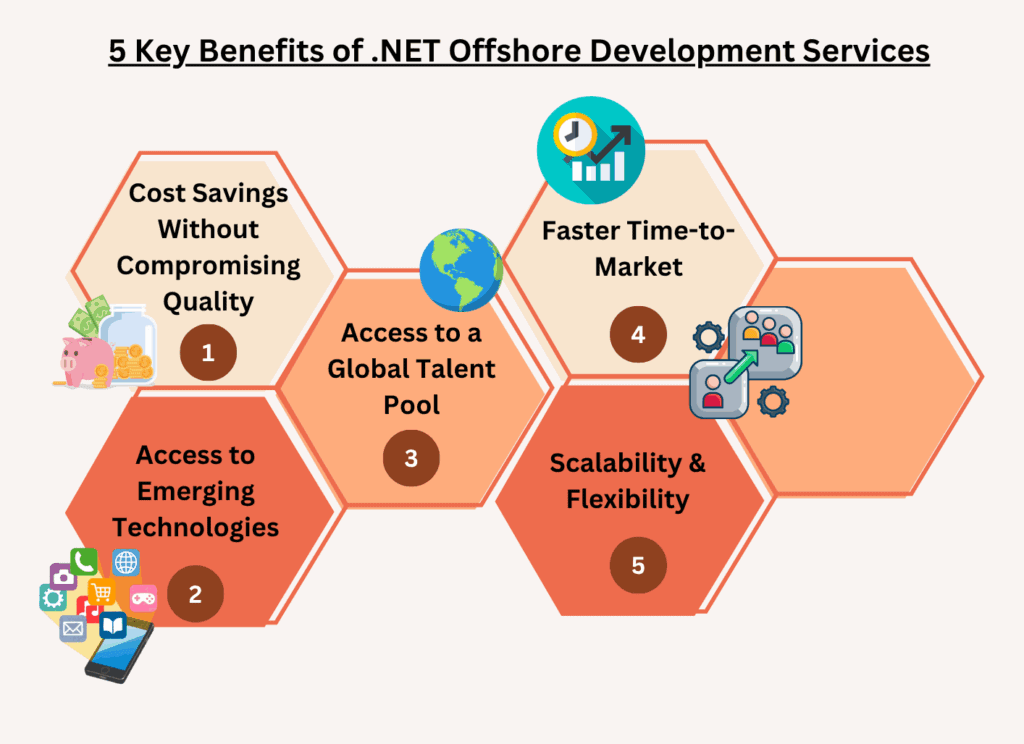
Let’s take a look at the advantages of .NET offshore development services:
1. Cost Savings Without Compromising Quality
Offshore .NET development can reduce labor costs by up to 70%, especially when hiring from regions like India, the Philippines, or Eastern Europe. Offshore developers deliver the same technical quality as onshore teams but at a fraction of the cost. This lets companies allocate more budget to innovation and growth.
2. Access to Emerging Technologies
Offshore teams are quick to adopt the latest tools. Over 50% of offshore developers report using AI-assisted coding tools like GitHub Copilot, according to GitHub’s data. These teams are also leading early adoption of technologies like .NET MAUI, Blazor, and Azure Functions, which gives clients access to modern frameworks without the need for internal upskilling.
3. Access to a Global Talent Pool
With over 28.7 million software developers worldwide, offshoring opens access to a vast pool of .NET specialists. This global reach helps you find developers with niche skills like Blazor, Azure, or microservices architecture, which are usually unavailable or unaffordable locally.
4. Faster Time-to-Market
Offshore development helps you get products out faster by keeping work moving even when your local team is offline. With teams in different time zones, progress continues around the clock. Agile offshore teams can improve performance by 30% to 50%, which means faster launches and quicker responses to customer needs.
5. Scalability & Flexibility
Offshore development lets you scale your .NET team up or down quickly based on project demands. According to a survey, 31% of organizations outsource to gain flexibility and speed up resources during busy periods or cut back during slower phases without committing to long-term hires.
8 Steps To Choose The Right .NET Offshore Partner

Here’s a step-by-step guide to help you find and work with the right .NET offshore partner:
Step 1: Define Your Project Requirements
- List the core features and functionality your application or system must have (e.g., user login, API integration, reporting dashboard).
- Specify your preferred .NET technologies such as ASP.NET Core, Blazor, Azure Functions, or Entity Framework.
- Set your budget range to filter out partners that don’t align with your financial limits.
- Outline your desired timeline, including start date, milestones, and delivery deadlines.
- Identify the roles you need filled (e.g., frontend developer, backend developer, QA tester, project manager).
Step 2: Research Offshore Regions
- Compare average hourly rates in regions like Eastern Europe, South Asia, Latin America, and Southeast Asia.
- Evaluate time zone compatibility to ensure at least 2–4 hours of overlap for real-time communication.
- Check English proficiency levels by reviewing global English fluency rankings or client feedback.
- Assess technical education and talent pool in each region to ensure access to skilled .NET developers.
- Review regional stability and infrastructure, including internet reliability, political environment, and legal frameworks for outsourcing.
Step 3: Shortlist Vendors With Proven .NET Experience
- Look for agencies with case studies showcasing .NET projects similar to your needs (e.g., enterprise apps, cloud solutions, legacy migration).
- Check for Microsoft certifications like Gold Partner status or developer credentials in .NET technologies.
- Read client reviews and ratings on platforms like Clutch, Upwork, or G2 to assess reliability and satisfaction.
- Ask for references or past clients you can contact to verify performance and professionalism.
- Confirm experience with your preferred stack, such as ASP.NET Core, Blazor, Azure, or microservices architecture.
Step 4: Evaluate Communication & Collaboration Tools
- Ask what tools they use for communication (e.g., Slack, Microsoft Teams, Zoom) and project tracking (e.g., Jira, Trello, Asana).
- Ensure real-time collaboration is possible with shared platforms for code (GitHub, GitLab) and documentation (Confluence, Notion).
- Check for time zone overlap to allow daily or weekly stand-ups and status updates.
- Confirm their responsiveness by testing how quickly they reply during initial discussions.
- Request a sample workflow showing how tasks, feedback, and deadlines are handled in their system.
Step 5: Review Portfolios & Assign Technical Tests
- Request recent .NET project samples that highlight relevant experience in your industry or application type.
- Look for complexity and scalability in their past work to see how they handle advanced logic, integrations, or multi-user systems.
- Evaluate code quality and structure to determine if they provide access to repositories or code snippets.
- Assign a short technical test based on your project needs, such as creating a simple API or UI component using .NET.
- Assess problem-solving and communication during the test to gauge how they handle feedback and follow instructions.
Step 6: Check Security Policies & Legal Compliance
- Ask if they follow industry standards like ISO 27001, SOC 2, or OWASP for secure software development.
- Make sure they offer NDAs and IP protection agreements that clearly define ownership of your code and data.
- Verify compliance with data privacy laws such as GDPR, HIPAA, or your local regulations.
- Check how they handle access control for source code, servers, and sensitive documentation.
- Review their policy for breach response and data backups to make sure your information is protected in case of incidents.
Step 7: Interview Key Team Members
- Ask about their experience with .NET technologies like ASP.NET Core, Blazor, Entity Framework, and Azure services.
- Discuss how they’ve handled past challenges in similar projects to assess their problem-solving approach.
- Evaluate communication skills and responsiveness to ensure smooth day-to-day collaboration.
- Confirm their availability and time zone to align with your preferred work hours and meeting schedule.
- Ask how they stay current with .NET updates to ensure your project benefits from the latest best practices and tools.
Step 8: Start With A Pilot Engagement
- Choose a small, self-contained feature or module that reflects the complexity of the full project.
- Set clear success criteria such as code quality, delivery time, and communication responsiveness.
- Limit the timeline to 2–4 weeks to test collaboration without a long-term commitment.
- Monitor their process and adaptability to your feedback, tools, and workflow.
- Evaluate the outcome before scaling up to a full contract or extended engagement.
“Offshore .NET development gives companies the flexibility and speed they need to stay competitive.”
Burkhard Berger, Founder & CEO
How To Get Started With .NET Offshore Development Services

Here’s a step-by-step guide to get started with .NET offshore development services:
1. Align On Goals, Scope, & Deliverables
- Host a kickoff meeting to align on business goals and development priorities.
- Define key deliverables, timelines, and milestones clearly with both teams.
- Break down the project scope into phases or feature sets.
- Clarify the expected outcome for the first 30, 60, and 90 days.
- Agree on success metrics like sprint velocity, bug rates, or deployment frequency.
2. Share All Essential Assets & Access
- Provide access to your Git repositories, cloud environments, and databases.
- Share existing documentation, user stories, and design assets.
- Use a secure password manager or SSO to manage credentials.
- Give read/write access to any test data or sandbox environments.
- Ensure onboarding materials are ready (architecture diagrams, naming conventions, etc.).
3. Set Up Your Collaboration Framework
- Choose your daily communication tools (Slack, Microsoft Teams, Zoom).
- Set up task tracking with Jira, Trello, or Azure DevOps.
- Define your Git workflow (branching model, PR rules, review process).
- Schedule regular meetings: daily standups, weekly reviews, retros, and demos.
- Create shared calendars, documentation spaces (e.g., Notion or Confluence), and dashboards.
4. Assign Internal Points Of Contact
- Designate a technical lead to guide architecture and code-related decisions.
- Assign a product owner to clarify priorities and manage scope.
- Provide a project manager to oversee timelines, dependencies, and blockers.
- Define escalation paths for delays, blockers, or quality issues.
- Share clear contact information and working hours for each internal lead.
5. Start With A Scoped Pilot Or Sprint
- Choose a self-contained feature or module for the pilot phase.
- Define clear goals, deliverables, and time limits (1–2 weeks).
- Monitor collaboration quality, responsiveness, and attention to detail.
- Evaluate code quality, documentation, and testing rigor.
- Use the pilot to surface and fix communication or process gaps early.
6. Review & Optimize Early
- Conduct a full retrospective after the pilot or first sprint.
- Gather feedback from both onshore and offshore team members.
- Review code quality, delivery pace, and alignment with expectations.
- Adjust communication, documentation, or process gaps proactively.
- Decide whether to scale up, iterate further, or fine-tune the current setup.
🤔 Did You Know?
Offshoring to Asia creates 8-12 hour time differences with only 33% overlap in working hours.
5 Common Challenges In .NET Offshore Development (And How to Solve Them)
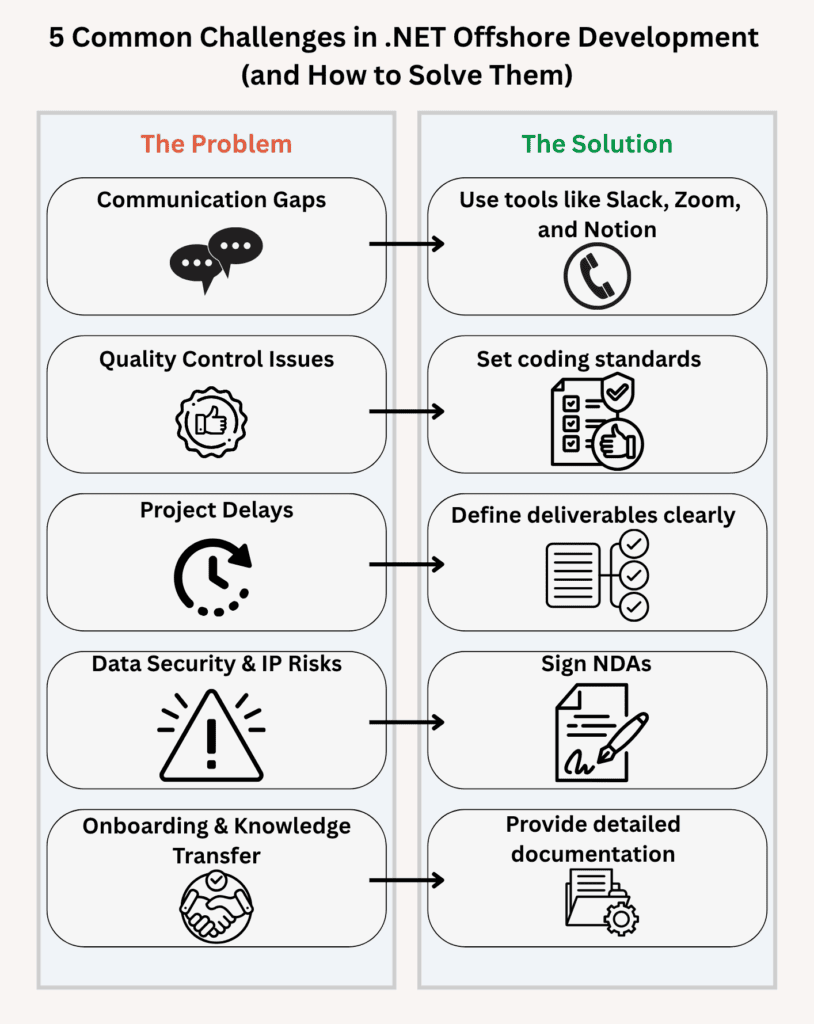
Before you begin, be aware of these potential roadblocks in .NET offshore development and how to manage them:
1. Communication Gaps
Working across different time zones and languages can cause missed updates and confusion if communication isn’t structured well.
Solution: Use tools like Slack, Zoom, and Notion. Set overlapping hours and define communication protocols upfront.
2. Quality Control Issues
When working with new or remote teams, maintaining consistent code quality can be challenging without clear standards, reviews, and testing in place.
Solution: Set coding standards, implement peer code reviews, and use automated testing with CI/CD pipelines.
3. Project Delays
Delays can happen when offshore teams aren’t fully aligned on goals, timelines, or priorities because of unclear requirements or shifting expectations.
Solution: Define deliverables clearly, use agile sprints, and track progress through project management tools like Jira or Trello.
4. Data Security & IP Risks
Without strong security measures and clear legal agreements, your sensitive data and intellectual property could be exposed or misused during offshore development.
Solution: Sign NDAs, use secure development environments, and ensure the vendor complies with standards like ISO 27001 or GDPR.
5. Onboarding & Knowledge Transfer
Offshore developers may face challenges getting up to speed if they lack context about your business goals, systems, or existing codebase, which can slow down initial progress.
Solution: Provide detailed documentation, walkthrough videos, and assign a liaison to guide the team through systems and expectations.
“Finding the right offshore .NET talent is about precision—skills, mindset, and culture all need to align.”
Christian Cabaluna, Senior Recruiter
How Much Does .NET Offshore Development Services Cost?
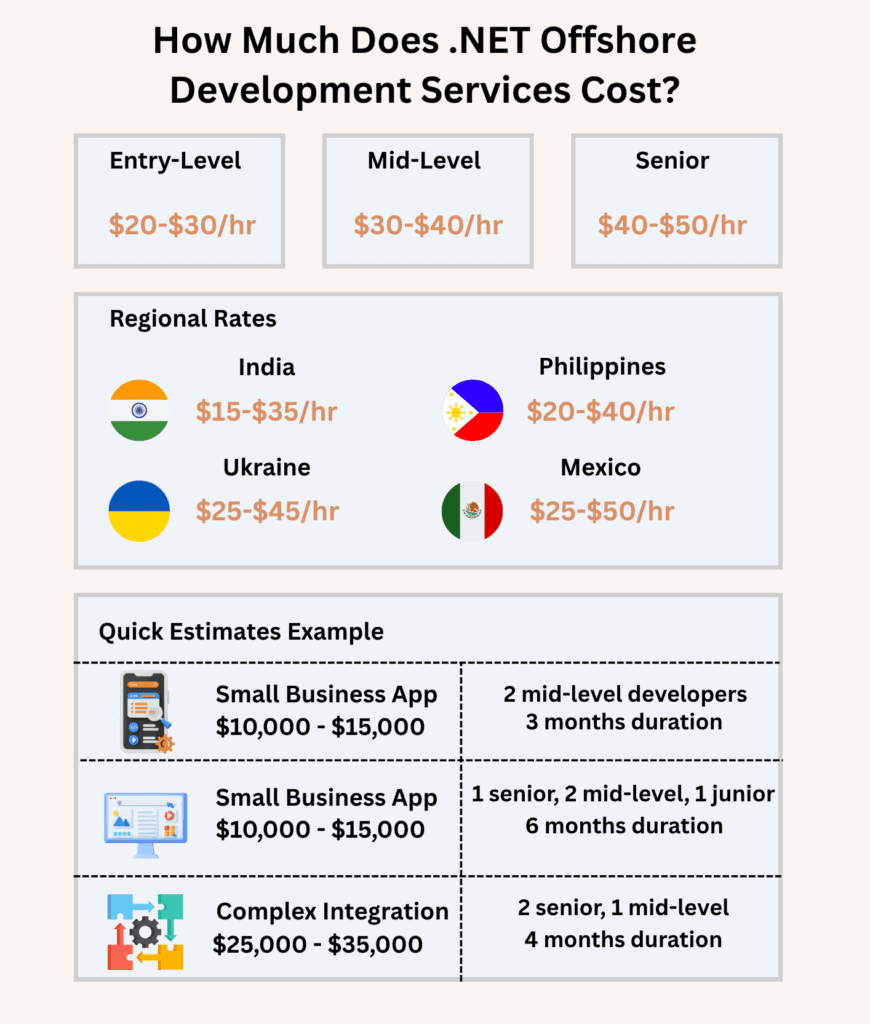
.NET offshore development usually costs between $20 to $50 per hour, depending on the developer’s location, experience level, and project complexity. Here’s a quick breakdown to help you estimate your budget:
- Entry-Level Developers (1–2 years experience): $20–$30/hour for simple tasks, bug fixes, and support work
- Mid-Level Developers (3–5 years experience): $30–$40/hour for most standard .NET projects
- Senior Developers (5+ years experience): $40–$50/hour for complex architecture, cloud integrations, or team leadership
- Monthly Costs (Dedicated Full-Time Developer): $3,500–$8,000/month (based on 160 working hours per month)
- Project-Based Pricing: Starts around $10,000–$25,000 for small-to-medium applications
😱 This Might Surprise You
India leads IT offshoring with 90% of top firms on board.
8 Trends Shaping .NET Offshore Development Services
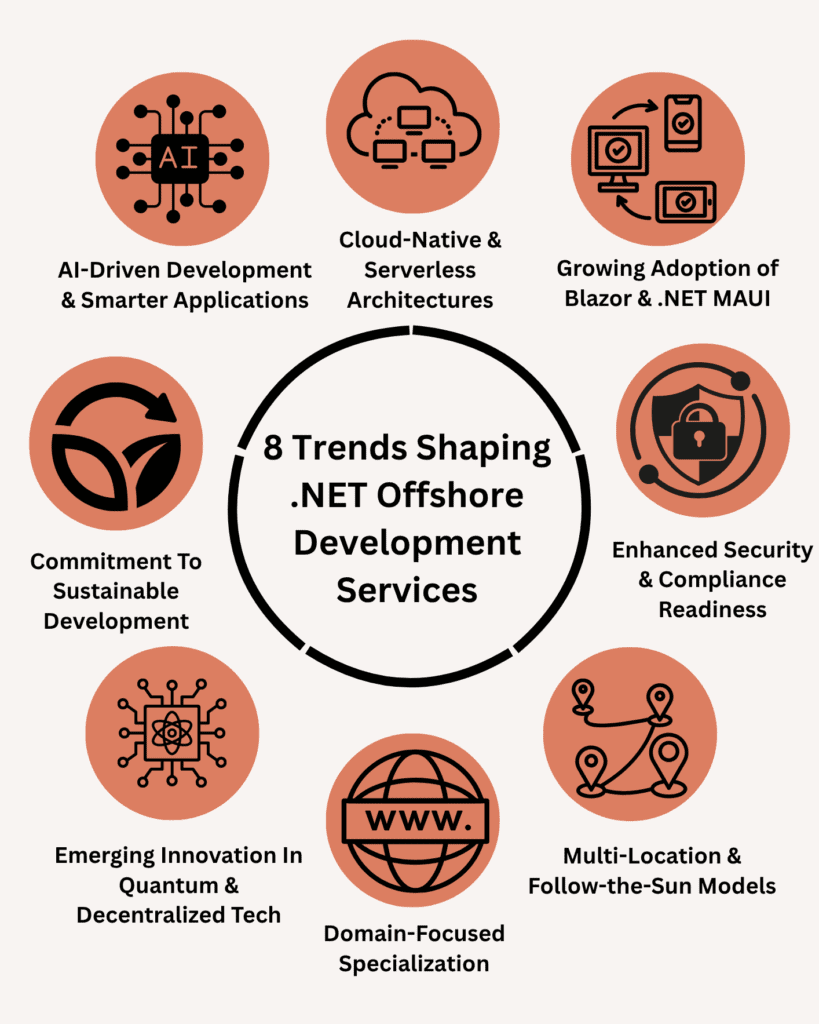
Here are the trends shaping .NET offshore development services and influencing how modern teams build and deliver applications:
1. AI-Driven Development & Smarter Applications
Offshore .NET teams are integrating AI directly into the applications they build. With tools like GitHub Copilot, Azure AI, and machine learning APIs, they’re generating code, automating tests, and delivering smarter, more adaptive solutions.
2. Cloud-Native & Serverless Architectures
Cloud-first development is now the default. Offshore teams are using .NET 6+, Docker, Kubernetes, and Azure Functions to build scalable, microservices-based systems that deploy faster, run efficiently, and scale seamlessly across platforms.
3. Growing Adoption of Blazor & .NET MAUI
Demand for modern front-end experiences and cross-platform apps is pushing offshore teams to master Blazor for web UIs and .NET MAUI for mobile and desktop. Clients now expect native-like performance with the flexibility of shared codebases.
4. Enhanced Security & Compliance Readiness
As data privacy laws tighten (GDPR, HIPAA, etc.), offshore teams are placing more emphasis on secure coding, threat modeling, and compliance documentation. Contract safeguards and security certifications are becoming standard requirements.
5. Multi-Location & Follow-the-Sun Models
To reduce risk and maximize efficiency, companies are distributing offshore .NET work across multiple regions. This global delivery model allows 24/7 progress while protecting against geopolitical, legal, and operational disruptions.
6. Domain-Focused Specialization
Offshore .NET teams are increasingly specializing in areas like fintech compliance, healthcare systems, and logistics software. This industry focus supports faster ramp-up times, fewer revisions, and solutions that align more closely with specific business needs.es, fewer revisions, and more industry-aligned solutions.
7. Emerging Innovation In Quantum & Decentralized Tech
Forward-thinking offshore providers are exploring Microsoft’s Quantum Development Kit and .NET-compatible Web3 libraries. Their focus includes quantum encryption, simulation models, and decentralized applications for finance and supply chain.
8. Commitment To Sustainable Development
Environmental goals are making their way into development workflows. Offshore .NET teams are adopting sustainable coding practices and choosing carbon-neutral cloud providers, which aligns services with clients’ ESG initiatives.
🔎 This Is Interesting
Companies that effectively implement Agile see a 60% increase in revenue.
Conclusion
If you’re planning to invest in .NET offshore development services, approach it with the same care you would when building an in-house team. Be clear about your goals, document your processes, and choose a partner with the right technical skills and communication style. Start small, build trust, and focus on long-term collaboration.
Most offshore hiring is a nightmare. So we built Genius to solve exactly that. We partner with local university networks and place on-ground recruiters where the talent lives. Plus, we have created a 12-step vetting process and built a system that guarantees culture fit, not just technical skills.
If you’re curious what A+ .NET talent at $12K/year really looks like, just tell us what you need. No monthly fees. No risk. And a 6-month guarantee to back it up.
FAQs
What are the main risks of offshore .NET development, and how can I mitigate them?
Key risks include communication gaps, time zone misalignment, and inconsistent quality. You can mitigate these by setting clear expectations, using collaboration tools, scheduling overlapping work hours, and working with vendors that have proven track records.
How do I ensure quality when working with offshore .NET teams?
Ensure quality by establishing coding standards, conducting regular code reviews, using automated testing, and maintaining detailed documentation. Choose teams with strong portfolios and enforce regular sprint reviews to track progress and performance.
How long does it take to set up an offshore .NET development team?
Setting up an offshore .NET team usually takes 1 to 3 weeks for smaller teams and up to 6 weeks for larger ones. The timeline depends on hiring processes, onboarding, and how quickly requirements are finalized.
How do offshore .NET developers handle version control and code collaboration?
Offshore .NET developers use tools like GitHub, GitLab, or Bitbucket for version control, allowing real-time collaboration, code reviews, and branching workflows. These platforms help ensure code quality, transparency, and seamless integration with your in-house development processes.