
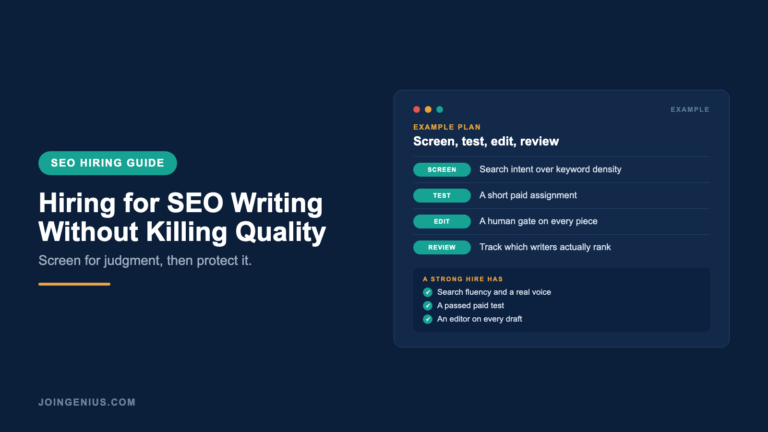
Hiring for SEO writing has a built-in trap. You need enough content to compete in search, so you hire fast and brief loosely. Three months later, the blog reads like it was written by a keyword tool. The volume went up and the quality quietly went down.
Most teams accept this as a tradeoff. It isn’t one. You can scale SEO writing and keep the bar high, but only with a sharper hiring filter and a system that protects quality. Below, we cover why it got harder and what to screen for, then how to grow output without losing the writers you worked hard to keep.
Why Hiring for SEO Writing Got Harder
The role you are hiring for is not the one you hired for two years ago. The title still says writer, but the job behind it has quietly changed.
The Job Is No Longer “Writing,” It’s Content Creation
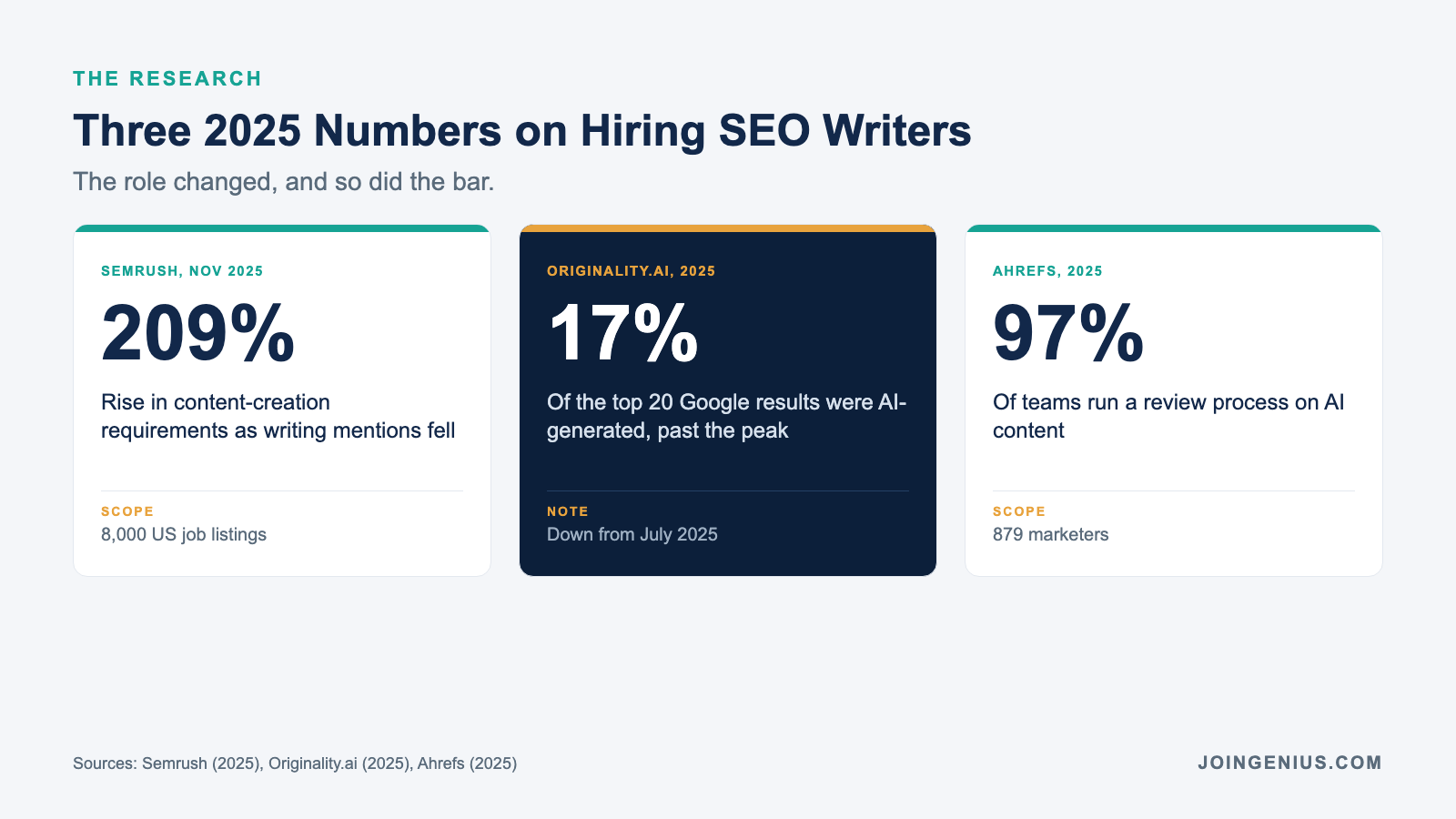
Look at what employers ask for now and the shift is obvious. In Semrush’s November 2025 analysis of 8,000 US job listings, mentions of writing fell 28% since 2023 while content-creation requirements rose 209%.
Companies want someone who can research and structure for search, not just turn a brief into clean prose. That widens the role and thins the pool of people who do all of it well.
The Pool Is Full of AI-Assisted Generalists
Almost everyone applying now writes with AI, which is fine, but it makes the resume a weak signal. A polished sample tells you the tool is good, not that the person is.
AI has reshaped how teams hire across every role, and SEO writing is the sharp end of it. The output all looks competent until you need the judgment the model does not have.
Good SEO Writers Now Need Two Rare Skills
The writers worth hiring pair search fluency with an actual voice. Search fluency without voice gives you technically correct pages no one finishes reading. Voice without search fluency gives you lovely essays that never rank. The overlap is where quality SEO writing lives, and it is genuinely rare, which is what makes the hire hard.
Why Scaling SEO Content Usually Kills Quality
Hiring is only half the risk. The other half is what happens to quality the moment you push for volume.
Volume Targets Reward Output Over Outcomes
The moment a team is measured on posts per month, writers optimize for the number. Briefs get thinner and research gets skipped, just to feed the calendar. Output metrics can flatter a report while the pages they produce bring in nothing. The scoreboard looks healthy right up until you check the traffic.
The “Just Use AI” Shortcut Hits a Ceiling
The tempting fix is to point AI at the calendar and publish. It scales output instantly and plateaus just as fast. By September 2025, AI-generated pages were about 17% of the top 20 Google results, down from a July peak.
Flooding search with unedited AI is not the edge it looked like. Volume without a quality gate just adds pages that never rank.
Thin Content Drags Down the Whole Domain
Low-quality pages are not harmless filler. Google judges sites in aggregate, so a pile of thin SEO content can weigh on the pages that actually deserve to rank. One careless quarter of volume hiring can cost you rankings you already earned. Quality is not a nice-to-have here; it is the thing that makes the whole program work.
The cleanup afterward almost always costs more than the extra volume ever earned.
What to Screen for in an SEO Writer
If the role changed, the screen has to change with it. A writing sample on its own no longer tells you much.
Search Intent, Not Just Keyword Coverage
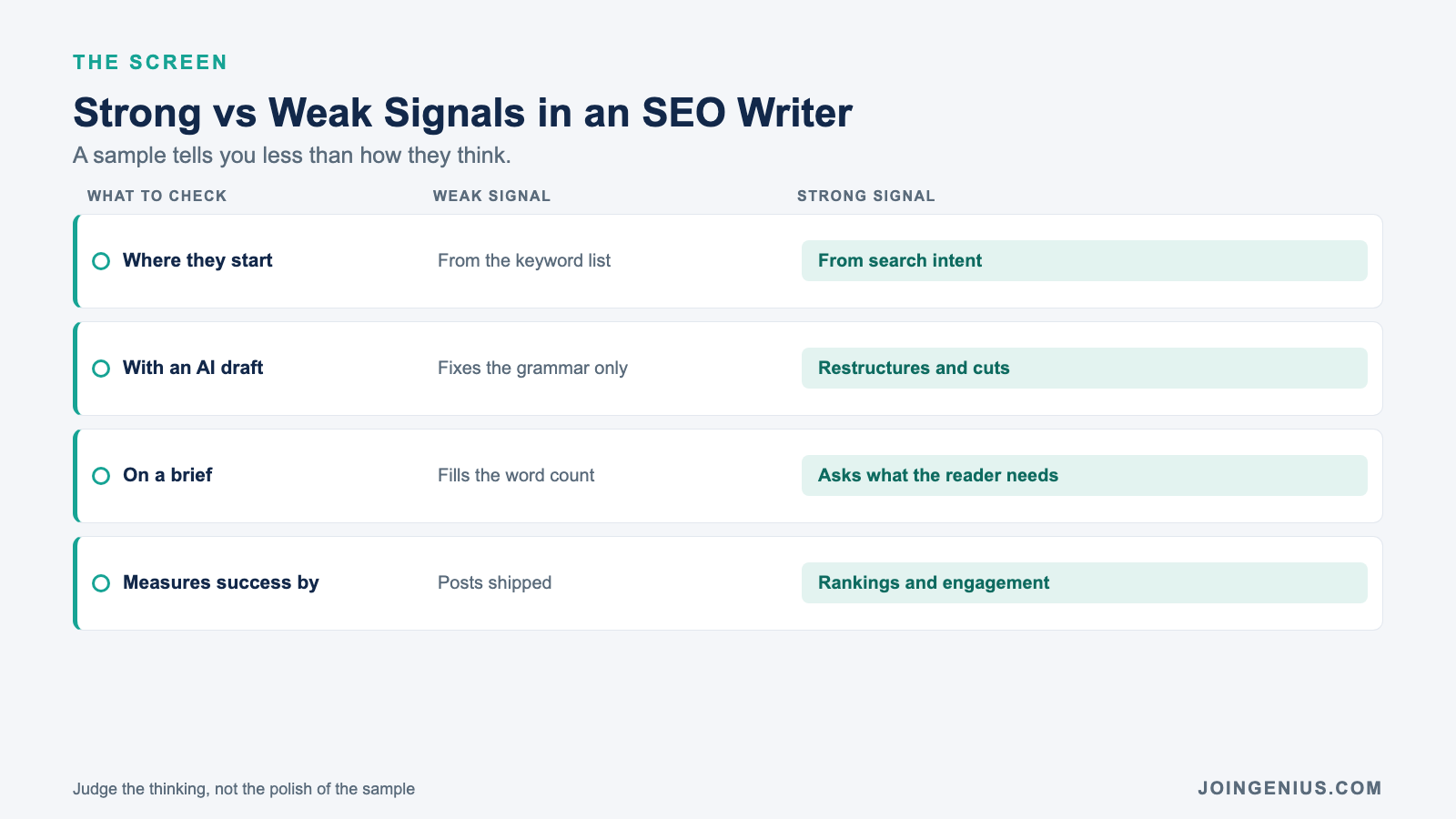
The best screen is whether a writer starts from the searcher, not the keyword. Give them a target query and ask what the person wants and what the page has to deliver to be useful. Writers who lead with intent produce content that ranks and converts. Writers who lead with keyword density produce pages that check boxes and bounce.
Can They Edit AI, Not Just Generate It
The modern SEO writer’s core skill is editing, not typing. Hand them a mediocre AI draft and watch what they do. The strong ones restructure the argument and cut the filler. The weak ones fix the grammar and call it done, because they cannot tell competent-looking from actually good.
That one test, handing over a weak draft, sorts most candidates in minutes.
Use a Paid Test That Mirrors the Real Work
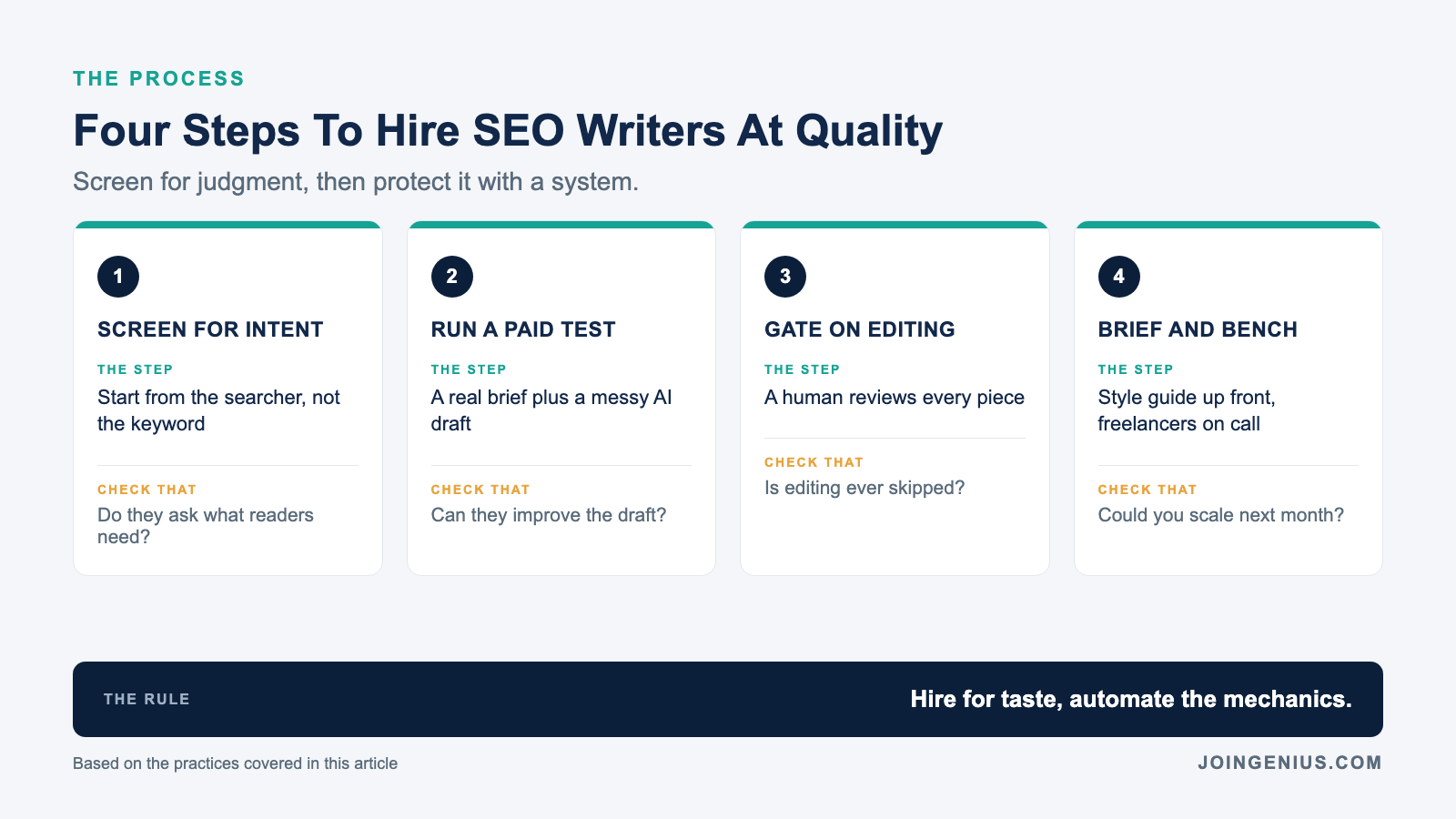
Resumes and portfolios are easy to dress up with good tools. A short paid assignment on a real topic is the only screen that reliably predicts the job.
- Give a real target keyword and a brief, then score the search intent.
- Include a messy AI draft and ask them to improve it visibly.
- Pay for the test so strong candidates actually take it seriously.
- Judge the edit and the thinking, not the word count delivered.
Build the System That Protects Quality at Scale
A good hire is necessary and not sufficient. Quality holds at scale only when the process assumes people will be busy.
Make Editing the Non-Negotiable Step
Every serious content operation gates publishing behind a human review, and the data backs it. In Ahrefs’ 2025 survey of 879 marketers, 97% had some review process for AI content and only 4% published mostly unedited AI. Treat editing as the step that cannot be skipped, even when the calendar is loud.
Separate the SEO Mechanics From the Writing
Much of what makes SEO writing slow is mechanical, like keyword research and matching structure to a search result. Making your best writers do that by hand wastes the judgment you hired them for.
Some teams let an AI SEO platform handle the keyword research and a first draft with a built-in optimization score, then put a human editor on top of every piece.
The writers you hire spend their time on intent and voice, not on fitting headers to a keyword list. It is also worth weighing whether to outsource part of your content operations outright.
A simple rule for the split looks like this:
| Task | Let the system do it | Keep a human on it |
|---|---|---|
| Keyword research | Yes | Spot-check |
| First draft | Optional | Always edit |
| Search intent and angle | No | Yes |
| Final quality call | No | Yes |
The machine handles the mechanical floor, and the writer owns the ceiling.
Briefs and Style Guides Set the Floor
The fastest way to protect quality is to decide it before anyone writes. A real brief gives the intent and the angle, and a style guide fixes the voice, so even a rushed writer clears a known bar. Without them, every piece is a coin flip on whoever wrote it that day.
A good brief is the cheapest quality control a content team can buy.
How to Run the Hiring Process Without Slowing Down
None of this helps if hiring takes a quarter. Speed and quality are not really in tension here, and a sharper process gives you both.
Hire for the Skill You Cannot Train
You can teach someone your CMS and your style guide in a week. You cannot teach taste or judgment in a quarter. Screen hard for the things that take years to build, and treat the trainable parts as onboarding rather than hiring criteria.
Replace the Resume Round With a Paid Test
Skip the long resume screen and go straight to a small paid assignment. It filters faster than any interview, because it shows the work instead of describing it. If you would rather not run the search yourself, a marketing recruitment agency can shortlist for you, but the paid test still decides it.
Build a Bench Before You Need It
The worst time to hire is when you are desperate for volume, because that is when standards slip. Keep a small pipeline warm so you always hire from strength.
- Keep two or three tested freelancers on call for overflow months.
- Re-run the paid test yearly so your bar stays put.
- Track which writers’ pieces actually rank, and give them more work.
- Document the brief and style guide so a new writer ramps in days.
Conclusion
Hiring for SEO writing without wrecking quality is not about finding unicorns. It is about screening for judgment, then building a process that assumes busy people and still holds the line. Do that, and volume stops being the enemy of quality. Skip it, and no amount of hiring fixes a system that rewards output over outcomes.
If the bottleneck is finding writers with that judgment at a price that lets you scale, that is worth solving at the source. At Genius, we help companies hire the top 1% of marketing and content talent from the Philippines and Latin America, at around 80% less than comparable local hires.
You keep the relationship direct, with no monthly agency fees and a 6-month replacement guarantee on every placement. If quality SEO writing is the hire you keep getting wrong, see how we source and place content talent.