Hiring for AI-first agencies breaks the playbook every founder learned the last decade. You used to hire designers and developers by the hour and bill their time. Now one strategist with the right tool outproduces three of them, and the old pyramid tilts. Keep hiring the agency way and payroll outruns margin fast.
That doesn’t mean you let AI write the client work. The roles and the screens shift, and so does the pay model. AI has reshaped how teams hire across every function, and agencies are the sharp end of it. Below, we cover what changes about agency hiring and which seats to fill first, then how to screen so quality holds.
What “AI-First Agency” Actually Means for Hiring
“AI-first” is a label every agency claims now. The actual test is whether AI runs the production floor or just gets bolted onto the side.
An AI-First Agency Produces Differently
A traditional agency scales by adding people. Each new client means more billed hours and more junior staff. An AI-first shop puts a model at the center of production and the person on top of it. The headcount per client drops and the margin changes shape.
That is a structural shift, not a short-term cost cut. The agencies that keep hiring the old way show up uncompetitive on bids inside a year.
The Agency Pyramid Flattens
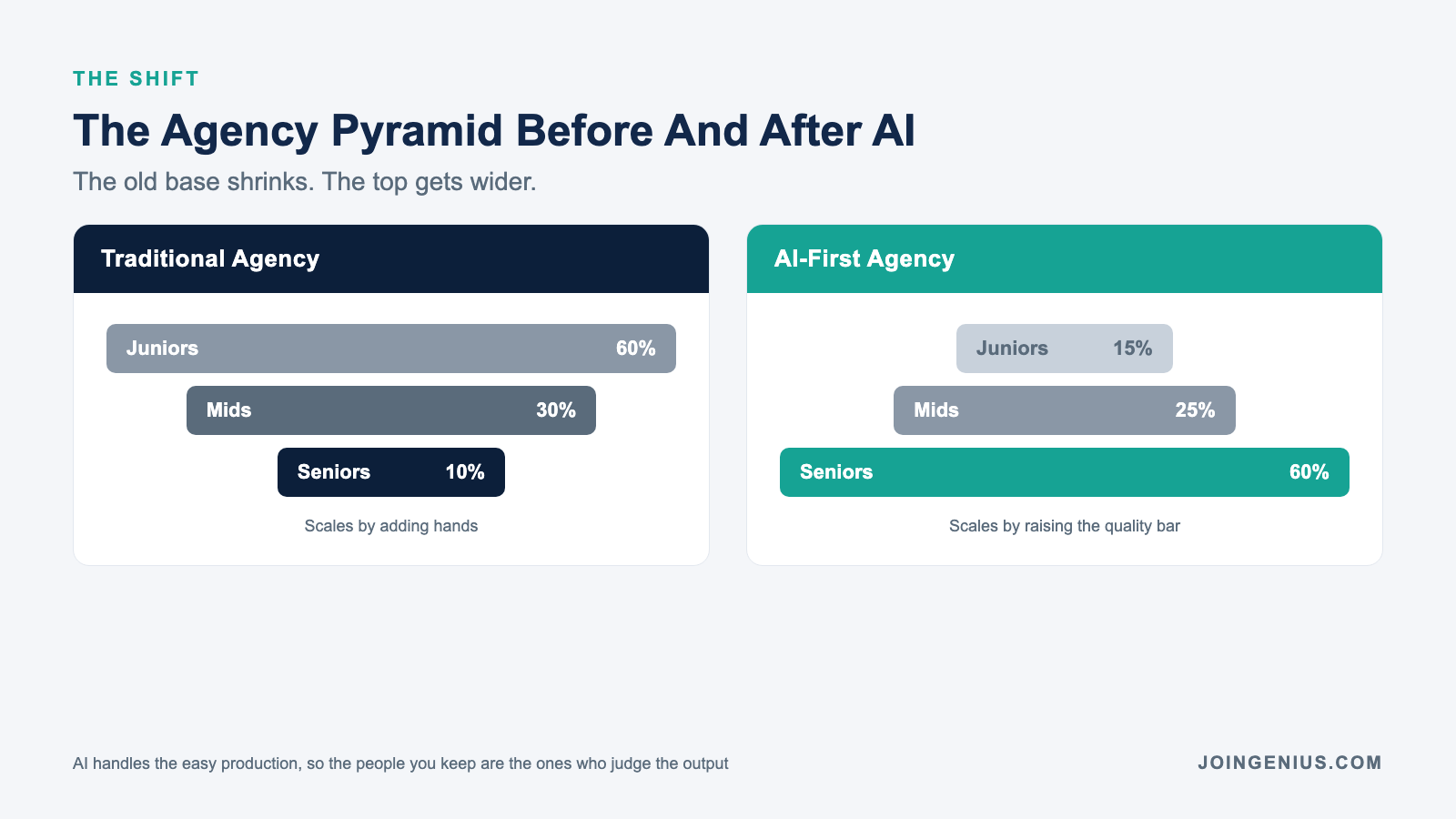
The old agency pyramid is wide at the bottom and narrow at the top. Juniors do production and seniors do strategy. AI compresses the bottom and widens the top. You need fewer production hands and more taste. Any workable talent acquisition strategy for an agency has to start from this picture.
Hiring for AI-First Agencies Rewards Judgment Over Hours
The output clients pay for is no longer a function of hours worked. They pay for the decision about what to make and how to make it stand out. That rewards people who can judge a draft in minutes, not people who can produce one in days.
How AI Tools Collapse the Traditional Agency Hiring Org
Once production shifts to AI, several familiar seats shrink or combine. The hiring plan has to match that shift before payroll outruns revenue.
Fewer Junior Production Roles
The junior designer who assembled mockups and the junior developer who built the stub site both lose most of their work to AI. The pattern repeats across copy and graphics, and across basic site builds. Agencies still need some early-career people, but as reviewers rather than output hands.
Senior Reviewers Replace Mid-Level Doers
Mid-level roles get the squeeze from both ends. AI handles the easy production and senior reviewers handle the quality call. The middle layer that used to translate between the two shrinks. Hiring for AI-first agencies now means picking seniors who can also edit and ship.
One Tool Can Replace an Entire Service Line
Entire service lines fold into a single integrated tool. Agencies on Snapps use a platform that handles the copy and images for a whole client site, with hosting bundled in, so a project that used to need three people and six weeks turns into one person and a few days. Choosing the right sourcing tools matters here, because the roles you still hire for depend on the tools you commit to.
What the Numbers Say About the Shift
In Stack Overflow’s 2025 developer survey, 84% of developers said they use or plan to use AI tools in their work, up from 76% the year before. That shift is already shaping how agencies get work out the door, whether the hiring plan has caught up or not.
The Roles AI-First Agencies Should Hire First
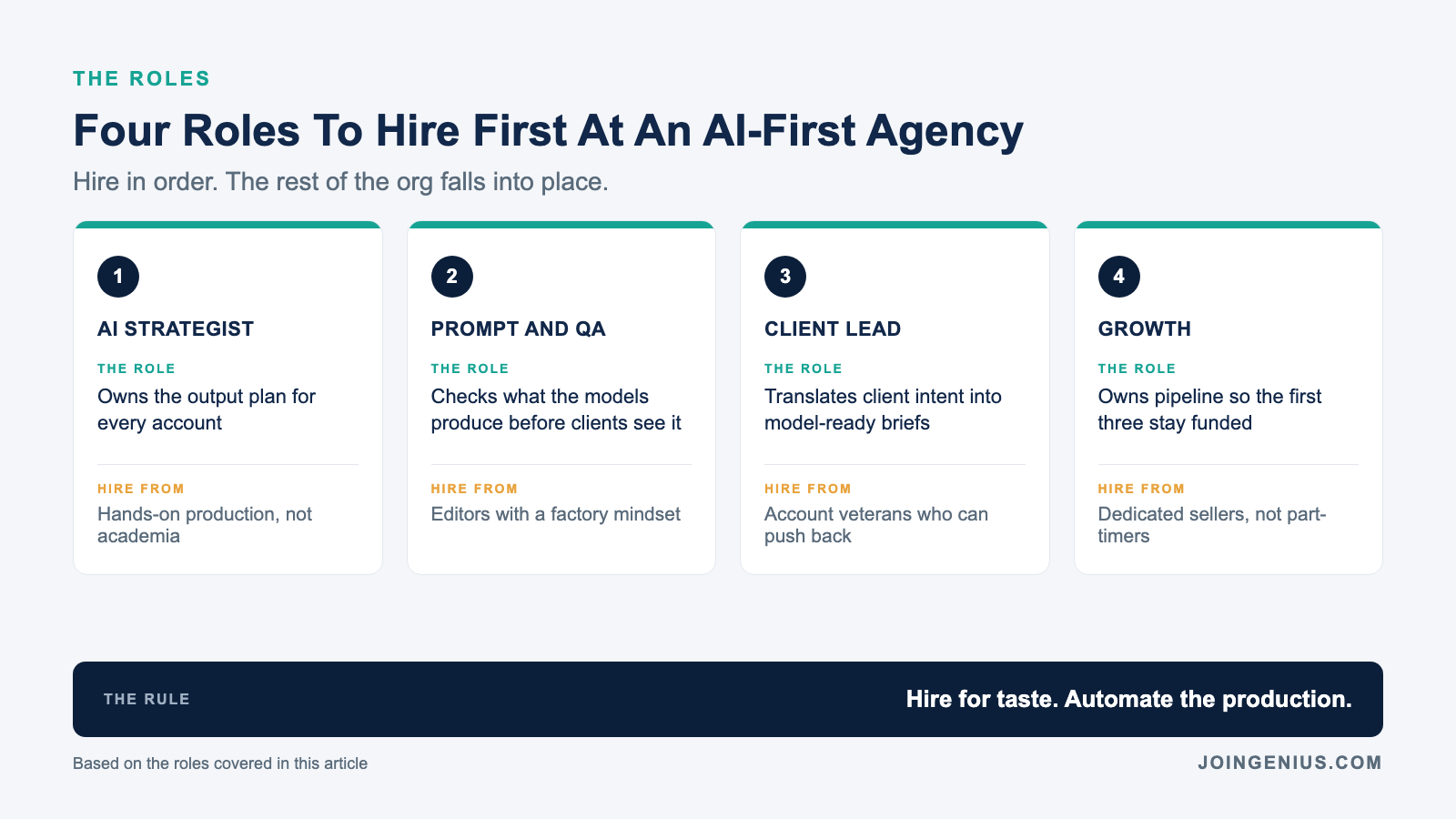
Once production collapses into tools, a short list of roles creates almost all the margin. Hire them in order and the rest of the org falls into place.
The AI Strategist (First Hire)
This person owns the output plan for each account. They decide which tools run which pieces and where a human has to review the result. Without this seat, every project reinvents the process. The best candidates come out of hands-on production, not out of academia.
The Prompt and QA Operator
Every AI-first agency needs someone whose job is checking what the models produce. They write the prompts and review the outputs. They also flag anything that will embarrass the client. Treat it like production QA at a factory — rigorous and non-negotiable. Sourcing founding engineers is a similar profile — generalist and obsessive.
The Client Lead Who Owns the Relationship
AI does not talk to clients. Someone has to translate what the client wants into what the models can produce, and defend the output when the client pushes back. This is the one role that gets more valuable, not less, in an AI-first agency. The bar should be high.
The Growth Hire You Still Need
Agencies die on sales, not on production. One dedicated growth seat beats three part-time contributors trying to help with pipeline. Hire this one as soon as the first three roles are paying for themselves.
Lightcast’s July 2025 analysis found 800% growth in generative AI roles across non-tech industries since 2022, so the AI strategist seat is now a real market and not a nice-to-have title.
How to Screen for AI-Tool Fluency Without Hiring an AI-Slop Factory
Everyone looks fluent in AI tools now. The screen has to tell you who can actually produce something a client will approve.
Resumes Tell You Almost Nothing
A tidy portfolio proves the tool is good, not the person. Writing samples get laundered through four rounds of model edits. The old resume filter sorts for presentation, not judgment. Treat the resume as a sanity check and move to the paid test fast.
Use a Paid Test That Mirrors the Real Work
Give a candidate a real brief and a messy AI first draft. Pay them to improve it visibly inside a few hours. The strong ones restructure the argument and cut the filler. The weak ones fix grammar and call it done. This is the only screen worth running for hiring for startups and small agencies alike.
A Short Signal Table
| What to Check | Weak Signal | Strong Signal |
|---|---|---|
| Starts the task from | The tool they will use | The client problem to solve |
| Treats an AI draft as | A finished piece to polish | A rough start to rebuild |
| Judges own output by | How clean it reads | Whether a client would ship it |
| Admits the limits | Rarely | Early and specifically |
Judge the Edit, Not the Generation
Anyone can generate. The job is editing. Score the paid test on how much better the final version is than the input, not on how many words it has. The gap between the two is the signal you cannot fake.
Why Hourly Billing Breaks the Moment You Hire for AI
The classic agency pricing model is time times rate. AI breaks the math and the hiring plan at the same time.
AI Compresses Hours and Blows Up the Rate Card
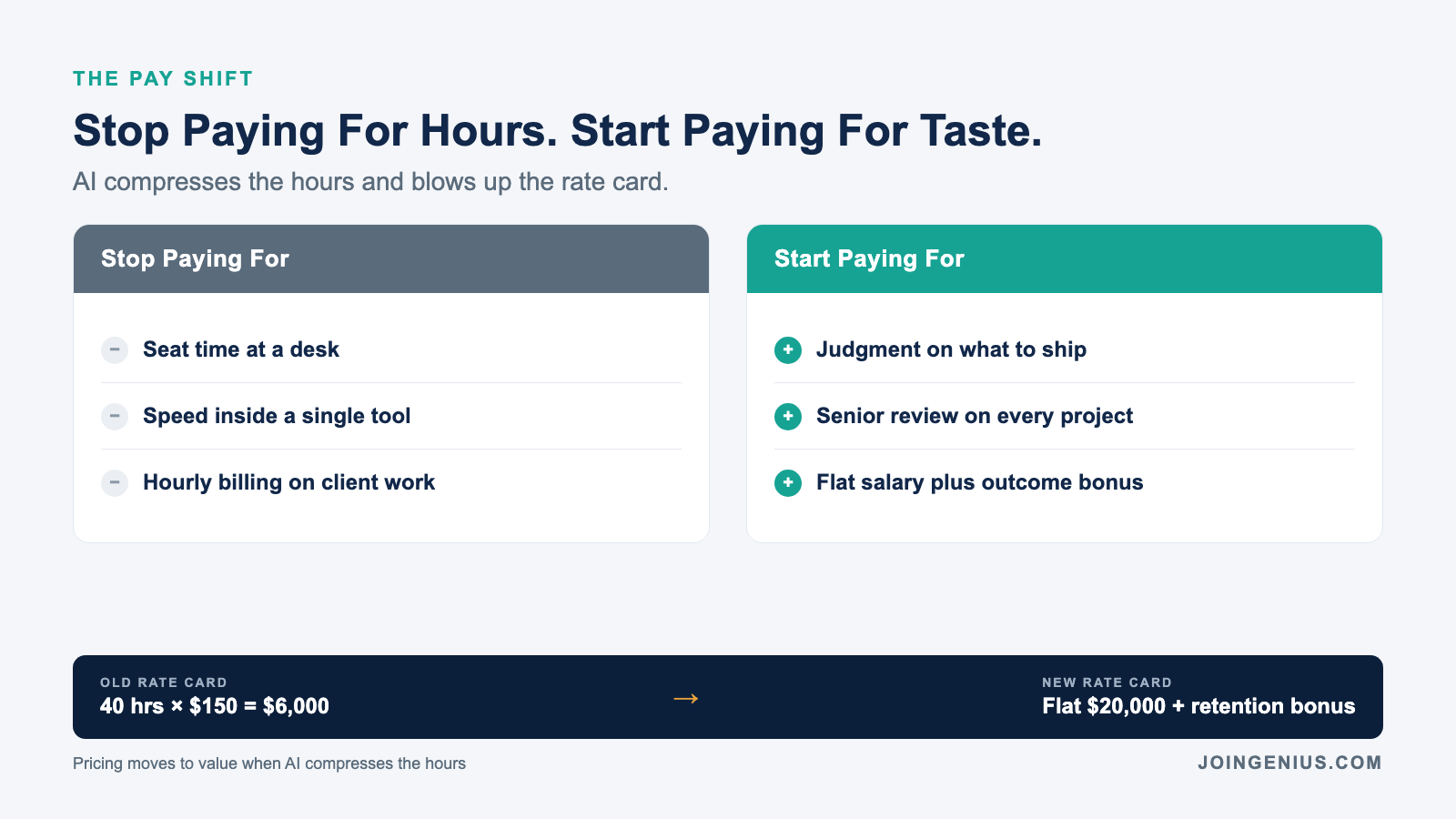
A project that used to take forty hours now takes four. If you still bill by the hour, revenue drops by an order of magnitude on the same deliverable. The pricing model has to move to value and away from time. That changes which hires pay for themselves.
Pay for Taste, Not for Seat Time
The hires that justify their cost are the ones whose decisions make the output better. Paying for seat time rewards people for being slow with the tools. Paying for output and judgment rewards the opposite. Build retention and attraction at an AI-first agency around paying the right people more, not everyone the same.
The Comp Model That Actually Works
Flat retainers on the client side and flat salaries on the hire side, with real bonuses tied to client outcomes and account retention. Hourly billing on the client side encourages padding. Hourly pay on the hire side encourages drag.
Upwork’s 2026 Future Workforce Index reported that freelancers performing AI work earn 34% more per hour than those not using AI, which gives you a market benchmark for what AI-fluent hires already price themselves at.
The Senior Review That Keeps the Bar Up
A thin review layer kills AI-first agencies faster than anything else. If output ships without a senior reading it, clients notice inside two months. Budget the senior reviewer’s time into every project from day one.
Conclusion
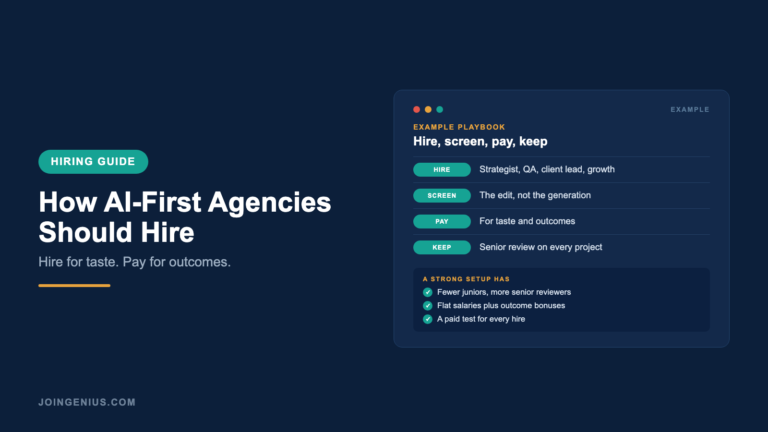
The agencies that keep up are the ones that hire for taste and pay for outcomes, not the ones that chase the cheapest producers. If a candidate’s main asset is speed inside a tool, the tool will replace them inside a year. Hire people who would still be worth paying if the model got twice as good tomorrow, because that is the actual bet an AI-first agency is making.
We built Genius to help agencies make exactly that hire. We place the top 1% of marketing and operations talent from the Philippines and Latin America, at around 80% less than comparable local hires. The relationship stays direct, with no monthly agency fees and a 6-month replacement guarantee on every placement. If the right AI-first team is the hire you keep getting wrong, see how we source and place talent for AI-first agencies.