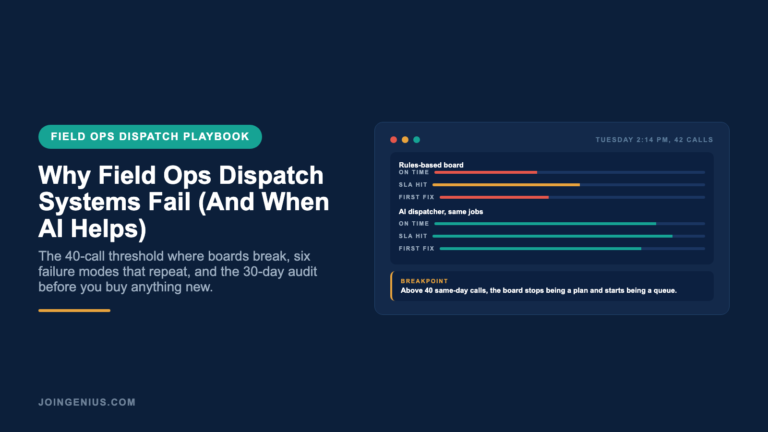
Field ops dispatch systems break in a predictable way. The whiteboard holds up to about forty same-day calls, past that the day stops being planned and starts being queued. Techs drive longer, SLAs slip, the dispatcher stays on chat until six. The vendor pitch is that AI helps, and sometimes it does, in exactly four places.
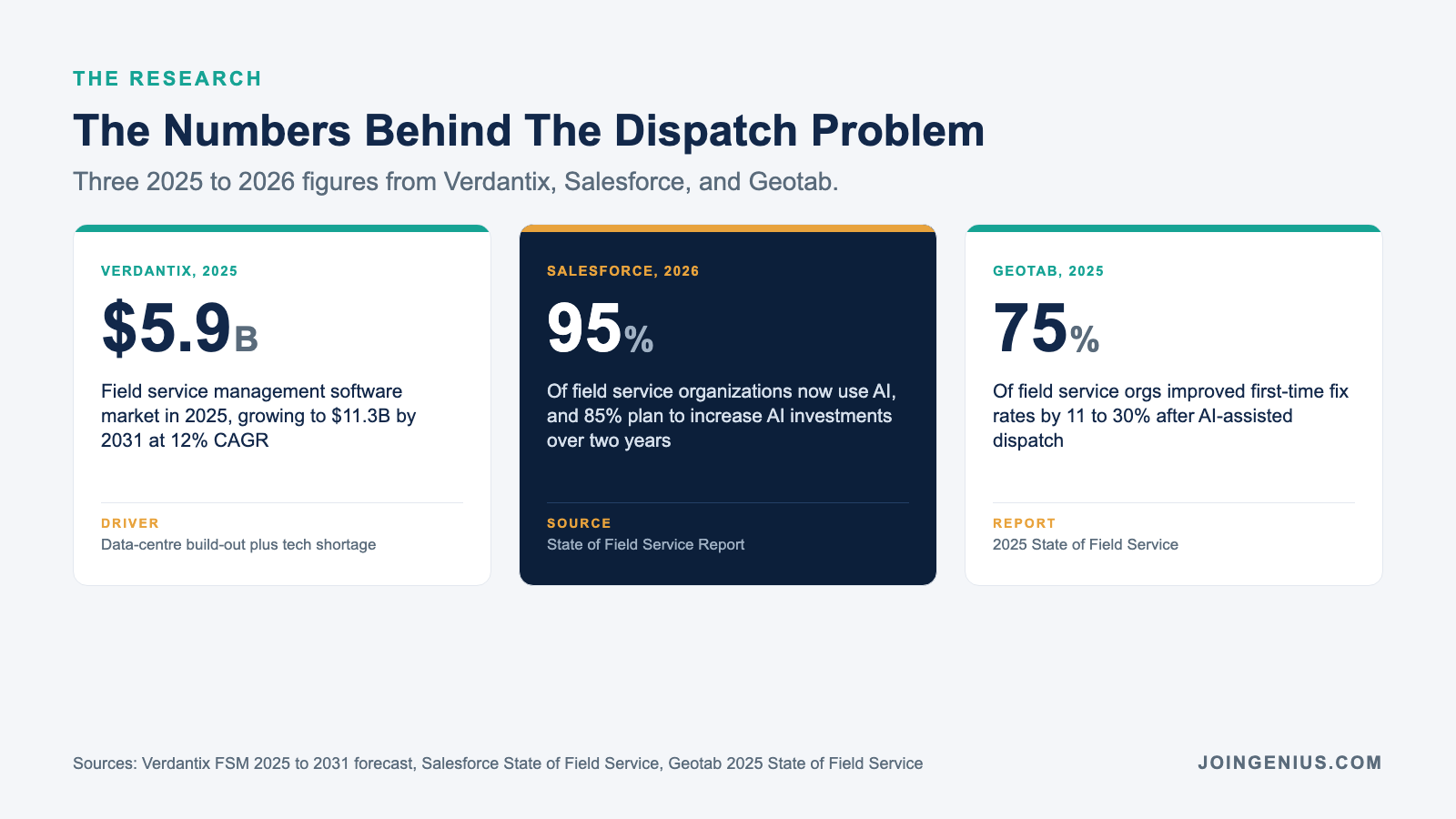
This piece draws the line between the failure modes rules-based boards keep repeating, the narrow jobs an AI dispatcher actually handles better, and the audit any shop should run before buying anything new. The math shifted in 2025, with the FSM software market at $5.9 billion and AI adoption at 95 percent.
The Classic Dispatch Board Breaks Around 40 Same-Day Calls
Every rules-based dispatch board has a soft ceiling. Below it, the dispatcher can hold the whole day in their head, know which tech is close to which job, and what each customer will tolerate.
Above it, memory stops being the system, and the board becomes a queue the dispatcher is paid to triage. Most shops cross that line the first time they add a second service line or a new metro without adding a second dispatcher.
The 40-Call Threshold
The threshold moves with job complexity, but shows up at the same point for most multi-trade shops. Under forty same-day calls, one dispatcher running a structured board covers the day.
At forty to sixty, the day runs on exceptions, with half of assignments getting reshuffled by lunch. Above sixty, the board becomes a lagging record of what happened, not a plan for what should.
Why It Is Dispatcher-Dependent
The rules-based board is only as good as the dispatcher using it. Skill matching lives in their head. Which customers prefer which techs lives in a notebook. Which parts a specific van carries lives in a group chat.
When that dispatcher takes PTO, the backup runs the day worse, and the shop quietly books fewer calls that week. A system that is effectively one person is not a system.
What Breaks First
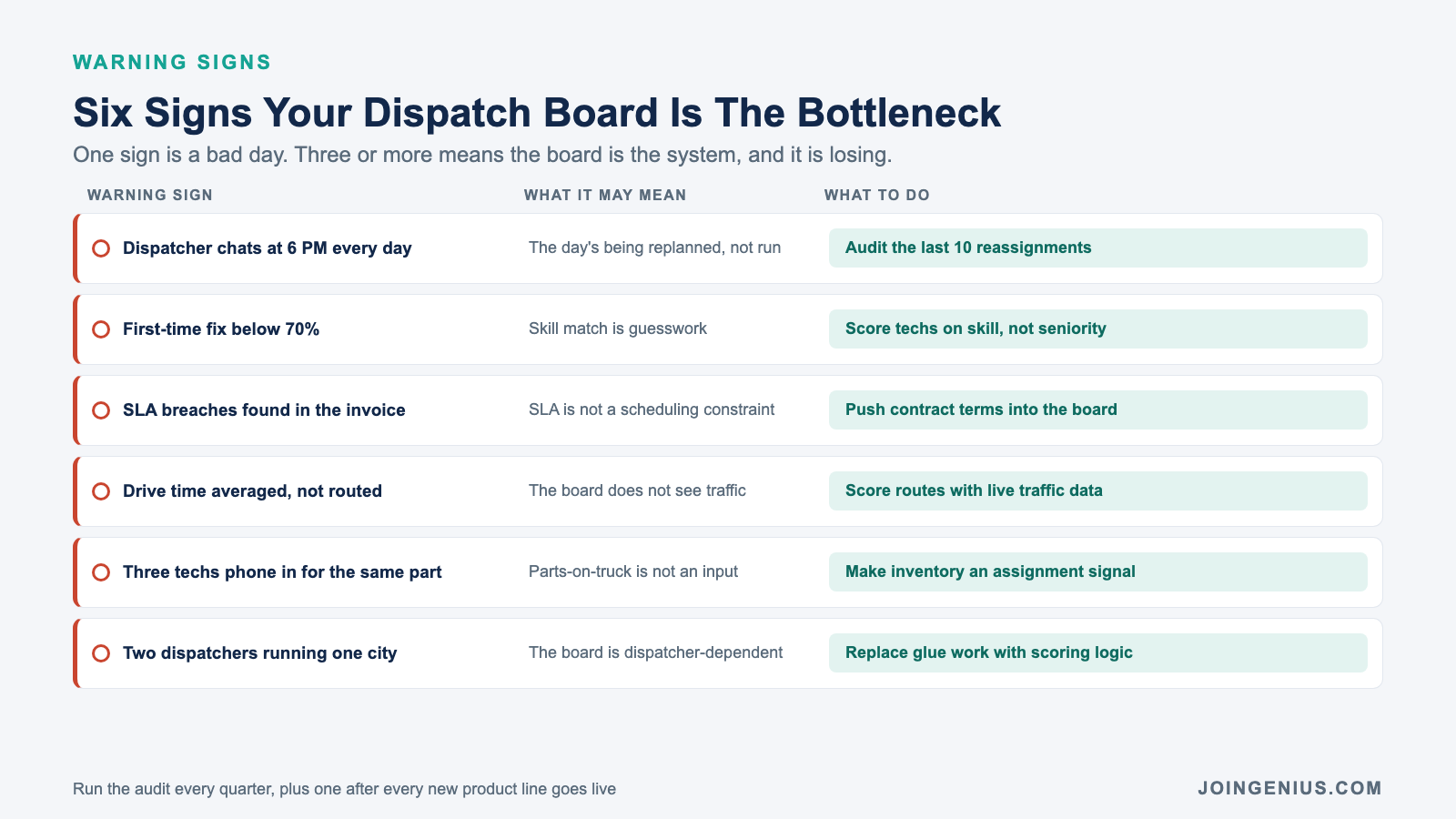
First-time fix rate slips first, because the dispatcher stops double-checking skill match when the queue piles up. Then on-time arrival drops, because drive times are averaged, not routed.
SLA breaches start appearing on invoices, because the contract clock was never a scheduling input. See the broader pattern in why ops staff burn out faster than any other team.
Six Failure Modes That Keep Repeating
The six failure modes below show up in every post-mortem of a dispatch system that could not keep up. None are the dispatcher’s fault. All of them are what a board built on eight columns and a color code cannot track at forty-plus calls a day.
Skill Mismatch That Looks Like Availability
The board shows a tech is free at 2 PM. The board does not show that tech has never worked a variable-speed compressor. The job gets assigned, the tech arrives, diagnoses, calls for the right hands, and a second truck roll goes out. That is two SLA clocks on one ticket.
Drive Time Averaged, Not Actual
Most rules-based boards compute drive time as a flat 25 minutes between calls in a metro. Live traffic and construction closures do not enter the plan.
The dispatcher builds the day assuming averages, and the techs call in late by 3 PM to say the plan is off. The 4 PM commute adds twelve minutes to any east-to-west route, and the board never knew.
SLAs As An Afterthought
Contract SLA terms live in the CRM, not the board. The dispatcher knows a few of the big accounts by heart and schedules around them, but the small-ticket SLAs leak. Every missed SLA is both a service credit and a renewal risk.
A tech can also call from site, double the scope, and the board still shows the next call on time, because the change order never made it back as a reroute.
| Failure Mode | Signal It Produces | What A Board Alone Cannot Fix |
|---|---|---|
| Skill mismatch | Second truck roll on one ticket | Scoring every tech on every job |
| Averaged drive time | Late arrivals after 3 PM | Live traffic as an input |
| SLA as afterthought | Service credits on small accounts | Contract terms as a constraint |
| Change orders off-board | Afternoon behind by two calls | Scope change triggering a reroute |
| Parts not on truck | Three techs calling for the same part | Inventory as an assignment signal |
| Dispatcher-only knowledge | Worse days when the backup runs it | Replacing glue work with logic |
Any one of the six is a bad week. Three or more at the same time means the board is now the bottleneck. The Geotab 2025 State of Field Service Report found 75 percent of field service orgs improved first-time fix rates by 11 to 30 percent after moving to AI-assisted dispatch.
Where AI Actually Helps Dispatch (Not Everywhere)
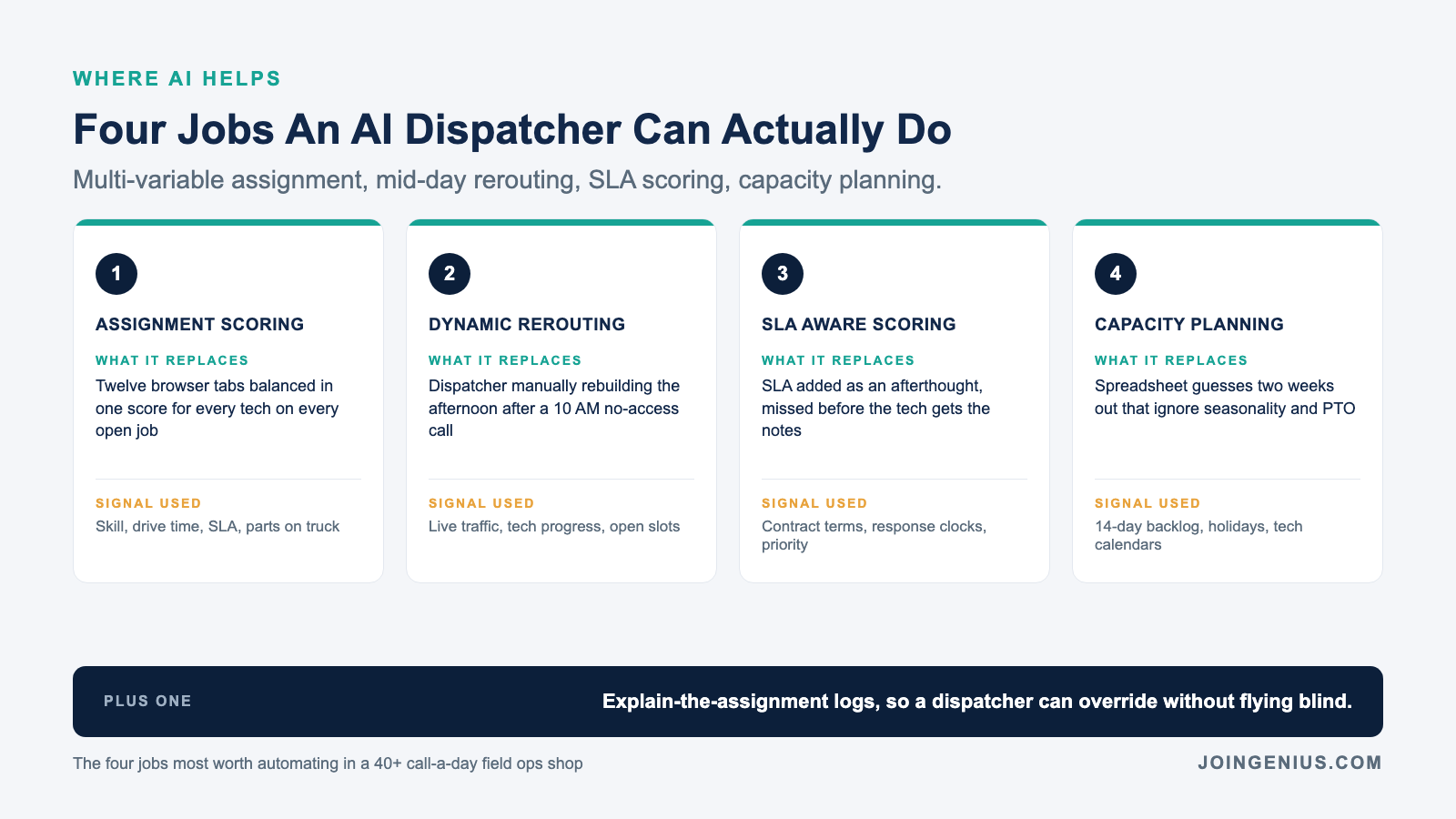
AI in dispatch is often sold as a general-purpose brain. In practice, it earns its license fee in four specific jobs. Those jobs are the ones a rules-based board was never built to do, not the ones a good dispatcher already does.
Shops that buy for those four and leave the rest alone see the 95 percent AI adoption rate Salesforce reported for 2026 translate into real throughput. Shops that buy for everything end up with a dashboard the dispatcher ignores.
Multi-Variable Assignment In Under A Second
The first job is scoring every tech against every open call on skill, live drive time, SLA clock, and parts on truck, in one pass. A dispatcher can do that for one call at a time by holding the board in their head. The AI does it for forty calls at the same time, and shows its work.
Rerouting And Capacity Planning
The second job is reflowing the afternoon the moment a 10 AM no-access call changes the day. A scored system reslots the next six calls, moves the fourth job to a closer tech, and leaves the rest alone.
The third job is projecting backlog forward with seasonality, holidays, and tech PTO built in. A model that ingests the last 24 months of volume and the next 14 days of tech calendars gives the sales floor a credible book-to-promise.
Where FieldCamp Fits
When a ticket queue crosses forty same-day calls, a system like the FieldCamp AI dispatcher that scores every tech against every open job on skill, drive time, SLA, and parts on truck trades a dispatcher’s twelve browser tabs for one ranked decision with an auditable log. The dispatcher still owns the call.
When An AI Dispatcher Is The Wrong Call
The same report that put AI adoption at 95 percent also found 68 percent of shops hit data quality problems implementing it. The pattern is clear. The shops that benefit are the ones already running at scale on clean job data. The ones that struggle are the ones trying to buy their way out of a data problem.
Under 20 Calls A Day
Below twenty same-day calls, a well-run board plus a strong dispatcher beats an AI system on both cost and flexibility. The AI needs volume to learn against, and the overhead of training it eats whatever lift it provides. Skip it until the shop crosses the threshold.
One Product Line, One Service Area
Single-trade, single-metro shops often do not have the assignment complexity that makes multi-variable scoring useful. Skill match is close to trivial, drive times are short, and SLAs are standardized. A rules-based board plus live traffic solves most of it. The AI dispatcher starts earning when complexity does.
No Clean Job Data
If the CRM has three fields for the same job type, techs log hours in a Google sheet, and parts live in a separate app, the AI cannot score. The project turns into a 12-month data migration dressed as a dispatch upgrade.
Fix the data first, then buy the model. For how data gaps cascade, see what workforce optimization actually requires upstream.
The 30-Day Audit Before You Change Your System
Switching a dispatch system is a nine-month project if it goes well. The audit below runs in 30 days and tells you whether you need to switch at all, keep the board and add a scoring layer, or fix the data before buying anything.
Pull Three Numbers First
Pull first-time fix rate, on-time arrival rate, and SLA compliance for the last 90 days, segmented by tech and by metro. If first-time fix is above 78 percent and SLA compliance is above 92, the board is holding and the problem is elsewhere. If either is below, the board is leaking and you have a case for the audit.
Shadow The Dispatcher For A Week
Count how many assignments get reshuffled after lunch and how often the backup dispatcher runs worse. If more than 30 percent of calls get reshuffled or the backup drops first-time fix by five points, the system is the dispatcher, not the software.
For how hiring compounds the problem, see how to hire planners who actually read market data.
Score The Vendors On The Boring Stuff
Any demo looks good on three clean calls. Score vendors on the boring work: data migration time from your current CRM, override logs the dispatcher can read in one page, and SLA fields that map one-to-one with your contract terms.
The vendors that fail on those three usually fail on everything else inside 90 days. Same test for any adjacent ops system, like how to manage in-house delivery without rebuilding software.
Conclusion
Dispatch systems fail at the forty-call threshold, in six repeating ways, and AI helps in exactly four of the six. The rest is still the dispatcher’s job.
Run the 30-day audit before buying anything, score the boring vendor categories hardest, and insist on override logs and SLA constraints from day one. For more on how field ops teams scale, visit Genius.