Your first executive hire changes what the company can do and what you stop doing yourself. It is also easy to get wrong. Many founders hire from a title (“we need a CMO”) instead of from a gap in how the company actually runs, and the mismatch shows up months later as a leader with a big title and no clear job.
Founders who handle this well tend to follow a similar sequence. They start with an honest look at their own work, define the role around outcomes, test candidates on real problems, and agree on a plan for the first 90 days before the person starts. This guide walks through that sequence and includes a table of warning signs to check as you go. These are practices worth borrowing, not a formula, and the right order of hires depends on your company’s stage.
Hire for the Gap, Not the Title
A title describes a job in most companies. A gap describes a problem in yours. Before you decide to hire a head of marketing, a COO or a finance lead, name the specific thing that is not getting done or is getting done badly, and who is covering it today. Often the answer is you.
Timing matters as much as the role. A leader hired before the company has product clarity or early traction ends up guessing at what to build a function around. If the gap is real but the company is not ready for a full-time executive, a part-time option can cover it for now. A fractional COO can take on operations and process, and a virtual CFO can handle finance, without a full executive package. Neither is a permanent answer, but both let you learn what the role really needs before you commit.
Map Your Own Energy and Edge Before You Write a Single Job Description
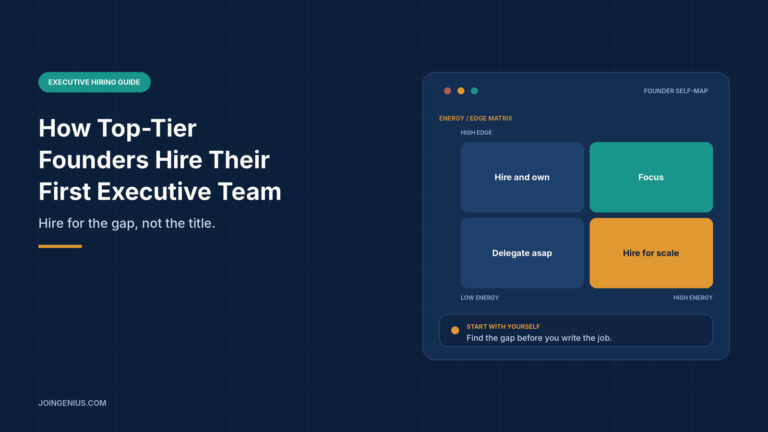
The most useful first step is not about candidates at all. It is a look at how you spend your own time. One practical tool is the Energy/Edge Matrix, a framework published by Daniel Dippold, CEO of the EWOR founder fellowship, for deciding what to hire for and when.
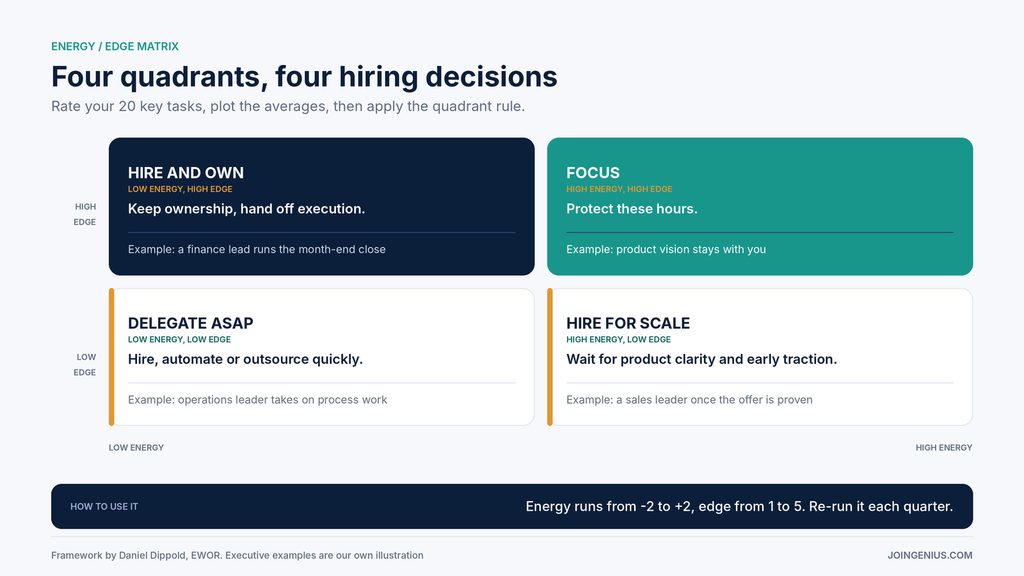
The method is simple. You list the 20 most important recurring tasks in your job, then rate each one after you do it. Energy measures how much the task gives you, from -2 to +2. Edge measures how strong you are at it, from 1 to 5. You plot the averages on a matrix with four quadrants. The article suggests repeating the ratings over a couple of weeks, then re-running the exercise every quarter.
- Focus: high energy, high edge. Protect these hours.
- Hire and own: low energy, high edge. Keep ownership and hand off the day-to-day execution.
- Delegate as soon as possible: low energy, low edge. Hire, automate or outsource these quickly.
- Hire for scale: high energy, low edge. Hire here only once the product is clear and there is early traction.
The article is about hiring in general and does not single out executives. Applying it to leadership roles is our reading, but it holds up. The tasks that drain you and that you do poorly point to the first leadership role to fill. The article also says to hire people who want to own those areas completely, which is a sensible test for an executive who will run a function without you.
A technical founder who dreads investor reporting and scores low on it, for example, has a finance gap. That points toward a finance leader sooner than a sales leader.
Scope the Role Around Outcomes
Once you know the gap, turn it into a one-page role card. A job description lists duties. A role card says what the person is accountable for and what you will stop doing. It usually has five parts:
- Outcome: the result you expect in the first year, in plain terms
- Decisions they own: what they can decide without asking you
- Decisions you keep: what stays with you, and for how long
- Handoffs: the tasks you will transfer, taken straight from your matrix
- Signals of success: how both of you will know it is working at 90 days and at one year
The “decisions you keep” line is the hardest to write and the most valuable. A role without clear decision rights tends to stall, because the new leader keeps asking permission and the founder keeps answering. EWOR’s founder resources page includes a Role Card Framework template if you want a starting point.

Test Candidates With Real Work, Not Only Interviews
Executive interviews reward people who talk well about strategy. To find out who can do the job, add work that looks like the job.
- Run a structured interview. Give every candidate the same core questions so answers are easy to compare. A list of strategic interview questions is a good base.
- Set a short, bounded case. Base it on a real problem in your company, with sensitive details removed. Ask for a plan, not a polished presentation.
- Discuss the plan live. Walk through it with you and one other team member, and watch how the candidate handles pushback.
- Verify the story. Check references and confirm that earlier roles and ventures match what the candidate says. For leaders with a history of earlier companies, this guide to vetting founder and executive candidates explains how to do that fairly and with consent.
- Score against the role card. Compare each candidate with the outcomes you wrote down, not with each other’s charm.
Judging a leader in a function you do not know well is hard, because you cannot assess the craft directly. Ask a trusted advisor or an experienced operator in that field to review the case work and give you a second opinion.

Choose Between Full-Time, Fractional and Search Help
Not every first executive has to be a full-time hire from day one. Three routes are common:
- Full-time hire from your network. Trust builds quickly and the cost of a bad fit is high, but your pool is limited to people you already know.
- Fractional or part-time leader. Lower commitment and a good way to test a role. A fractional CTO is a typical example for companies that need technical direction before a full-time hire makes sense.
- Executive search firm. Wider reach and a structured process, in exchange for more time and a larger budget. This overview of the executive search firm model shows what to expect.
Match the route to how clear the role is. The clearer the role card, the safer a full-time hire becomes. The less clear it is, the more a fractional start helps.
Warning Signs in Your Executive Hiring, and What to Do About Each
Use this table as a checkpoint at three moments: before you post the role, before the final interview and before you sign the offer. One sign means fix one thing. Three or more mean pause the search and revisit the role card.

Set a 90-Day Plan Before Day One
Agree on what the new leader owns before they start. A simple shape works well:
- By day 30: learn the business, meet the team and customers, and review the handoff list with you.
- By day 60: take full ownership of the first agreed area and propose changes.
- By day 90: report against the outcomes on the role card, and agree what comes next.
Then re-run the matrix each quarter. If the gap you hired for has closed, the next gap becomes the next hire. It also helps to write down who covers the role if the leader leaves, and a succession planning template gives you a structure for that.
Hire the Gap You Can Name
The founders who build strong leadership teams are rarely the ones who hire fastest. They know where their own time goes, write down what the role must deliver, test candidates on real work and plan the first 90 days. Start with the matrix, name the gap and let the first executive hire follow from it.