A Shopify agency’s lead developer builds a custom theme and a checkout extension for a client, then hands in notice with three launches on the calendar. The rest of the team has never opened the code. A rushed hire starts a month later and spends it asking questions. That is an illustration, not a case study, but it shows the risk this guide covers: what leaves with the person matters as much as the departure.
This guide explains why senior Shopify developers are hard to keep, what a departure costs and how to cover the gap while you rehire. It covers cost, knowledge concentration, store setup, outside cover, testing candidates and a table of warning signs. We found no study of why Shopify agencies in particular struggle to retain senior developers, or of how often it happens. “Senior” is our label, not a standard one. The advice rests on a turnover cost review, a study of knowledge concentration in software projects, Shopify’s developer documentation, one agency’s hiring page and our reasoning.
What We Can and Cannot Say About Why They Leave
We found no research on why senior Shopify developers leave agencies, so any list of causes is our reasoning. Plausible ones include client deadline pressure, a few seniors carrying the hardest work and the pull of freelance or in-house roles. We have not tested any of them. Our piece on why full-stack developers leave agencies covers general agency attrition, and our guide to retaining mid-level engineers covers the freelance pull. This guide starts after the notice: what you lose and how to cover it.
What a Senior Departure Costs
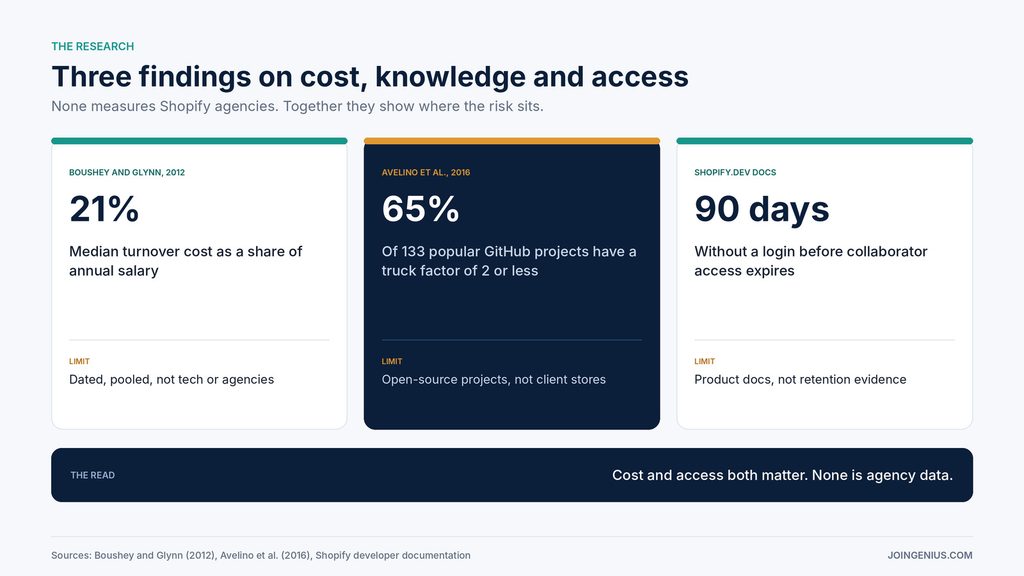
A 2012 review by Heather Boushey and Sarah Jane Glynn for the Center for American Progress pooled case studies of turnover costs. It found a median cost of 21% of annual salary across the positions it covered, with costs for highly paid roles running as high as 213%. Executives and physicians were excluded from the median. The authors say indirect costs such as lost productivity and institutional knowledge are hard to measure, and only 2 of the 11 papers they used included them.
The limits matter. The data is more than a decade old, comes from specific occupations unrelated to Shopify or agencies and is pooled across very different jobs. We use it only to show that a departure has costs beyond the recruiting fee. Our reasoning is that in an agency the cost appears as slipped delivery dates and a team relearning client stores. We would not apply the percentage to your own salaries.
The Bigger Risk Is Knowledge in One Head
Software teams have a name for this risk. The truck factor is the smallest number of developers who would have to quit, or be hit by a truck, before a project is incapacitated. In a 2016 paper, Guilherme Avelino and colleagues estimated it for 133 popular GitHub projects and found that 65% had a truck factor of 2 or less.
The limits are clear. These were popular open-source projects, not client stores. The authors note there is no consensus on how to calculate the metric, and in their survey only 53% of answers about the estimated truck factors were positive or partly positive. Our reasoning is that a client store with a custom Liquid theme or custom app can concentrate knowledge in one developer in the same way. We do not know how common that is in Shopify agencies. A quick check is to ask who else could ship a change to each store tomorrow.
Set Up Each Store So Any Developer Can Pick It Up
Shopify’s developer documentation describes two tools that help. Its GitHub integration for themes syncs theme code to and from a repository, and the page says files are updated in GitHub whenever changes are made to a connected theme, which cannot be disabled. Only organization members with write access can connect branches, and the code editor has no conflict alerts. Its collaborator access lets an agency work inside a merchant’s store, with the merchant setting the scope of permissions. The page says access expires if nobody from the organization logs in for 90 days.
These are product docs, not evidence about retention, and they do not say how agencies use them. The suggestions that follow are ours. Keep theme code in a shared organization repository, not on one person’s machine. Give each developer scoped access so removing one person never means changing a shared login. Keep a one-page note per store covering custom work, apps, open tickets and who approves what. Our guide to offshore development risks covers handover problems with outside teams.
Keep Delivery Moving While You Rehire a Senior Shopify Developer
A senior search takes time, and client dates do not wait. List what is due in the next two months and decide which work can move and which needs a senior hand. For the rest, outside capacity is one option. Dynamicdreamz’s page for those who hire Shopify experts lists ways to start, from one task or project to flexible hours or dedicated monthly capacity. That is a vendor describing its own service, and we did not test it.
The page cites Shopify certifications and delivery experience. It does not state seniority tiers, how candidates are screened, confidentiality or IP terms, replacement or trial policies, or start times. Ask for each in writing before anyone touches a client store. Our reasoning is that cover works best when bounded: give the partner the handover note, scoped access and one small task, check the result, then widen the scope. Treat it as a bridge, not a substitute for rehiring. Our guide to offshore Shopify developers covers where outside developers are found and what to ask.
Test Replacements and Cover the Same Way
Selection research supports a shared, realistic task, with a limit. A HumRRO summary of Sackett, Zhang, Berry and Lievens (2022) reports revised validity estimates in which structured interviews were highest at .42 and work sample tests were .33. The authors argue that earlier estimates were inflated by range restriction corrections, and they note that structured interview validity varies considerably. These figures concern job performance in general, not Shopify developers. They support a modest point: the same realistic task, scored the same way, beats improvising. Our interview guide covers how to structure the conversation.
To run the test, set up a development store with a small theme and a bounded task, such as fixing a section bug and writing a short note on what changed. Give every candidate the same store, brief and a time limit such as three hours, and pay for the time. Unpaid tests ask people to work for nothing and may put off experienced developers. That is our view, not a finding. Write the rubric first, with criteria such as a clean change, readable code, a clear note and good questions about the existing setup. Our guide to hiring eCommerce developers covers wider sourcing.
A Four-Step Plan to Cover the Gap
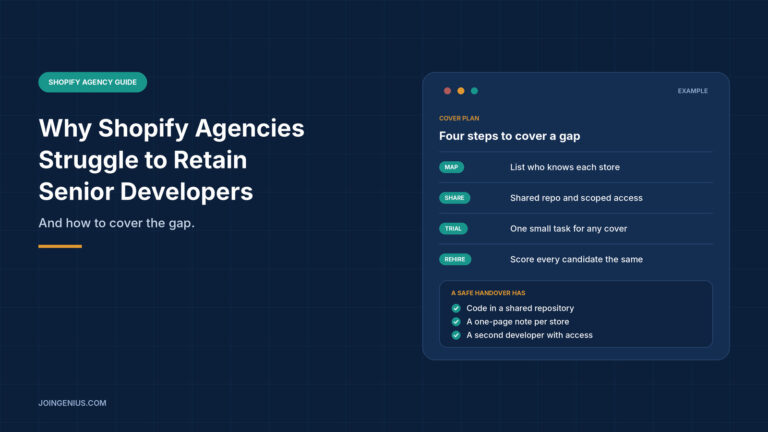
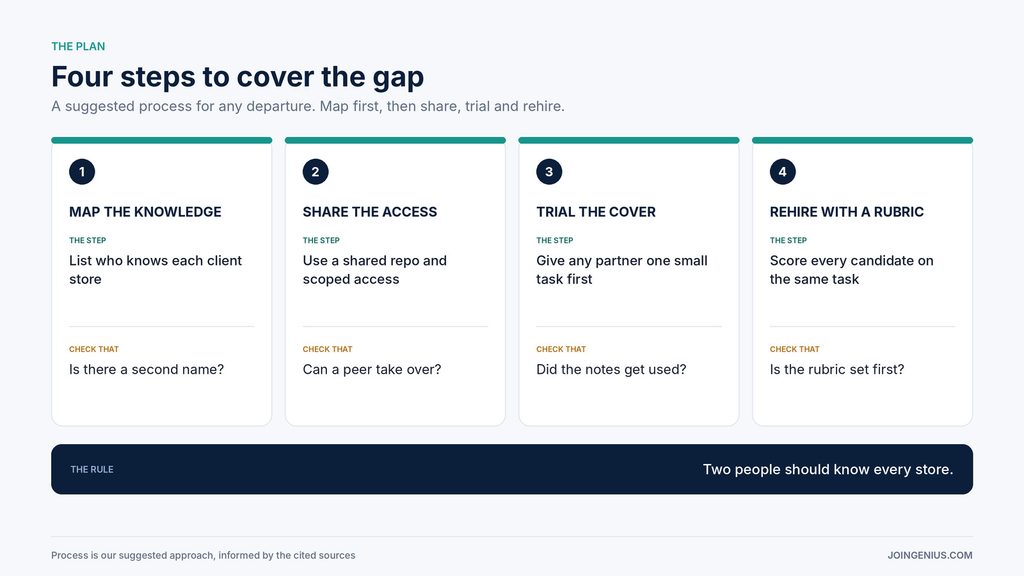
Use this four-step plan whenever a senior developer leaves or before it happens. It is our suggested process, informed by the sources above.
- Map the knowledge. List who knows each client store and where only one person does.
- Share the access. Put code in a shared repository and give each developer scoped access.
- Trial the cover. Give any outside partner one small task before more.
- Rehire with a rubric. Score every candidate on the same task.
The order matters because mapping shows where the risk sits, and sharing access makes any new developer, in-house or outside, productive faster.
Measure Whether the Gap Is Closed
Track how many client stores have a second developer who can ship a change, how many have code in a shared repository and a current handover note, how long a new developer takes to ship a first change and how often delivery dates slip. Judge over several months, since one slipped date proves little. These measures are our suggestions, not findings.
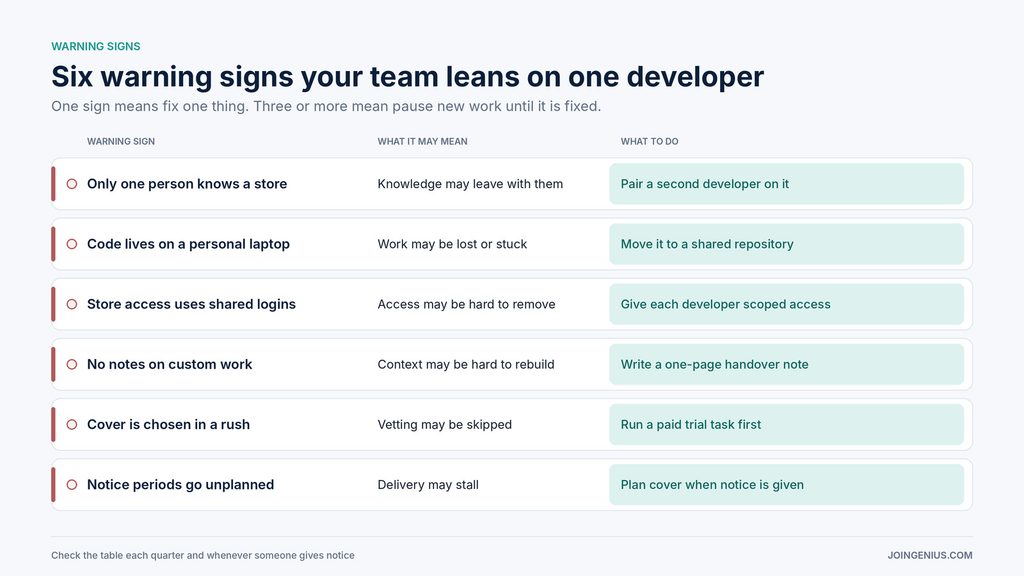
Warning Signs Your Shopify Team Leans on One Developer, and What to Do About Each
Check this table each quarter and whenever someone gives notice. One sign means fix one thing. Three or more mean pause new work until it is fixed.
Cover the Gap, Then Close It
Senior Shopify developers will sometimes leave, so the aim is a team that keeps delivering when they do. Map who knows each store, move code and access to shared homes, trial any outside cover on one small task and rehire against a rubric written in advance. We found no study proving this plan reduces the cost of a departure, but each step replaces a hope with a check. If a second developer can ship a change to every store, the next notice will be a hiring problem and not a delivery crisis.