Most companies say they want analysts who model decisions. In practice, they hire people who build bigger spreadsheets. There is a real gap between an analyst who can pivot a table and one who can build a decision model that handles uncertainty. Hiring the second kind is harder, and most interviews are not built to find them.
Decision modeling software lets an analyst reason about risk, not just report an average, and the people who think that way are a minority of the pool. AI is reshaping hiring, and it raises the bar on real analytical skill. Below, we cover why most analysts stop at the spreadsheet and how to test for the rest.
Why Most Analysts Stop at the Spreadsheet
The spreadsheet is the default analytical tool, and it quietly limits what most analysts can do. It also costs more than teams admit.
Spreadsheets Hide the Thinking
A spreadsheet shows numbers, not the reasoning behind them. Assumptions get buried in cells, and nobody can see why a result came out the way it did. When the model is a wall of formulas, you can audit the output but not the logic. That opacity is convenient for the person who built it and a liability for everyone else.
You end up trusting the person, not the model, which is a bad way to bet real money.
And They Are Quietly Expensive
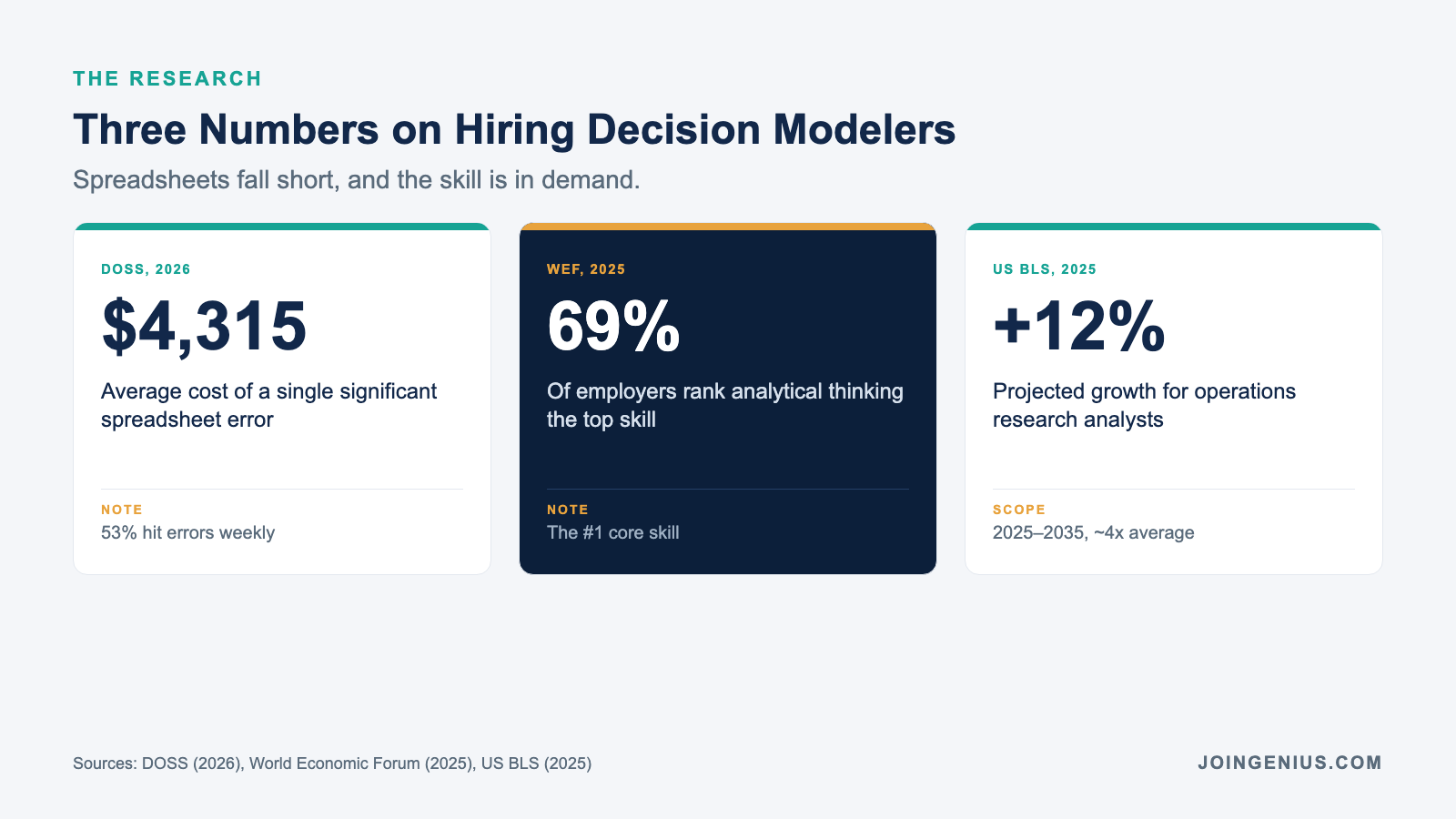
The errors are not rare. In a 2026 DOSS survey of 1,003 operations professionals, a single significant spreadsheet error cost about $4,315 on average, and 53% of teams hit errors every week. When important decisions ride on a brittle spreadsheet, the occasional expensive mistake is part of the deal.
And most of those errors are never flagged to anyone who could have caught them.
Point Estimates Dodge the Real Question
Most spreadsheet analysis produces a single number, as if the future were certain. The real question is usually about risk, like how likely this is and what the downside looks like. An analyst who only hands you a point estimate has skipped the part of the job that actually informs a decision.
A number with no confidence range is barely better than a guess.
What a Decision-Modeling Analyst Does Differently
The difference is not fancier charts; it is a different way of thinking about a problem. That way of thinking is exactly what employers now rank highest, which is why an analytical hiring lens matters here.
They Model Uncertainty, Not Just Averages
A decision modeler starts from what is unknown. Instead of one number, they build a range and a distribution, so a decision-maker can see the odds and the risk. In the World Economic Forum’s 2025 survey, 69% of employers ranked analytical thinking as the top core skill. Modeling uncertainty is that skill at its sharpest.
A range tells a leader how much to worry; a single number tells them nothing about risk.
They Make the Assumptions Visible
A good model shows its work. Every assumption is explicit and easy to change, so anyone can ask what happens if a number is wrong and get an answer in seconds. That transparency turns a model from one analyst’s black box into a tool the whole team can trust and challenge.
When the assumptions are hidden, every disagreement becomes an argument instead of a test.
They Run the Scenarios Before You Ask
A spreadsheet analyst waits to be told which scenario to run. A decision modeler has already tested the ones that matter, like the worst case and the break-even point. They come to the meeting with the sensitivity analysis done, because that is where the actual insight lives.
They arrive with the answer and the three ways it could be wrong.
The two approaches diverge in ways you can screen for:
| Dimension | Spreadsheet analyst | Decision modeler |
|---|---|---|
| Output | A single number | A range and the odds |
| Assumptions | Buried in cells | Explicit and adjustable |
| Uncertainty | Ignored | Modeled directly |
| Scenarios | Run on request | Tested in advance |
You are hiring for the right-hand column.
What to Screen For When You Hire
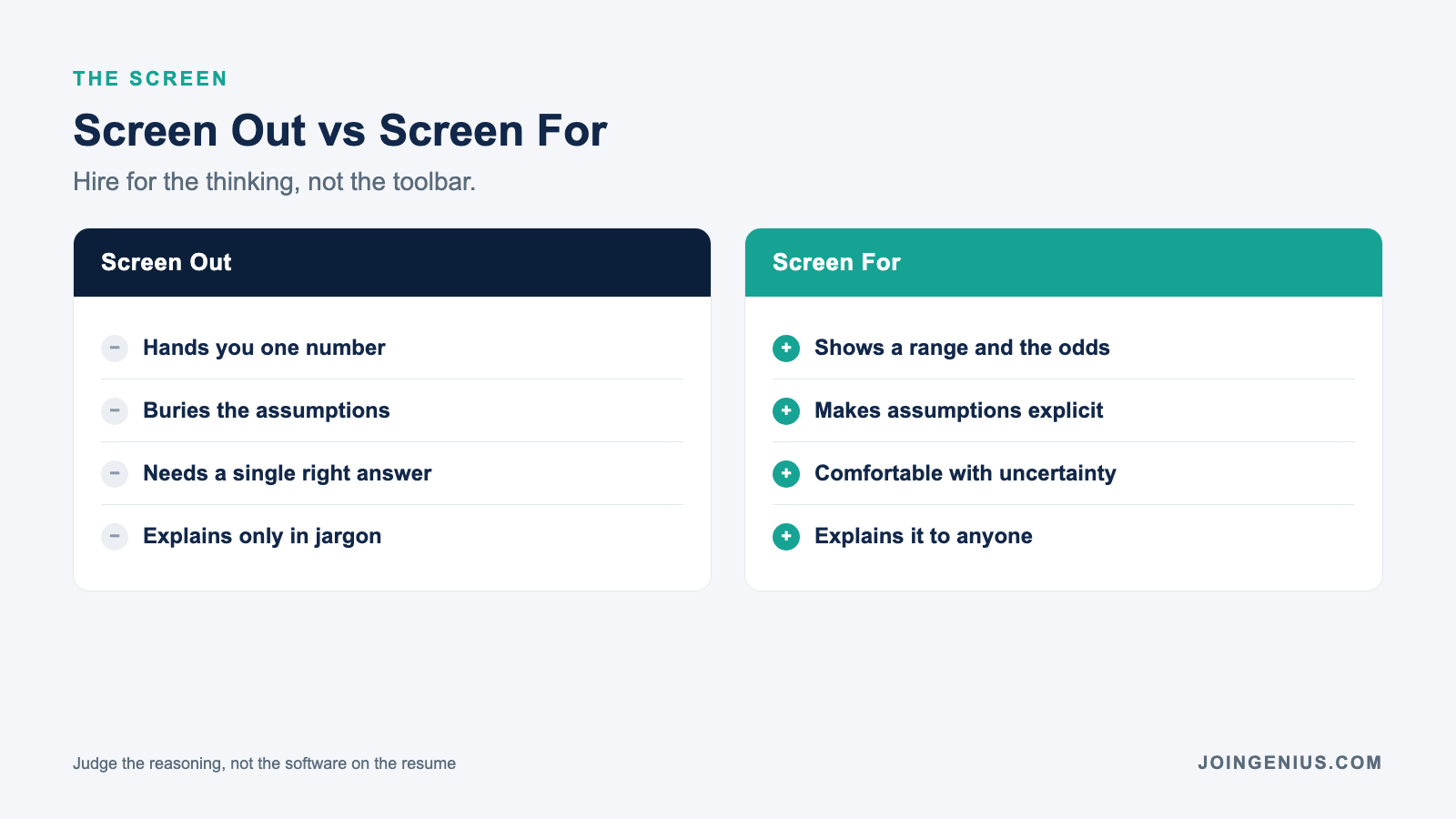
If decision modeling is the skill, the screen has to target the thinking, not the toolbar. And the demand for it is only rising.
Analytical Thinking Over Tool Trivia
Do not screen for which software is on the résumé. Screen for how someone reasons about an uncertain problem. The US Bureau of Labor Statistics projects operations research analyst roles to grow 12% through 2035, about four times the average. A sharp modeler learns a new tool in days; the thinking takes years.
Comfort With Uncertainty
Some people need a single right answer, while decision modelers are comfortable without one. Ask a candidate how confident they are in an estimate and listen for a range, not false precision. The ones who say “it depends, and here is on what” are the ones you want. A structured hiring process keeps you focused on that signal.
False confidence is the easiest red flag to miss and the most expensive to hire.
Can They Explain It to a Non-Modeler
A model nobody understands is useless. The best decision modelers translate a complex result into a clear recommendation a leader can act on. Screen for that. If a candidate cannot explain their thinking without jargon, the model will not survive contact with the people who have to use it.
The model that changes a decision is the one the decision-maker actually understands.
Test It With a Real Modeling Problem
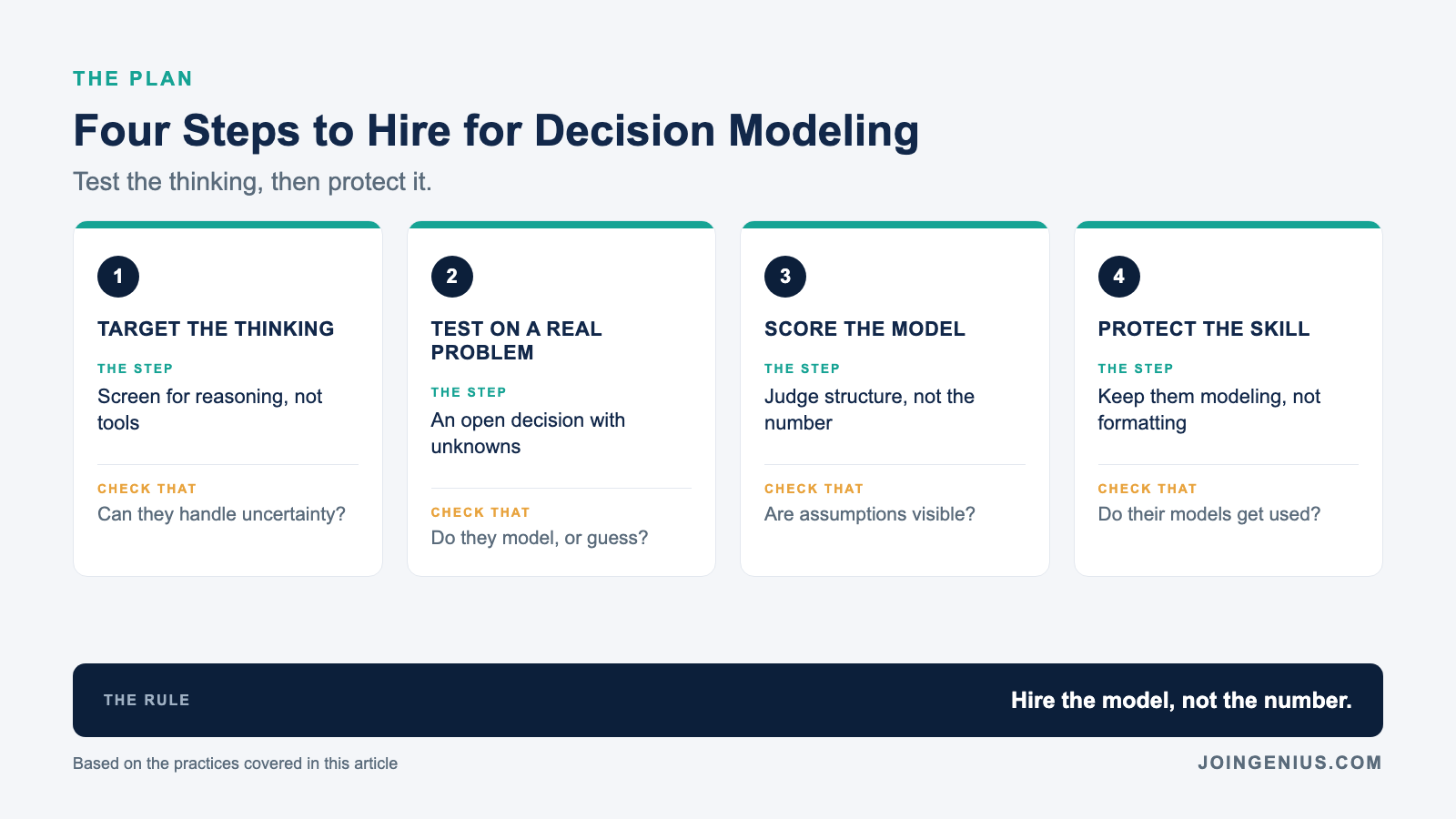
You cannot find a decision modeler with trivia questions. Hand them a real, uncertain problem and watch how they build.
Give Them an Open Problem With Unknowns
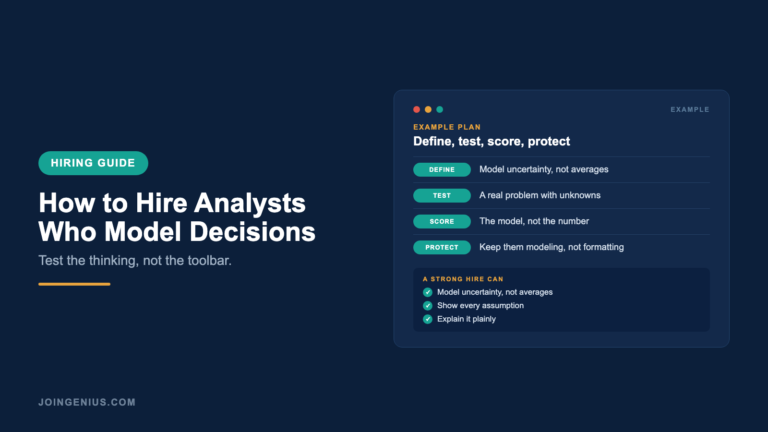
Skip the puzzle and use something like the real job: a decision with incomplete data and real stakes. Ask them to build a quick model, in decision modeling software or even on paper, that lays out the options and the key uncertainties behind them. You are watching how they frame the problem, not whether they know your tool.
A clean textbook case tells you little; the ambiguity is the whole test.
Score the Model, Not the Number
There is rarely one right answer, so judge the structure of their thinking. Did they surface the real uncertainties and test what actually moves the decision? What predicts on-the-job performance is the quality of the model, not whether their point estimate matched yours.
Watch Them Handle a Changed Assumption
Mid-test, change a key number and see what happens. A spreadsheet thinker scrambles to rework the sheet; a decision modeler updates one input and reads off the new result. How fast and cleanly they adapt tells you whether they built a model or just a calculation.
A real model bends to a new number, while a spreadsheet usually breaks.
How to Build a Team That Models Decisions
One decision modeler is a strong hire. A team that models decisions by default changes how the whole business makes calls.
Give Them the Tools and the Standing
Modeling only helps if the organization listens. Make sure analysts have real modeling software and a seat at the decision, not just a request queue. An analyst whose careful model gets overruled by a louder gut will stop building careful models.
Authority without good analysis is reckless, and good analysis without authority is wasted.
Protect the Skill From Spreadsheet Gravity
Even good modelers get pulled back into spreadsheet grunt work if you let them. Protect their time for real modeling, and do not let the role quietly turn into report formatting. Protecting that work is part of how you keep your best analysts, who leave when the hard, interesting part disappears.
Hire Ahead of the Big Decisions
The worst time to need a decision modeler is the week before a major call. Build the capability before you need it, so the model is ready when the stakes are high. Teams that wait end up making the biggest decisions on the flimsiest analysis.
The capability has to exist before the decision does, not after.
Conclusion
Hiring analysts who use decision modeling software is less about the tool and more about the thinking behind it. Most analysts stop at a spreadsheet and a single number, and the ones worth hiring model the uncertainty and show their work.
Test for it with a real problem and score the model, not the answer. Then protect the skill once it is on the team, because the decisions are only as good as the analysis behind them.
If the real constraint is that analysts who can actually model decisions are scarce and expensive where you are hiring, that is worth solving at the source. At Genius, we help companies hire the top 1% of analytics and decision-science talent from the Philippines and Latin America, at around 80% less than comparable local hires.
You get people who think in models, not just spreadsheets, with no monthly agency fees and a 6-month replacement guarantee. If finding analysts who model decisions is the problem you keep hitting, see how we source and place talent.