
If you are trying to figure out the different types of Recruitment Process Outsourcing (RPO), you are probably already knee-deep in hiring challenges or scaling plans. And truth be told, most of what is out there about RPO types is either overly technical or trying too hard to sell you something.
This article isn’t that.
We are cutting straight through the fluff and laying out the 11 types of RPO with real-world examples, side-by-side comparisons, and advantages of RPO. You will know which RPO companies to sidestep and find the model that gives your team actual breathing room.
Recruitment Process Outsourcing Types At A Glance
Flag your most urgent hiring challenges and match them to the right type of recruitment process outsourcing using this table.
| RPO Type | Best For | Scope & Duration |
| Enterprise RPO (Full-Cycle RPO) | Ongoing, high-volume hiring across business units. | Full lifecycle, long-term. |
| Project-Based RPO (Short-Term, High-Volume Hiring) | Surge hiring for expansions, product launches, or rebrands. | End-to-end, short-term. |
| Selective RPO (Partial RPO) | Outsourcing specific steps like sourcing or screening. | Specific process steps, flexible. |
| On-Demand RPO (Flex RPO) | Quick plug-and-play help during seasonal spikes. | Short-term, scalable. |
| Modular RPO (Component-Based) | Filling gaps in talent acquisition team with expert modules. | Targeted functions, modular. |
| Hybrid RPO (Internal + External Blend) | Call centers, retail chains, and logistics during peak seasons. | Mixed approach, varies by team. |
| Contingent RPO (Gig & Contract Focused) | Filling contractor and temp roles across departments. | Temporary and gig talent, ongoing. |
| Global RPO (Multinational Hiring) | Hiring at scale across multiple countries or regions. | Global, consistent across borders. |
| Industry-Specific RPO (Vertical-Focused RPO) | Hiring in regulated or niche industries like healthcare or mining. | Deep sector expertise, long-term or short-term. |
| Retained RPO (Strategic, Long-Term Partnership) | Leadership roles or high-impact long-term partnerships. | Multi-year strategic focus. |
| High-Volume RPO | Call centers, retail chains, logistics during peak seasons. | High volume, short-to-mid term. |
Check Out More Popular Reads
🔥 17 Best IT Recruitment Process Outsourcing Companies
🧨 RPO Payroll Process: Benefits, Strategies, & Best Practices
🎆 RPO Vs In House Recruitment: Pros, Cons, & Best Fit For You
What Is Recruitment Process Outsourcing & How Does It Differ From Traditional Recruitment & Staffing Agencies
Recruitment process outsourcing (RPO) means handing over part or all of your recruitment to a specialized partner who owns the process, tech, performance metrics, and outcomes. It’s for companies that want consistency, scale, and expertise without burning out internal HR or betting on short-term fixes.
Here’s how RPO differs from staffing agencies and traditional recruitment:
| RPO (Recruitment Process Outsourcing) | Traditional In-House Recruitment | Staffing Agencies | |
| Scope | Full lifecycle or modular (2–10+ functions outsourced). | 100% internal control, no external partners. | Transactional (1–2 steps like sourcing or placement). |
| Ownership | RPO owns sourcing, tech stack, data, reporting, and results. | In-house talent acquisition or HR team handles everything. | Agency owns candidate pipeline only. |
| Scalability | 30–50% faster ramp-up in hiring surges. | Requires new hires or contractor support. | Limited scalability, often manual sourcing. |
| Cost Model | 30–60% cost savings vs. staffing agencies in Year 1. | Fixed HR costs, salaries, tech, and turnover expenses. | Markup fees of 15–30% per placement. |
| Expertise | Industry-specialized recruiters + dedicated account teams. | Generalist HR/recruiter roles. | Varies; often junior recruiters. |
| Tech & Data | Built-in ATS, CRM, sourcing AI, DEI tools, analytics dashboard. | Depends on company investment. | Limited access, often agency-owned platforms. |
| Candidate Quality | 2x improvement in quality of hire; pipeline-focused hiring. | Depends on recruiter bandwidth and internal tools. | Prioritizes speed; often lower quality match. |
| Time To Hire | 25–40% faster than traditional models (average: 20–30 days to fill). | Can stretch to 45–60+ days depending on team load. | Typically 10–20 days, but high risk of mismatches. |
| Best Fit For | Mid-market to enterprise or high-growth firms. | Stable organizations with predictable hiring volume. | Temporary staffing, short-term project hires. |
11 Main Types Of Recruitment Process Outsourcing

Scan this section to know more about the recruitment process outsourcing types and match them against your volume, timeline, and internal bandwidth.
1. Enterprise RPO (Full-Cycle RPO)
This model hands over your entire hiring process—from job design to onboarding—to an RPO partner and embeds their recruiters into your team.
Best For:
- Companies with 100+ annual hires
- High-growth firms with constant recruitment needs
- Businesses looking to rebuild or overhaul internal TA
Use Case Scenario: If you are in tech, sales, or ops and need a plug-and-play system, Enterprise RPO can fully manage sourcing, screening, offer stages, and tech stack for all roles.
Pricing Models & ROI Expectations: Management fee, long-term ROI
Pros:
- Reduces time-to-hire by up to 40%
- Standardizes processes across departments
- Frees internal HR to focus on improving employee retention rate
- Boosts employer brand visibility
- Ideal for multi-location or multinational hiring
Cons:
- Longest implementation timeline (8–12 weeks)
- Requires deep collaboration and upfront planning
2. Project-Based RPO (Short-Term, High-Volume Hiring)
This is a fixed-term engagement where the RPO team manages a spike in hiring for a defined period or business initiative.
Best For:
- M&A, product launches, or seasonal hiring waves
- Companies with a surge in job openings
Use Case Scenario: If you want to expand to a new region and need 60+ people onboarded in 3 months, Project RPO provides recruiters and systems to hit that number on time.
Pricing Models & ROI Expectations: Pay-per-hire, fast turnaround
Pros:
- Fast 2–4 week ramp-up
- Scales talent teams quickly
- Lower long-term commitment
- Offers proof-of-concept for full RPO
Cons:
- Not ideal for ongoing needs
- Limited long-term process optimization
3. Selective RPO (Partial RPO)

Selective RPO lets you outsource specific talent acquisition steps while keeping the rest in-house, like sourcing only, or interview scheduling.
Best For:
- Companies that have decent in-house recruiters but lack time
- HR teams that need to free up bandwidth
Use Case Scenario: If your team is buried in interviews but no one is sourcing new talent, an RPO partner can take over top-of-funnel candidate sourcing.
Pricing Models & ROI Expectations: Component fee, quick uplift
Pros:
- Keeps your internal recruiters in the loop
- Flexible service scope
- Improves one weak spot in your funnel fast
Cons:
- Limited impact on overall metrics
- Can create handoff inefficiencies if poorly scoped
4. On-Demand RPO (Flex RPO)
This model works like an RPO subscription. You bring in recruiters when needed without long contracts.
Best For:
- Startups and SMBs with unpredictable hiring
- Companies testing outsourced recruitment for the first time
Use Case Scenario: If your internal recruiter is on leave and you need 8 new hires this quarter, On-Demand RPO fills the gap instantly without affecting other functions.
Pricing Models & ROI Expectations: Pay-per-hire, flexible ROI
Pros:
- Zero commitment options
- Quick-start (1–2 weeks)
- Budget-friendly
- Easy to pause or scale
Cons:
- Less strategic input from the provider
- Best for short-term needs only
5. Modular RPO (Component-Based)
In this type of HR outsourcing, you hand-pick specific modules (like assessments, branding, or analytics) and plug them into your current recruitment process.
Best For:
- Internal teams that want to upgrade parts of their process
- Companies focused on data, employer branding, or DEI
Use Case Scenario: If your hiring managers need better candidate assessments but you want to keep sourcing in-house, Modular RPO drops in assessment tools only.
Pricing Models & ROI Expectations: Fixed module fee, targeted ROI
Pros:
- Improves precision in one hiring stage
- Low-cost, high-impact
- Works with your existing tech
Cons:
- Doesn’t address full hiring challenges
- Needs strong internal coordination
🔥 Did You Know?
Offshore recruitment can cut labor costs by up to 70%.
6. Hybrid RPO (Internal + External Blend)

Hybrid RPO blends in-house recruiters with outsourced experts so both work together as one talent function.
Best For:
- Mid-market companies with 50–100 roles annually
- Businesses that want help without giving up full control
Use Case Scenario: If your in-house team handles executive hiring but struggles with sales and customer service, the RPO can manage those functions only.
Pricing Models & ROI Expectations: Hybrid pricing, shared savings
Pros:
- Keeps internal knowledge intact
- Shared accountability
- Easy to scale or reduce
Cons:
- Needs tight communication systems
- Can blur ownership lines
7. Contingent RPO (Gig & Contract Focused)
Contingent RPO is built for high-volume contract, freelance, or temporary workforce hiring.
Best For:
- Industries with heavy contract staffing (e.g., logistics, events, gig economy)
Use Case Scenario: If you need to fill 200 seasonal warehouse roles within a month, Contingent RPO offers staffing plus compliance and vendor coordination.
Pricing Models & ROI Expectations: Volume-based pricing, rapid ROI
Pros:
- Fills roles fast (as little as 7 days)
- Includes compliance support
- Centralizes contractor hiring across locations
Cons:
- Doesn’t cover long-term or executive roles
- May need integration with a Managed Service Provider (MSP)
8. Global RPO (Multinational Hiring)
This RPO type manages international hiring across multiple regions while keeping workflows consistent and compliant.
Best For:
- Companies hiring in 3+ countries
- Businesses scaling overseas
Use Case Scenario: If your U.S.-based company is opening offices in the UK, Mexico, and Singapore, Global RPO can build a single hiring process flowchart across all 3.
Pricing Models & ROI Expectations: Hybrid pricing, global ROI
Pros:
- Ensures global compliance
- Creates centralized reporting
- Manages timezone and language barriers
Cons:
- Higher upfront costs
- Requires global payroll or EOR partnerships
9. Industry-Specific RPO (Vertical-Focused RPO)
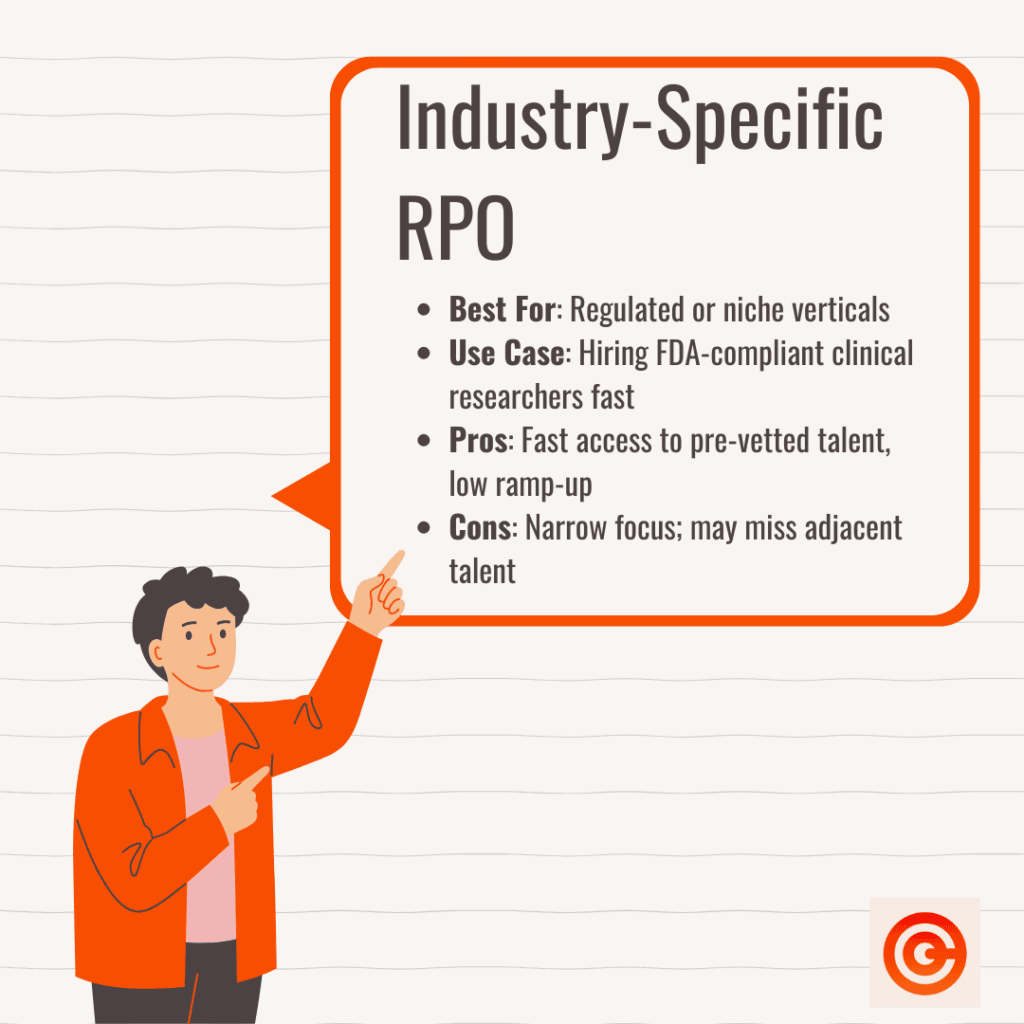
Focused on one industry’s hiring needs, like healthcare, tech, or life sciences, often with pre-built pipelines.
Best For:
- Niche industries with talent shortages
- Regulated fields like pharma, aviation, etc.
Use Case Scenario: If you’re a biotech firm hiring clinical research associates, an RPO that already works with FDA-regulated roles is better equipped.
Pricing Models & ROI Expectations: Management fee, deep expertise ROI
Pros:
Faster access to pre-vetted talent
- Deep understanding of industry lingo and certifications
- Shorter ramp-up time
Cons:
- Narrow focus may miss crossover talent
- Less adaptable outside core niche
10. Retained RPO (Strategic, Long-Term Partnership)
This is a long-term model where the RPO is deeply embedded in your culture, processes, and long-term workforce planning.
Best For:
- Companies looking to build a recruitment engine from scratch
- Businesses that want to turn hiring into a competitive advantage
Use Case Scenario: If your C-suite wants to revamp employee value proposition (EVP), career pathing, and workforce planning over 3 years, Retained RPO supports that full transformation.
Pricing Models & ROI Expectations: Retainer fee, strategic ROI
Pros:
- Strategic workforce insights
- Ongoing tech and process upgrades
- Builds a competitive edge
Cons:
- Largest time and resource investment
- Less useful for urgent short-term needs
11. High-Volume RPO
High-volume RPO is specifically built for consistent, repeatable hiring at scale, typically 500+ roles per year.
Best For:
- Retail, hospitality, BPOs, customer support
- Centralized hiring across large teams
Use Case Scenario: If your contact center opens 5 new locations and needs 1,000 reps hired in 6 months, High-Volume RPO builds a repeatable recruitment pipeline.
Pricing Models & ROI Expectations: Pay-per-hire, high-efficiency ROI
Pros:
- Reduces cost-per-hire by up to 50%
- Centralizes sourcing, screening, and onboarding
- Efficient interview-to-offer ratios
Cons:
- Less personalization in candidate experience
- Only works well at scale
“When you’re scaling fast, you don’t need another dashboard—you need someone who shows up on Monday and crushes it by Tuesday.”
—Burkhard Berger, Founder & CEO of Genius
What To Look For In Each Recruitment Process Outsourcing (RPO) Recruitment Model
Use this table to spot exactly what to look for in each model and how to assess it in practice.
| RPO Model | What To Look For | How To Assess It |
| Enterprise RPO | Depth across sourcing, tech, and process ownership. | Ask for end-to-end case studies. Request KPI snapshots from current or past clients. |
| Project-Based RPO | Ability to spin up fast and manage spikes. | Look for proof of rapid ramp-up (within 2–4 weeks). Ask how they’ve handled 100+ hires in a short window. |
| Selective RPO | Precision in specific functions (e.g. sourcing or screening). | Request samples of shortlists, sourcing workflows, or screening scorecards. |
| On-Demand RPO | Flexibility to scale in days, not weeks. | Ask how quickly they can deploy recruiters. Check if they charge retainer fees or only per project. |
| Modular RPO | Clean plug-in with your current team/process. | Ask how they integrate with existing ATS. Check their experience working in shared ownership models. |
| Hybrid RPO | Balance of external support and internal control. | Ask what percentage of hires they fully handle. Request an overview of decision split with in-house HR. |
| Contingent RPO | Networks and speed for freelance/gig hiring. | Ask what platforms or tools they use for sourcing temp/contract roles. Request fill rate metrics. |
| Global RPO | Compliance, sourcing reach, and localization. | Ask how they handle cross-border background checks, labor laws, and language localization. |
| Industry-Specific RPO | Domain expertise and access to niche talent pools. | Ask for sector-specific benchmarks. Request sample candidate profiles for hard-to-fill roles. |
| Retained RPO | Long-term value and strategic advisory ability. | Ask how they support internal transformation over time. Request quarterly impact reports. |
| High-Volume RPO | Ability to scale screening, scheduling, and onboarding. | Request automation tools used. Ask for volume case studies and time-to-hire stats. |
How To Choose The Right RPO Type For Your Business

Here’s how you can quickly zero in on the RPO model that gives you the right coverage, flexibility, and speed.
Ask Yourself These 7 Questions
1. How predictable is your hiring volume each quarter?
- Look for a model that handles either steady pipelines (Enterprise) or spikes (Project-Based).
2. Do you need help with the full process or just one part?
- Pick Enterprise for full-cycle support, or Selective for help with specific gaps.
3. Can your in-house team handle growth on its own?
- If not, consider Modular or Hybrid models to plug gaps without replacing the team.
4. Do you need to hire across multiple countries or time zones?
- You’ll need a Global RPO partner with compliance and language coverage.
5. Are you struggling with hard-to-fill or niche roles?
- An Industry-Specific or Retained model can tap into deeper talent networks.
6. How fast do you need to fill roles once approved?
- Go with On-Demand or High-Volume if time-to-fill is your biggest KPI.
7. Is recruitment already slowing down other core functions?
- Use this as your trigger to shift to an RPO model that takes full ownership.
📣 Interesting Fact
The US has roughly 76.4 million freelancers.
5 Key Factors To Weigh Before You Choose The Right RPO Model
| Factor | What To Consider |
| Team Bandwidth | Pinpoint where internal recruiters hit capacity. Use Selective or Modular to fill gaps. |
| Hiring Volume | If you need to fill over 50 roles per quarter, shortlist Project, High-Volume, or Enterprise. |
| Implementation Time | Match urgency to model; On-Demand kicks off in 2 weeks; Enterprise takes 8–12 weeks. |
| Budget | Fixed budgets work best with Hybrid or Pay-for-Performance pricing models. |
| Geography | Global or remote roles need RPOs with cross-border sourcing and compliance coverage. |
Industry-Specific Strategies To Remember
- Tech: Prioritize RPOs that use AI sourcing, offer fast SLAs, and understand passive talent markets.
- Healthcare: Look for firms with licensing knowledge and high-volume placement systems.
- Retail & Hospitality: Choose a model built for high-churn roles (often Project or High-Volume RPO).
- Manufacturing: Global and Contingent RPO models help when temp staffing needs shift quickly.
- Financial Services: Retained or Enterprise models work best to reduce compliance risks and bad hires.
Implementing Different Recruitment Process Outsourcing Models: 7 Steps To Follow

Use these steps to ensure a smooth handoff and build realistic launch timelines.
Step 1: Set Internal Expectations (Week 1–Week 2)
- Define what success looks like at 30, 60, and 90 days
- Confirm which teams or regions RPO will cover
- Lock in your internal SLAs, approval chains, and role intake process
Step 2: Assign An RPO Owner Internally (Week 1–Week 2)
- Appoint one RPO owner with decision-making authority
- Set up weekly standups with your provider
- Let them own unblocking, feedback loops, and stakeholder syncs
Step 3: Define The Tech Setup (Week 2–Week 3)
- Grant access to your ATS, HRIS, and sourcing tools
- Map out how you’ll track and report candidate data
- Add the RPO team to your Slack, email, and calendar stack
Step 4: Run A Sourcing Calibration (Week 3–Week 4)
- Align on 3–5 real open roles across departments
- Define ideal candidate profiles, screening criteria, and red flags
- Test sourcing reach and quality benchmarks before scaling
Step 5: Lock In Your Workflow Dependencies (Week 4–Week 5)
- Map out background checks, onboarding steps, and offer approvals
- Assign owners to each stage in the pipeline
- Document compliance checkpoints and legal requirements
Step 6: Launch A Pilot (Week 5–Week 6)
- Choose 5–10 roles across 1–2 teams for your test phase
- Track feedback loops, bottlenecks, and drop-offs
- Revisit scope, team mix, or tools before full rollout
Step 7: Use A Kickoff Checklist Before Full Launch (Week 6–Week 7)
✅ Role scorecards approved
✅ Candidate experience plan in place
✅ Data-sharing systems set up
✅ Team intros completed
✅ Reporting dashboards ready
✅ First batch of roles queued up
“Most RPOs build systems to manage volume. We look for people who move the needle from day 1.”
—Christian Cabaluna, Senior Recruiter at Genius
5 RPO Best Practices For Smooth Launching
Focus on these quick wins before and after kickoff to keep things moving cleanly across teams, tools, and timelines.
- Get Every Offer Process In Writing Upfront: Lock down how approvals, salary ranges, and contract terms will work across functions. Otherwise, bottlenecks will hit after the shortlist.
- Use 1 Hub for Updates—Not 12 Email Threads: Centralize all hiring activity in one workspace (Slack channel, Notion board, shared doc). It cuts feedback loops in half and keeps everyone on the same page.
- Ask For Sourcing Samples Before Launch: Don’t wait until you go live to test candidate quality. Ask for sample candidate profiles from similar past projects and vet them against your bar.
- Share Rejection Reasons Weekly: Give the RPO team context on why candidates didn’t pass. Just one 30-minute sync per week sharpens their screening and reduces wasted interviews.
- Track Hiring Velocity By Stage, Not Just Totals: Use your ATS or dashboards to flag stalls at each stage (screen, interview, offer). This tells you where to tweak the process, not just how many people were hired.
How To Measure Success Across Different RPO Types?

Use this table to track the right KPIs for the types of recruitment process outsourcing.
| RPO Type | Key Metrics To Track | Target Benchmark |
| Enterprise RPO | Time to Fill, Cost per Hire, Quality of Hire | Time to Fill: 20–30 days Cost per Hire: 25–40% less than agency QoH: Avg 80%+ satisfaction |
| Project-Based RPO | Fill Rate, Ramp-Up Speed, Candidate Pipeline Volume | Fill Rate: 90–95% Ramp-Up: 7–14 days Pipeline: 3–5 qualified candidates per role |
| Selective RPO | Funnel Conversion Rates, Candidate Quality Score | Conversion: 25–35% Quality Score: 4.0+ out of 5 |
| On-Demand RPO | Deployment Time, Offer Acceptance Rate | Deployment: 5–10 days Acceptance Rate: 85–90% |
| Modular RPO | Module-Specific KPIs (e.g., Assessment Accuracy, Tech Adoption Rate) | Accuracy: 70–80% Adoption: 85–90% |
| Hybrid RPO | SLA Compliance, Internal Satisfaction Score | SLA: 95%+ compliance Satisfaction: 8/10 or higher |
| Contingent RPO | Speed to Offer, Compliance Accuracy | Speed: Under 10 days Compliance: 100% |
| Global RPO | Geo-Specific Time to Fill, Local Compliance | Fill Time: 25–35 days globally Compliance: 100% by location |
| Industry-Specific RPO | Role-Specific Fill Time, Certification Accuracy | Fill Time: 20–25 days Cert Accuracy: 98–100% |
| Retained RPO | Strategic Impact Metrics (Retention, Promotion Rates) | Retention: 80%+ after 1 year Promotions: 15–25% after 12 months |
| High-Volume RPO | Cost per Hire, Automation Rate, Interview-to-Hire Ratio | Cost per Hire: 30–50% below avg Automation: 50%+ I:H Ratio: 3:1 to 4:1 |
5 Common Challenges In Each RPO Type + How To Fix Them

Flag these 5 common challenges early so you can patch them before they clog your pipeline or slow hiring momentum.
1. Overly Generic Talent Pools: Ask for past sourcing examples by role and location before launch to make sure the RPO can actually find niche-fit talent.
- Mostly Impacts: Global, High-Volume, On-Demand
2. No Clear Exit Or Handoff Plan: Set a hard transition timeline and define who takes over what once the contract ends or shifts.
- Mostly Impacts: Project-Based, Retained
3. One-Size-Fits-All Recruitment Messaging: Review employer branding content before you go live to make sure it fits your audience, not just the RPO’s past clients.
- Mostly Impacts: Industry-Specific, Modular
4. Inflexible Tech Stack From RPO Provider: Confirm tech compatibility during vendor selection and avoid providers who force platform changes.
- Mostly Impacts: Enterprise, Retained, Global
5. Hidden Fees & Scope Creep: Lock your scope, SLAs, and pricing model in writing with a change request protocol to avoid nickel-and-diming mid-project.
- Mostly Impacts: Hybrid, Contingent
💭 Food For Thought
93% of employers plan to keep doing job interviews remotely.
Conclusion
You now know which types of recruitment process outsourcing are scalable, which will slow you down, and which will likely fall apart the moment speed or volume spike. Most RPOs sound good on paper until the resume floods start and your team is stuck sifting through average candidates at best. That’s where Genius skips the chaos.
While RPOs build pipelines, we drop pre-vetted, culture-ready hires straight into your team. We screen 250+ candidates to find the ONE A+ player who is fluent in English, operates in your time zone, and shows up with the work ethic that scales companies fast.
If you want fewer handoffs, faster hires, and zero fluff, start recruiting with Genius. We’re already 3 steps ahead.
FAQs
What is the difference between RPO and BPO in recruitment?
RPO focuses on outsourcing recruitment functions like sourcing, screening, and hiring. BPO (Business Process Outsourcing) covers broader administrative tasks like payroll, customer service, and HR support, but doesn’t specialize in hiring strategy or talent acquisition.
Which industries use niche-focused RPO types the most?
Industries like life sciences, legal, aviation, and financial services rely on Industry-Specific or Retained RPOs due to compliance-heavy roles, rare skill sets, and long hiring cycles.
Can you combine multiple types of recruitment process outsourcing in one strategy?
Yes. Many companies mix models like Enterprise and Modular or Hybrid and On-Demand to meet regional hiring needs, tech gaps, or temporary surges without overcommitting to one structure.
How often should you reassess your RPO model?
It’s smart to reevaluate every 12 months or after a major shift like a merger, product launch, or market expansion. If hiring speed, cost, or quality has dropped, the model may no longer fit.