A company has a good product and a messy pitch. Sales says one thing, the website says another and the founder tells a third version at conferences. Someone suggests hiring a storyteller. The job post goes out, and the applicants range from novelists to brand copywriters to former journalists. That is an illustration, not a case study, but it shows the problem: the title does not tell you what the person can do.
This guide explains how to hire storytellers and narrative strategists. It covers what each role does, what research says about stories, when to hire and when to bring in an outside consultant, how to test candidates and a table of warning signs. We found no study showing that any hiring method picks better storytellers or narrative strategists, and “narrative strategist” is our label, not a standard job title. The advice rests on narrative persuasion research, selection research, one consultancy’s description of its work and our reasoning.
What Each Role Does
A storyteller, in our usage, produces the stories: a founder narrative, a customer case, a keynote or a launch script. A narrative strategist decides which story the organization tells, to whom and in what order, and checks that sales, product and marketing tell the same one. Those definitions are ours. In small teams one person covers both, and in large ones the strategist may never write a word. A strong drafter may not be a strong strategist, and the reverse can also be true. That is our reasoning.
Decide which job you are filling before you write the post. Our guide to hiring writers covers where to find drafters, and our guide to hiring branding specialists covers the positioning side. Our piece on brand content strategy shows where a narrative fits in a wider plan.
What Research Says About Stories
Research on stories is about messages, not about the people who make them. It can tell you what to expect from a story. It cannot tell you who will write a good one.
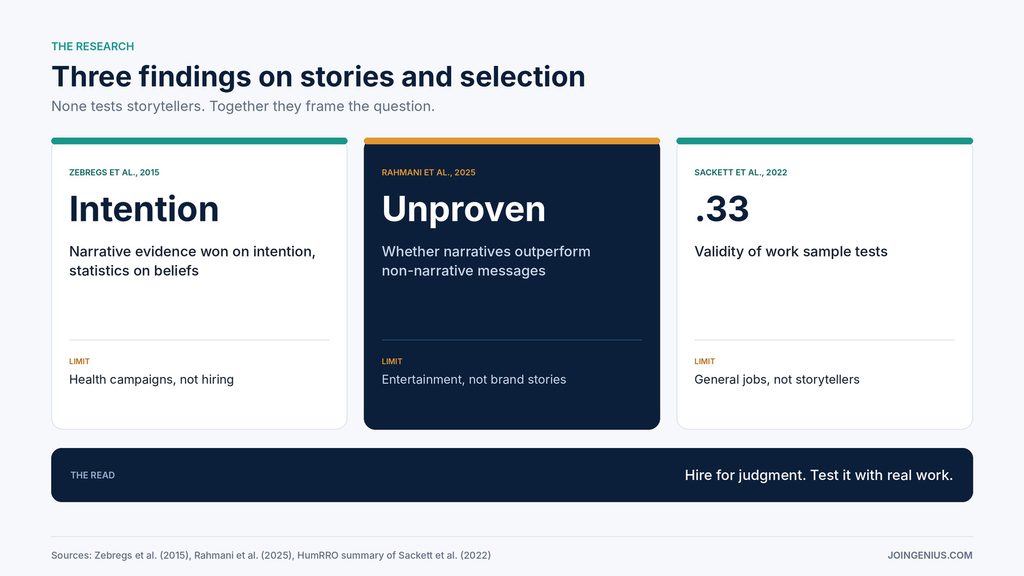
A 2025 meta-analysis in Behavioural Public Policy by Bardia Rahmani, Beatrice Montano, Dylan Groves and Donald Green looked at the persuasive effects of narrative entertainment. It drew on 77 experimental comparisons from 57 articles and 24,380 respondents. Against controls that received no message or a placebo, narratives had an effect of about 0.24 on a standardized scale. When narratives were compared with non-narrative messages, the difference was not statistically significant, and the authors conclude that the advantage of narratives is unproven. The studies concern narrative entertainment, not brand or business stories.
A 2015 meta-analysis in Health Communication by S. Zebregs and colleagues compared statistical and narrative evidence. Statistical evidence had a stronger influence on beliefs and attitude, while narrative evidence had a stronger influence on intention. The authors explain this as a match between evidence type and outcome. The summary we read gave no effect sizes, and the work concerns health campaigns.
Our reasoning from both is simple. Stories can move people, but they do not automatically beat facts. A narrative strategist is worth hiring for judgment about when to use a story, when to use a number and how to combine them. That is an inference, not a finding.
Hire In-House or Bring In an Outside Narrative Strategist
Not every need calls for a permanent hire. Business of Story, a brand storytelling consultancy, lists brand story assessment, planning and creation among its services, alongside storytelling for leaders and sales training. Its consulting page says it serves owners and leaders of emerging companies, describes a 10-step method it calls the Story Cycle and says engagements typically run 60 to 90 days, starting with an introductory call and written proposals.
That is one firm’s description, and we treat it as a claim. The page says clients have grown by as much as 400 percent and that the system works every single time. It gives no named results behind those figures, so we do not rely on them. Its FAQ page cites research on narrative transportation and memory, but several citations link to general search pages instead of specific papers, so check anything you plan to repeat.
Our reasoning is that a time-limited outside engagement suits a defined problem, such as a messy brand story before a launch, while a permanent hire suits ongoing work, such as weekly content across channels. Neither is proven better. A consultant is still a hire. Ask in writing who will do the work, what you receive at the end (the page lists written reports, a brand story and a communications plan) and how your team keeps using it afterward. Our piece on outsourcing content creation covers splitting work with outside teams.
Test Candidates With a Paid Story Brief
A portfolio of finished stories hides how much the candidate shaped the facts, the angle and the structure. Company storytelling is usually a team effort, and credit is blurry. A paid task shows how someone turns raw material into a narrative.
Selection research supports a shared, realistic task, with a limit. A HumRRO summary of Sackett, Zhang, Berry and Lievens (2022) reports revised validity estimates in which structured interviews were highest at .42 and work sample tests were .33. The authors argue that earlier estimates were inflated by range restriction corrections, and they note that structured interview validity varies considerably. These figures concern job performance in general, not storytellers. They support a modest point: the same realistic task, scored the same way, beats improvising. Our interview guide covers how to structure the conversation.
To run the test, prepare a fact pack for a real or realistic company: a product description, three customer quotes, a short market note and one awkward fact, such as a delayed launch. Give every candidate the same pack and a time limit such as three hours. Ask a strategist for a one-page narrative covering the audience, the core message, the order of the story and the proof each part needs. Ask a storyteller for a 300-word piece from the same pack. Pay for the time, since unpaid tests ask people to work for nothing and may put off experienced candidates. That is our view, not a finding.
Write the rubric before you read any submissions. Useful criteria include a clear audience, a point that survives a one-sentence summary, claims tied to the fact pack and honest handling of the awkward fact.
Hire for Evidence Discipline
Business of Story’s FAQ warns that emotionally compelling narratives can deceive if they are not grounded in truth, and it recommends pairing story with evidence. We agree, and the research above points the same way, since numbers did better than stories on beliefs and attitude in the health communication review.
In the interview, ask how a candidate would check a customer anecdote before using it, what they would cut when two facts conflict with the story and how they would explain a delay without spin. Our reasoning is that answers naming a check are stronger than answers naming a feeling. These questions are our suggestions, not validated measures. Our piece on hiring communications leaders covers a related trust problem.
A Four-Step Plan to Hire a Storyteller or Strategist
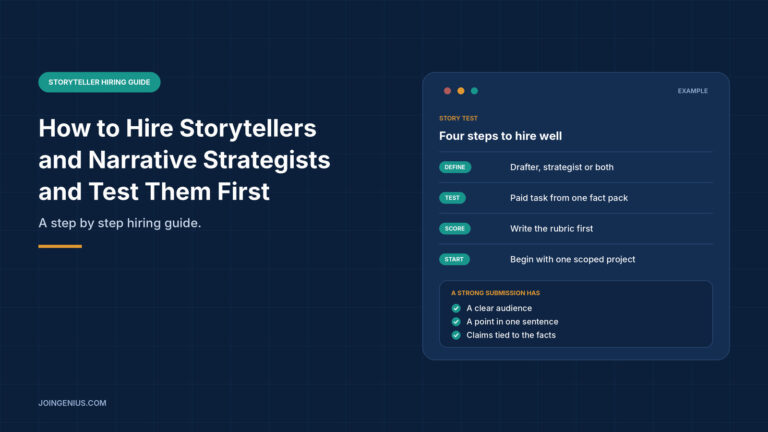
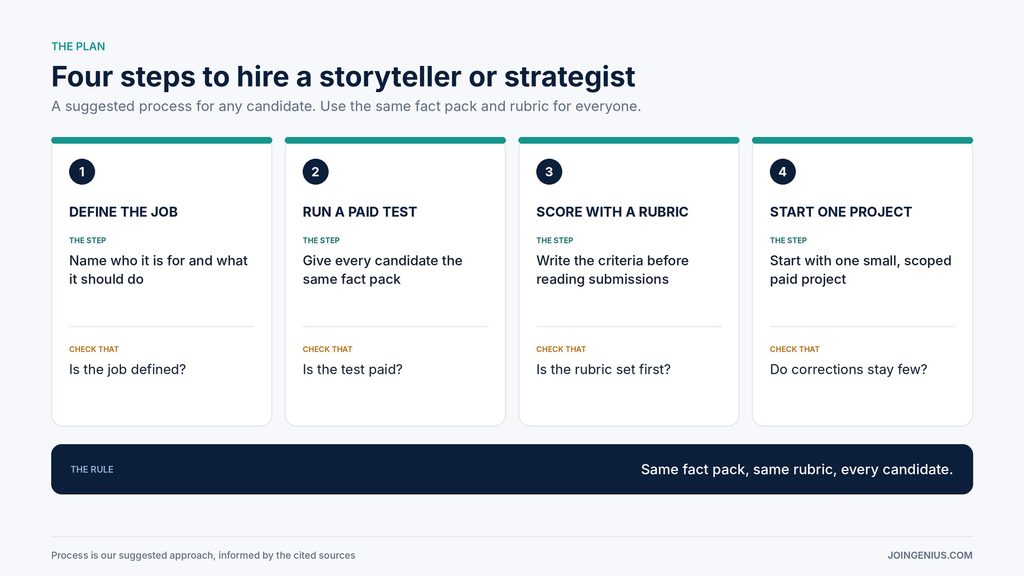
Use this four-step plan for every storytelling hire. It is our suggested process, informed by the sources above.
- Define the job. Decide whether you need a drafter, a strategist or both, and name the audience and the outcome.
- Run a paid test. Give every candidate the same fact pack and pay for their time.
- Score with a rubric. Write the criteria before you read any submissions.
- Start with one scoped project. Begin with one small paid project before a longer commitment.
The last step matters because a test shows how someone handles one brief, and a first real project shows how they handle your team, your approvals and your data.
Measure Whether the Hire Works
Track how many facts need correcting in each piece, how many revision rounds it takes, whether sales and marketing use the same core message and whether leaders can retell the story in a sentence. Judge the person over several pieces, since one submission proves little, and be careful about crediting a story for sales changes, because many factors move revenue. Ask a few customers what they remember. These measures are our suggestions, not findings.
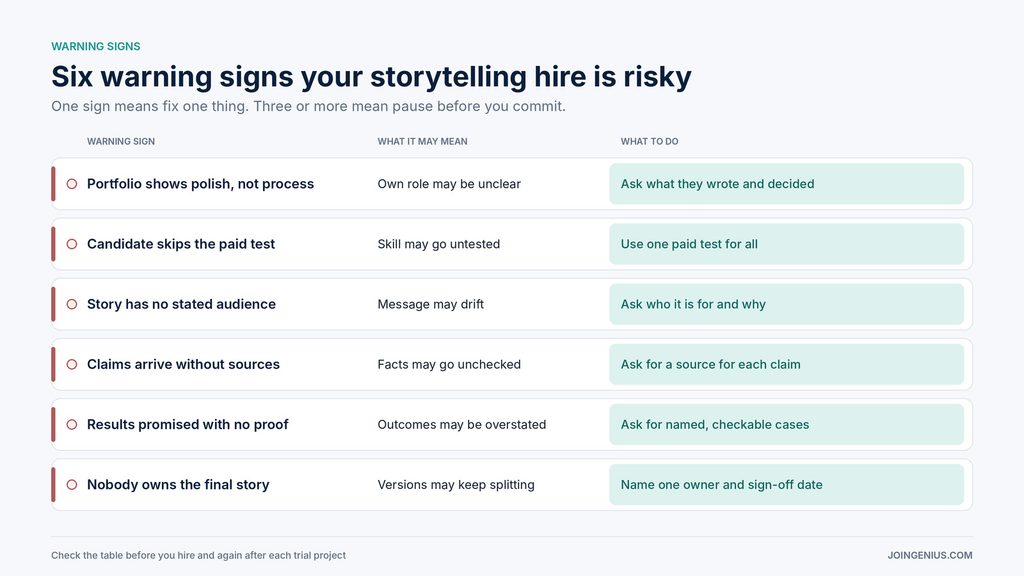
Warning Signs Your Storytelling Hire Is Risky, and What to Do About Each
Check this table before you hire and after each trial project. One sign means fix one thing. Three or more mean pause before you commit.
Hire for Judgment, Then Test for It
A good storyteller turns raw facts into something people can follow and repeat. A good narrative strategist decides which story to tell and makes sure the whole company tells it the same way. Define the job first, give every candidate the same paid brief, score the results against a rubric written in advance and start with one small project. We found no study proving that this method picks better candidates, but each step replaces a guess with evidence. If the first project needs few corrections and your team can retell the story in a sentence, you have a better reason to keep the person than any polished portfolio.