The best interview questions to ask a software engineer are not the ones everyone else is asking. The whiteboard round that reverses a linked list tells you who memorized a textbook. It does not tell you who will own a service in production six months in, who will read someone else’s code without complaining, or who will catch the subtle bug that a scanner never would.
That gap keeps getting wider. AI has reshaped how teams hire across most engineering roles, so the trivia a candidate can now Google in two seconds is a weak signal. Below, we cover why the standard loop stopped working, the questions that actually predict performance, and the ones to stop asking before another good candidate walks out of your pipeline.
Why the Standard Interview Loop Stopped Working
The classic five-round software engineer interview was designed for a world where the whiteboard was the only visible proxy for skill. That world is gone and the loop didn’t keep up.
Algorithm Trivia Stopped Predicting the Job
The engineer who can reverse a binary tree in forty-five minutes is not the engineer who ships. The two sets overlap, but far less than hiring managers assume. A good interview question connects to the actual work the person will do, not to a university data structures class.
AI Tools Shifted What to Test For
A candidate with Cursor open can pass most take-home tests you remember. The signal is no longer whether they can produce code. It is whether they can read code, judge it, and ship something a senior engineer would approve. The question set has to match that.
Candidates Started Walking From Bad Loops
Strong engineers have options. A six-round loop with four whiteboard sessions reads as a company that does not value their time. The best candidates drop out before the final round, and the ones who stay are the ones with fewer offers.
Which Interview Methods Actually Predict Performance
The hiring methods research is clear, and most engineering interview loops ignore most of it. The best interview questions to ask a software engineer come from the methods that actually show up in the data.
Structured Interviews Over Casual Chats
Ask every candidate the same questions, in the same order, scored on the same rubric. Casual chats feel better in the moment and tell you much less. A workable talent acquisition strategy for engineering has to put structure above vibes, or every hire turns into a coin flip.
Work Samples Over Whiteboard Puzzles
A real sample of the work beats a puzzle every time. If the role maintains a Django service, let the candidate read a small Django service and describe what they’d change. The signal from forty minutes of that beats three hours of algorithm trivia.
Judgment Questions Over Trivia
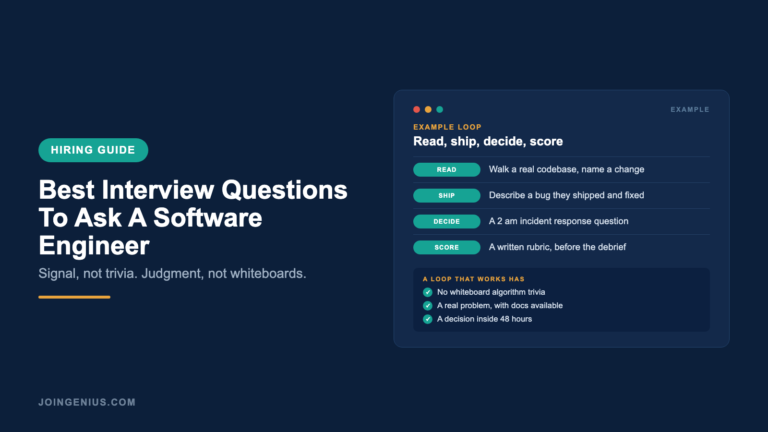
Ask about the last time they rolled back a deploy. Ask what they’d check first if the error rate spiked at 2 am. Judgment questions tell you how the engineer thinks under pressure, which is the thing you are actually hiring for.
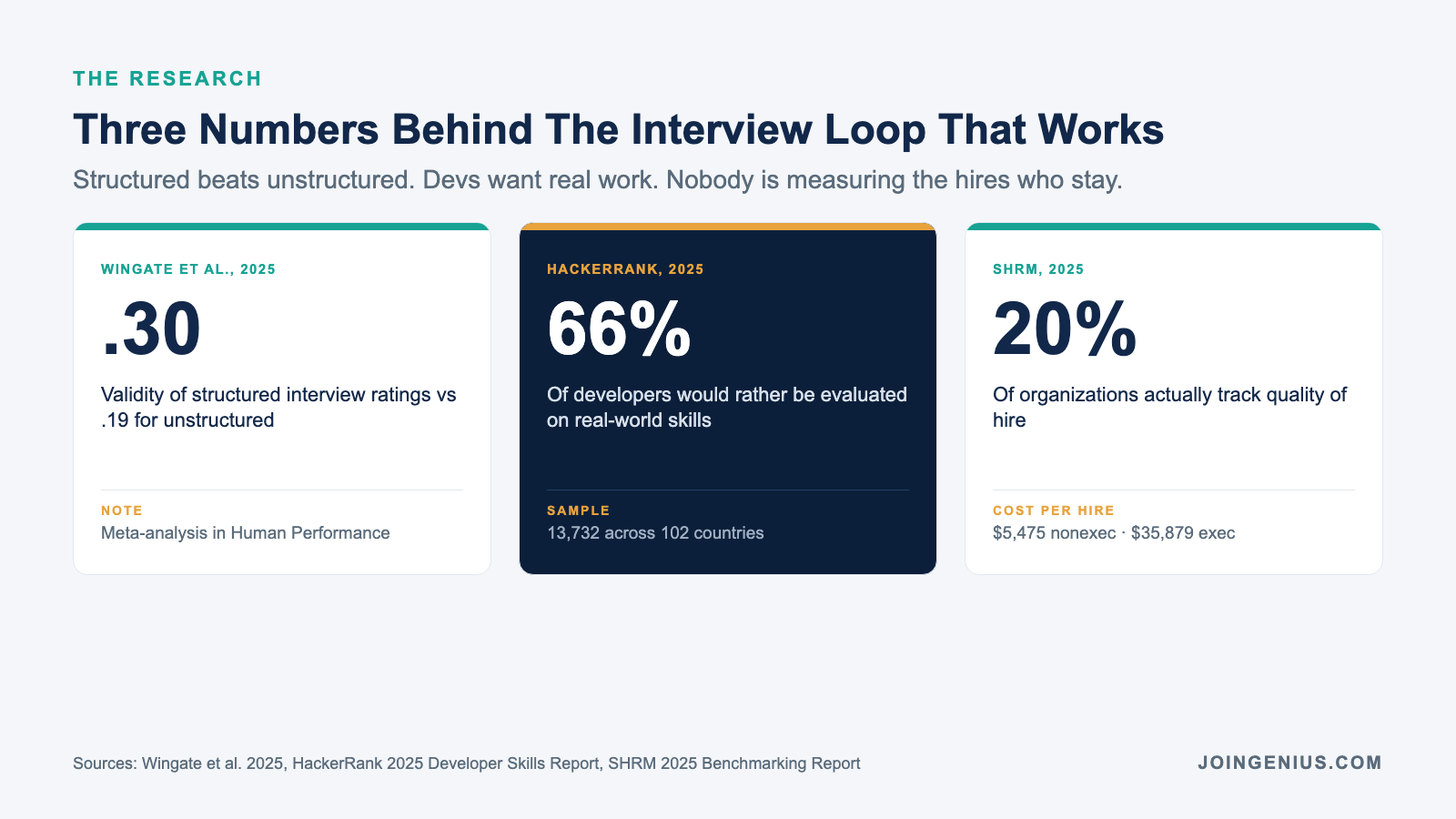
A 2025 meta-analysis by Wingate and colleagues found structured interview ratings predict on-the-job task performance at ρ = .30, well above the ρ = .19 that unstructured interviews achieve. The gap is wider than most hiring leaders assume, and it is where most engineering loops lose their quality.
The Interview Questions That Actually Work
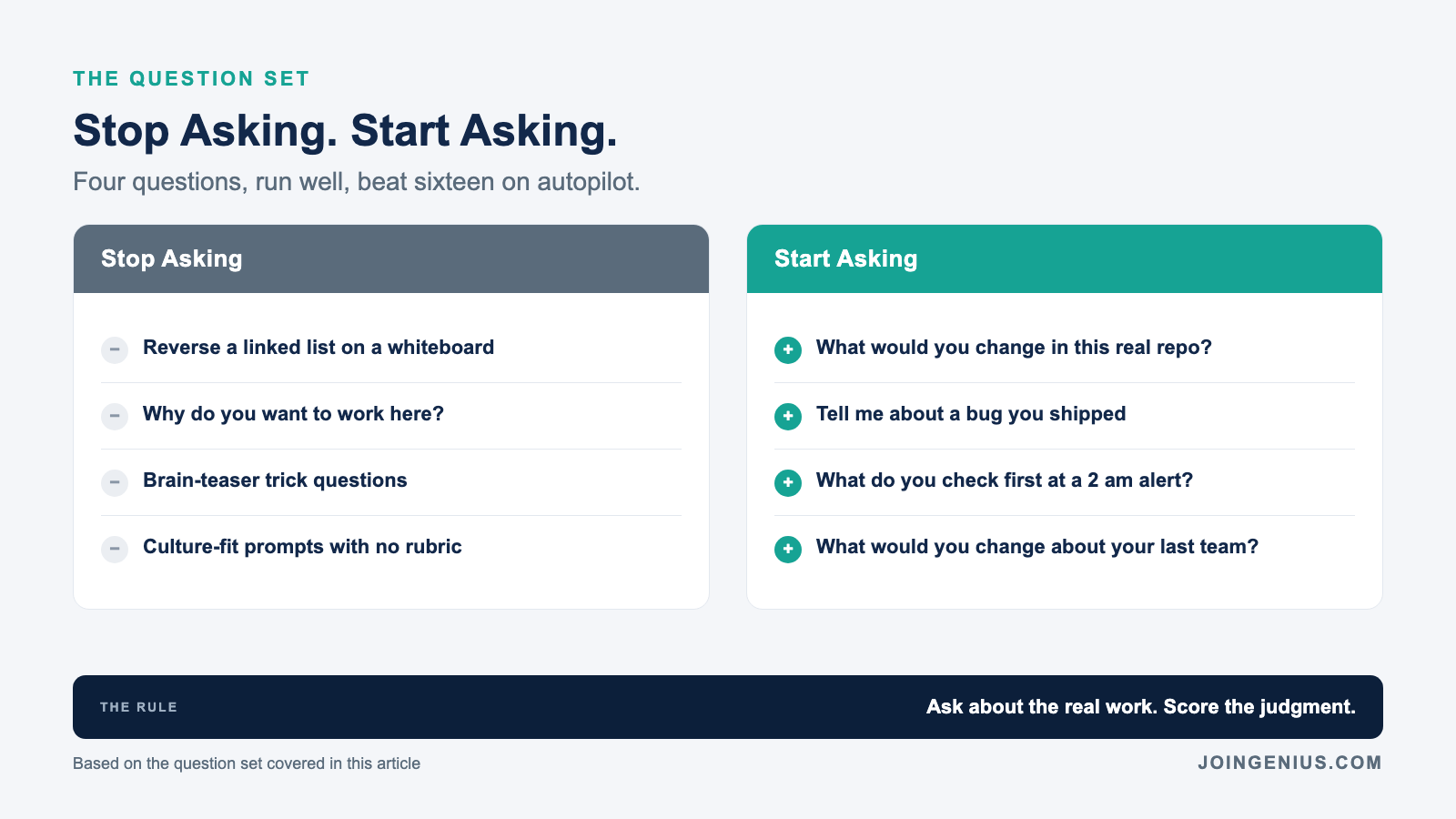
A good question set is short, specific, and connected to the real work. Four questions, run well, beat sixteen questions run on autopilot.
Give Them a Real Codebase and Watch Them Read It
Hand the candidate a small, real repository and ask what they’d change in the first week. The answer tells you how they approach a codebase they didn’t write, which is 80% of a working engineer’s day. The ones who ask good questions about it are usually the ones who stay.
Ask About a Recent Bug They Shipped
Not the bug they fixed. The bug they shipped. The candidate who can describe a real production mistake, what they missed, and how they changed their process afterward is the candidate who learns on the job. The ones who claim they have never shipped a bug are either lying or junior.
Let Them Use the Tools They’d Use at Work
The best technical screen looks like the real job. Hand the candidate a real problem and let them look things up, so they can reach for a reference like StackAbuse or the official docs the way they would on the job. The engineer who knows how to search for the right pattern beats the engineer who memorized one answer.
Ask What They’d Change About Their Last Team’s Process
The answer tells you how they think about engineering as a system, not just as code. Candidates who have real opinions here are candidates who will make your team better. Candidates who have no opinions have never actually owned anything.
HackerRank’s 2025 Developer Skills Report, which surveyed 13,732 people across 102 countries, found 56% of developers consider algorithm-based interview questions irrelevant to their jobs, and 66% would rather be evaluated on real-world skills. The candidates are telling you what to ask them, and most loops are still ignoring it.
What to Stop Asking Software Engineers
A good question set is defined by what it leaves out. These are the questions almost everyone still asks and almost no one should.
“Reverse a Linked List on a Whiteboard”
The question tests memorization, not engineering. Any candidate who has interviewed in the last year has rehearsed it, and any production engineer solves it with a one-line library call. The signal-to-noise is terrible and it costs you time.
“Why Do You Want to Work Here?”
Every candidate has the same rehearsed answer and nobody tells the real one. The honest version is “the comp was good and the role matched my skills,” and nobody will say it. Skip the question and ask what they would want to work on, which actually tells you something.
Trick Questions and Brain Teasers
The engineer who gets the manhole-cover question right is not a better engineer than the one who doesn’t. The question tests how comfortable the candidate is with the specific style of puzzle, which has nothing to do with the work. Sourcing founding engineers at a startup should not depend on this kind of trivia either.
Culture-Fit Questions With No Rubric
“Would I want to grab a beer with this person” is not a hiring criterion and it introduces bias at every step. Replace it with a specific question about collaboration, scored on the same rubric as every other answer. Hiring for startups especially needs this discipline because the stakes per hire are higher.
How to Score and Decide Without Guesswork
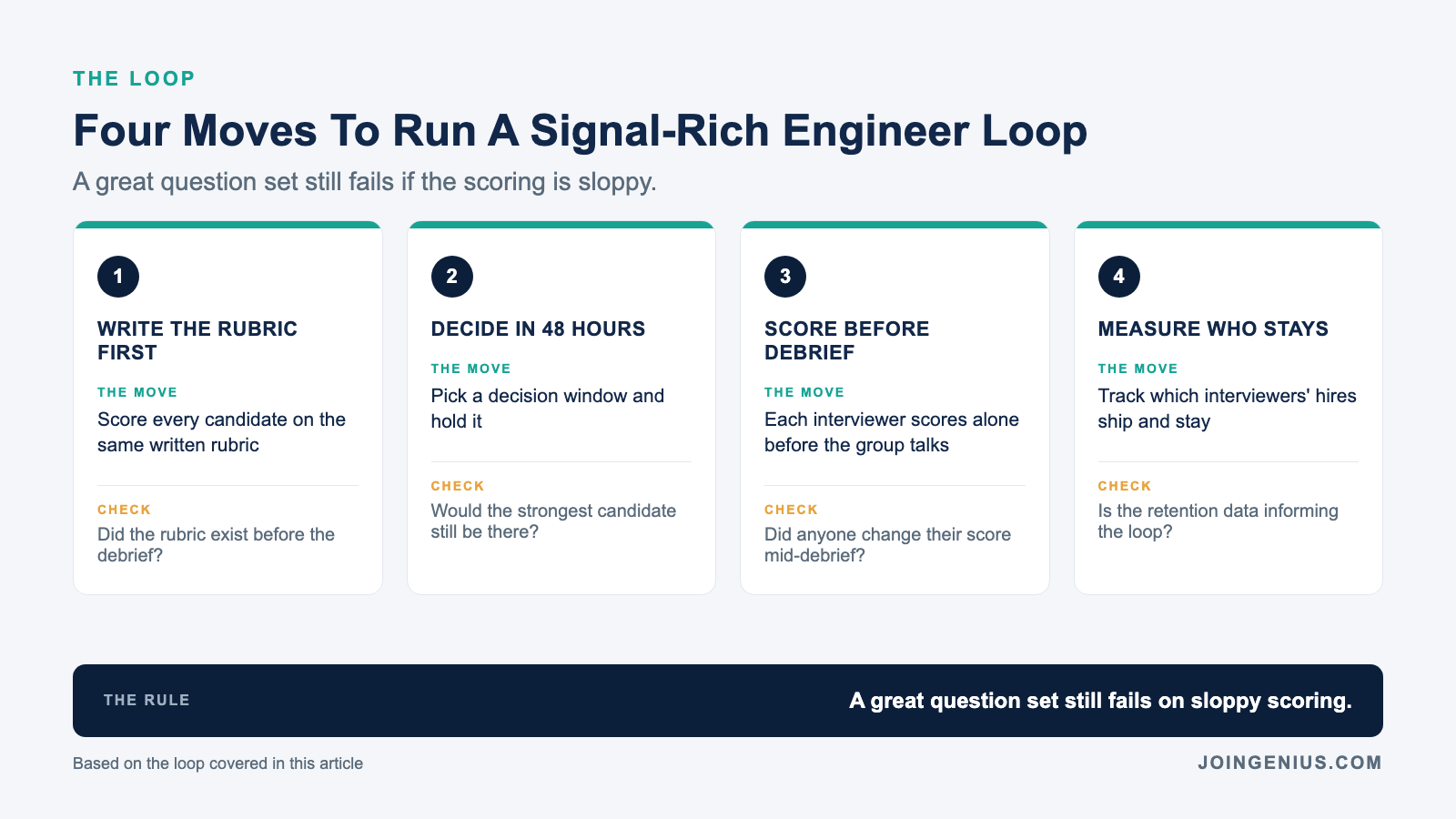
A great question set still fails if the scoring is sloppy. The decision step is where most engineering loops quietly leak quality.
One Rubric for Every Candidate
Write the rubric before the first interview, not after. Every candidate gets scored on the same dimensions on the same scale. Score before the debrief, so nobody anchors to someone else’s opinion.
Decide in Forty-Eight Hours
A loop that drags for two weeks loses the candidate to the company that decided in two days. Pick a 48-hour decision window and stick to it. If the panel cannot agree in two days, the signal is weak and the answer is probably no.
Measure the Hires Who Stay, Not the Ones You Liked
Track which interviewers’ hires ship, stay and get promoted. The interviewer whose candidates all quit at month six is not a good interviewer, no matter how much they liked their picks. Retention and attraction data makes the loop better over time, not just the comp plan.
A Short Signal Table
| What to Check | Weak Interview Signal | Strong Interview Signal |
|---|---|---|
| Asks the candidate for | A clean algorithm from memory | A real bug they shipped |
| Treats a Google search as | A disqualification | Expected and normal |
| Scores against | The last interviewer’s take | A written rubric filled in before the debrief |
| Decides within | Two to three weeks | Forty-eight hours |
In SHRM’s 2025 Recruiting Benchmarking Report, which surveyed 2,371 members in early 2025, average cost per hire reached $5,475 for nonexecutives and $35,879 for executives — and only 20% of organizations track quality of hire. If you are paying that much per seat and not measuring who stays, the loop is operating blind.
Conclusion
The best interview questions to ask a software engineer are the ones that look like the work the person will actually do. A real codebase, a real bug, a real decision under pressure. If the loop still tests memory and trivia, the loop is testing the wrong thing and the strongest candidates know it before you do.
We built Genius so engineering teams can run that kind of loop with candidates they otherwise would not meet. We place the top 1% of engineering and operations talent from the Philippines and Latin America, at around 80% less than comparable local hires. The relationship stays direct, with no monthly agency fees and a 6-month replacement guarantee on every placement. If the next engineering hire is the one you keep running the wrong interview for, see how we source and place engineering talent.