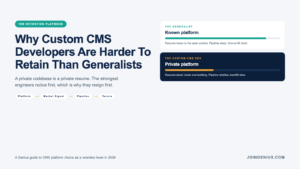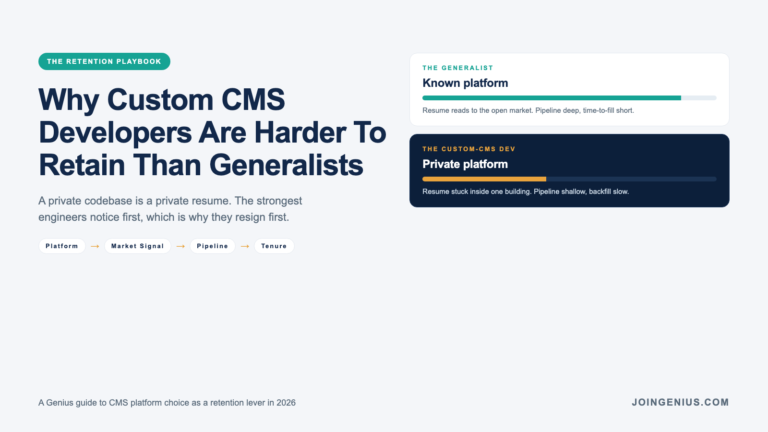
The two engineers you cannot replace are the ones who built the custom CMS. They know every quirk and every undocumented function. They also know why the deploy script lives in a file nobody else has read in three years. They are the two engineers most likely to resign next quarter. That pattern is not bad luck, and it is not about pay. It is a structural feature of what it feels like to maintain a bespoke CMS in 2026.
The platform choice your team made four years ago is quietly shaping your retention curve today. Modern hiring workflows have made it faster than ever to hire a React engineer or a WordPress specialist, but they have done nothing to make it faster to hire a replacement for someone leaving a custom PHP CMS nobody outside your building has heard of. Below, we cover why custom CMS work shortens developer tenure and where the platform choice changes the retention math. We also cover the hiring playbook for a team that wants to keep the people who know the system.
Why Custom CMS Work Shortens Developer Tenure
A generalist engineer on a known platform is building a resume the market can read. A custom CMS engineer is building a resume that only one employer can read. The gap between those two situations compounds over a year, and the two-week notice is where it finally shows up.
The Market Signal Is Weak
A WordPress or Drupal developer has a public skill. A “Acme Internal CMS v3” developer has a private one. The second group has to translate every bullet on their resume into something the recruiter at the next company understands. Most of them stop trying after the third round of translation and start applying for the roles whose stack is on the job post already.
The Codebase Is Lonely
A known CMS has a community and a documentation site. It also has a Discord and ten thousand Stack Overflow answers waiting for the engineer at 10pm. A bespoke CMS has one person on Slack who may or may not still work there. That isolation is a career tax the engineer pays every day, and it is not visible on any dashboard.
Technical Debt Lands On The Same Two People
Every unloved corner of a custom CMS has an owner by default. It is the engineer who touched it last. That person becomes the single point of failure for whole surfaces of the product, and single-point-of-failure engineers burn out faster than anyone else on the team.
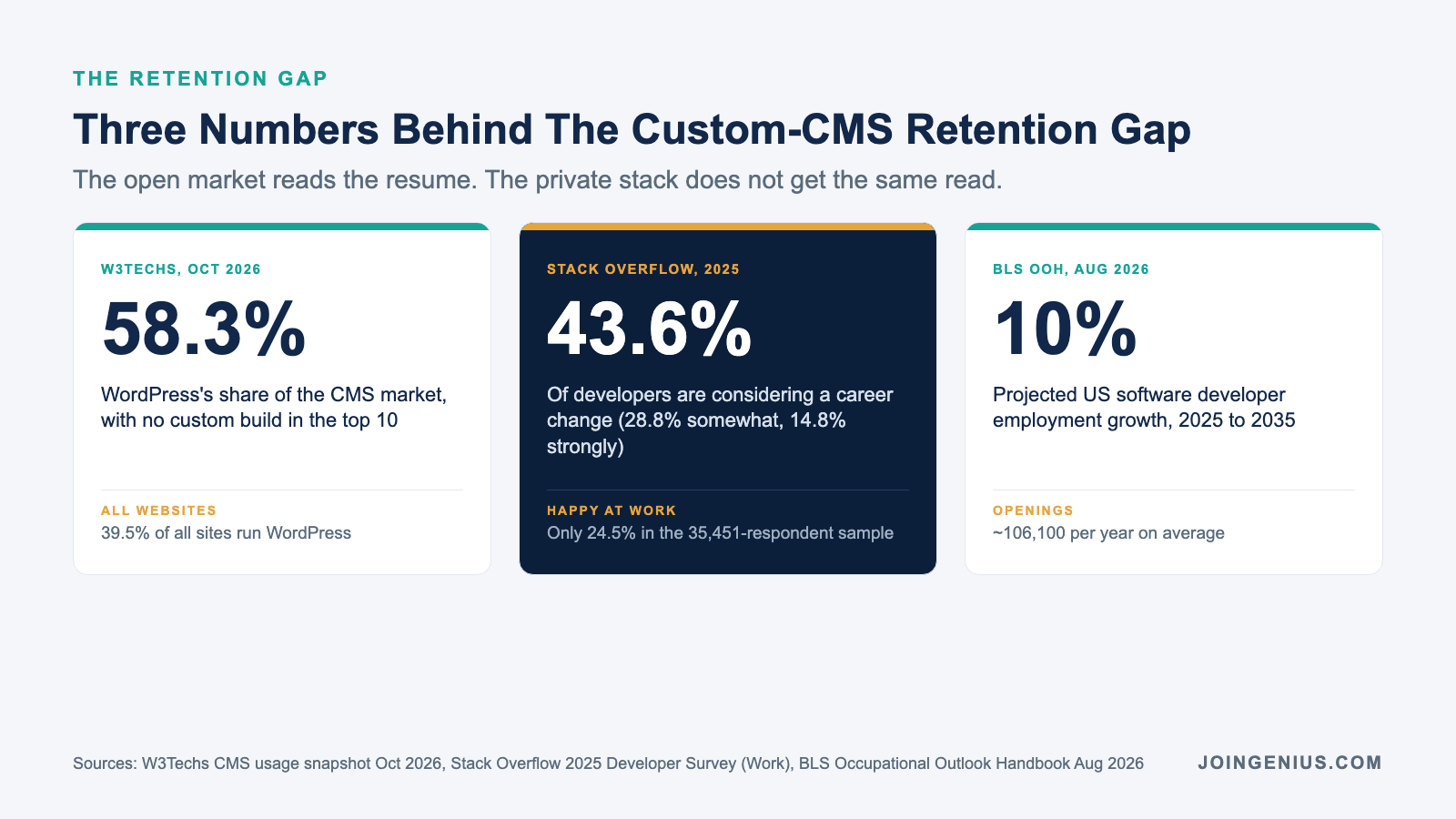
W3Techs’ content management system usage tracker, snapshot dated 29 October 2026, shows WordPress powering 39.5% of all websites and holding 58.3% of the CMS market, with no custom build cracking the top 10. The nearest named competitors (Shopify at 7.9% of the CMS market, Wix at 6.2%) sit far behind. The talent pool a WordPress or Drupal shop pulls from is orders of magnitude deeper than the pool for any bespoke in-house CMS, and the open market sets the resume reader for every one of your engineers.
What a Custom CMS Costs the Engineer (and Then You)
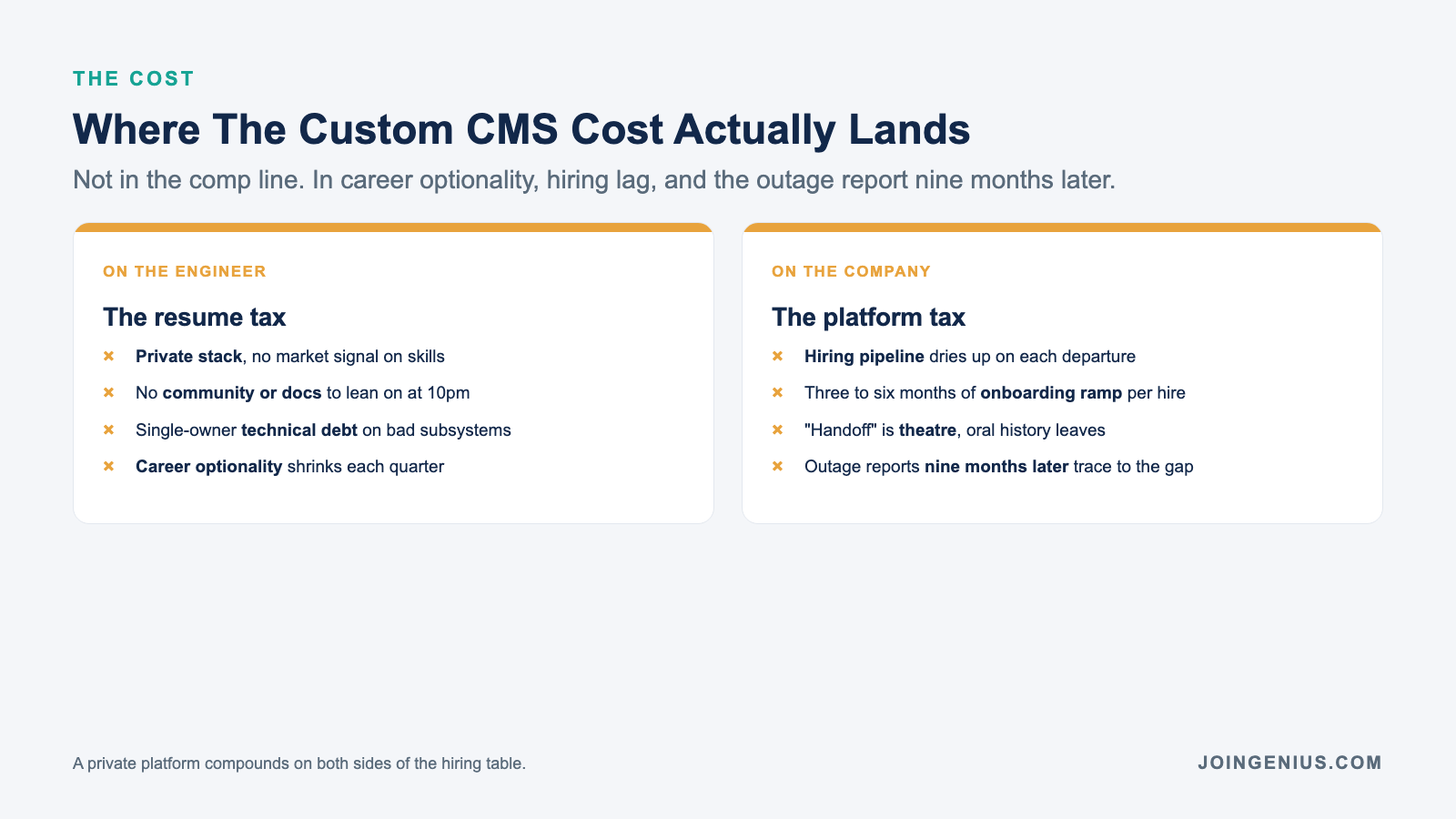
The engineer leaves because the role costs them something they can measure. The company pays those costs on the back end, usually without ever naming them.
Career Optionality Shrinks Each Quarter
Every month on a bespoke stack is a month not spent getting better at a platform the open market will pay for. The strongest engineers notice this first, which is exactly why the strongest engineers are the first to leave.
The Hiring Pipeline Dries Up
When a custom CMS engineer resigns, the replacement search is a different kind of search. You are not hiring a WordPress developer, you are hiring a general-purpose engineer and then paying for three to six months of ramp while they learn your private system. The cost per hire doubles and the time to productive triples.
Knowledge Transfer Is Theatre
The two weeks of “handoff” at the end of a resignation never captures what the engineer actually knew. The documentation is thin and the oral history goes with them. The next person inherits a codebase that works for reasons nobody can state in a single meeting.
Platform Risk Shows Up In Downtime
The engineer who leaves is also the person who kept a specific subsystem running. The outage report nine months after their departure almost always traces back to a corner of the code the new team has not yet mapped.
Stack Overflow’s 2025 Developer Survey Work section, published July 2025 with 35,451 respondents, found that 28.4% of developers are “not happy at work” and 43.6% are considering a career change (28.8% somewhat, 14.8% strongly), with 8.8% having voluntarily transitioned to a new role in the past year. Only 24.5% described themselves as “happy at work.” The ranked satisfaction drivers (autonomy, competitive pay, solving real problems) are exactly what a lonely bespoke CMS codebase without a community tends to erode first.
Where Platform Choice Changes the Retention Math
The retention lever most CMS teams underuse is not comp or culture. It is the choice of what sits under the “C” in “CMS” in the first place.
A Known Platform Means A Known Resume
An engineer working on a widely adopted platform is also building a career artifact the next employer recognizes. The retention effect is counterintuitive but real, which is that the engineer stays longer when they feel they could leave easily, because the job itself stops feeling like a trap.
Customization Does Not Require Ownership Of The Core
The reason most teams end up on a bespoke CMS is that the editor needed something the off-the-shelf platform could not do. A mature open source CMS like MODX gives you the ability to customize a proven platform to the exact needs of the site, without the ongoing cost of maintaining the core yourself. You get the flexibility and the security track record together, which is the combination a hand-built CMS can rarely sustain past year three.
Community Replaces Tribal Knowledge
A platform with an active community means your engineer can ask a question outside the building and get an answer. That one feature does more for retention than any brown-bag or hackathon week.
The Hiring Pool Opens Up
When the next CMS engineer you need is already on the market because they already work on the same platform, the time-to-fill drops from months to weeks. That alone changes how urgent any one departure feels, which changes how overworked the people who stayed feel.
The Hiring Playbook for CMS Dev Retention
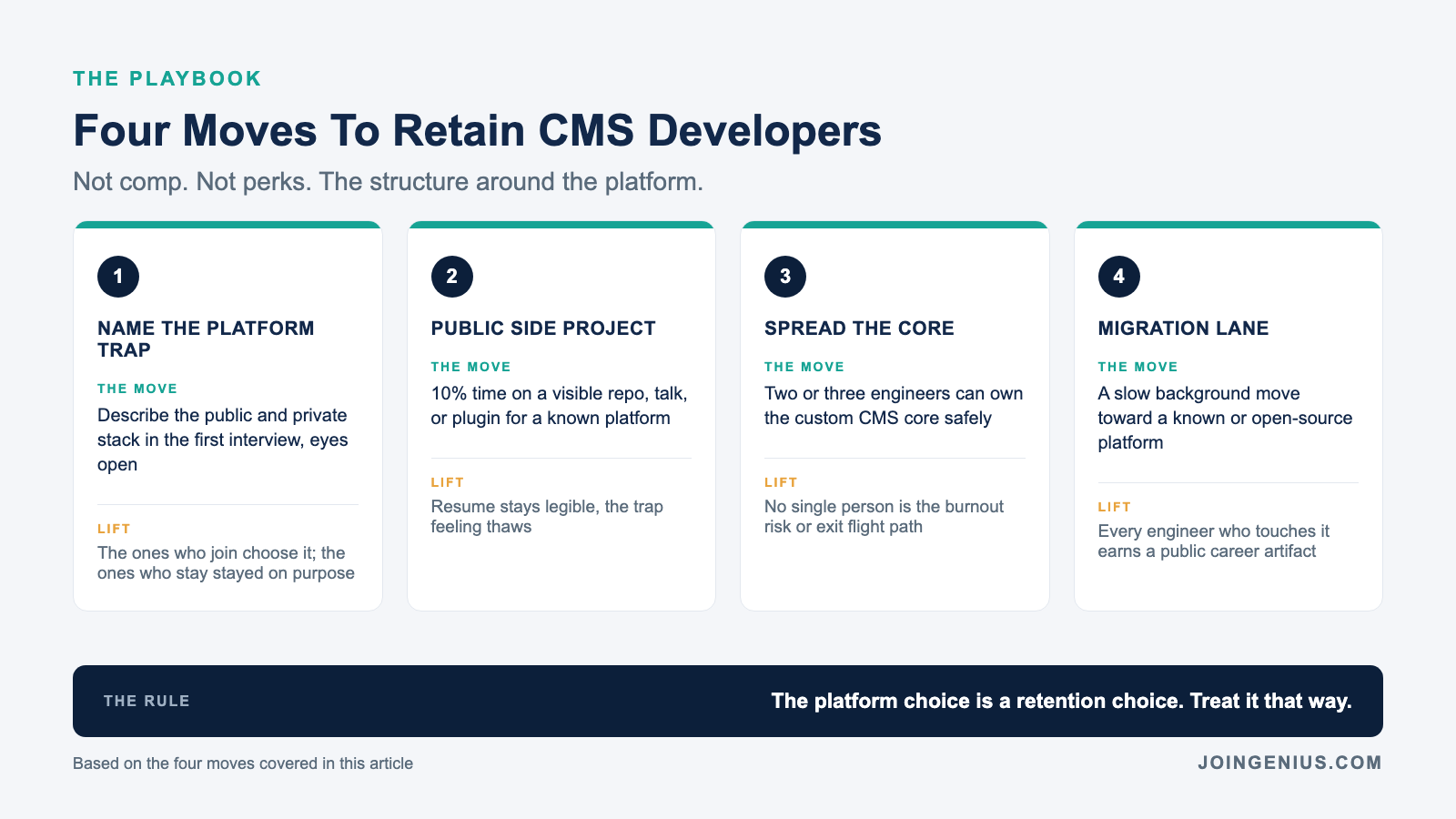
Four moves consistently improve CMS engineer tenure. None of them require a comp band change.
Audit The “Platform Trap” At Hiring Time
If a candidate joins a team that runs a bespoke CMS, name it in the first interview. Describe the public and private stack explicitly. The ones who stay are the ones who signed up for the private side with eyes open. The ones who leave are the ones who thought they were joining the public side.
Pair Every Custom-CMS Engineer With A Public Side Project
Give the engineer 10% of their time on a public technology adjacent to the role. A published repo or a conference talk works. A plugin for a known CMS works too. Any one of these keeps the resume readable to the outside market and keeps the engineer in the role longer because the trap feeling thaws.
Document Toward A Hire You Have Not Made Yet
Write documentation for the person you will hire next, not for the person who already works there. Why marketing ops hires don’t stay past their first 18 months teaches the same lesson in a different domain, which is that onboarding quality is a retention metric even for the people who have already onboarded.
Build A Platform-Migration Lane Before You Need One
The teams that run a slow migration from a bespoke CMS to a known platform in the background have the strongest retention. The migration itself is a career artifact for every engineer who touches it, and it quietly removes the trap.
What to Stop Doing (It’s Pushing Them Out)
Four moves consistently inflate CMS engineer attrition. Cut these first.
Making One Engineer The Single Owner Of The Core
If one person owns the custom CMS core, they also own the exit path. Spread the knowledge across at least two or three engineers so no one person is the burnout risk.
Hiring Generalists And Expecting Them To Stay On Bespoke Work
A generalist you hired on their React skill will not want to spend eighteen months in a legacy PHP CMS codebase. Match the role to the resume, or they will leave to match the resume to the role.
Confusing Low Attrition With High Satisfaction
A team with no resignations is not necessarily a happy team. It may be a team whose market options are blocked by their own stack. Low morale at work often sits highest on teams where the engineers feel they cannot leave as easily as they want to.
Treating The Custom CMS As Unmovable
Every bespoke CMS was a choice. Every bespoke CMS can be moved off, in part or in whole. Treating the platform as a given is how the retention curve stays flat and the hiring cost stays high.
How to Measure CMS Developer Retention Over Time
A healthy CMS team shows up in the data in four places.
Custom-Core Tenure Vs General-Engineer Tenure
The average tenure of the engineers who touch the custom CMS core, next to the average tenure of the generalists on the broader team. If the first number is lower than the second by more than six months, the platform is the problem.
Time To Fill On The Next CMS Engineer Role
The number of weeks between posting the role and signing the hire. On a known platform this should be measured in weeks, not months.
Bus-Factor On The Custom CMS Core
The number of engineers who can safely ship a non-trivial change to the core subsystem without supervision. If the number is one, every departure is a crisis.
A Short CMS Retention Scorecard
| What To Measure | Weak Signal | Strong Signal |
|---|---|---|
| Platform market signal | Private stack, resume-illegible | Known stack, resume-legible |
| Core ownership | One single-point-of-failure engineer | 2+ engineers can own the core |
| Time to fill | Months, custom search | Weeks, standard pipeline |
| Public work | None, all internal | 10% time, visible contributions |
The US Bureau of Labor Statistics Occupational Outlook Handbook for Software Developers, last updated August 2026, projects 10% employment growth from 2025 to 2035 (far faster than the 3% average for all occupations) and roughly 106,100 openings per year on average over the decade. The market a bored custom-CMS engineer can walk into stays persistently wide open. That is a retention tax on every stack that is not resume-portable.
Conclusion
The retention problem on a custom CMS team is not a comp problem and it is not a culture problem. It is a platform problem, and the fix sits two decisions upstream of HR. Move toward a stack the market recognizes, open the private codebase into a public one wherever you reasonably can, and the engineers who were on their way out stop writing the resignation email in their head.
We built Genius so engineering teams can staff the people who make that migration possible. We place the top 1% of software engineering and operations talent from the Philippines and Latin America, at around 80% less than comparable local hires. The relationship stays direct, with no monthly agency fees and a 6-month replacement guarantee on every placement. If the next engineering hire is the one who finally untangles the custom CMS without burning out doing it, see how we source and place the engineering talent that stays through the migration.