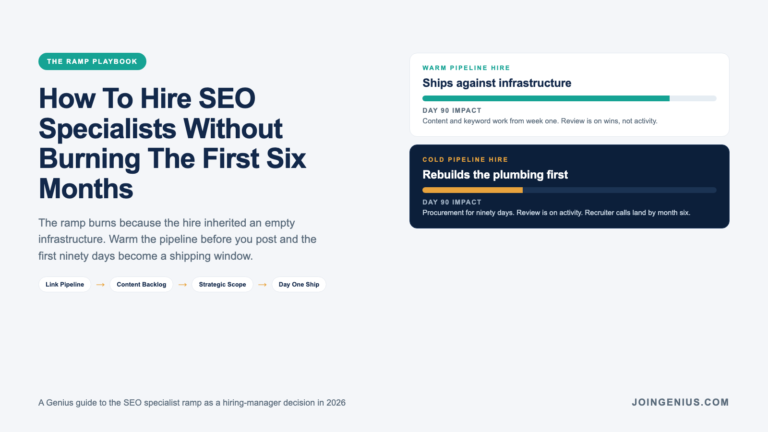
The SEO specialist you hire in Q1 is almost never the SEO specialist you review in Q3. In between those two moments is a six-month tunnel that eats most of the role’s early momentum, and the reason is almost always the same: the hire inherited an empty infrastructure. No backlink pipeline. No content pipeline. No warm relationships with publishers. Just a dashboard and a mandate. By month four the quarterly review is a long explanation of why the needle has not moved yet, and by month six the strongest hires are already fielding recruiter calls.
The six-month burn is not a talent problem. It is a scoping problem that lands squarely on the hiring manager, and it is one of the most expensive mistakes a growth org can make. Modern hiring workflows have made it faster than ever to find a qualified SEO specialist, but speeding up the search without fixing the ramp is just a faster path to the same outcome. Below we cover why the first six months of an SEO hire usually burn and what a working link pipeline changes for the new hire. We also cover the hiring playbook for SEO specialists who actually ship, and how to measure the ramp.
Why The First Six Months Of An SEO Hire Usually Burn
The ramp problem on a new SEO hire is predictable to the point of being measurable. The hire walks into a cold stack and spends their first two quarters building the plumbing. The strategic work the role was hired for does not start until month seven.
The Hire Inherits An Empty Infrastructure
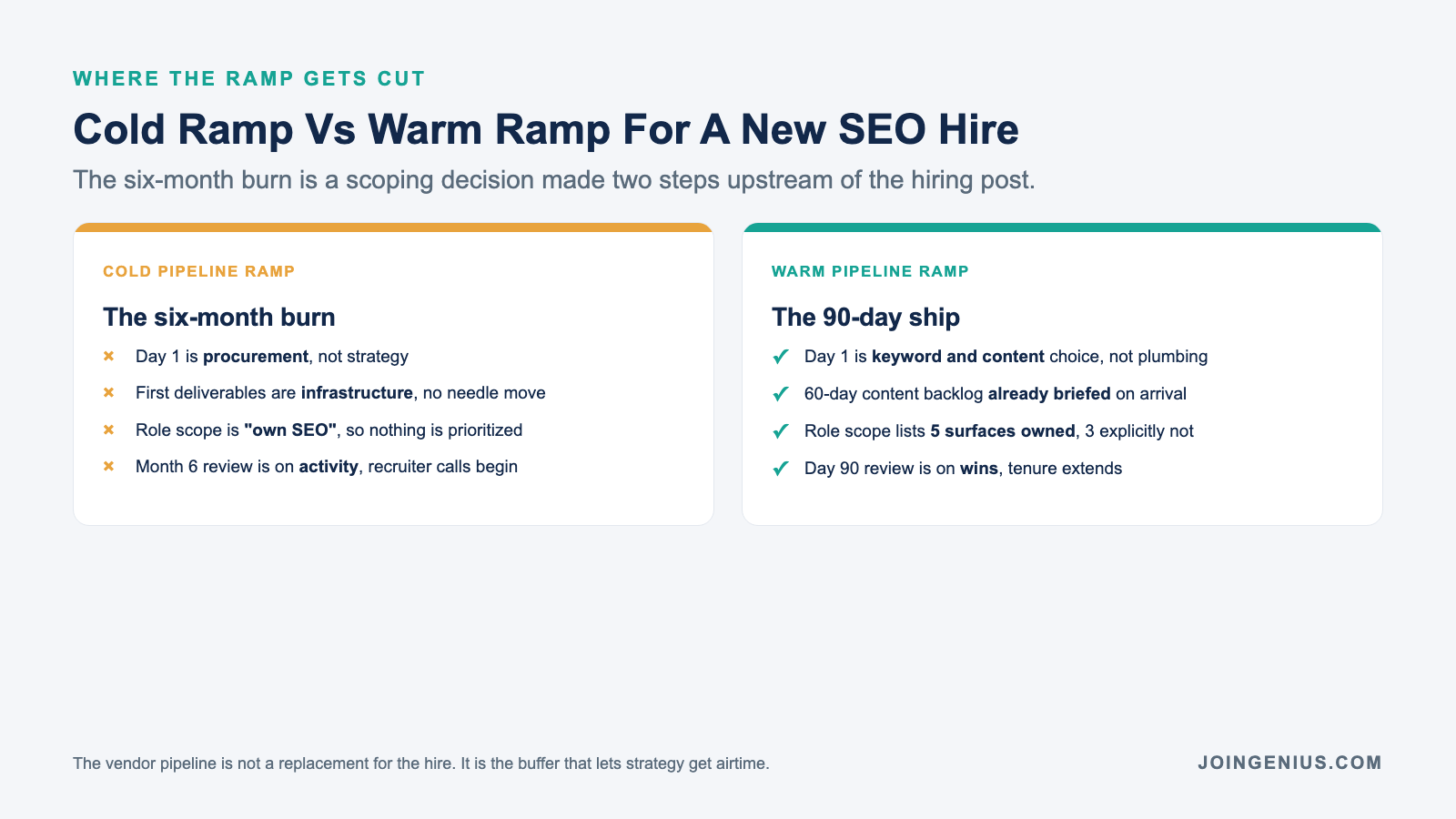
Most SEO roles are posted the quarter after the growth plan called for one, which means the hire arrives before anyone has stood up the link pipeline, and before the content ops and publisher relationships the work needs even exist. They spend the first ninety days doing procurement instead of strategy, and the clock on their “impact” runs the whole time.
The Role Is Scoped Too Wide
“Own SEO” on a job post almost always means “do everything SEO touches,” from technical audits to outreach to content briefs to internal links. One person doing all four jobs is one person who ships none of them well. The role that stays scoped above the commodity work is the role that lands.
The First Deliverables Are Infrastructure, Not Rankings
A new SEO hire’s first deliverables are a backlink audit and a content pipeline, usually with a reporting dashboard built in the same window. None of those move the needle on their own. The team notices nothing has moved and the hire notices the team is noticing. Should you outsource SEO & content operations? covers the same scope question from the other direction, which is that the parts of SEO you can hand off are the parts a new hire should not be inventing from scratch.
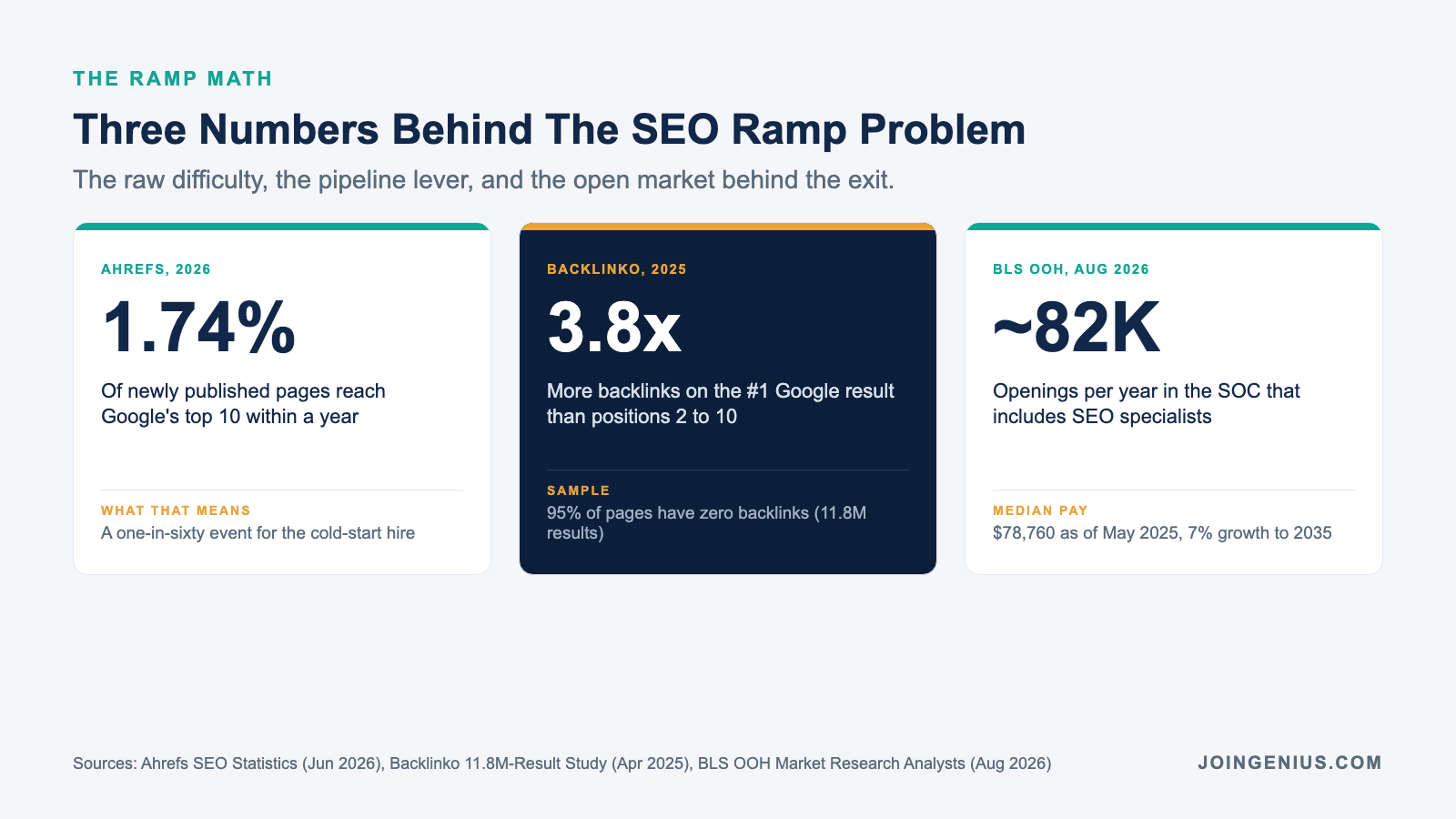
Ahrefs’ SEO statistics compendium, updated June 2, 2026, draws on their own backlink and ranking datasets to show that only 1.74% of newly published pages break into Google’s top 10 for at least one keyword inside a full year. If the raw math on new pages is that steep, asking a new SEO hire to generate top-10 placements inside their first six months is asking them to clear a bar the data says is roughly a one-in-sixty event. The pipeline you set up before you post the role is what moves the bar inside their reach.
What A Working Link Pipeline Changes For The New Hire
A warm infrastructure is the single biggest change you can make to a new SEO hire’s first six months. The specialist who walks into a running pipeline ships against it. The specialist who walks into a blank slate ships against nothing.
Ninety Days Of Scope Shifts To Strategy
When the backlinks and the content calendar are already moving, the hire’s first ninety days go to picking which pages to prioritize and which keyword clusters to invest in. That is the work they were hired for, and it is also the work that produces a measurable move inside the first quarter.
The Hire Builds On Signal, Not On Rubble
A warm link profile tells the new hire where the market already trusts the brand. A cold profile tells them nothing except that they have six months of fetching ahead. The ramp difference between those two starting positions is roughly a quarter.
The Reporting Conversation Changes
A hire that ships in month two is reviewed on wins in month three. A hire that ships in month seven is reviewed on activity in month three, which is a different (and worse) conversation. The pipeline you set up before posting the role protects the hire from the review that will push them to leave.
Momentum Compounds Faster Than Headcount
Every SEO lever compounds, which is why the warmest pipelines pull ahead of the coldest ones in a nonlinear way. Adding a specialist to a warm pipeline multiplies output. Adding one to a cold pipeline rebuilds the plumbing.
Hire Against A Working Link Pipeline, Not A Blank Slate
The strongest move an SEO hiring manager can make is to stand up the infrastructure before they post the role. The hire then walks into a ship-against stance from week one, not a build-from-scratch stance.
Why The Pipeline Matters More Than The Playbook
An SEO specialist walking into a brand with a working backlink pipeline already in place can start on the content and keyword work from day one, so standing up a link-building service like LinkDaddy before you post the role turns the first ninety days from “ramp the pipeline” into “ship against the pipeline” and the hire feels like a win instead of a slog.
Define The Role Above The Commodity Work
The parts of SEO that look the same at every company (prospecting backlinks, pushing out foundational citations, filing basic press releases) do not need a strategist’s time. The parts of SEO that only your team can do (keyword and content choice, internal linking, product-page SEO) are what the hire should own. Sending the commodity layer to a vendor and keeping the strategy layer in-house is the oldest leverage move in growth and the one most SEO hiring managers skip.
Give The Hire A Monthly Report They Did Not Write
The reporting cadence a hire inherits should include a monthly link report they do not have to assemble themselves. That one artifact tells them two things on day one: that the pipeline is real, and that nobody expects them to generate it from a cold start.
The Vendor Is The Buffer, Not The Role
A vendor pipeline is not a replacement for an SEO specialist, it is the buffer that lets them show up ready to work. The role is still strategic. The buffer is what lets strategy get airtime before infrastructure eats the quarter.
The Hiring Playbook For SEO Specialists Who Actually Ship
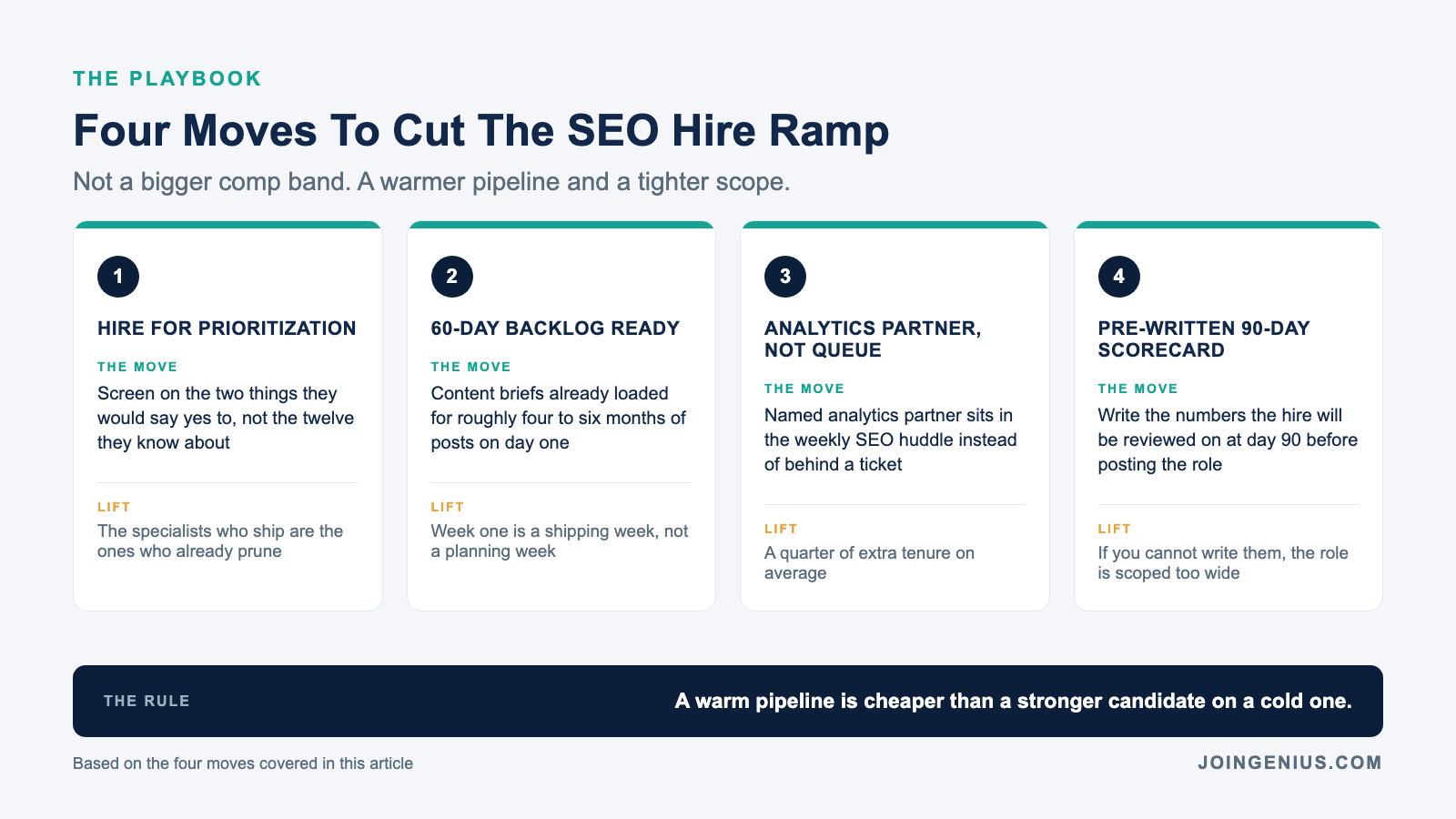
Four moves consistently cut the SEO ramp without lowering the quality bar on the hire.
Hire For Prioritization, Not For Breadth
The strongest SEO specialists are good at saying no to the twelve things that could work and yes to the two that will. Screen the final round on how they prioritize, not on how much they know.
Pay For A 60-Day Content Backlog Before The Hire Starts
The new hire should walk into sixty days of briefs ready to go, which is roughly four to six months of posts. That one preparation turns their first week from a planning week into a shipping week. Why marketing ops hires don’t stay past their first 18 months is the sister retention story in an adjacent role, which is that readiness on day one is the single biggest tenure lever.
Make The Analytics Lead A Partner, Not A Ticket Queue
The SEO hire should not have to file a ticket for every report. They should have a named partner on the analytics side and a weekly huddle. That one change is a quarter of tenure on its own.
Build The 90-Day Scorecard Before The Interview
Write the exact numbers you will review the hire on at day 90 before you interview the first candidate. If you cannot write them, the role is scoped too wide and the hire will burn their ramp proving a target that was never named.
What To Stop Doing (It’s Burning The Ramp)
Four moves consistently stretch the ramp past six months. Cut these first.
Scoping The Role As “Own SEO”
Any role scope that fits in two words is a role scope that will consume four quarters. Name the five surfaces the hire owns and the three they do not, in writing, before you post.
Expecting Ranking Movement Inside The First Quarter
SEO moves on a two to four quarter lag, and reviewing a new hire on rankings inside their first ninety days is reviewing them on work that was done before they arrived. Move the review to leading indicators. Save the lag-indicator conversation for month seven.
Pulling The Specialist Into Technical Audits They Should Not Own
The content strategist you hired is not the person who should be fixing hreflang tags. Low morale at work often sits highest on teams whose scope mixes high-leverage strategy with ticket-queue cleanup, and SEO is one of the easiest places for that mix to go unnoticed.
Treating Links As A Vendor Expense, Not A Hiring Expense
The spend that keeps the hire’s ramp short is not comp. It is the pipeline. Cutting the vendor budget to afford a bigger salary is the trade that gets you a stronger hire burning out faster.
Backlinko’s 11.8-million-result ranking study, last updated April 14, 2025, found that 95% of all pages have zero backlinks and that the #1 Google result has 3.8 times as many backlinks as the pages at positions 2 through 10. The gap between those two populations is the gap your SEO hire is being asked to close, and it is the exact gap a warm link pipeline closes before the specialist arrives.
How To Measure Ramp Speed For A New SEO Hire
A healthy SEO ramp shows up in the data in four places.
Time To First Shipped Page
The number of business days between the hire’s start date and the first new page they published. If this is over three weeks, the content pipeline was not warm enough on day one.
Leading-Indicator Movement By Day 90
Impressions and clicks on target keywords, not rankings. The leading indicator moves inside the first quarter. The lag indicator should not even be reviewed yet.
Scope Compliance
The share of the hire’s weekly hours spent on the five surfaces named in the scope document, versus the three they do not own. If this is below 70%, the scope leaked and the ramp is going to stretch.
A Short SEO Hire Ramp Scorecard
| What To Measure | Weak Signal | Strong Signal |
|---|---|---|
| Time to first shipped page | 3+ weeks, briefs still being written | Under 10 business days |
| Leading-indicator movement by day 90 | Flat, “it is still ramping” | +15% on target keyword impressions |
| Scope compliance | Under 70% on named surfaces | 85%+ on the surfaces owned |
| Link pipeline status at hire date | Cold, built in-month | Warm, vendor already shipping |
The US Bureau of Labor Statistics Occupational Outlook Handbook for Market Research Analysts, last updated August 27, 2026, projects 7% employment growth from 2025 to 2035 in the SOC category SEO specialists sit inside, with roughly 82,000 openings per year on average and a median wage of $78,760 as of May 2025. The market a stalled SEO hire can step into stays persistently open, which is why the ramp a hiring manager designs is also the retention lever they are quietly pulling.
Conclusion
The six-month burn on an SEO hire is not a performance issue, and it is not a culture issue. It is a scoping and infrastructure issue, and both of those decisions sit two steps upstream of the hiring post. Stand up the link pipeline and warm the content backlog, and the hire you make walks into a role that lets them ship from the first week. The one who stays is the one whose ramp was already paid for before they arrived.
We built Genius so growth leaders can staff the people who actually make that ramp pay off. We place the top 1% of marketing and operations talent from the Philippines and Latin America, at around 80% less than comparable local hires. The relationship stays direct, with no monthly agency fees and a 6-month replacement guarantee on every placement. If the next SEO hire is the one who finally ships from week one, see how we source and place the SEO talent that lands running.