Let’s skip the definitions – you are here because you have heard the buzz around nearshore outsourcing, and now you want receipts. Not definitions. Not theory. Just nearshore outsourcing examples where teams stopped wasting time and actually got people on board, fast.
Fair. That’s what this is. 10 stories. 10 shortcuts. 10 “why didn’t we try this sooner?” moments from companies that stopped chasing unicorns and started hiring smarter, without crossing oceans or losing sleep over time zones.
Nearshore Outsourcing Examples: 5 Key Takeaways You Need To Know

Running short on time? Here are the key takeaways you need to know:
- Companies cut hiring time by up to 80% with pre-vetted nearshore talent pools instead of battling long domestic recruiting cycles.
- Strategic region selection (Philippines, Mexico, Poland, Colombia) slashes onboarding delays by 2–3x, which keeps launches and growth plans on track.
- Pilot sprints and deliverable-driven scorecards eliminate misfires, which saves 20–30% more time during early team ramp-ups.
- Cross-border 30/60/90 onboarding templates help new hires hit KPIs 40% faster, especially for technical, support, and product roles.
- Consolidating roles under 1 nearshore partner cuts communication delays by up to 50% and boosts project velocity and CX consistency.
Here Are Some More Reads You’ll Like
🎯 What Is Offshoring? Easy-To-Understand Guide For Beginners
🌟 What Is Recruitment Process Outsourcing? (RPO Guide)
💻 Top 13 Benefits & Risks Of Offshoring To Help You Decide
What Is Nearshore Outsourcing & Why Is It Important?

Nearshore outsourcing means working with a team based in a nearby country, often within the same or a close time zone. It’s a way to access skilled talent faster, cut overhead, and keep communication fluid without building an in-house team.
Why Nearshore Outsourcing Matters:
- 2–3x faster hiring compared to domestic recruiting cycles, thanks to pre-vetted regional talent pools.
- Lower costs without losing proximity. Most companies cut labor costs by 30–70% using this model.
- Fewer timezone headaches. Most nearshore hubs sit within 1–3 hours of US or European HQs.
- Easier travel and oversight, which helps with training, team integration, and quarterly reviews.
- Faster ramp-up for urgent builds, support surges, or launches without draining in-house bandwidth.
10 Nearshore Outsourcing Examples From Real Companies With Real Results

Use these 10 nearshore outsourcing examples to pinpoint the gaps in your current hiring timelines and build a plan to close them.
1. Google: Building Cloud Capabilities In Eastern Europe
Google wanted to boost its Google Cloud platform offerings and needed quick, specialized engineering support.
Why They Outsourced: They sought faster VMware migration expertise without stretching in-house teams.
Where They Outsourced: Eastern Europe (primarily Poland).
What They Outsourced: Software development and cloud infrastructure engineering.
How It Benefited Them: Time-to-hire for niche roles dropped by over 55% compared to recruiting domestically.
What You Can Learn: Build strategic partnerships in proven engineering hubs like Poland to access senior cloud talent without 6-month hiring lags. Use third-party pre-vetting services to cut recruitment cycles by half.
2. Bath & Body Works: Replacing Offshore Delays With Local Proximity
Bath & Body Works needed faster turnaround for product supply chains.
Why They Outsourced: Offshore delays from Asia were hurting inventory flow and promotions.
Where They Outsourced: United States (Ohio) and nearby suppliers.
What They Outsourced: Manufacturing and distribution.
How It Benefited Them: They slashed time-to-delivery from 90 days to just 21 days.
What You Can Learn: When physical products are involved, nearshoring production closer to major distribution hubs can chop lead times dramatically. Prioritize regions with strong logistics networks.
3. Fexco: Nearshoring Fintech Development To Spain
Fexco, a global fintech company, faced skill shortages in Ireland.
Why They Outsourced: They needed a cloud-ready dev team quickly without the long onboarding.
Where They Outsourced: Spain and Poland.
What They Outsourced: Full-stack development and cloud migration.
How It Benefited Them: They reduced hiring time by 74%, migrating core apps faster and modernizing tech stacks.
What You Can Learn: For fintech, nearshoring to EU tech hubs speeds up modernization. Focus on nearshore development partners with strong Azure, AWS, and microservices expertise.
4. Dropp: Last-Mile Delivery With A Dedicated Nearshore Tech Team
Dropp, a delivery startup, needed to scale their platform rapidly.
Why They Outsourced: They lacked in-house technical capacity for launch deadlines.
Where They Outsourced: Spain
What They Outsourced: End-to-end software architecture, QA, and DevOps.
How It Benefited Them: Launch speed increased by 60% with a dedicated nearshore team.
What You Can Learn: For startups, assembling a project-based nearshore squad accelerates time-to-market. Always map tech stack needs first, then hire specialists.
5. DoorDash: Outsourced Support Without Sacrificing CX
DoorDash had to scale customer service during explosive growth.
Why They Outsourced: Offshore support created CX consistency issues.
Where They Outsourced: Latin America (Colombia and Mexico).
What They Outsourced: Customer service and live support.
How It Benefited Them: They cut agent hiring times by 80% while boosting CSAT scores.
What You Can Learn: Match customer support hubs to core markets’ culture and language nuances. Use nearshore partners specializing in omnichannel support.
📢 Did You Know?
70% of companies offshore work to cut costs.
6. Heinsohn Case: Healthcare Outsourcing In The IT Sector
Heinsohn, a healthcare IT provider, needed to expand delivery capacity.
Why They Outsourced: Rapid growth demanded more developers and QA testers.
Where They Outsourced: Colombia.
What They Outsourced: Healthcare software development and IT services.
How It Benefited Them: Staff scaling time dropped by over 65% compared to U.S.-based hiring.
What You Can Learn: For regulated industries, pick nearshore teams experienced in HIPAA, GDPR, or local compliance laws.
7. Uber: Support Workflow Optimization In LATAM
Uber needed flexible support to match unpredictable rider and driver needs.
Why They Outsourced: They wanted faster escalation resolution and multilingual support.
Where They Outsourced: Jamaica and Mexico.
What They Outsourced: Customer support, technical support.
How It Benefited Them: Cut support team assembly time by 82% compared to North American hiring.
What You Can Learn: Blend local customer understanding with scalable staffing by nearshoring to culturally adjacent locations.
8. Microsoft: Nearshore Software Development In Mexico
Microsoft needed faster software development cycles for certain Azure services.
Why They Outsourced: They sought lower-cost, bilingual engineering teams.
Where They Outsourced: Mexico.
What They Outsourced: Backend engineering and QA testing.
How It Benefited Them: Reduced hiring cycles by 60% and boosted project delivery timelines.
What You Can Learn: Mexico remains an ideal tech hub for bilingual, U.S.-timezone software work. Always test coding quality with pilot sprints before scaling.
9. Amazon: Nearshore Support In Costa Rica
Amazon expanded its Latin America customer operations.
Why They Outsourced: Needed quick multilingual support for Prime and Marketplace users.
Where They Outsourced: Costa Rica.
What They Outsourced: Customer service and escalation management.
How It Benefited Them: Agent ramp-up times dropped by 85% while maintaining service KPIs.
What You Can Learn: For multilingual support, Central America delivers fast, culturally close hires. Pick partners with dedicated customer experience training programs.
10. Canva: Nearshore Design & Development In The Philippines
Canva needed to expand product development and creative teams.
Why They Outsourced: Massive scaling outpaced local Sydney talent supply.
Where They Outsourced: Philippines.
What They Outsourced: UI/UX design, frontend development.
How It Benefited Them: Hiring time dropped by 68%, allowing faster rollout of new features.
What You Can Learn: Nearshoring to English-speaking countries with strong design cultures, like the Philippines, works for creative and product teams.
“The smartest companies are nearshoring talent, building teams that deliver 80% faster and cost 60% less.”
—Burkhard Berger (Founder/CEO)
Making The Most Of Nearshore Outsourcing Examples: 8 Key Strategies To Cut Hiring Time

Use these 8 strategies to speed up onshore hiring without slipping on quality.
1. Prioritize Pre-Built Teams Instead Of Starting From Scratch
Look for vendors who already have fully trained engineering squads, support teams, or finance units ready to deploy. This can cut ramp-up time by 50–70% compared to assembling teams role-by-role.
2. Insist On Time-Zone Overlap Within A 1–3 Hour Window
Choose nearshore partners based in countries like Mexico, Colombia, or Poland to keep collaboration real-time. Set up shared agile boards (like Jira or Trello) synced to your HQ’s working hours.
3. Use Pilot Sprints To Validate Talent Before Scaling
Instead of hiring a large team at once, run a 30-day test sprint with a small squad. Measure code quality, communication, and delivery speed upfront, so you only scale top performers.
4. Tap Into Sector-Specific Talent Hubs
Match location strengths to your needs. Poland for backend engineers, Mexico for customer service, Colombia for cloud support, and Argentina for product teams. Pick hubs where top universities and tech ecosystems already support your skill set.
5. Set Up Cross-Border Onboarding Templates
Pre-build 30/60/90-day plans with tools like BambooHR or ClickUp. Standardize onboarding packets, training schedules, and KPIs to cut week-long ramp-ups down to 2–3 days.
6. Leverage Bilingual Hubs For Faster Client-Facing Hires
For customer support or sales teams, prioritize locations with strong bilingual rates. Costa Rica, Mexico, and the Philippines produce English-speaking hires who can be customer-ready in 20–30% less time.
7. Choose Vendors With Embedded QA & Compliance Processes
Pick nearshore partners who already meet HIPAA, GDPR, or ISO standards. You save months of audits, onboarding, and trust-building by starting with compliance baked into the team.
8. Bundle Functions Under A Single Nearshore Partner
Instead of juggling multiple vendors, consolidate related roles (like frontend development + QA or customer service + tech support) under one nearshore outsourcing provider. This trims communication delays and gives you a single point of accountability.
ℹ️ Interesting Fact
Only 49% of companies include a company overview during onboarding.
Nearshore Vs Offshore Vs Onshore: Which Model Fits Your Business Best?
Use this table to match the right outsourcing model to the right business pressure.
| Nearshore Outsourcing | Offshore Outsourcing | Onshore Outsourcing | |
| Cost | 30–60% lower than domestic hiring | 50–80% lower than domestic hiring | Highest cost model (local market rates) |
| Collaboration | High. Same or close time zones for real-time work | Low. 8–12 hour time differences delay collaboration | Very high. Same time zones and immediate access |
| Talent Pool Size | Medium to large, depending on the region | Very large, but often more generalist | Small to medium, often highly specialized |
| Risk & Compliance | Low to moderate. Easier oversight, fewer barriers | Higher. Data security, IP laws, compliance gaps common | Lowest. Full local legal protections and compliance |
| Ramp-Up Speed | 2–3x faster than US/UK recruiting | Fast, but slower if large time zone gaps complicate onboarding | Slowest. Local hiring cycles often drag 60–120 days |
| Cultural Fit | Strong. Language and business norms closely match | Variable. Cultural and language gaps can delay integration | Seamless. No cultural or language barriers |
| Travel & Supervision | Easy. 2–5 hour flights for quarterly check-ins | Hard. Expensive and time-consuming international travel | Agile development, CX, and product teams needing fast ramp |
| Best For | Agile development, CX, product teams needing fast ramp | Easiest. Local offices or same-city visits are possible | Critical strategic roles needing close control |
8 Steps To Choose The Right Nearshore Outsourcing Partner & Create Your Own Success Story
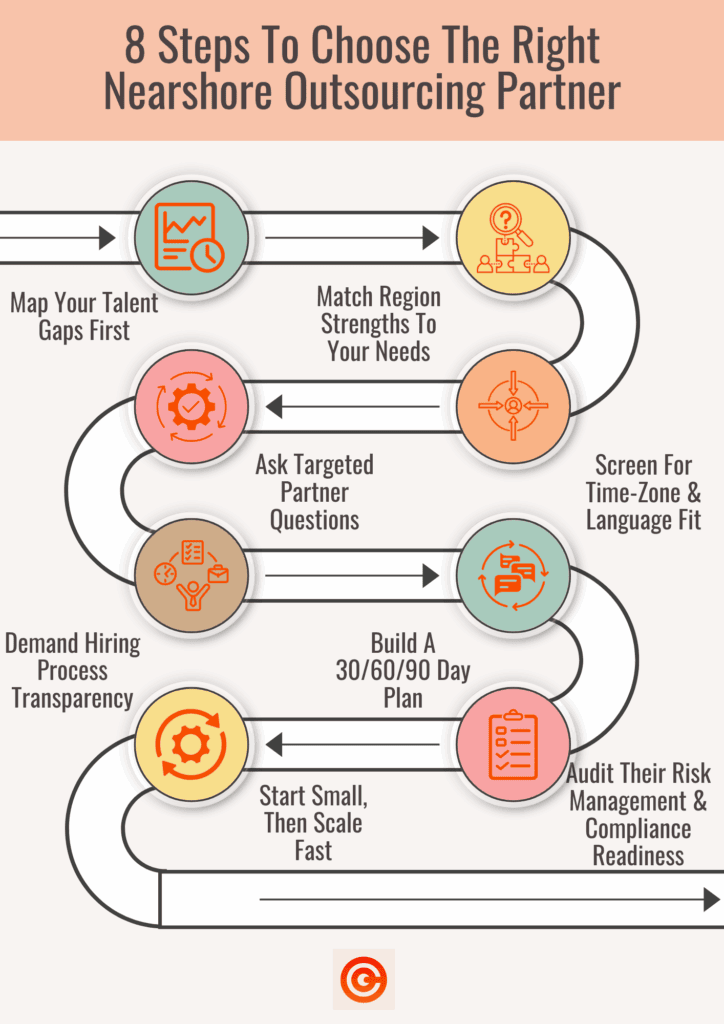
Follow these steps to vet the right nearshoring partner from the start.
Step 1: Map Your Talent Gaps First
Before you even start shortlisting partners, lock down what skill sets you need. Broad “development” or “support” asks waste time.
- List every role by function, skill, and seniority.
- Prioritize time-critical roles based on launch timelines or revenue goals.
- Use tools like Teamhood.io to map dependencies between roles.
- Build a simple 2-column sheet: “Must-have” vs. “Nice-to-have” skills.
- Estimate capacity needs in weekly hours to avoid overhiring.
Step 2: Match Region Strengths To Your Needs
Not every nearshore hub fits every project. Match the region’s specialty to your tech stack or support model.
- Mexico → Frontend engineers, customer support agents.
- Colombia → Cloud engineers, technical support analysts.
- Poland → Backend developers, cybersecurity specialists.
- Argentina → Product managers, QA testers.
- Cross-reference local university rankings and tech hubs with sources like Coursera’s Global Skills Report.
Step 3: Screen For Time-Zone & Language Fit
Even a small time mismatch can jam agile workflows. You need teams that can stand up daily scrums, not just asynchronous handoffs.
- Pick regions within a 1–3 hour overlap with your HQ time.
- Confirm B2 English fluency or higher with standardized testing (like Versant or IELTS).
- Require real-time collaboration test runs before contract finalization.
- Use timezone tools like Spacetime.am to schedule interviews across teams.
- Check sample meeting recordings if the vendor provides them.
Step 4: Ask Targeted Partner Questions (Not Generic Ones)
Skip the “what industries have you worked in” fluff. Get the real answers you need to predict success.
- How do you pre-qualify candidates before presenting them?
- What is your average time-to-hire for X roles?
- How do you run onboarding and early performance tracking?
- Can you provide 2-3 client references for similar projects?
- Do you have fallback candidates ready if a hire drops out mid-project?
Step 5: Demand Hiring Process Transparency
You need to see exactly how they source, vet, and present talent. No black box hiring.
- Require a copy of their hiring pipeline workflows.
- Ask for sample candidate scorecards and skills assessments.
- Confirm access to hiring dashboards through ATS tools like Workable or Lever.
- Set SLA benchmarks (e.g., present top 3 candidates within 10 business days).
- Build contract penalties or bonus clauses based on time-to-hire SLAs.
Step 6: Build A 30/60/90 Day Plan With Your Vendor
The first 90 days can make or break team success. Set up onboarding like a military operation.
- Outline deliverables for each 30-day block (not just a “learn and explore” plan).
- Assign a mentor or buddy from your HQ side to each nearshore hire.
- Use tools like ClickUp or Monday.com to manage onboarding tasks.
- Set up check-in meetings at 15, 30, and 60 days post-hire.
- Track first 90-day KPIs like bug counts, support resolution times, or sprint velocity.
Step 7: Audit Their Risk Management & Compliance Readiness
Risk doesn’t stop with your signature. Vet how they protect your IP, data, and customer trust.
- Require ISO 27001 certification or equivalent proof of security practices.
- Review sample NDAs, contracts, and disaster recovery plans.
- Confirm where staff work (on-site secure facilities vs. remote home setups).
- Mandate VPN access, endpoint protection, and encrypted communications.
- Ask if they run annual penetration testing through third-party firms.
Step 8: Start Small, Then Scale Fast
Never commit your whole roadmap to a brand-new vendor. Prove them out first.
- Launch with a 3–6 month pilot project or 1–2 core squads.
- Use fixed milestones instead of time-based billing to measure delivery.
- Track early velocity and quality metrics (like sprint burndown charts).
- After pilot success, set structured expansion stages every 3 months.
- Lock multi-squad SLAs for larger team scaling (pre-negotiated hiring timelines, onboarding windows, etc.)
“Nearshore hiring unlocks a talent pipeline that moves twice as fast without sacrificing the quality that global teams depend on.”
—Christian Cabaluna (Senior Recruiter)
5 Common Nearshore Outsourcing Pitfalls (& How To Dodge Them)

Make sure you avoid these common traps so your nearshore outsourcing strategy works like the examples discussed.
- Vague role requirements
- Use Breezy HR or a simple spreadsheet to list hard deliverables for each hire before you even meet vendors.
- Use Breezy HR or a simple spreadsheet to list hard deliverables for each hire before you even meet vendors.
- Skipping legal compliance checks
- Run all vendor agreements through Deel, Remote.com, or a local attorney to lock compliance upfront.
- Run all vendor agreements through Deel, Remote.com, or a local attorney to lock compliance upfront.
- Blind trust in candidate screening
- Ask for Codility scores, portfolio links, and 1–2 real project samples before you green-light any new hire.
- Ask for Codility scores, portfolio links, and 1–2 real project samples before you green-light any new hire.
- Weak feedback loops
- Use Jira, Trello, or Monday.com to create sprint checklists with clear owners and hard weekly deadlines.
- Use Jira, Trello, or Monday.com to create sprint checklists with clear owners and hard weekly deadlines.
- Single-Vendor Dependency
- Keep at least 1 secondary vendor or recruiting firm on standby to avoid slowdowns when you scale.
💭 Food For Thought
Nearshore software development costs 46% less than onshore rates.
Conclusion
Nearshore outsourcing examples prove that smart companies are no longer stuck in slow hiring loops. They build real momentum with nearby talent pools, cut hiring timelines by up to 80%, and scale without sacrificing quality. Whether it’s cloud developers in Poland or CX teams in Costa Rica, the right nearshore move clears bottlenecks and puts growth back on track.
At Genius, we don’t just talk about better teams — we hunt them down. Our headhunting model is built to find pre-vetted, Western-work-culture talent in regions where others barely scratch the surface. We screen 250+ candidates to find the ONE who delivers — whether you need engineers, marketers, or support stars at up to 80% savings.
Skip the noise. Build faster, stronger, smarter teams. Start hiring with Genius today.
FAQs
What countries are examples of nearshore outsourcing?
Popular nearshore outsourcing countries include Mexico, Colombia, Costa Rica, Poland, the Philippines, Argentina, and Brazil. These offer a strong mix of skilled talent and close time zone proximity to major US and European markets.
What industries benefit most from nearshore outsourcing?
Industries like software development, customer support, fintech, healthcare IT, and digital marketing often see the fastest results, cutting project timelines by up to 60–80% compared to traditional hiring.
What types of roles are typically outsourced nearshore?
Nearshore outsourcing often covers roles like backend developers, UI/UX designers, customer service agents, QA testers, DevOps engineers, finance support staff, and technical support specialists.
Are there compliance risks with nearshore outsourcing?
Compliance risks are generally lower in nearshore locations because many countries (like Poland, Mexico, and Colombia) have strong data protection laws and robust IP enforcement frameworks.