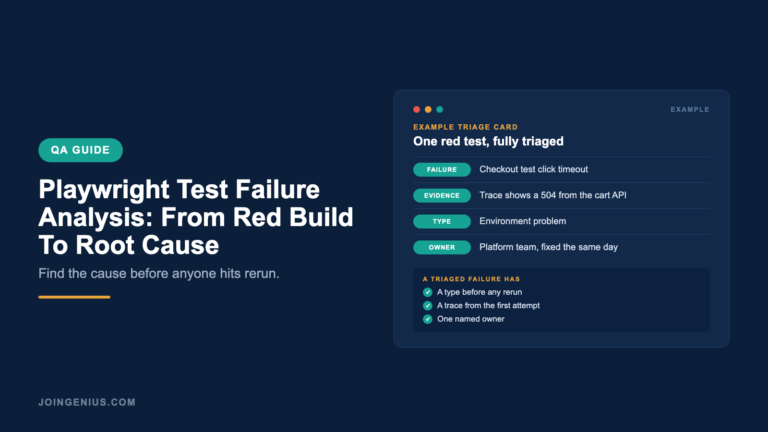
A Playwright test fails on a pull request, so someone scrolls through a few thousand lines of CI log and hits rerun. The build turns green. Two days later the same test fails again. Playwright test failure analysis is how you break that loop, but most teams skip it because the evidence is spread across too many tools.
Below, we cover what a real analysis has to answer and which evidence Playwright should keep on every failed run. Then we get into grouping failures by cause and handling flaky tests. We finish with who should own the work as your suite grows.
What Playwright Test Failure Analysis Actually Involves
A red test proves that one action or assertion failed. Analysis gets you from that red result to a cause someone can fix and the person who should fix it.
The Error Message Only Describes A Symptom
Take a familiar Playwright error, a click that times out after 30 seconds. The error’s top line reads the same whether a developer renamed the button or a cookie banner covered it. It also reads the same when a slow API delayed the page, so that line alone cannot say who should act.
Why AI-Written Code Makes The First Question Harder
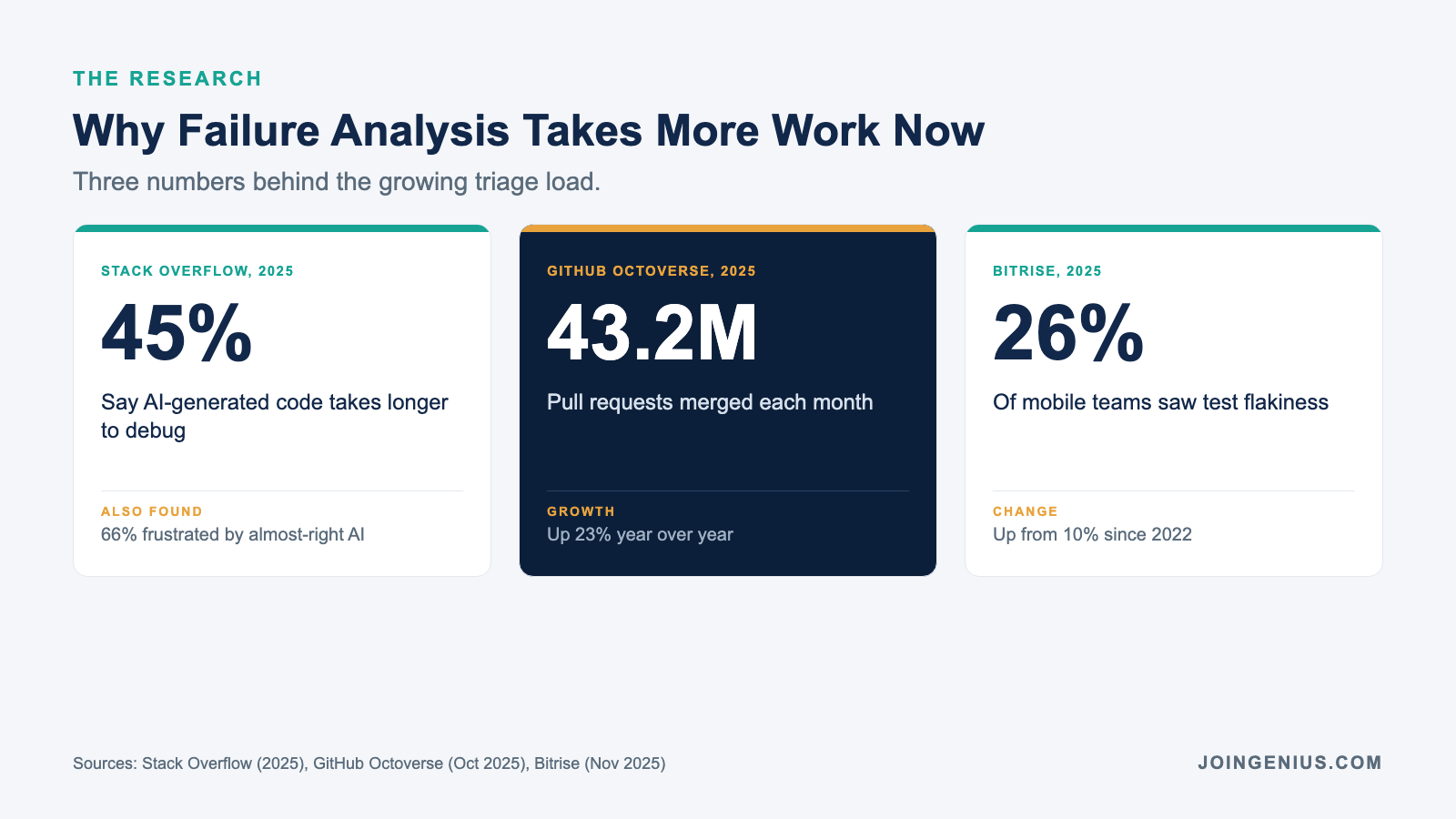
Stack Overflow’s 2025 Developer Survey found that 66% of developers are frustrated with AI solutions that are almost right, but not quite. In the same survey, 45% said debugging AI-generated code is more time-consuming.
Almost-right code can pass review and then fail a test in a way that looks like a test problem. As more teams adopt AI-assisted coding, the first question in any analysis gets harder: is the test wrong, or is the application?
Sort Every Failure Into One Of Five Types
Every failure should get a type before anyone writes a fix. This reference table covers five common types and the evidence that usually points to each.
| Failure Type | What The Evidence Usually Shows | Who Owns The Fix |
|---|---|---|
| Product bug | Fails the same way locally and in CI | Developer who changed the feature |
| Broken test | Locator or assertion no longer matches the UI | Test author |
| Environment problem | Unrelated tests fail together in one job | Platform or DevOps owner |
| Flaky timing | Passes on retry with no code change | Test author, tracked as a bug |
| Shared test data | Fails only when tests run in parallel | Test author and fixture owner |
The type decides who gets the ticket. Without one, every red build goes to whoever is on call, and product bugs get patched in the test instead of the code. Write the five types into your onboarding documentation so new engineers label failures the same way.
Collect The Evidence Before Anyone Hits Rerun
Playwright test failure analysis often stalls because the evidence is gone by the time someone looks. Hosted CI runners start clean for every job, so anything not saved as an artifact disappears when the job ends.
Change The Trace Setting First
Many Playwright configs use trace: 'on-first-retry', which records a trace only when a test is retried for the first time. So the original failing attempt is never traced. With retries off, nothing is recorded at all.
- Set trace to
retain-on-failurein CI so every failing run keeps its trace. - Set screenshot to
only-on-failureso each report shows the page when it broke. - Upload the HTML report and trace files as CI artifacts on every failed job.
- Use the blob reporter on sharded runs and merge the results into one report.
Read Each Trace In The Same Order
A trace records every action in the test, with a snapshot of the page before and after each step. Reading it in the same order keeps two engineers from reaching different conclusions about one failure.
- Open the failed action and compare its Before and After snapshots in the viewer.
- Check the Network tab for slow or failed requests just before that action.
- Read the Console tab for application errors logged earlier in the same test.
- Find the first action that misbehaved, which often comes before the failing one.
Group Failures By Cause Instead Of Reading Them One By One
Reading failures one at a time works when a run has two of them. It stops working when one broken dependency turns 30 tests red in a single job.
Why One Root Cause Shows Up As Many Failures
GitHub’s Octoverse 2025 report found developers merged an average of 43.2 million pull requests a month, up 23% from the year before. More pull requests mean more suite runs, and more runs where one fault can turn many tests red.
Shared setup is a common reason. When a login fixture or a seeded database breaks, every test that depends on it fails with nearly the same error under a different test name. Reading those one by one means investigating one cause over and over.
Match Failures On Their Error Signature
An error signature is the error message with the variable parts removed, plus the line of code where the test failed. Two failures with the same signature usually share a cause, even when they come from different test files.
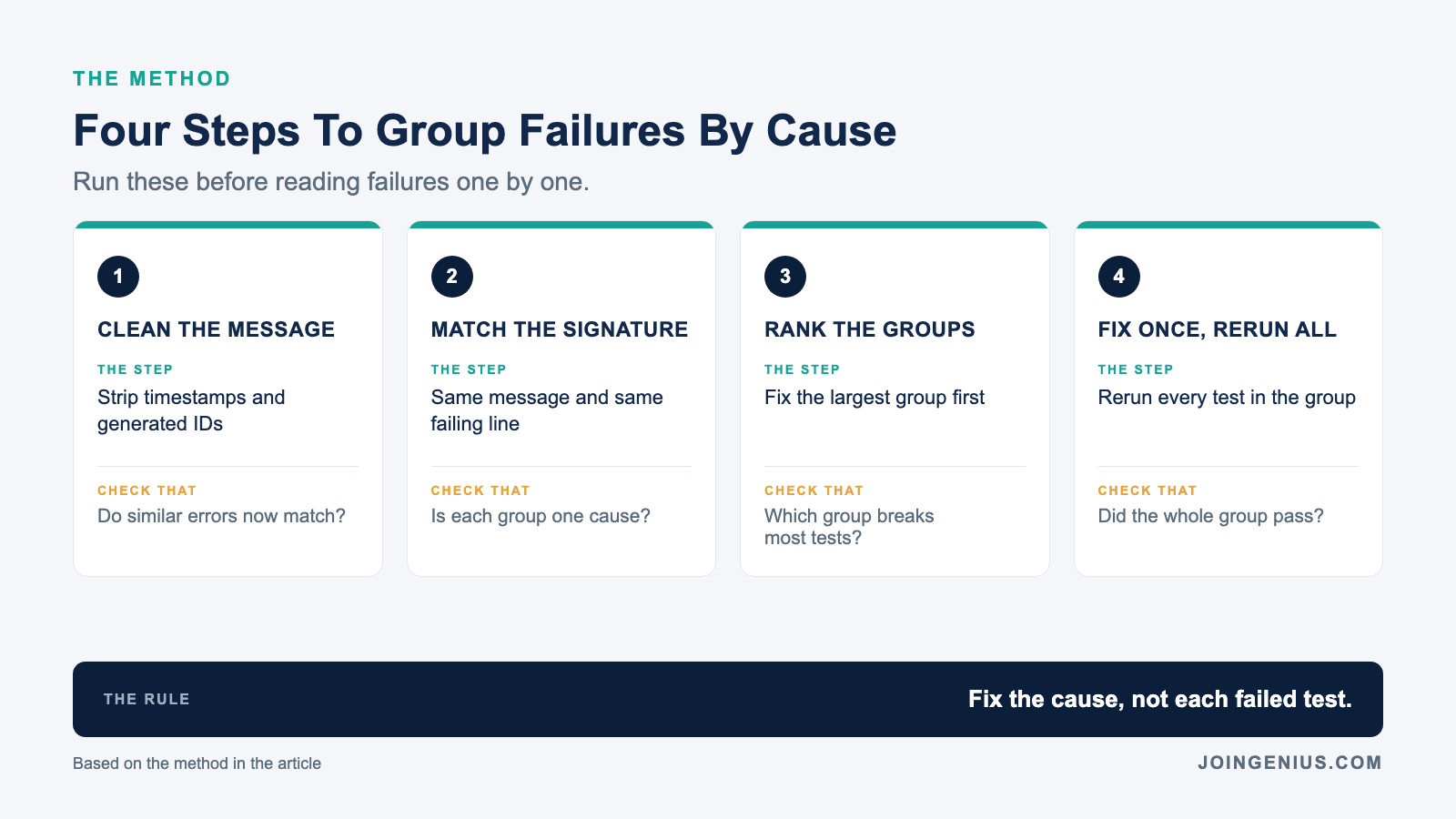
- Strip timestamps and generated IDs from each error message before comparing failures.
- Group failures that share the cleaned message and the same failing line of code.
- Rank the groups by how many tests they break, and start with the largest.
- Rerun the whole group after one fix to confirm every test in it passes.
Grouping by hand works for a handful of failures. For bigger suites, TestDino does this matching automatically with Playwright error grouping, which clusters failing tests by error pattern so the team investigates each root cause once. Its guide to Playwright test failure analysis shows how to debug those failures faster without reading CI logs by hand.
Treat Flaky Tests As Bugs With An Owner
A test that fails and then passes on retry still has a defect, usually in timing or shared state. Retries keep the build green, but they also hide that defect from the people who could fix it.
What Retries Hide From Your Team
Playwright labels a test flaky when it fails on the first run and passes on a retry. The label shows up in the report. But few people open the report for a green build, so the count can climb for months unnoticed.
Bitrise’s Mobile Insights report, based on more than 10 million builds from January 2022 to June 2025, found that the share of teams experiencing any flakiness grew from 10% to 26%. Those are mobile builds, not web suites, so read the trend rather than the exact share.
If the count keeps climbing, add --fail-on-flaky-tests to main branch runs. Playwright then fails the build whenever a test passes only on retry.
How To Reproduce And Fix A Flaky Test
A flaky test is hard to fix until you can make it fail on demand. The aim is a repeatable failure rate, not a single lucky reproduction.
- Run the test with
--repeat-each=50to measure how often it really fails. - Run it again with
--workers=1to see whether parallel tests share data. - Replace fixed waits with web-first assertions that retry until the page is ready.
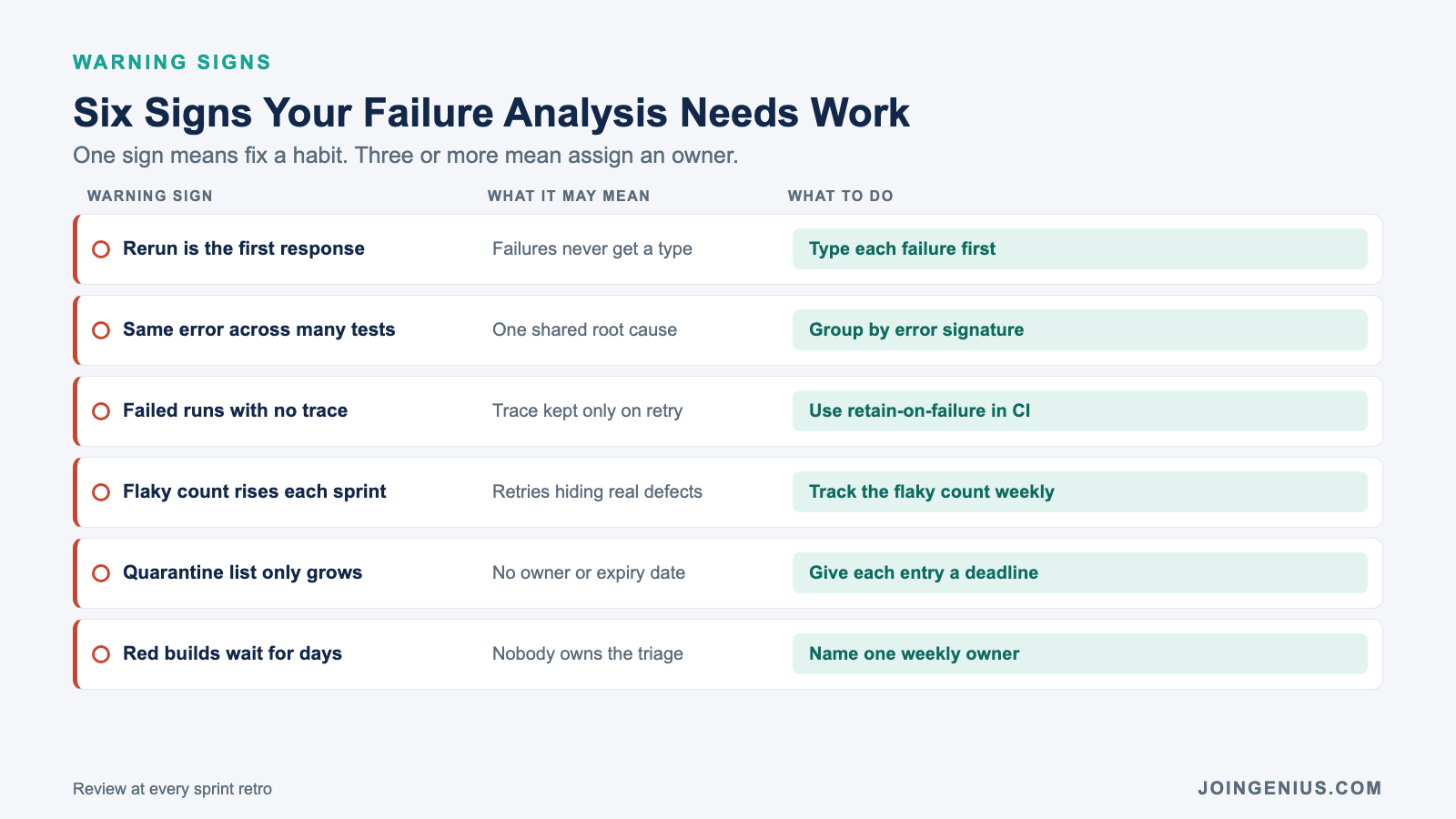
- Quarantine tests you cannot fix this week, with an owner and an expiry date.
Who Should Own Playwright Test Failure Analysis
Failure analysis only works when one person answers for it each week. Shared ownership usually means the red build waits until someone has a free afternoon.
A Rotation Works Until The Suite Outgrows It
On a small team, a weekly triage rotation among developers is enough. Everyone learns the suite, and nobody is stuck on failures for long.
The rotation breaks down once triage takes more than a few hours a week. At that point the job needs a dedicated owner, usually one of your QA automation engineers, since they already know which tests are fragile.
What To Look For In A Triage Owner
The skill is judgment more than tooling. A good triage owner can tell a product bug from a test bug quickly and explain the call to the developer who has to act.
- Reads traces fluently and can explain a failure without rerunning the test first.
- Knows the application well enough to separate product bugs from broken tests.
- Writes locators with
getByRoleand test IDs instead of long CSS selectors. - Reports the flaky count and the top failure groups to the team every week.
What A Dedicated Owner Costs
The Bureau of Labor Statistics puts the median annual wage for software quality assurance analysts and testers at $104,300 as of May 2025. It projects employment in that occupation to grow 6% from 2025 to 2035.
Few teams need that hire for failure analysis alone. The same person usually owns test stability across releases too, and that mix of skills is why browser automation engineers are hard to hire.
Conclusion
Start with one rule this week: no red build gets a manual rerun until its failure has a type. Playwright test failure analysis improves fastest when skipping it is harder than doing it. Once a type is required, someone has to open the evidence. The failure then reaches the right owner the same day.
Genius can fill that seat. We find top 1% QA automation engineers in the Philippines and Latin America for 80% less than a comparable US hire. You pay $0 in monthly fees, and every hire is backed by a 6-month talent guarantee. If your red builds need a dedicated owner, start hiring with Genius.