
You don’t care about another “global strategy.” You care that your burn rate is brutal and every decent developer within 50 miles is already hired by Google – or worse, wants $300K and equity to fix a login bug. Sure, you can try IT offshoring, but is that really what you want, or just the last card left in your hand?
Thing is, offshoring is not just a desperate play. There is more to it – benefits that make it worth it, risks that can bite if ignored, and offshoring companies that make it work like a charm. We are diving into all of it: who is doing IT offshoring right, when it makes sense, and when it is a trap disguised as a shortcut.
IT Offshoring: Everything You Need To Know In 30 Seconds
- IT offshoring relocates tech services abroad to reduce costs, access specialized talent, and extend operational hours
- 5 main types: Project-Based, Dedicated Team, Staff Augmentation, Managed Services, and Offshore Development Centers
- Common offshored tasks include software development, technical support, and data processing
- Best for companies scaling quickly, needing hard-to-find skills locally, or requiring 24/7 operations
- Not recommended for companies with messy internal processes or those requiring constant real-time collaboration
- Top destinations include India, Philippines, Ukraine, Poland, and Vietnam, each with different specializations
- Main challenges include communication gaps, quality control, data security risks, and cultural misalignment
Don’t Miss These Helpful Reads
🎯 Offshoring Cycle Explained Simply: Stages, Goals, & Flow
⚡ Business Process Offshoring: Explained With Real Cases
🛑 Offshoring Solutions: 7 Models Explained With Examples
What Is IT Offshoring?

IT offshoring is the practice of relocating information technology (IT) services or functions to another country, usually to reduce costs, access specialized skills, or extend operational hours.
Companies often offshore tasks like:
- Software development
- Technical support
- Data entry and processing
- Infrastructure management
- Cybersecurity monitoring
5 Types Of IT Offshoring You Should Know

When someone says “IT offshoring,” it sounds like one big strategy, but it is not. There are different offshoring types, and understanding them helps you make smarter decisions about what fits your business best. Let’s break them down.
1. Project-Based Offshoring
This one is the most common, especially with startups or small-to-mid-sized businesses. Here’s how it works:
You have a specific IT project – maybe a mobile app, a website redesign, or a data migration. Instead of hiring an in-house team, you send that entire project to an offshore vendor or development agency. They handle it from start to finish.
Why companies choose this:
- They don’t want long-term commitments.
- It is usually cheaper than hiring locally.
- They get access to a team that already knows what they are doing.
What to watch for:
It is really important to define the scope clearly. If the goals, deadlines, or deliverables are vague, things can go sideways fast.
2. Dedicated Offshore Team
Now we are talking about something more long-term.
A dedicated offshore team is just that – a group of developers, testers, or IT specialists who work only for your company. But they are based in another country.
Think of it like a satellite team. They might work from a different time zone, but they are basically an extension of your local team.
Why this works:
- You get consistent people working on your product or systems.
- It is easier to manage quality over time.
- You avoid the hassle of hiring and HR headaches in another country – usually, a vendor handles that for you.
Best for:
Companies that want control, consistency, and a stable team without the local price tag.
3. Staff Augmentation (aka Remote Hiring)
This is a fancy term for “renting talent.” You need extra hands – maybe one or two engineers or a UI designer. Instead of hiring them permanently or outsourcing the whole project, you augment your team with offshore experts.
These professionals work with your in-house team, often full-time, just like regular employees. But they are based elsewhere.
Why businesses love it:
- Highly flexible.
- Perfect when you are short-staffed or need niche skills.
- No need to commit to full-time hiring contracts.
“Micromanagers hate offshoring. Builders and thinkers love it. That tells you everything.”
— Burkhard Berger, CEO/Founder
4. Managed Services Offshoring
This one is more hands-off. Instead of managing offshore developers directly, you hand over responsibility to a vendor who runs the entire show for you.
The vendor handles staffing, tech stack decisions, timelines, everything. You get regular updates but don’t need to get into the weeds.
Best for:
Businesses that want to focus on core operations and let a third party manage the IT backend.
What it covers:
- IT infrastructure
- Network management
- Cloud hosting
- Cybersecurity monitoring
Why it is great:
- Less day-to-day stress for your internal team.
- Works well for non-tech companies that need IT support but don’t want to build an IT department from scratch.
5. Offshore Development Center (ODC)
An ODC is a full-fledged branch of your company, but overseas. You set up an actual office (or work with a vendor who does), hire people under your brand, and build a team that is entirely yours. It is like opening a new office, but in a country where everything costs less.
Why go this route?
- Long-term vision.
- Total control over operations.
- Build a deep company culture with your offshore team.
It is not for everyone, though:
Setting up an ODC requires time, planning, legal help, and a real budget. But for companies with consistent IT needs, it can pay off big time.
So, How Do You Choose the Right Type?
Honestly, it comes down to what your business needs right now.
Here’s a quick cheat sheet:
| If You Need…. | Go With…. |
| A one-time job | Project-Based Offshoring |
| A reliable remote team | Dedicated Offshore Team |
| A few extra skilled hands | Staff Augmentation |
| Someone else to fully manage IT | Managed Services Offshoring |
| A long-term, custom offshore branch | Offshore Development Center |
7 Key Benefits Of IT Offshoring To Consider Before Your Next Tech Hire
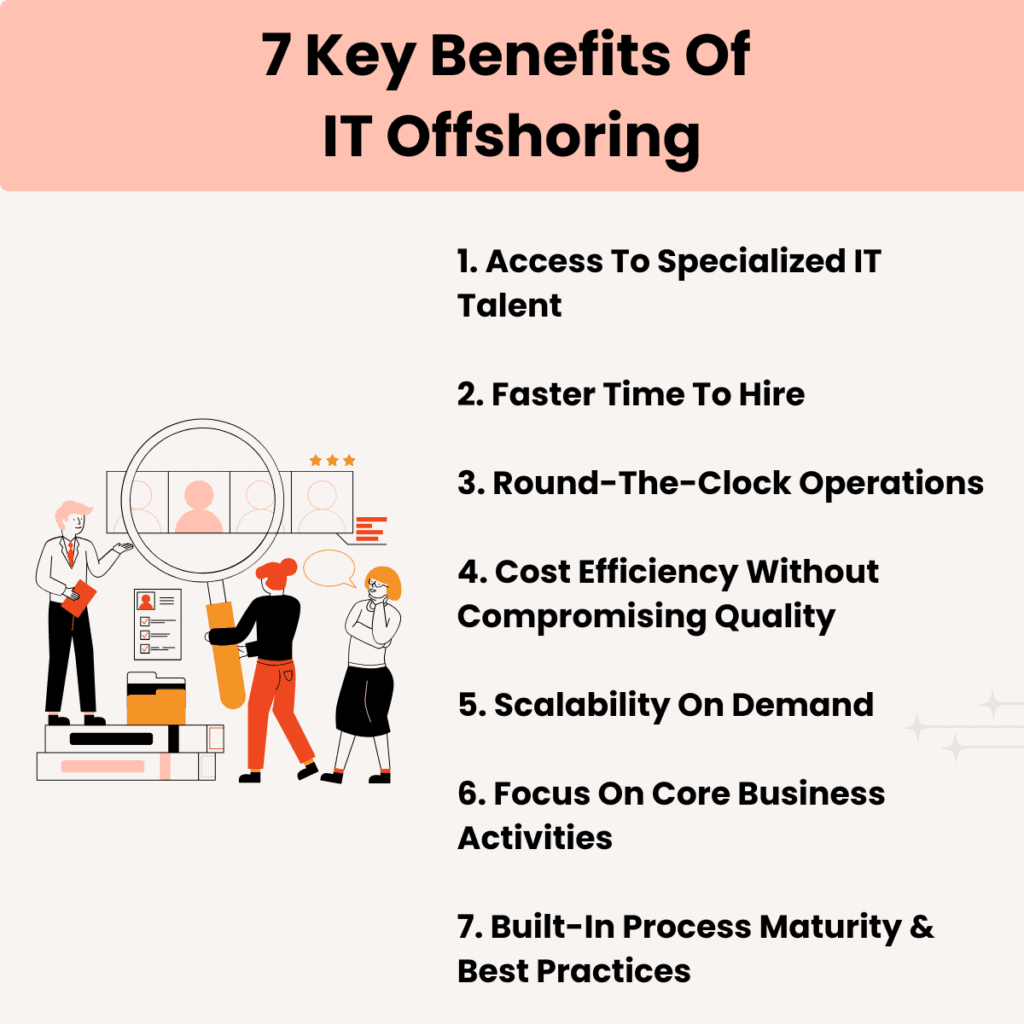
When it is done right, IT offshoring can give you way more than just a smaller payroll. Let’s walk through 7 real benefits of offshoring IT that actually make a difference.
1. Access To Specialized IT Talent
Not every region has the talent you need, especially when it comes to highly technical roles like AI engineers, DevOps experts, or cybersecurity specialists.
IT offshoring opens up the global talent pool. You are no longer limited by who happens to live within a 30-mile radius of your office. You can tap into countries known for specific skills – like software development in India, IT security in Israel, or cloud architecture in Eastern Europe.
2. Faster Time To Hire (And Start Work)
Hiring locally can be painfully slow – between job ads, interviews, paperwork, and notice periods. Offshore vendors or staffing platforms can match you with pre-vetted IT professionals in days, not weeks.
Even if you are not in a rush, offshoring skips the long hiring process. You get people onboard quickly, so projects don’t stall waiting for a perfect resume to land.
3. Round-The-Clock Operations
This one can seriously level things up if you are offering digital products or services.
By offshoring to teams in different time zones, you can keep work moving 24/7. Your onshore team wraps up at 6 PM, and your offshore team picks it up from there. No downtime. No waiting until morning to fix bugs, answer tickets, or push updates.
4. Cost Efficiency Without Compromising Quality
Yes, cost savings are a big deal – but it is not about being cheap. It is about being smart with your budget.
Offshoring lets you reinvest what you save into better tools, better infrastructure, or even scaling your business. You can hire senior developers offshore for the price of junior talent at home. That means higher quality work for the same – or less – money.
The key:
Don’t go for the cheapest. Go for the best value. And offshoring gives you a lot more room to find that balance.
⚠️ Did You Know?
The technology sector makes up 31% of the offshoring market.
5. Scalability On Demand
Let’s say you land a big project and need to triple your IT capacity next month. Or maybe your product just hit traction and now you need support, QA, backend engineers, and data people – yesterday.
With offshoring, you can scale your team up (or down) quickly without dealing with office space, hardware, or long-term contracts. You plug into existing infrastructures and processes, which makes rapid scaling actually doable.
6. Focus On Core Business Activities
If you are constantly buried in code reviews or infrastructure setup, you can’t really focus on your big-picture goals, like building partnerships or refining your product strategy.
Offshoring lets you hand off IT operations so you can stay focused on the things that move your business forward. You are still in control, but you are no longer in the weeds every day.
7. Built-In Process Maturity & Best Practices
Established offshore IT providers come with tried-and-tested processes, tools, and workflows. They have handled hundreds of projects before yours. That experience brings smoother delivery, fewer errors, and faster turnaround.
You benefit from their systems – whether it is agile sprints, DevOps pipelines, automated testing, or 24/7 monitoring. That alone can save months of headaches.
5 Common Risks & Challenges Of IT Offshoring & How To Mitigate Them

If you have never offshored before (or even if you have), there are a few hurdles that can trip you up fast. But every single one of these risks can be managed, as long as you go in with your eyes open and your plan ready. Let’s break it down.
1. Communication Gaps & Time Zone Differences
This is probably the most obvious issue – different countries, different time zones, different working hours. And then there is the language barrier or just different communication styles (some teams don’t speak up unless asked).
What to do:
- Set 1–2 overlapping hours daily for real-time check-ins (e.g., 9 AM your time, 6 PM theirs).
- Use tools like Slack + Loom to maintain async visibility and clarity.
- Document everything – don’t leave tasks or decisions floating in chat.
- Choose teams with proven English proficiency (ask for live video calls upfront).
- Assign a local project coordinator if your internal team doesn’t want to manage time zone syncs.
2. Quality Control & Lack Of Oversight
When your developers are 8,000 miles away, it is tempting to assume things are being handled. But unless you have built in real checkpoints, quality can drop fast, and you won’t see it until it is already a problem.
What to do:
- Set up weekly code reviews or sprint demos – don’t wait until the deadline.
- Use issue trackers like Jira or ClickUp to monitor progress visually.
- Define acceptance criteria clearly for every task. No vague deliverables.
- Start with a paid test project to assess their attention to detail.
- Use tools like GitHub Actions or Jenkins for automated code quality checks.
3. Data Security & IP Protection Risks
You are giving access to sensitive systems, codebases, or customer data, sometimes in countries where laws are different or enforcement is weak. That is a real risk you can’t ignore.
What to do:
- Have every offshore team member sign an NDA and IP agreement before onboarding.
- Choose vendors in countries with strong data protection laws or international certifications (like ISO 27001).
- Use VPNs, access control, and encrypted channels for data sharing.
- Don’t offshore highly sensitive tasks. Keep security-critical systems in-house.
- Limit access. Give offshore teams only what they need to do their part.
“Most companies offshore too late. The smart ones do it before they even need it.”
— Christian Cabaluna — Senior Recruiter
4. Cultural Misalignment
Different countries have different work cultures – some teams might not push back on bad ideas, others may hesitate to take initiative. That can affect everything from project momentum to creativity.
What to do:
- Share your company’s values, tone, and work style during onboarding.
- Encourage open dialogue and set the expectation that pushback is welcome.
- Celebrate small wins and give feedback regularly – it helps build rapport.
- Assign cultural liaisons or use hybrid teams (one local lead, offshore devs).
- Learn a bit about their work culture. It builds mutual respect quickly.
5. Hidden Costs & Scope Creep
IT offshoring seems cost-effective at first, but without structure, costs can spiral – extra hours, unclear deliverables, rework, or suddenly needing to hire more people.
What to do:
- Break down projects into fixed-scope phases with milestone-based payments.
- Use detailed SOWs (Statements of Work) to define what is included and what is not.
- Set time limits per sprint or week, especially if you are on a time-and-materials contract.
- Monitor billable hours weekly and compare against actual output.
- Budget a 15–20% buffer for unforeseen adjustments, but flag any repeated scope expansion.
When IT Offshoring Makes Sense: Key Scenarios & Business Factors To Consider

Offshoring is a great strategy, but you can’t do it just because others are doing it. Here’s when IT offshoring actually makes sense, along with what you need to evaluate before jumping in.
1. You Are Scaling Fast, But Hiring Locally Is Too Slow
Your product is taking off. You have features to ship, bugs to squash, and customers waiting. But local hiring is dragging – 3 weeks for interviews, 2 more for onboarding. It is slowing you down.
Offshoring development makes sense when you need a ready-to-go team without waiting months.
How to evaluate:
- Are open roles taking 4+ weeks to fill locally?
- Is work piling up or slowing down delivery timelines?
- Do you have a backlog of product or IT tasks that is growing weekly?
- Can your current team handle onboarding offshore help efficiently?
- Are you able to break down tasks clearly for remote execution?
2. You Need Skills That Are Hard (Or Expensive) To Find Locally
Some IT roles – like cloud security engineers or senior DevOps engineers – are either very rare or cost 2–3x more in your local market.
Offshoring gives you access to niche specialists who have done this kind of work across multiple industries, without blowing your entire budget.
How to evaluate:
- Have you interviewed multiple candidates but still not found the right skill fit?
- Are you forced to settle for junior-level talent just to stay on budget?
- Is a major IT initiative (like a migration or rebuild) stuck due to a lack of expertise?
- Can the task be clearly scoped and remotely managed?
- Have you validated that the same skillset is more available in offshore markets?
3. You Are A Startup Or Small Company Needing To Stay Lean
If you are early-stage, burning through runway, or bootstrapping, you need to build without overspending. Offshoring helps you hire high-quality devs or IT ops for a fraction of the local cost.
How to evaluate:
- Are salaries eating up 60–80% of your monthly spend?
- Do you only need part-time or short-term IT roles?
- Do you need to build a minimum viable product (MVP) fast and cheap?
- Can your local team handle strategy while offshore talent builds the tech?
- Do you already use cloud-based collaboration tools (like GitHub, Jira, Slack)?
🏅 That’s Something
Approximately 30 million U.S. jobs could be candidates for offshoring.
4. You Want 24/7 IT Coverage Or Development Continuity
Say your team signs off at 6 PM. But your servers are still running, your users are still clicking, and things still break overnight. Or maybe you want development progress to happen while your core team sleeps. Offshoring to a different time zone gives you around-the-clock coverage and productivity.
How to evaluate:
- Are you dealing with outages or support tickets outside of working hours?
- Do you want to reduce downtime or improve response time overnight?
- Can your work be split in a “follow-the-sun” model (handoffs between teams)?
- Do you have DevOps or support tasks that can be monitored remotely?
- Will offshore time zones complement your current team’s schedule?
5. You Have Repetitive Or Maintenance IT Work That Is Distracting Your Core Team
Your senior developers should be focusing on system design and architecture, not fixing WordPress plugins or managing backups.
IT offshoring helps you offload low-complexity, high-frequency IT tasks so your in-house team can stay focused on core innovation.
How to evaluate:
- Is your team spending time on tasks that don’t require deep expertise?
- Do you have recurring IT support or testing tasks that eat up hours weekly?
- Are internal projects getting delayed because of ongoing maintenance?
- Can the work be easily standardized or documented for someone to pick up?
- Is your team frustrated with context-switching between high and low-value work?
When You Should Avoid IT Offshoring: 5 Red Flags & Warning Signs

IT offshoring isn’t always the smart move. There are red flags that tell you loud and clear: “Not the right time” or “Not the right setup.” So let’s talk about those moments.
1. Your Internal Processes Are A Mess
If your internal systems, workflows, and documentation are all over the place, bringing in an offshore IT team will only multiply the confusion.
Tech offshoring thrives on structure. If your team doesn’t have that yet, it will be chaos – missed deadlines, duplicated work, and constant miscommunication.
How to spot this red flag:
- You don’t have a single source of truth for projects (like Jira, Notion, or Trello).
- Your team constantly asks each other for the same info.
- Onboarding a new internal hire takes more than a week.
- Your team doesn’t use proper version control (like Git) or documentation practices.
- You rely heavily on in-person knowledge sharing or Slack threads that no one can find later.
What to do instead:
- Build internal SOPs (Standard Operating Procedures) before offshoring.
- Document key workflows, tech stack dependencies, and recurring tasks.
- Set up basic project management tools with clear task owners and deadlines.
- Assign a dedicated point of contact to manage offshore communication.
- Run a “dry run” by documenting a feature end-to-end and sharing it with your local team first.
2. You Need Constant Real-Time Collaboration
IT offshoring doesn’t work well when your team needs to be in the same room (or Zoom call) constantly.
If you are still bouncing ideas in real-time, changing scopes daily, or brainstorming on the fly, an offshore setup will slow you down instead of helping.
How to spot this red flag:
- You regularly have impromptu strategy huddles or code reviews.
- Your product scope shifts more than once a week.
- Your team isn’t disciplined about writing things down.
- You have never successfully completed a fully asynchronous project.
- You say “we’ll figure it out as we go” more than you’d like to admit.
What to do instead:
- Shift toward asynchronous workflows internally (Slack threads > calls).
- Start using short Loom videos or docs to share ideas instead of live sessions.
- Timebox planning and sprint scoping to reduce daily changes.
- Train your team to write better briefs and specs.
- Only offshore work that can be defined clearly upfront.
3. You Don’t Have A Technical Leader Or Project Owner In-House
If you are offshoring IT but have no one technical enough to guide, review, or manage the work on your end, you are pretty much asking for trouble.
Offshore teams can’t read your mind. If there is no one on your side making sure things are done right, code quality and project direction will suffer.
How to spot this red flag:
- You are relying solely on the offshore team to “figure it out.”
- You have no in-house dev who can do code reviews.
- You don’t understand the tech stack or the architecture they are working on.
- You have missed bugs or inconsistencies in the past because no one reviewed things.
- You are treating the offshore team like a vendor, not collaborators.
What to do instead:
- Assign a tech lead (even part-time) to oversee offshore output.
- Set up mandatory code reviews before merging anything.
- Use automated CI/CD pipelines for testing and deployment.
- Schedule weekly stand-ups and retros with clear deliverables.
- Push for visibility – track progress using Git commits, tickets closed, etc.
💼 Check This Out
Over 66% of U.S. companies with 50+ employees outsource services.
4. You Are Offshoring Core Product Development Too Early
If you are still figuring out your product-market fit or making major pivots, don’t offshore core features yet. Why? Because early-stage development needs tight feedback loops and quick iterations – things that slow down with offshoring.
This is the time to keep your product team as close and agile as possible.
How to spot this red flag:
- Your product roadmap changes drastically every 2–3 weeks.
- You are still validating your MVP or experimenting with different flows.
- You rely heavily on user feedback to steer development.
- You have no finalized product specs or style guides.
- Your team is still debating what the core features are.
What to do instead:
- Keep product definition, UI/UX, and first builds in-house.
- Use offshoring for non-core elements like admin dashboards or internal tools.
- Offshore maintenance or legacy tech while your core team builds new stuff.
- Create a product playbook before handing off anything externally.
- Use the first few months to create repeatable dev tasks, then offshore those.
5. You Think Offshoring Will Magically Fix A Failing Project
This one is brutal but real: if your project is already tanking – behind schedule, poorly scoped, or plagued by technical debt – throwing offshore resources at it will only make things worse.
Offshoring isn’t a band-aid. It is a strategy that works only when the foundation is healthy.
How to spot this red flag:
- You are saying “we just need more hands” when the real issue is unclear goals.
- Your specs keep changing because no one knows what the final version should be.
- You have major legacy code with no documentation.
- You have already burned through one or more failed dev teams.
- You are hoping that a “cheaper” team will save you money long term.
What to do instead:
- Pause. Do a full audit of the current state (code, team, blockers).
- Fix your project scope, timelines, and goals first.
- Bring in a CTO or technical consultant to guide the recovery.
- Build documentation and eliminate major tech debt before outsourcing.
- If needed, offshore a small non-critical piece as a pilot, not the whole thing.
5 Best IT Offshoring Companies To Consider
Here’s a quick list of the top 5 IT offshoring companies that actually know what they are doing – and won’t leave you cleaning up the mess later.
1. Genius

If you have ever tried hiring offshore developers, you already know the drill: tons of bad applications, sketchy resumes, timezone issues, and people ghosting after 2 weeks. It is frustrating.
So we built Genius to fix all this. Think: university networks, on-site recruiters, and a 12-step vetting process that filters out 249 people to find the one who is actually good. We are talking full-time senior developers with perfect English, modern software skills, and a strong work ethic – starting at $12K a year. Yes, really.
And they are not just technically sharp. These developers “understand” Western work culture. They work your hours, adapt fast (especially with AI), and stay loyal. And there are no monthly fees. Zero risk. 6-month talent replacement guarantee.
| Pros | Cons |
| Up to 80% cost saving compared to local hiring | Top candidates get hired fast |
| Perfect English + Western work culture alignment | |
| Teams adopt AI tools 3x faster |
2. SoftServe

Founded in 1993 in Lviv, Ukraine, SoftServe has grown into a global IT consulting and software development company. With over 12,000 employees across 58 offices in 14 countries, SoftServe specializes in areas like cloud computing, AI/ML, IoT, and cybersecurity.
The company has maintained a consistent growth rate of over 20% annually and aims to reach $1 billion in revenue by 2025.
| Pros | Cons |
| Strong partnerships with tech giants like AWS, Google Cloud, and Microsoft | Potential geopolitical risks due to its Ukrainian roots |
| Recognized multiple times in the Global Outsourcing 100 list | Rapid expansion might lead to challenges in maintaining service quality |
| Offers a wide range of services across various industries | Time zone differences can affect real-time collaboration with clients in certain regions. |
3. FPT Software

Established in 1999, FPT Software is a subsidiary of FPT Corporation and is headquartered in Hanoi, Vietnam. The company boasts over 33,000 employees across 88 offices in 30 countries. In 2024, FPT Software reported a revenue of $1.22 billion, offering services in software development, IT outsourcing, and digital transformation.
| Pros | Cons |
| Strong presence in the Asia-Pacific region | Language barriers might arise in certain projects |
| Recognized for its sustainability practices with an EcoVadis Silver Rating | Cultural differences can impact project expectations and outcomes |
| Collaborations with major global clients, including partnerships in the automotive sector | Time zone challenges for clients based in the Americas |
4. ScienceSoft

Founded in 1989, ScienceSoft is a U.S.-based IT consulting and software development company with a team of 750+ IT professionals. They have completed over 4,000 projects for more than 1,300 clients across 70+ countries and 30+ industries, including IBM, eBay, NASA JPL, PerkinElmer, and Baxter.
| Pros | Cons |
| Strong enterprise client experience | Time zone coordination needed |
| Wide tech stack coverage | Limited startup-specific services |
| High project success rate | May have longer onboarding timelines |
5. TMA Solutions
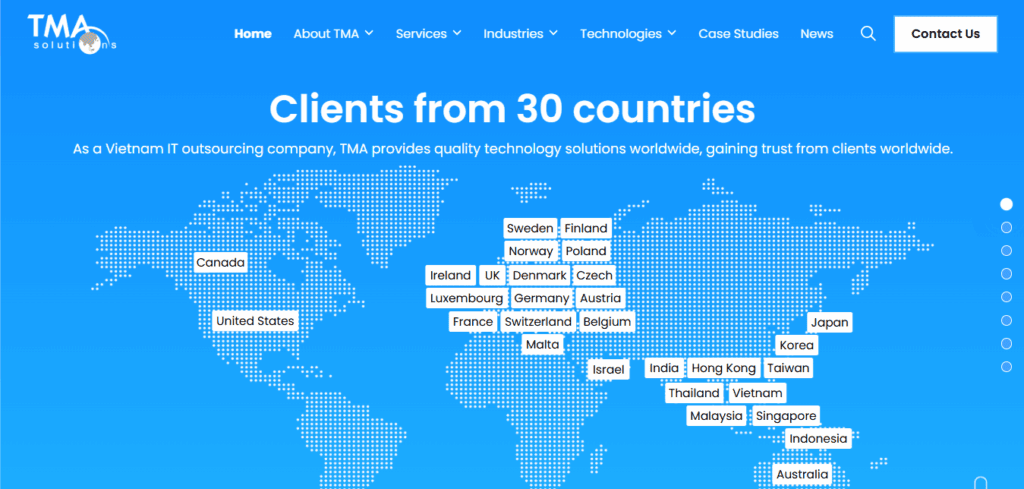
Founded in 1997 in Ho Chi Minh City, Vietnam, TMA Solutions is a privately owned software offshoring company. With a workforce of over 4,000 employees, TMA has expanded its operations to countries like Canada, the USA, Australia, and Germany. The company offers services in software development, IoT, and AI.
| Pros | Cons |
| Achieved CMMi Level 5 certification, indicating high process maturity | Smaller scale compared to global giants might limit resource availability |
| Strong emphasis on research and development | Less brand recognition in Western markets |
| Flexible engagement models tailored to client needs | Potential challenges in scaling rapidly for large projects |
Top IT Offshoring Destinations Around The World & Why They Stand Out
When it comes to IT offshoring, some countries consistently rise to the top. Let’s take a look at them.
1. India — The Longstanding Leader In IT Offshoring
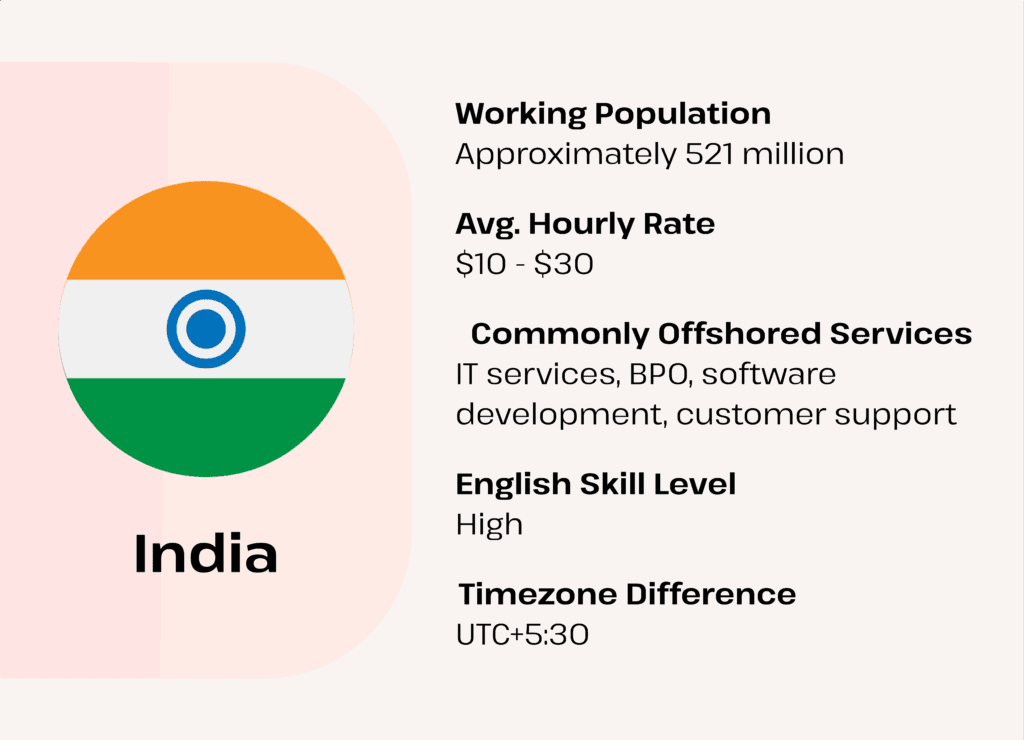
Let’s not pretend otherwise; India dominates this space. And for good reason. You get a massive pool of English-speaking tech professionals, competitive rates, and strong government support for IT infrastructure.
- Massive Talent Pool: India is expected to have the highest number of software developers by 2024, surpassing even the US.
- Industry Growth: The Indian IT outsourcing industry is projected to grow at a 7.45% CAGR by 2025, reaching a value of approximately $121 billion.
- Global Capability Centers (GCCs): India’s GCC market is projected to increase from $64.6 billion in 2024 to between $99 billion and $105 billion by 2030.
- Employment Impact: The IT outsourcing industry in India employs over 10 million people and is expected to create 4 million new jobs by 2025.
Best cities to offshore IT to in India: Bengaluru, Hyderabad, Pune, Chennai, Gurugram
2. The Philippines — The Communication Powerhouse
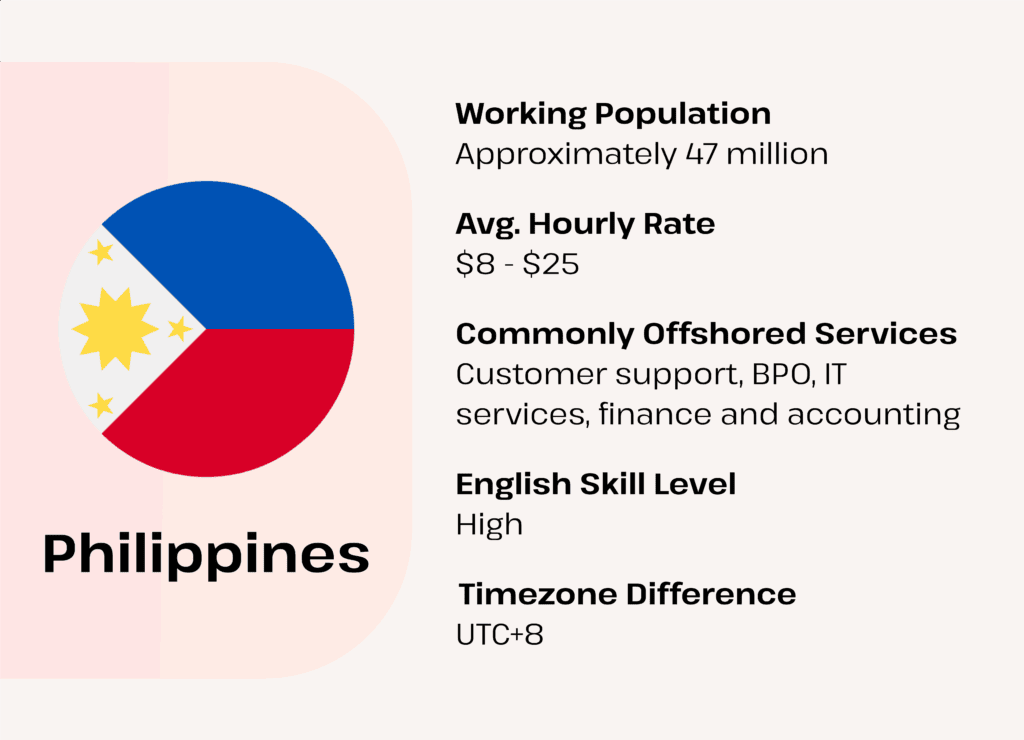
If fluent English and cultural compatibility are high on your list, the Philippines is hard to beat. While the country is more famous for BPO, it has also become a go-to for front-end development, QA, and WordPress-based work.
- English Proficiency: The Philippines ranked 2nd in Asia for English proficiency, with a score of 578.
- IT-BPM Industry Growth: The Philippine IT-BPM industry is on track to generate $38 billion in revenue in 2024, with a workforce of 1.82 million professionals.
- Literacy Rate: The country boasts a 97% literacy rate, ensuring a well-educated talent pool.
Best cities to offshore IT to in the Philippines: Manila, Cebu City, Davao City
3. Ukraine — Europe’s IT Talent Engine
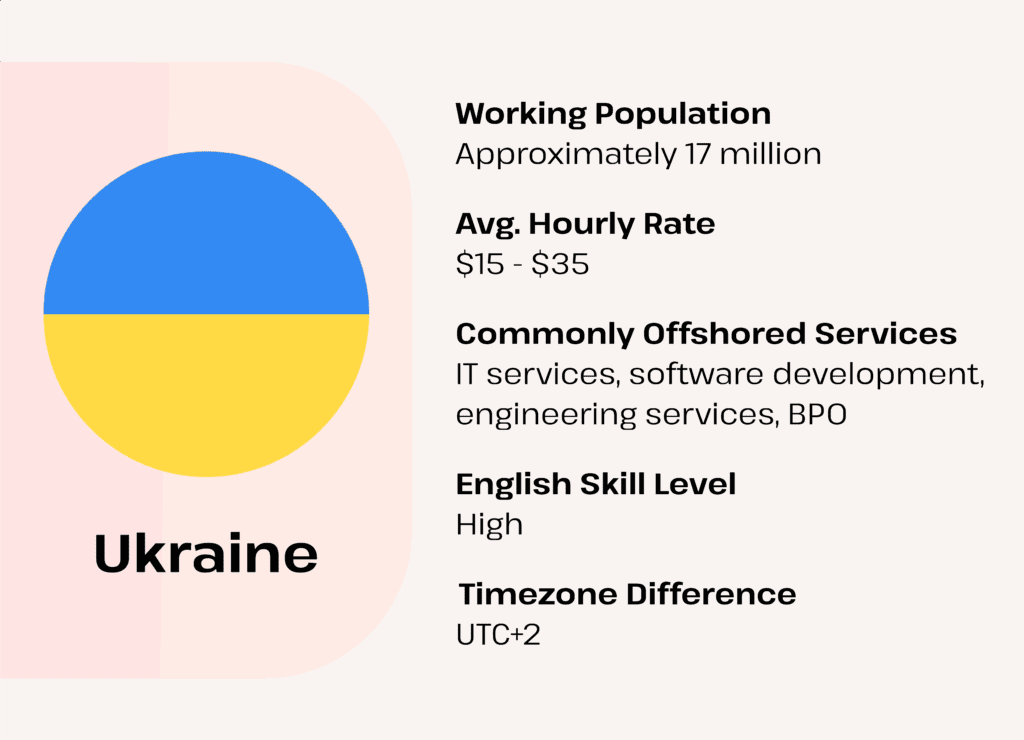
Despite its geopolitical challenges, Ukraine remains a top-tier choice for offshoring software development, especially for companies in Europe or the U.S. looking for strong engineering fundamentals and advanced tech skills.
- IT Specialist Base: Ukraine has approximately 363,000 IT specialists, with an additional 25,000 graduating from tech universities annually.
- AI Expertise: There are 243 IT companies in Ukraine working in the AI field, with over 5,000 AI/ML specialists.
- Developer Salaries: The median salary for a software developer in Ukraine was $3,500 per month in 2024, offering cost-effective yet high-quality services.
Best cities to offshore IT to in Ukraine: Kyiv, Lviv, Kharkiv, Dnipro
4. Poland — The EU’s Quiet Offshoring Champion
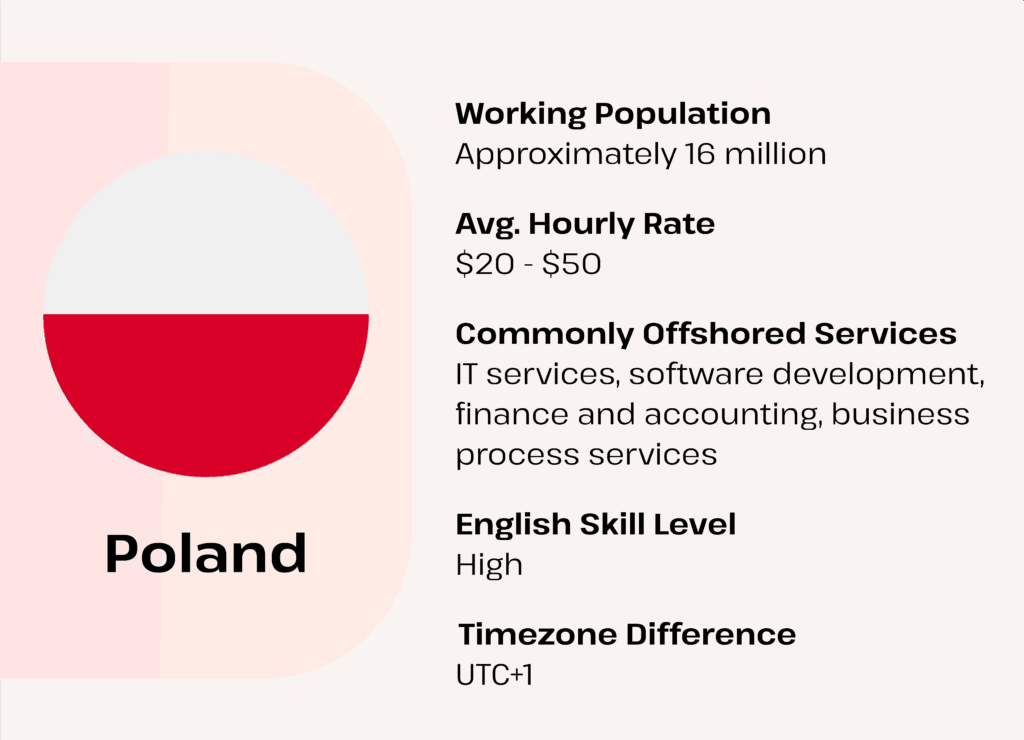
Poland flies under the radar, but it delivers premium tech talent within an EU legal and data protection framework. It is perfect if you want quality + stability without going too far afield.
- Tech Workforce: Poland boasts over 525,000 tech experts.
- Engineering Graduates: The country produces around 100,000 engineering graduates annually, ensuring a steady influx of new talent.
- Outsourcing Market Size: Software outsourcing in Poland is projected to reach over $3 billion.
Best cities to offshore IT to in Poland: Warsaw, Krakow, Wroclaw, Gdansk
5. Vietnam — The Fast-Rising Star of Southeast Asia
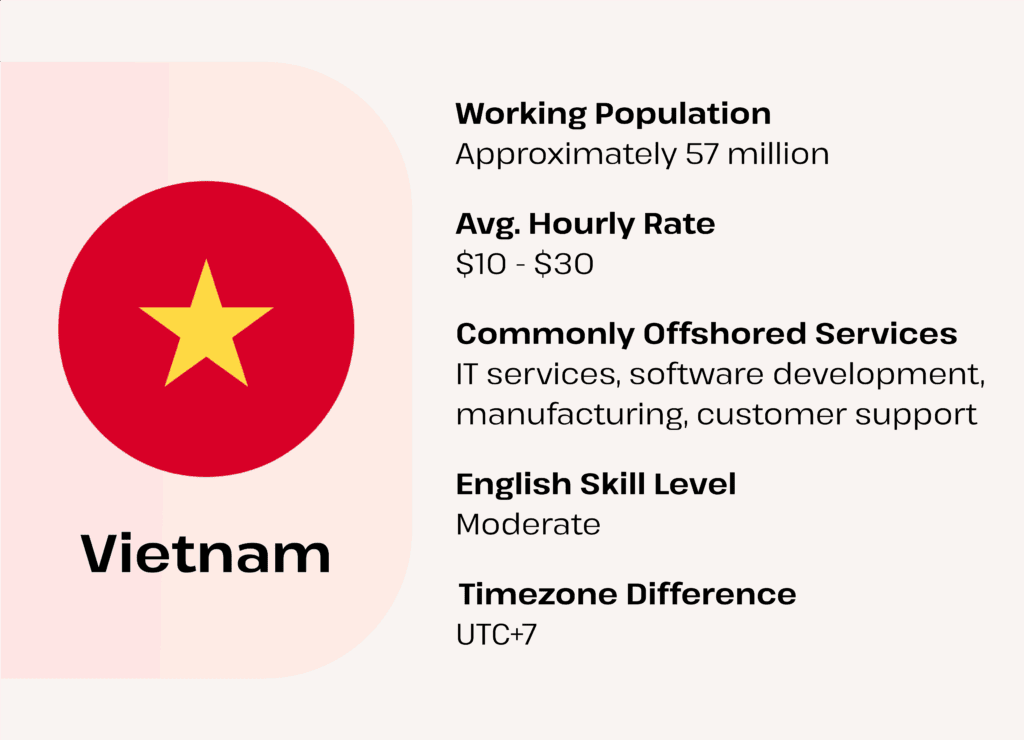
Vietnam has quickly become a favorite for startups and mid-size companies looking for strong developers at a competitive price, without compromising too much on quality.
- Developer Community: Vietnam is home to about 480,000 developers and software engineers.
- Industry Revenue: Vietnam’s software development industry reached a revenue of $1.76 billion.
- Youthful Workforce: With over 70% of its nearly 100 million population under 35, Vietnam offers a young and dynamic labor force.
Best cities to offshore IT to in Vietnam: Ho Chi Minh City, Hanoi, Da Nang
Conclusion
So, should you offshore? Maybe. Maybe not. But if your gut is already asking the question, that is your cue to dig deeper. But remember, IT offshoring isn’t the hero or the villain. It is a power tool. Use it right, and it will scale you faster than your local hiring spree ever could. Use it wrong, and you will spend 6 months decoding passive-aggressive status reports and rewriting code that didn’t need to exist.
At Genius, we give you access to pre-vetted, ridiculously good offshore talent for a fraction of what you are probably burning right now. We are talking full-time A+ developers—$12K/year, perfect English, same timezone, 5-star work ethic.
So the question isn’t “Should you offshore?” – it is “Why aren’t you doing it with Genius?”
👉 Tell us what you need in 1 minute.
FAQs
How much does IT offshoring typically cost?
IT offshoring can cost anywhere from $12,000 to $40,000 per year for full-time developers, depending on the role, location, and experience level. It is often 60–80% cheaper than hiring locally in the US or Europe.
How is IT offshoring different from outsourcing?
IT offshoring means hiring your own remote tech team in another country. IT outsourcing means hiring a third-party company to handle the development work. IT offshoring gives you more control and long-term team building. IT outsourcing is more hands-off.
What types of IT roles are best suited for offshoring?
Roles like software developers, QA testers, DevOps engineers, tech support agents, and UI/UX designers are commonly offshored. These positions involve repeatable, process-driven work that doesn’t need constant on-site presence.
What should I look for in an IT offshore partner?
Look for strong vetting processes, timezone compatibility, clear communication standards, and a track record with similar companies. Bonus if they offer culture fit screening and risk-free trials, or guarantees.