You don’t need a five-star app team parked outside your office to build something great. These days, smart businesses are cutting costs and skipping the endless local hiring drama by taking their mobile app development offshore. Sounds risky? Only if you are winging it.
That is why we have put this guide together – to give you clear, workable methods to make it succeed. So, let’s talk about how actually to build an efficient mobile app development offshore setup.
Building Mobile App Development Offshore: 5 Key Takeaways

- Offshore teams reduce build costs by up to 60% and help double your daily output with 8–12 hours of extra coverage.
- You can launch your MVP 30–40% faster if you cap features, run weekly demos, and build in 2-week sprints.
- Hiring offshore unlocks niche expertise like AI, cloud, and security, without 3-month recruitment delays or full-time contracts.
- The right offshore vendor owns the code, signs airtight contracts, and passes audits for GDPR or HIPAA from day one.
- Daily written updates, fixed sprint reviews, and real-time tracking in tools like Jira keep your project on track and transparent.
Check Out These Related Reads
🔥 Offshore Big Data Development: Your Complete Starter Guide
📣 .NET Offshore Development Services: A Quick Starter Guide
🏅 How To Work Efficiently With Agile Offshore Software Development
What Is Mobile App Development Offshore & How Is It Different?

Taking mobile app development offshore is hiring a development team in another country, typically with lower labor costs, to build your mobile application from design through deployment. Unlike onshore or nearshore work, offshore teams sit in lower-cost regions, so the same skill set costs less while the clock runs on a 24-hour loop.
Here’s why most businesses prefer offshoring mobile app development:
- It saves up to 60% on development costs as you tap into affordable offshore mobile app development services.
- 76% of companies outsource IT tasks to reach skilled developers unavailable locally.
- Offshore teams can deliver projects around the clock, which accelerates launch timelines.
- It helps you easily expand or shrink your team based on project needs without hiring full-time staff.
- You can access niche skills like AI, AR, or cross-platform development without lengthy recruitment.
Offshore Mobile App Development Services vs Onshore vs Nearshore
| Offshore | Nearshore | Onshore | |
|---|---|---|---|
| Time-zone difference | ≥ 5 hrs | 1–4 hrs | <1 hr |
| Hourly rate | $20–50 (Asia, E. Europe, LatAm) | $40–80 (Central Europe, Mexico) | Limited to the local market |
| Talent availability | Very large global pool | Good with some overlap | Limited by the local workday |
| Communication overlap | 2–4 hours daily overlap | 6–8 hours (same continent) | 8+ hours; real-time collaboration |
| Cultural & legal fit | Diverse; needs management | Partially aligned | Strong cultural, legal alignment |
| Speed & flexibility | Limited by the local workday | Extended workday possible | Limited by local workday |
| Risk level | Moderate (IP, quality) | Lower than offshore | Lowest (control, security) |
| Best for | Budget‑driven, fast build | Balanced cost/control | High‑control, on-premises needs |
5 Steps To Choose The Perfect Offshore Mobile App Development Company For Your Needs

Follow these 5 steps to choose your ideal offshore partner and stay in control.
Step 1: Check Their Real Track Record
Look beyond glossy marketing. Ask for 3 recent projects similar in size and industry to verify outcomes.
- Review deliverables, timelines, and cost variances within 15% of estimates.
- Confirm use of your tech stack (for example, React Native or Flutter).
- Ask for direct client contact and check whether feedback scores hit at least 4 out of 5.
Step 2: Double-Check Their Skills & Toolset
Make sure they bring the right expertise; don’t guess.
- Confirm team roles: developer, QA, UI/UX, project manager.
- Look for certifications (e.g., AWS, Google Firebase).
- Ask for code examples or GitHub links with clean comments and structure.
Step 3: Test Their Communication Quality
Good tools do not equal good communication. Make sure they talk clearly and often.
- Require daily written status updates at fixed times.
- Ensure at least a 2-hour overlap in your workdays.
- Host a video “show and tell” each sprint to review work versus plan.
Step 4: Lock Down Legal, IP, & Security Terms
Protect your idea and your data from day one.
- Include nondisclosure agreements with penalties for breaches.
- Define code ownership: You must own the final product.
- Require compliance with security standards (like GDPR or ISO 27001).
Step 5: Hunt Down Red Flags
Catch trouble before it becomes costly.
- Avoid vendors that quote significantly lower costs. Quality often pays hidden costs.
- Beware of overly aggressive timelines. If they promise a full build in 4 weeks, ask for logic.
- Watch out for vague team structures or turnover rates above 30%.
📢 Did You Know?
66% of US businesses use offshore teams for software development.
6 Steps To Build An Efficient Mobile App Development Offshore Setup Without Hiccups

Use this step-by-step roadmap to build your mobile app development offshore.
Step 1: Lock In Scope, Budget, & Features
Define what your app must do, how much runway you can burn, and which features matter most. Clear boundaries prevent runaway costs and missed expectations.
- Create a one-page functional specification with core vs add-on features.
- Set a hard budget cap that protects your runway.
- Build a timeline with 2-week sprints and a 10–20% buffer.
- Share this with your team before any work starts.
Step 2: Pick Your Engagement Model
Decide whether you want to go fixed-price, pay-as-you-use, or hire a dedicated team. Match the style to your appetite for control and flexibility.
- Fixed-price works if your scope stays within a 10% variation.
- Choose time-and-materials for evolving scope or experimentation.
- Opt for a dedicated team when you need ongoing staffing beyond launch.
Step 3: Run A Pilot Or MVP Phase
Start small. Launch a test phase that proves the team delivers before you commit full-scale resources.
- Budget 15–20% of total funds for a small feature set.
- Define MVP success criteria: functional build, code quality pass, weekly demos.
- Treat this pilot like a mini-project: same documentation and review.
Step 4: Set Communication & PM Systems
Use tools that everyone actually uses and keep updates real. Ditch corporate fluff and keep reports concrete and concise.
- Require daily written updates: what got done, what blocks, next steps.
- Fix overlapping work hours of at least 2 hours daily.
- Use shared boards in Jira or Trello for task tracking and accountability.
Step 5: Monitor Quality & Security
Always check the code and your security safeguards along the way. Fixing flaws early saves weeks later.
- Run code reviews every sprint using GitHub pull requests.
- Automate testing for unit tests and run a security scan before each release.
- Confirm compliance with GDPR or relevant security standards if the app handles data.
Step 6: Keep Feedback Loops Tight
Avoid drifting off course. Keep reviews fast and deliverables transparent so the whole team stays on the same page.
- Hold end-of-sprint demos every 2 weeks with clear feedback points.
- Track agreed success metrics like bug count, velocity, and code coverage.
- Adjust the plan each sprint based on numbers, not gut feel.
“Offshoring works when execution outpaces planning. The teams that win are the ones that ship, not the ones that hesitate.”
— Burkhard Berger, Founder and CEO of Genius
4 Best Regions To Take Mobile App Development Offshore: Comparing Key Decision-Making Factors

Compare regions head to head so you can match your budget, timeline, and risk tolerance without guesswork.
| Region | Average Rate (USD/hour) | Key Advantages & Trade‑offs |
|---|---|---|
| Eastern Europe (Poland, Ukraine, Romania) | $30–$60 | ✅ Highly skilled in enterprise and backend work. ✅ Time overlap with US connects at 6–8 hours. ✅ Legal systems support GDPR/IP protection. |
| South Asia (India, Pakistan) | $20–$50 | ✅ Massive talent pools, especially in mobile, AI, and cloud. ✅ Time overlaps with the US early morning. ✅ English fluency varies—pick carefully. |
| Latin America (Argentina, Brazil) | $30–$50 | ✅ Strong time overlap with US (same to +2 hours). ✅ Fluent English, growing infrastructure. ✅ Slightly higher rates but fewer communication issues. |
| Philippines | $30–$40 | ✅ Good English and cultural compatibility with the US. ✅ Android and support expertise. ✅ Time overlaps best with the West Coast (12 am–4 pm PT). |
How Much Does It Cost To Move Mobile App Development Offshore?

Offshore mobile app development costs between US$20 to US$70 per hour, depending on skill level and destination. Total project cost ranges from US$30,000 for simple apps to more than US$300,000 for complex builds.
Hidden costs to factor:
- Maintenance & support: ~20–25% of initial budget per year
- Infrastructure, tools, administration: typically add 5–10% to the total bill
- Communication overhead (time‐zone management, meetings): can reduce productivity by 15–20%
6 Key Benefits To Expect With Mobile App Development Offshore

Pin down the real-world gains that mobile app development offshore brings to your team, timeline, and budget.
- Stretches your budget further: Offshore teams in South Asia or Eastern Europe charge 50–70% less than US-based developers. You get the same code output for less than half the cost, without cutting corners.
- Taps into global skill pools instantly: Whether you need Flutter, AI/ML, or backend DevOps, offshore markets already have certified experts who onboard in under 5 days. No 3-month hiring delays, no recruiter fees.
- Works while you sleep: Offshore teams add 8–12 hours of daily coverage, which means your sprint velocity doubles without adding headcount. While your team sleeps, theirs ships.
- Scales without a headcount headache: Add or drop developers in under 48 hours as project needs change. Offshore setups plug right into your workflow without W-2 compliance or benefits admin.
- Keeps your core team focused: Let offshore teams handle execution so your US staff can lead product strategy, partnerships, or investor relations. You gain leverage without burnout.
- Speeds up your launch timeline: Offshore teams work in parallel tracks. QA runs while the developer builds, the design finalizes the next sprint, and the backend wraps up the last one. This cuts time-to-market by 25–40%.
🔥 Interesting Fact
80% of North American companies are using or considering nearshore software development.
6 Best Offshore Mobile App Development Practices That Will Improve Your Operations

Tighten your processes with these so your offshore build stays lean, on track, and under budget.
1. Set Numbers Before You Start
Lock KPIs like bug count, test coverage, and sprint velocity before the first task. Keep these metrics visible in tools like Jira or ClickUp so no one works in the dark.
2. Run Agile The Way It’s Meant To Work
Use 2-week sprints, define clear story points, and ship something testable at every sprint demo. Cut dead weight by reviewing the sprint backlog every Friday without fail.
3. Make Time Zones Work For You
Create a 2–4 hour daily overlap for live collaboration. Use asynchronous tools like Loom or Notion for anything that does not need a live call.
4. Double Down On Automated QA
Set up CI pipelines from day 1 using GitHub Actions or Bitbucket Pipelines. Make sure each push triggers unit tests, UI checks, and security scans before it touches staging.
5. Keep Reviews Short & Brutal
End each sprint with a no-fluff 30-minute review. Track what failed, fix it fast, and cut what no longer matters. Store decisions in a shared document that everyone can access.
6. Scale Your Team With Zero Drag
Use modular task planning and code repositories with clean onboarding checklists. New developers should complete and submit their first task within 48 hours—no extra help needed.
5 Common Risks In Offshore App Development & How To Proactively Avoid Them

Spot these 5 mobile app development offshore issues before they wreck your budget.
- Vague contracts with no accountability: Skip generic scopes. Lock every deliverable into a statement of work with penalties for more than 15% timeline or budget overruns. Use fixed milestones tied to payments.
- Vendors who dodge ownership terms: Never accept shared or undefined code rights. Include IP clauses that assign 100% ownership to you from day one. Require all code and assets to sit in your GitHub or Bitbucket.
- Teams that say “yes” to everything: Over-promising usually means under-delivery. Ask for a week-by-week roadmap with specific story points, and reject proposals that skip scope boundaries or buffers.
- Security with zero real compliance: If your app handles user data, demand proof of ISO 27001, SOC 2, or GDPR compliance. Use automated tools like SonarQube and OWASP ZAP to scan for vulnerabilities weekly.
- Developers working in the dark: Silence kills momentum. Require daily standup notes with blockers, use issue-tracking tools like Jira with real-time status updates, and audit them every Friday without fail.
“The real advantage of offshore development is getting the right specialist live in under a week when your roadmap cannot wait.”
— Christian Cabaluna, Senior Recruiter at Genius
Top 6 Tools Startups Should Use For Offshore Mobile App Development

Set up these tools before your offshore team writes a single line of code for your startup.
- Jira: Use for task tracking, sprint planning, and issue management across distributed teams. Add dashboards to track velocity, bug count, and backlog progress in real time.
- GitHub: Best for version control, code collaboration, and pull request reviews. Set branch protections and CI triggers from the word go to reduce merge conflicts and faulty builds.
- Slack: Use it for daily status updates, quick syncs, and automated alerts. Create dedicated channels for each feature, and integrate with Jira and GitHub to centralize updates.
- Loom: Ideal for recording asynchronous walkthroughs of features, blockers, or UI flows. Replace live calls for non-urgent reviews and cut meetings by up to 40%.
- Bitbucket Pipelines: Use this to automate build, test, and deploy steps. Connect it to your main repo to trigger security scans and unit tests with every commit.
- Postman: Use it to test APIs during development and catch integration bugs early. Share test collections with your offshore team to stay in sync on expected inputs and outputs.
💭 Food For Thought
Offshoring to India or the Philippines can cut labor costs by up to 70% compared to the US
3 Offshore Mobile App Development Case Studies That Offer Crucial Lessons
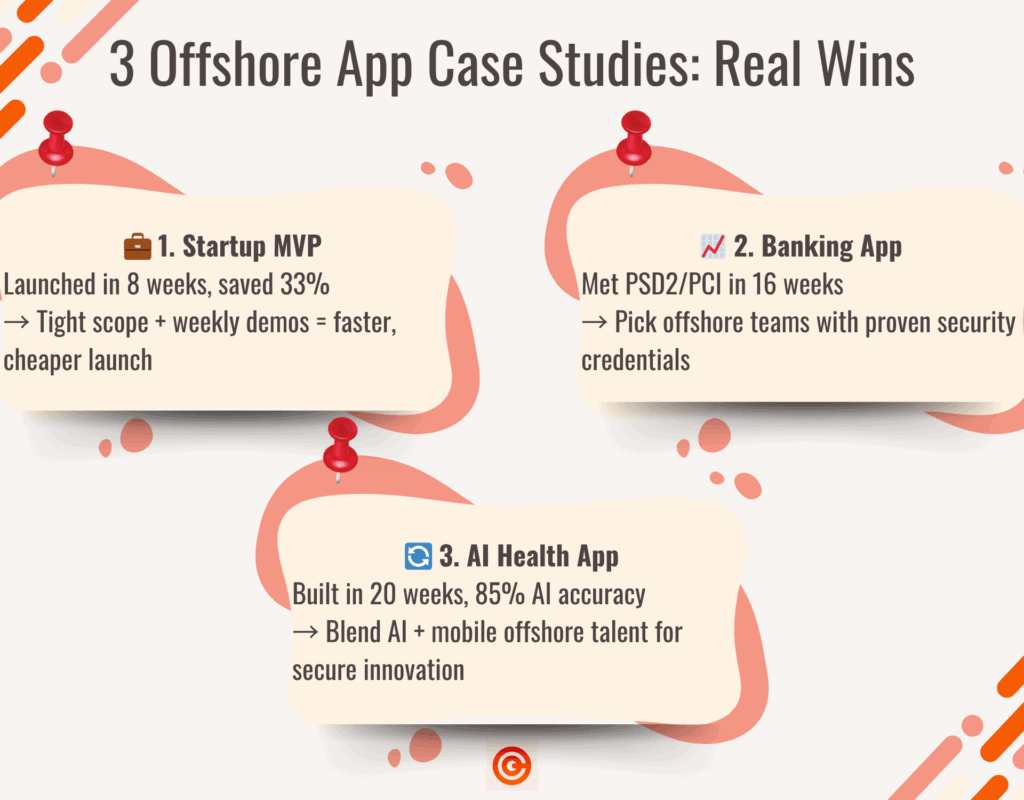
Use these examples as you assess your offshore strategy and budget phases.
1. Startup MVP Launch (Cost Saved, Time Reduced)
Company background: Early-stage startup aiming to validate a consumer app.
The problem they faced: The Local team required 3 months and US$60,000 to deliver an MVP, while the runway was only 4 months.
The solution they used: They hired an offshore team and defined the MVP scope tightly, with weekly demo checkpoints.
The outcome: Launch in 8 weeks, total cost US$40,000 (‑33%), and runway preserved.
Key takeaway: Cap scope and enforce weekly demos to save time and money.
2. Enterprise Banking App Built Offshore (Security + Compliance)
Company background: Mid‑sized bank expanding mobile services abroad.
The problem they faced: The in-house team lacked security expertise for API compliance under PSD2/PCI DSS.
The solution they used: Offshore vendor with security certifications and bank‑grade API controls.
The outcome: Live app launched in 16 weeks, met PSD2 and PCI DSS standards, and passed third‑party audit.
Key takeaway: Use offshore teams with certified security chops to hit compliance fast.
3. Healthcare App With AI Features Via Offshore Talent
Company background: Health‑tech startup building an AI‑powered symptom checker.
The problem they faced: They needed data‑science, mobile, and security skills beyond the in‑house staff.
The solution they used: Assembled an offshore team with AI, Flutter, and HIPAA‑aware development.
The outcome: Beta release in 20 weeks at US$120,000. AI accuracy hit 85%, and the security audit cleared.
Key takeaway: Mix offshore AI and mobile expertise to build secure, innovative apps cost‑effectively.
Conclusion
Your mobile app development offshore strategy is a mapped-out operation, not a wild gamble. You now know how to cut scope bloat, dodge vendor red flags, and ship faster without letting your runway vanish. The difference between a missed deadline and a product-market win is in the details you just read. But here is the part most teams skip: hiring the right people.
You can build the best plan on paper, but if your developers flake, miscommunicate, or ship junk code, it is game over. That is where Genius comes in. We are your shortcut to vetted offshore talent who already know how to build, communicate, and show up like it is their name on the product. We screen 250+ candidates to find the ONE who actually delivers.
No payroll headaches. No monthly fees. Just rockstar hires at 80% less. Hire with Genius today.
FAQs
What types of mobile apps are best suited for offshore development?
Apps with well-defined functionality, fixed budgets, or tight deadlines often benefit the most. These include eCommerce platforms, MVPs, internal tools, and standard booking or delivery apps.
How long does a typical offshore mobile app project take from start to finish?
Simple apps take 8–12 weeks, mid-range projects need 4–6 months, and large-scale enterprise apps can run 8–12 months or longer, depending on features, review speed, and team size.
Which time zones work best for US companies outsourcing offshore?
Teams based in Latin America, Eastern Europe, and parts of South Asia offer the best overlap. Aim for at least 2–4 hours of real-time collaboration per day.
How do offshore teams usually structure mobile app sprints?
Most follow Agile with 2-week sprints. A standard sprint includes planning, build, testing, demo, and retro with clear output tied to story points or sprint velocity.