
Hiring great people is hard. But hiring nearshore outsourcing talent is a different beast altogether. Sure, the perks are clear: lower costs, real-time collaboration, cultural fit. But when it is time to actually find top-tier professionals, it is chaos.
Who do you trust? Where do you look? How do you filter the real experts from the risky bets?
This guide is your shortcut. We will break down exactly how to find nearshore outsourcing talent—quickly and without the guesswork. From cost comparisons and vetting strategies to top talent hubs and red flags to avoid, this is the roadmap to your next A+ onshore hire.
Finding Nearshore Outsourcing Talent: At A Glance
- Start with regions, not resumes—some countries are built for developers, others for support.
- Ditch generic job boards and tap role-specific marketplaces with built-in vetting.
- Look for proof of work: portfolios, real outcomes, and client reviews—not just skill lists.
- Use 24-hour micro-tests to spot clarity, speed, and problem-solving without wasting time.
- Always ask about internet backups, system specs, and timezone overlap before the interview.
- Get 3 curated profiles from a specialist agency that knows your function cold.
Check Out These Related Popular Reads
🔥 Offshoring Cycle Explained Simply: Stages, Goals, & Flow
🎯 Business Process Offshoring: Explained With Real Cases
📣 17 Reasons For Offshoring: Why Top Companies Do It
What Is Nearshore Outsourcing Talent & How Does It Differ From Offshore & Onshore Models?
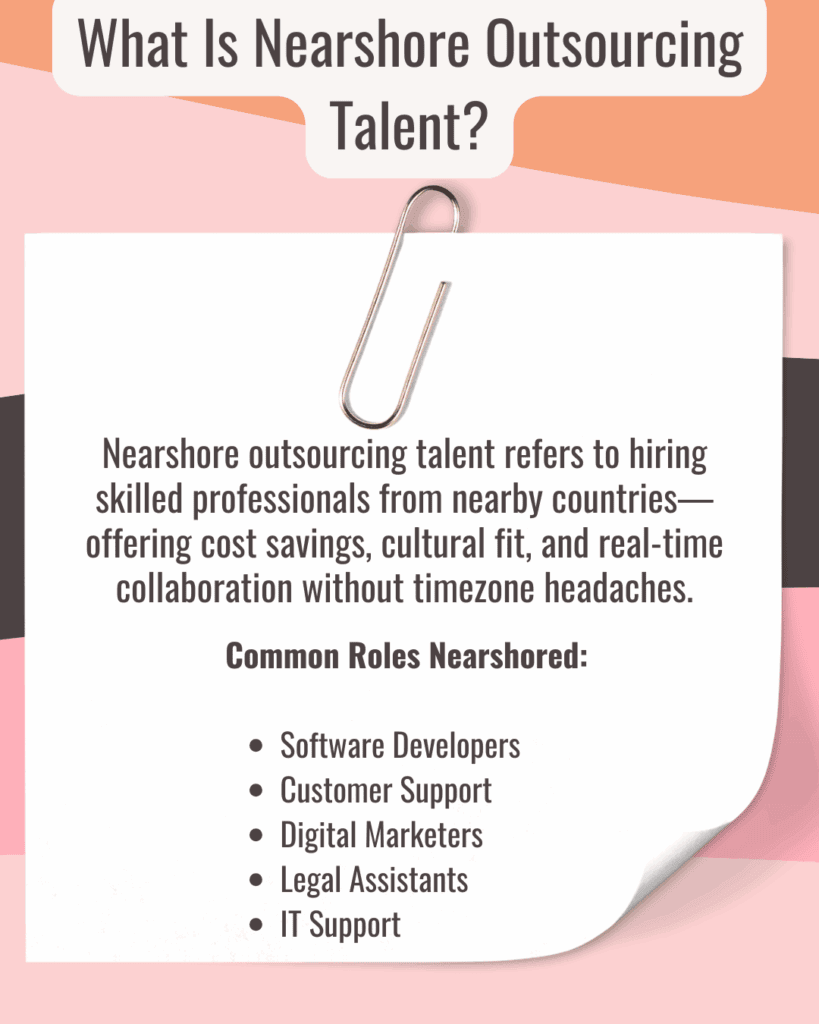
Nearshore outsourcing talent is hiring professionals from neighboring or nearby countries to perform business functions. This approach helps save costs, ensure cultural similarities, facilitate smoother collaboration, and maintain time zone alignment.
Common Roles Outsourced To Nearshore Talent:
- Software Developers
- Customer Support Agents
- Digital Marketing Specialists
- Legal Assistants
- IT Support Staff
Comparison: Nearshore Outsourcing Talent Vs Offshore Vs Onshore
| Nearshore | Offshore | Onshore | |
| Cost | Moderate savings | Highest savings | Highest cost |
| Time Zone Compatibility | Similar or same time zones | Significant differences | Same time zone |
| Cultural Alignment | High | Low to moderate | Very high |
| Communication | Easier due to language and culture | Potential language barriers | Seamless |
| Travel Convenience | Short travel times | Long travel times | No travel required |
| Control & Oversight | Moderate to high | Lower | High |
7 Steps To Find Nearshore Outsourcing Talent Quickly & Reliably

Work your way through these 7 proven steps to find nearshore outsourcing talent.
Step 1: Lock In The Role, Budget, & Time Zone Window
Before you start your search, clarify exactly what you are looking for. Get specific about the role, compensation range, and working hours overlap.
- Write a 3-line role summary (not a job post) that describes the outcomes you expect.
- Pick 1–2 time zones that offer at least 4 hours of overlap with your core team.
- Calculate a rough salary benchmark using Glassdoor, Talent.com, or accelerators like Arc.dev and Nearsure.
- Decide if you want full-time employees, long-term contractors, or flexible project-based talent.
- Flag any legal, compliance, or language needs up front so they don’t slow you down later.
Step 2: Skip Job Boards. Go Straight To Role-Specific Marketplaces
General job boards waste time. Use platforms where top nearshore talent already exists for your role type.
- For software roles, check platforms like Turing, Nearsure, or Zartis.
- For support, marketing, or admin, try Genius, Pavago, or Vinali Group.
- Look at country-specific talent hubs (e.g., Get On Board in LATAM, RemoteOK with regional filters).
- Avoid starting from scratch—search pre-vetted candidate pools with verified track records.
- Use filters to target candidates in your preferred countries or regions.
Step 3: Vet The Country Before You Vet The Candidate
Not every nearshore market fits every role. Some countries are stronger in engineering, others in support or back office.
- Use real market data (from Accelerance, Multishoring, or Localyze) to compare average rates, turnover trends, and language fluency.
- Colombia, Brazil, and Mexico are strong in IT and CX; Argentina leads in creative and marketing roles.
- For legal or finance support, prioritize countries with strong compliance ecosystems (e.g., Chile or Costa Rica).
- Factor in time zone reliability—avoid countries with frequent outages or inconsistent infrastructure.
- Cross-check their labor laws if you plan to engage full-time, not freelance.
Step 4: Use Referrals From Niche Agencies Who Specialize In Your Function
Referrals from focused staffing agencies beat cold searches every time, especially when they live and breathe your function.
- Reach out to firms that specialize by vertical (e.g., Genius for full-time placements in IT/support, QX Global for finance roles).
- Ask for 3 pre-vetted profiles per role, not a candidate dump.
- Prioritize agencies that operate in the region you’re targeting—not global firms pretending to be regional experts.
- Check if they offer a short trial or replacement guarantee.
- Avoid agencies that charge ongoing fees unless they actively manage the talent post-placement.
Step 5: Spot The Real Experts Without A Single Interview
You don’t need to book 10 interviews to spot a great candidate. Use their digital footprint instead.
- Review GitHub or Behance portfolios (devs/designers) and LinkedIn activity for real insights.
- Look for candidates with client reviews on platforms like Clutch or Upwork—even if you’re not hiring through those.
- Watch 2-minute intro videos if available—many agencies include these to save you time.
- Avoid resumes that just list tools—prioritize outcome-driven profiles with numbers and team impact.
- Discard any candidate who lacks basic English fluency if the role requires daily client interaction.
Step 6: Run A Silent 24-Hour Test Before You Engage
You don’t need to gamble. Run a quick test before you commit, without wasting anyone’s time.
- Assign a mini-task with a real deliverable that takes under 2 hours.
- Use Slack or Loom to check communication style, attention to detail, and follow-through.
- Evaluate how well they document their work, not just what they deliver.
- Give realistic instructions and a firm 24-hour deadline—don’t coach during the trial.
- Compare 2–3 candidates on the same task to spot the difference in thinking and execution speed.
Step 7: Check Their Setup, Not Just Their Skills
Even a great candidate can slow you down if they’re working from unstable infrastructure.
- Ask what their power and internet backup plan is, especially in LATAM or Southeast Asia.
- Confirm working hours in your time zone, not theirs.
- Request a screenshot of their system specs or workspace if the role involves sensitive data.
- Check their past experience working remotely with US/European companies.
- Don’t compromise on basics like work availability, daily overlap, or security awareness.
“Great nearshore talent isn’t rare. The problem is most companies don’t have the process to find them before someone else does.”
—Burkhard Berger, Founder & CEO
Evaluating Nearshore Outsourcing Talent: 6 Steps To Vet A+ Professionals
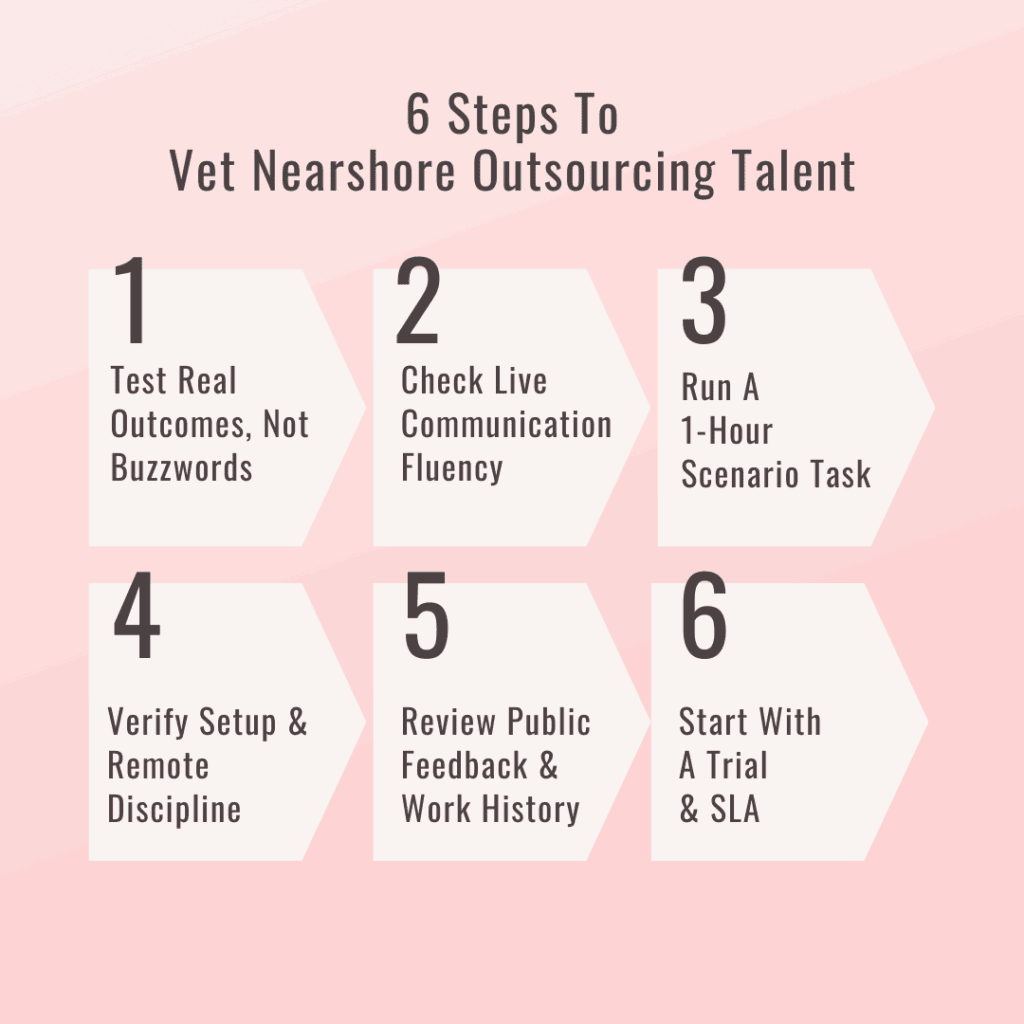
Use these 6 steps to vet nearshore candidates with real positive impact on your business.
Step 1: Stress-Test Their Real-World Experience, Not Just Tools
You don’t need another resume stacked with buzzwords. You need proof they’ve solved problems like yours.
- Ask for 1–2 project case studies showing results they owned (e.g., revenue lift, cost savings, process efficiency).
- Prioritize candidates with measurable impact, not just task completion.
- Review outcomes on client-facing work, especially for roles in support, marketing, or QA.
- Use work samples or portfolios that include team size, tools used, and results delivered.
- Cross-check for consistency between their portfolio, LinkedIn, and job history.
Step 2: Gauge English Fluency & Communication in a Live, Unscripted Setting
Canned email replies or polished resumes won’t reveal how they actually communicate.
- Schedule a short async video or audio intro.
- Ask them to walk you through a recent project without slides or notes.
- Evaluate tone, clarity, pacing, and ability to simplify technical points.
- For client-facing roles, test how they explain mistakes or changes in priorities.
- Use a shared document or Slack thread to check written communications in real time.
Step 3: Run a Micro-Scenario Test That Mimics the Real Work
You can’t vet decision-making from a resume. You need to see how they think.
- Give a 1-hour task based on a real, lightweight scenario (e.g. rewrite a help article, debug a code snippet, draft an ad brief).
- Provide 0 hand-holding—clarity of execution matters more than the “correct” answer.
- Observe how they handle ambiguity, time pressure, and instructions.
- Track how well they explain their decisions, not just what they delivered.
- Score candidates across the same rubric to reduce bias.
Step 4: Check Their Setup, Schedule, and Self-Management Habits
Even great talent flops if their infrastructure or habits fail under pressure.
- Ask when they usually work in your timezone and how they handle scheduling overlap.
- Request a screenshot of their current tech setup, including backup plans for power or internet.
- Confirm they’ve worked with distributed teams before and understand async workflows.
- Ask how they track tasks and deadlines—manual or tool-based.
- Test responsiveness by giving them a small scheduling or doc follow-up.
Step 5: Review Platform Reviews, Client Feedback & Past Collaborations
You’re not hiring in a vacuum—see what other clients have experienced.
- Review client feedback and satisfaction scores if you’ve sourced them via a marketplace or agency.
- Search their name or email on GitHub, Behance, Clutch, or Upwork to find project history.
- Look for long-term collaborations or repeat clients (a strong proxy for reliability).
- Ask if you can speak with a former manager or team lead for functional feedback.
- Verify any “top-rated” or “certified” badges with real metrics or assessments.
Step 6: Include an SLA Clause or Trial Period in Your First Agreement
Every hire needs a real-world test phase, even with strong vetting.
- Start with a 2–4 week trial focused on measurable deliverables, not “learning time.”
- Build an opt-out clause into your first agreement (with no penalties if expectations aren’t met).
- Define a weekly cadence for check-ins, progress reviews, and blocker removal.
- Use this period to evaluate autonomy, collaboration, and follow-through.
- Include a simple service-level agreement (SLA) for deliverables, updates, and hours of overlap.
🚨 Did You Know?
80% of North American companies are using or exploring nearshore software development.
6 Steps To Hire, Onboard, & Work With Nearshore Outsourcing Talent
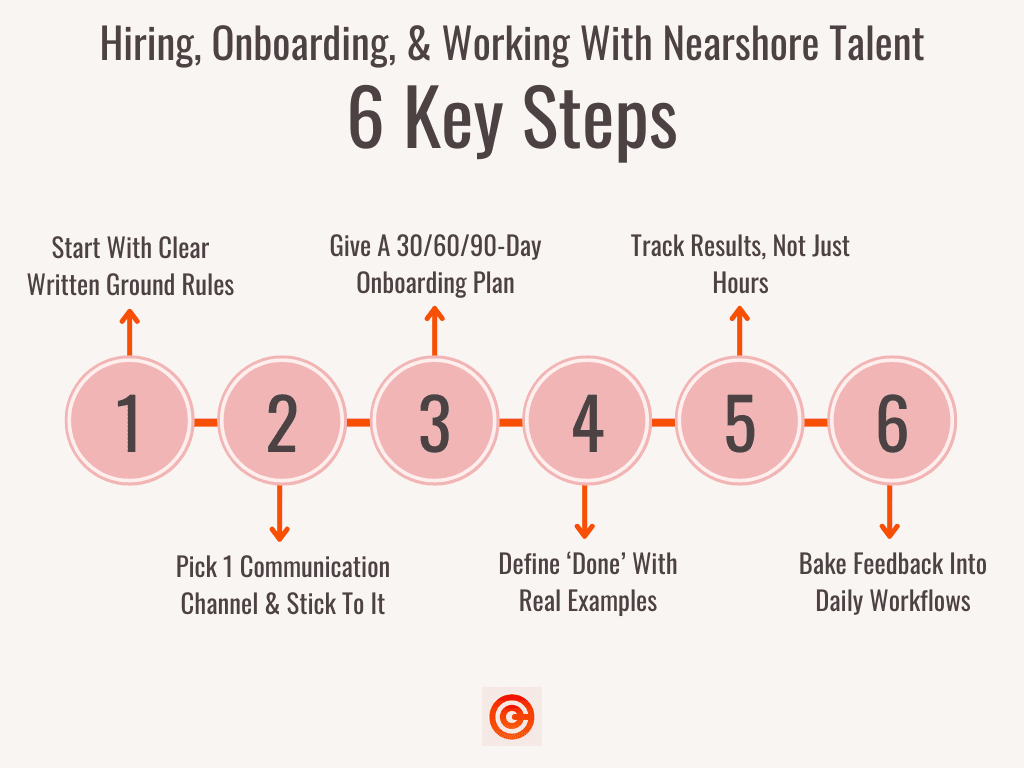
Work through these 6 steps to move from a signed agreement to a productive nearshore collaboration.
Step 1: Set The Ground Rules In Writing Before Kickoff
Make everything explicit. You can avoid 90% of early confusion with a clear written agreement.
- Send a short welcome brief with your company structure, tools, and main goals.
- Lock in daily or weekly time blocks for check-ins (use Calendly links to simplify scheduling).
- Define communication expectations: what to send via Slack, what belongs in email, and how quickly they need to reply.
- Share a sample of a successful task or project to set the bar.
- Include a simple SLA or trial clause to reduce ambiguity in the first 2–4 weeks.
Step 2: Pick A Real-Time Channel & Stick To It
Tool overload breaks flow. Choose one default channel for real-time updates, and don’t let team members bounce across 6 apps.
- Default to Slack, MS Teams, or WhatsApp depending on the region.
- Create a private channel for each project or role owner.
- Use asynchronous tools like Loom for status updates or walkthroughs.
- Install a timezone bot to make coordination easier for global teams.
- Set a 1-hour daily sync window and protect it like a meeting.
Step 3: Give A Simple 30/60/90-Day Plan
Nearshore talent isn’t temporary labor. Treat them like a real team member with a plan, not just tasks.
- Create a 1-page onboarding document with goals for week 1, month 1, and month 3.
- Use Notion, ClickUp, or Trello to assign tasks by milestone, not just to-dos.
- Include a buddy or sponsor for the first 30 days (ideally from your in-house team).
- Add cultural or industry context in your onboarding (e.g., sample customer persona decks).
- Review and revise milestones in week 2 based on actual work pace.
Step 4: Define What “Done” Means On Day 1
Scope creep kills speed. You need clean definitions for outcomes before real work starts.
- Use short deliverable templates with fields like “Purpose,” “Deadline,” “Review Owner.”
- Attach sample outputs, not vague briefs.
- Use versioned checklists for handoffs and reviews (especially for QA or design).
- Define what happens if blockers pop up: who handles what, by when.
- Store everything in 1 project hub—Google Drive, Notion, or similar.
Step 5: Track Value, Not Just Hours
Hourly tracking without outcome metrics turns into micromanagement. Instead, track output and business value.
- Set 1–2 key results per week or sprint (e.g., tickets resolved, leads added, bugs closed).
- Add a progress comment every Friday in your task system.
- Compare baseline performance pre-outsourcing with current outcomes.
- Review project velocity biweekly instead of waiting until end-of-quarter retros.
- Share wins publicly with the team to reinforce results.
Step 6: Build Feedback Loops Into The Work, Not As Add-Ons
You shouldn’t need a calendar invite to give useful feedback. Weave it into the rhythm of your work.
- Use Loom or voice notes to give clear, contextual input asynchronously.
- Create a recurring Slack thread called “1 Thing I Did Well / 1 Thing I’ll Do Better.”
- Set a 10-minute retro once per week, focused on process gaps and work friction.
- Pair nearshore talent with in-house leads to swap reviews or code audits.
- Keep a shared document of friction points and how you resolved them.
“The best nearshore hires match how your team thinks, moves, and communicates day to day.”
—Christian Cabaluna, Senior Recruiter
Measuring Nearshore Outsourcing Talent’s ROI & Success
Use this table to measure the real impact of your nearshore outsourcing talent.
| What To Measure | How To Measure It | |
| Performance Metrics | Task accuracy, SLA compliance, feedback scores | Weekly QA audits, Net Promoter Score (NPS), SLA dashboard tracking |
| Cost-Benefit Analysis | Total cost vs in-house or offshore, % savings, value per dollar spent | Track hourly rates, overhead, and compare ROI over 3–6 months |
| Productivity Tracking | Output per sprint/week, response speed, ticket closure rate | Use tools like Jira, Asana, ClickUp to count completed tasks vs plan |
| Quality Assurance | Bug rate, revision cycles, adherence to specs | Score work against acceptance criteria and internal benchmarks |
| Long-Term Value | Retention rate, role expansion, long-term output vs cost | Review quarterly deliverables, manager feedback, and tenure history |
8 Reasons You Should Consider Nearshore Outsourcing Talent For Your Business
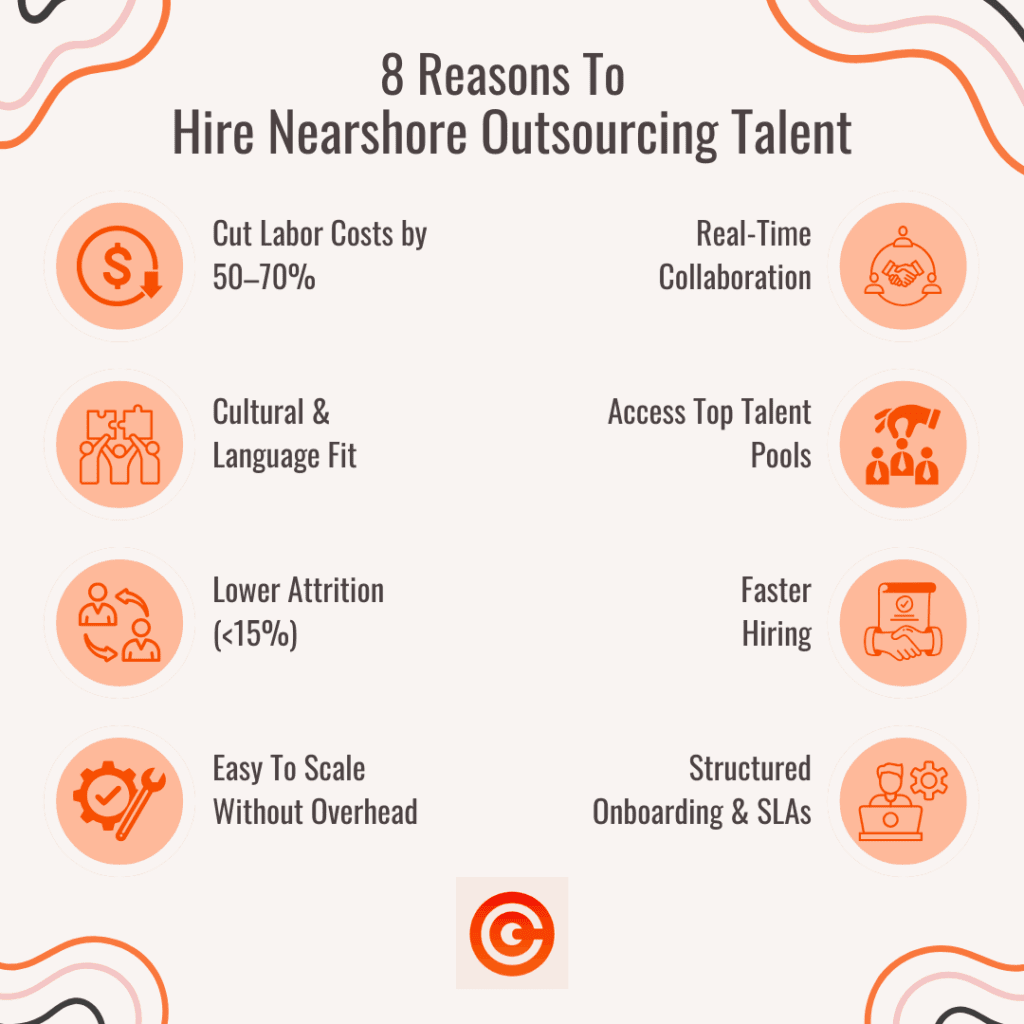
Consider these 8 compelling reasons to explore nearshore outsourcing talent.
1. Significant Cost Savings
Hiring nearshore talent can reduce labor costs by 50% to 70% compared to domestic hiring. For example, software engineers in Latin America often command hourly rates between $45 and $65, whereas their US counterparts may charge between $70 and $100 per hour.
2. Real-Time Collaboration
Nearshore teams operate in similar time zones, which offers real-time communication and collaboration. This can increase productivity and reduce project delays.
3. Cultural & Language Compatibility
Working with nearshore teams often means fewer cultural misunderstandings and smoother communication, as many nearshore professionals share similar cultural backgrounds and language proficiency.
4. Access To Specialized Talent Pools
Countries like Mexico and Colombia produce a significant number of engineering and technology graduates annually, which offers a rich pool of specialized talent for various industries.
5. Lower Attrition Rates
Nearshore outsourcing destinations, such as Latin America, report attrition rates of less than 15%, compared to offshore locations, where turnover can range between 30% and 40%. This stability ensures continuity and reduces the costs associated with frequent rehiring.
6. Faster Time-To-Hire
Nearshore outsourcing can expedite the hiring process, which helps companies fill critical roles more quickly and efficiently, which is crucial in fast-paced industries.
7. Scalable Hiring Without Infrastructure Overhead
Nearshore outsourcing enables businesses to scale their teams up or down without the need for additional infrastructure investments. This means more flexibility to adapt to changing project demands.
8. Seamless Onboarding & SLA-Driven Delivery
Nearshore partners often offer structured onboarding processes and service-level agreements (SLAs) that guarantee clear expectations, timely delivery, and accountability, which translates to smoother project execution.
📢 Interesting Fact
For 70% of businesses, cutting costs is the main reason for offshoring.
9 Nearshore Outsourcing Talent Hubs By Region
Use this table to narrow your talent search based on what you need.
| Region | Best For | Average Attrition Rate | Time Zone Overlap (US) |
| Mexico | Customer Support, BPO, IT Support | 12% | 6–8 hours |
| Colombia | Software Engineering, QA, Customer Experience | 13% | 5–7 hours |
| Argentina | Creative Roles, Marketing, Product Design | 14% | 4–6 hours |
| Brazil | Full-Stack Development, DevOps, Data Engineering | 16% | 4–6 hours |
| Poland | Cybersecurity, Backend Development, Fintech | 10% | 6–9 hours |
| Romania | Data Analysis, QA Testing, Enterprise Software | 11% | 6–9 hours |
| Czech Republic | Front-End Development, Automation, Support | 12% | 6–9 hours |
| Philippines | Virtual Assistance, Voice Support, Data Entry | 30% | 12–14 hours |
| Malaysia | Finance Ops, Admin Support, IT Services | 25% | 12–14 hours |
5 Common Challenges With Nearshore Outsourcing Talent & How To Solve Them
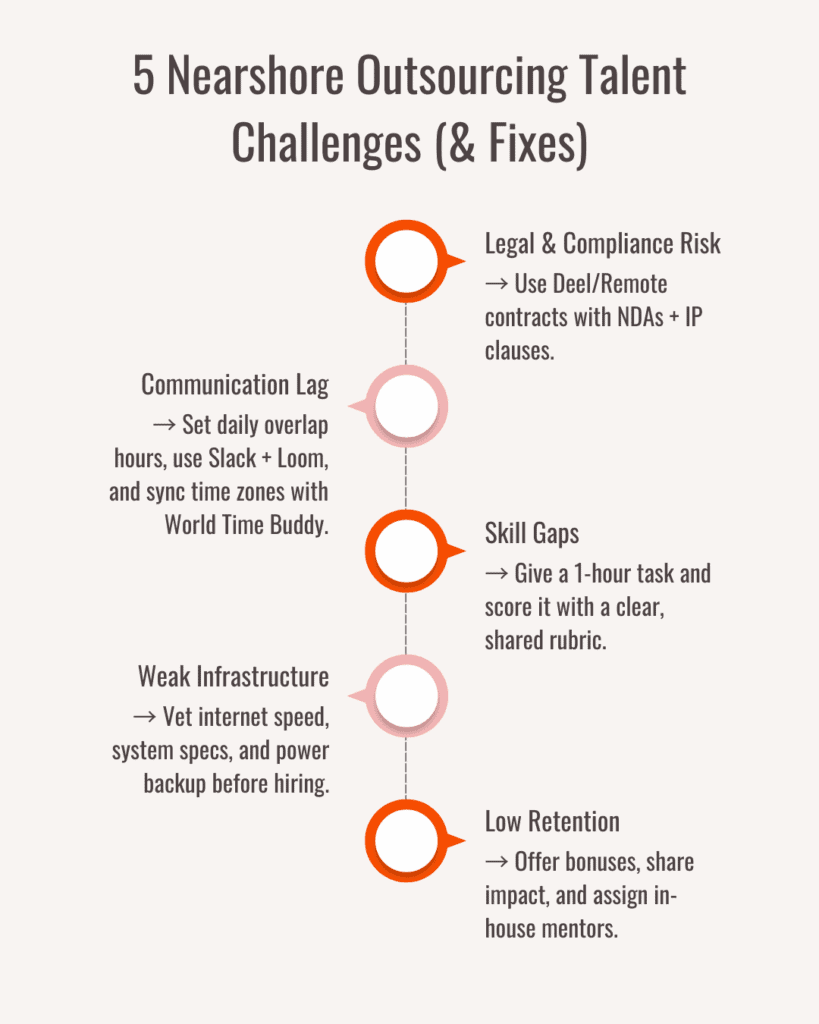
Review these 5 common challenges with nearshore outsourcing talent and take precautionary measures before they derail your team.
- Legal & Compliance Risk:
- Use country-specific contracts with IP clauses through platforms like Deel or Remote. Confirm employment classification and add NDAs before kickoff.
- Use country-specific contracts with IP clauses through platforms like Deel or Remote. Confirm employment classification and add NDAs before kickoff.
- Communication Lag:
- Set a daily overlap window (at least 1 hour), use Slack for real-time updates, and Loom for async walkthroughs. Automate timezone syncing with tools like World Time Buddy.
- Set a daily overlap window (at least 1 hour), use Slack for real-time updates, and Loom for async walkthroughs. Automate timezone syncing with tools like World Time Buddy.
- Role Fit & Skill Gaps:
- Run a 1-hour real-world task before you hire. Score submissions with a shared rubric and test for autonomy instead of just accuracy.
- Run a 1-hour real-world task before you hire. Score submissions with a shared rubric and test for autonomy instead of just accuracy.
- Weak Infrastructure:
- Check system specifications, internet speed, and backup power plans during vetting. Require screenshots for roles with security or uptime sensitivity.
- Check system specifications, internet speed, and backup power plans during vetting. Require screenshots for roles with security or uptime sensitivity.
- Retention & Engagement:
- Offer milestone bonuses, share impact metrics, and assign in-house mentors. Nearshore teams with a clear growth path stay 2–3x longer.
3 Best Nearshore Outsourcing Companies To Hire The Best Talent
Identify your role requirements, preferred hiring model, and budget to make the most of these 3 company profiles.
1. Genius

Core Services: Genius connects businesses with top-tier talent from the Philippines and Latin America, focusing on roles in IT, customer support, sales, marketing, finance, and virtual assistance.
Best For:
- Startups and SMEs that need cost-effective talent solutions.
- Companies that require rapid hiring processes.
- Businesses that want to scale teams without long-term commitments.
Sourcing & Vetting Process: Genius uses a rigorous 12-phase vetting process that accepts only the top 1% of candidates. This includes skill assessments, background checks, and cultural fit evaluations.
Time-To-Hire & Hiring Model: Typically, Genius can present pre-vetted candidates within a week. We offer flexible hiring models, including full-time, part-time, and freelance arrangements.
Guarantees: Genius offers a 6-month “Perfect Hire Guarantee,” offering support through onboarding and a 1-time flat fee with no hidden costs.
Who It’s Not For:
- Companies that need on-site personnel.
💭 Food For Thought
61% of businesses outsource tax functions to boost compliance and efficiency.
2. Softtek

Core Services: Softtek offers comprehensive IT services, like application development, cloud solutions, and digital transformation, and primarily serves clients in Latin America and the US.
Best For:
- Large enterprises that need end-to-end IT solutions.
- Organizations that want digital transformation initiatives.
- Companies that require robust compliance and governance frameworks.
Sourcing & Vetting Process: Softtek uses a mature and disciplined process that emphasizes digitized workflows and real-time tracking of metrics to maintain service quality and efficiency.
Time-To-Hire & Hiring Model: While specific time-to-hire metrics aren’t publicly disclosed, Softtek’s established processes suggest a focus on quality and thoroughness, suitable for long-term engagements.
Guarantees: Softtek emphasizes full-cycle visibility and control, which helps maintain transparency and accountability throughout the service delivery process.
Who It’s Not For:
- Startups or small businesses with limited budgets.
- Companies that need rapid, short-term staffing solutions.
3. 10Pearls

Core Services: 10Pearls is a digital development company that offers services in software development, AI & data analytics, product innovation, and cybersecurity. They cater to businesses of all sizes.
Best For:
- Businesses that prioritize digital transformation and innovation.
- Organizations that need expertise in AI, machine learning, and data analytics.
- Companies that need a partner with a global presence.
Sourcing & Vetting Process: 10Pearls combines onshore, nearshore, and offshore teams to offer tailored solutions. Their approach includes thorough assessments to ensure alignment with client objectives.
Time-To-Hire & Hiring Model: 10Pearls offers flexible engagement models, like project-based, managed teams, and team augmentation, which ensures scalability and adaptability to client needs.
Guarantees: While specific guarantees aren’t detailed, 10Pearls emphasizes delivery excellence and client satisfaction, backed by their global delivery centers and experienced teams.
Who It’s Not For:
- Companies that need low-cost, entry-level talent.
- Organizations with very short-term or narrowly scoped projects.
Conclusion
Hiring nearshore outsourcing talent sounds easy until you hit the wall—bad fits, time drains, and vendors who vanish after the kickoff call. You’ve now seen what actually works: country-first screening, role-specific platforms, micro-tests, infrastructure checks, and service-level hiring, not guesswork.
But if you want results without the slog, Genius does the hard part for you. We hunt down the top 1% across Latin America and the Philippines, vet 250+ candidates for every ONE we approve, and deliver English-fluent A+ professionals with modern skills, cultural fluency, and 0 fluff—backed by a 6-month guarantee and $0 monthly fees.
Cut your hiring costs by up to 80% and start hiring with Genius today.
FAQs
What’s the average salary of nearshore outsourcing talent?
Salaries vary by country and role. For example, a mid-level software engineer in Latin America might cost $2,500 to $4,500/month, while a customer support agent might fall between $800 and $1,500/month.
Which nearshore countries are best for software vs support roles?
Mexico, Colombia, and Brazil are strong for software and engineering roles. For support, virtual assistance, and customer service, the Philippines and Argentina are top picks.
How do I know if a nearshore provider is trustworthy?
Check client reviews on Clutch or G2, confirm their hiring success metrics, and ask how many candidates they screen per hire. Reliable providers typically showcase real hiring data and long-term client case studies.
How is nearshore outsourcing talent different from hiring remote freelancers?
Nearshore teams are usually long-term hires with infrastructure and time zone alignment, while freelancers often work independently, with less oversight and varying availability.