
Agile nearshore development sounds like the dream—faster delivery, leaner budgets, better alignment. But the moment you try to implement it, you are knee-deep in vague frameworks, bloated nearshore partner pitches, and team setups that look agile but stall after sprint 1.
This guide fixes that for you. It is a straight-up, step-by-step breakdown of how to launch agile nearshore development that actually works. From picking the right region to setting up sprints, tool stacks, and trust-building rituals, we are giving you the real playbook your development shop wishes you had.
Agile Nearshore Development: All You Need To Know At A Glance
- Cut costs by 30–50% without sacrificing speed or quality by nearshoring to LATAM regions with strong Agile maturity and cultural compatibility.
- Sprint-ready teams in your time zone mean faster feedback, clearer communication, and fewer late-night meetings.
- Pilot first with a 2-sprint trial to test team fit, velocity, and QA hygiene before scaling up.
- Track 3 core metrics—velocity, defect rate, cycle time—weekly to catch delivery slowdowns early.
- Async-first rituals and AI tooling help teams ship 40% faster while keeping burnout low and handoffs tight.
Check Out More Popular Reads
🔥 Business Process Offshoring: Explained With Real Cases
🧨 17 Reasons For Offshoring: Why Top Companies Do It In 2025
🎆 IT Nearshoring Explained: What It Is And Who Needs It
What Is Agile Nearshore Development & How Is It Different Than Traditional Outsourcing?
Agile nearshore development means working with a software team in a nearby country using the Agile way of building projects. You break work into short chunks, meet regularly, and make changes fast. Because the team is close by, it’s easier to stay in sync, talk during the day, and keep costs under control.
Agile Nearshore Development vs Traditional Outsourcing vs Offshore Agile Teams

Review this table to see how nearshoring compares against offshoring and traditional outsourcing.
| Agile Nearshore Development | Traditional Outsourcing | Offshore Agile Teams | |
| Time Zone Difference | 1–3 hours | 8–12 hours | 8–12 hours |
| Communication | Real-time, daily stand-ups feasible | Delayed responses, limited overlap | Delayed responses, limited overlap |
| Cultural Alignment | High cultural and language similarity | Low cultural alignment | Moderate cultural alignment |
| Cost | Moderate savings (20–30% compared to onshore) | High savings (up to 60% compared to onshore) | High savings (up to 60% compared to onshore) |
| Project Flexibility | High flexibility, easy to adapt to changes | Low flexibility, rigid contracts | Moderate flexibility |
| Quality Of Talent | Access to skilled developers with relevant expertise | Variable quality, depends on vendor | Access to skilled developers with relevant expertise |
| Collaboration | Seamless collaboration due to proximity and cultural fit | Challenging collaboration due to distance and cultural gaps | Challenging collaboration due to distance and cultural gaps |
| Travel For Meetings | Short travel time, face-to-face meetings feasible | Long travel time, face-to-face meetings less feasible | Long travel time, face-to-face meetings less feasible |
| Legal & IP Protection | Strong legal frameworks, similar regulations | Varies by country, potential legal complexities | Varies by country, potential legal complexities |
Implementing Agile Nearshore Development In 7 Steps

Use these 7 agile nearshore development steps to get started right away.
Step 1: Lock In Your Scope & Pick The Right Agile Model
You need a clear build list, not a vague wishlist. Lock your scope before any hiring starts, and choose an Agile model that matches your speed and structure—Scrum for sprints, Kanban for continuous delivery, or Scrumban for both.
What To Do:
- Write a 2-page scope document with project outcomes, not tasks.
- Use a decision tree to pick between Scrum, Kanban, Scrumban, and XP.
- Avoid overcommitting—cap sprint deliverables to 70% of team capacity.
- Prioritize features using MoSCoW (Must have, Should have, Could have, Won’t have).
- Involve end-users in pre-sprint backlog refinement, not just tech leads.
Step 2: Choose A Region That Works With Your Work Hours
Don’t just pick a country for cost. Choose one where your team overlaps at least 4 working hours with the nearshore team and where your developers won’t spend half the sprint decoding cultural signals.
What To Do:
- Use World Time Buddy to map the exact overlap before you commit.
- Compare attrition and cost rates between Colombia, Brazil, Mexico, and Argentina.
- Use English Proficiency Index and Agile maturity benchmarks by country.
- Cross-check regional IP laws before contracts go out.
- Look for developer hubs near airports for in-person visits.
Step 3: Vet Partners Like You’d Vet A Cofounder
The right partner won’t just ship code. They’ll push back when needed, own problems quickly, and scale with your pace. You don’t want “yes people”—you want a delivery team with backbone.
What To Do:
- Ask how they handle missed sprint goals—look for process, not blame.
- Ask for case studies with exact velocity metrics (not just logos).
- Interview their Scrum Masters, not just sales reps.
- Run a 2-week test sprint with 1-2 developers before you sign a long-term deal.
- Check if they’ve worked with hybrid teams (yours + theirs) before.
Step 4: Set A Communication Cadence That Doesn’t Burn People Out
Daily standups aren’t enough. You need clarity on how, when, and where updates happen, without draining every time zone dry.
What To Do:
- Use Slack + Loom for async demos and sprint walkthroughs.
- Set maximum weekly meeting hours (3–5 hours for most delivery teams).
- Use red/yellow/green sprint health indicators in Notion or Confluence.
- Create a shared sprint tracker in Jira with role-specific views.
- Set a fixed window for feedback on pull requests (e.g., 12 hours).
Step 5: Launch With A 2-Sprint Pilot (Not A Full Project)
Start small, fast, and with full visibility. A 2-sprint pilot tests velocity, culture fit, and communication hygiene without burning your roadmap.
What To Do:
- Choose a medium-complexity module for the pilot—something with UI + logic.
- Track sprint burndown, PR cycle times, and blockers by type.
- Ask for daily updates via Slack voice memos or Looms.
- Include your product manager in sprint reviews from day 1.
- Grade the pilot against a 10-point rubric: clarity, velocity, QA bugs, ownership.
Step 6: Use Velocity Metrics (Not Gut Feel) To Scale
Don’t scale just because the pilot “felt good.” Use real numbers like velocity, issue reopens, and team satisfaction to decide if and how to grow.
What To Do:
- Benchmark sprint velocity against your internal team (e.g., 80%+ match).
- Track story point accuracy over 3 sprints—aim for ≤15% variance.
- Use TeamHealth radar surveys to check burnout risk every 4 weeks.
- Cap team size growth to 1–2 new members per sprint to avoid chaos.
- Pause growth if the code review backlog crosses 48 hours.
Step 7: Run Monthly Retros That Go Beyond Jira Tickets
Retros shouldn’t just ask what went well. They should surface cultural gaps, trust issues, and unclear ownership—all early, before they spread.
What To Do:
- Use async retros with Miro or Parabol and emoji-based QA scoring.
- Add a “Trust Check” question to every retro: What eroded or built trust?
- Highlight 1 root process fix per retro—track in a “Fixes Log”.
- Rotate facilitators so feedback doesn’t bottleneck with 1 lead.
- Use retro outcomes to tweak hiring profiles or swap out sprint ceremonies.
🔥 Did You Know?
92% of US manufacturing executives have considered shifting to nearshoring.
Agile Nearshore Development Team Kickoff Checklist (Day 1 To Sprint 1)
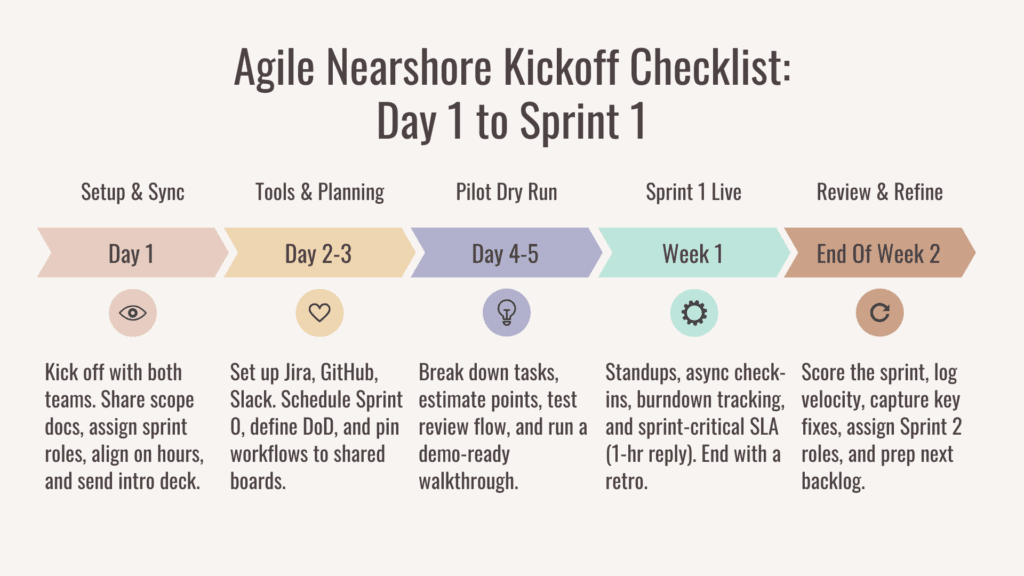
Use this checklist to pressure-test your agile nearshore development launch.
Day 1: Setup & Introductions
Start with clarity. Day 1 sets the tone for trust, context, and delivery expectations.
- Run a 30-minute kickoff with both teams: include HR, product, and delivery leads.
- Share your 2-page scope document + sprint roadmap via Notion or Confluence.
- Assign every team member to a sprint-specific role (e.g., QA lead, PR reviewer).
- Set working hours to overlap blocks (e.g., 10 a.m.–1 p.m. EST) in the shared calendar.
- Send out a short async team intro deck with photos, bios, and Slack handles.
Days 2–3: Tools, Access & Sprint Planning
Now get tactical. Block access delays and clarify how people will collaborate.
- Set up Jira, GitHub, Slack, and Notion access by function, not just role.
- Add Git naming conventions + CI/CD checklist to the team wiki.
- Schedule a 60-minute Sprint 0 planning session to finalize scope and effort.
- Pin a definition of done (DoD) document to the shared sprint board.
- Create a shared Slack channel with pinned docs, links, and sprint health indicators.
Days 4–5: Pilot Sprint Dry Run
Run a no-code, low-stakes sprint preview. Focus on clarity instead of velocity.
- Break your first backlog item into subtasks as a group using Planning Poker.
- Estimate story points live and document the logic behind point values.
- Assign each subtask to both a developer and a reviewer—set max PR time to 12 hrs.
- Walk through what “demo-ready” means using a test task.
- End with a 15-minute async video review to spot gaps before Sprint 1 kicks off.
Week 1: Sprint 1 Launch
Now you’re live. Sprint 1 is your team’s baseline. Track how they scope, collaborate, and hand off.
- Run daily standups at the same hour using a shared 3-question template in Slack.
- Monitor sprint burndown daily—set a red flag if progress stalls 2+ days in a row.
- Use Parabol or Range for async mid-sprint check-ins every 3 days.
- Set max response time to 1 working hour for sprint-critical questions.
- End Sprint 1 with a 30-minute retro + a public “what we learned” recap post.
End of Week 2: Review, Refine & Commit
Lock in what worked. Remove what slowed you down. Document everything for Sprint 2.
- Grade the sprint using a 10-point rubric (delivery, comms, QA, trust, ownership).
- Log velocity (story points completed ÷ committed) and track sprint over/under.
- Identify 1 communication fix + 1 handoff improvement for the next sprint.
- Confirm who owns each ceremony for Sprint 2—avoid floating roles.
- Archive sprint artifacts and create a new backlog column for “Next Up (Post-Retro).”
“Agile nearshore development only works when you hire people who know how to move at startup speed and still deliver enterprise quality.”
—Burkhard Berger, Founder & CEO
8 Reasons Nearshore Agile Development Works So Well

Consider these 8 benefits to evaluate the potential of nearshore agile development for your organization.
- Cost Efficiency: Nearshore developers typically offer hourly rates that are approximately 46% lower than their onshore counterparts, which offers substantial cost savings without compromising quality.
- Enhanced Project Success Rates: Adopting agile methodologies in nearshore development has shown a 60% improvement in project success rates compared to traditional approaches.
- Time Zone Compatibility: Collaborating with nearshore teams in similar time zones facilitates real-time communication, which offers faster decision-making and streamlined project timelines.
- Access To Skilled Talent: Nearshore outsourcing opens up access to a broader pool of skilled developers, which helps organizations find the right expertise for their projects more efficiently.
- Reduced Operational Costs: With nearshore teams, you can lower overhead expenses related to infrastructure and administrative support, which contributes to overall cost-effectiveness.
- Improved Collaboration: Cultural similarities and shared business practices with nearshore teams enhance collaboration and reduce the likelihood of misunderstandings. This creates a more cohesive working relationship.
- Scalability: Nearshore agile development allows for flexible scaling of teams based on project needs, which helps organizations adapt quickly to changing requirements without significant delays.
- Faster Time-To-Market: The combination of agile practices and nearshore collaboration accelerates the development process, which helps you bring products to market more swiftly.
5 Agile Nearshore Development Methodologies (& When To Use Each)

Use this breakdown to decide which Agile model fits your nearshore development setup best.
1. Scrum: Best For Iterative Product Releases
What It Is: Scrum breaks work into fixed-length sprints (1–4 weeks), with planning, demos, and retros built in. Each sprint delivers a small, usable chunk of the product.
Best For: New product builds, MVPs, or feature-driven roadmaps.
Use Cases:
- Launching a SaaS MVP with weekly stakeholder demos.
- Building a fintech app with frequent regulatory updates.
- Scaling a retail platform that needs 2–3 new features per month.
- Projects with shifting priorities that need 2-week planning windows.
Extra Tip: Keep sprint goals at 70% of team capacity to leave room for surprises and urgent fixes.
2. Kanban: Best For Continuous Delivery & Maintenance
What It Is: Kanban is a pull-based workflow system. Teams move tasks through a visual board (e.g., To Do → In Progress → Done) with no fixed sprint cycles.
Best For: Ongoing maintenance, bug fixing, and internal tooling.
Use Cases:
- Supporting a live product with daily defect fixes.
- Handling DevOps or CI/CD pipelines where delivery never stops.
- Managing requests from multiple business units in real time.
- Maintaining APIs with fast-changing third-party integrations.
Extra Tip: Set WIP (Work In Progress) limits per column to avoid bottlenecks and burnout.
3. Scrumban: Best For Mixed Agile Workloads
What It Is: Scrumban mixes the structure of Scrum with the flow of Kanban. You still hold planning sessions, but your work moves flexibly across the board without hard sprint boundaries.
Best For: Teams juggling new development and support or multiple product lines.
Use Cases:
- Growing startups that need to release and fix in parallel.
- HR tech tools with overlapping client implementations.
- Agile teams in hybrid roles: Part R&D, part live support.
- Projects where requirements change mid-sprint.
Extra Tip: Use Planning Poker + rolling backlog grooming every 5–7 days to stay on track.
4. Lean & XP: When Process Optimization Or Code Quality Is Key
What It Is: Lean cuts waste; XP (Extreme Programming) boosts engineering quality. Together, they shorten delivery loops and reduce bugs as they emphasize test-driven development, pair programming, and rapid iteration.
Best For: Projects with strict performance standards or fast-changing tech stacks.
Use Cases:
- AI/ML models where code quality directly impacts training output.
- High-load fintech systems where any bug costs real money.
- Early-stage prototypes in medtech that require regulatory prep.
- DevOps-heavy builds with heavy automation.
Extra Tip: Use pair programming for complex logic or security-critical code paths—schedule no more than 4 hours/day to avoid fatigue.
5: Hybrid Agile Approaches: Best For Nearshore Development Success
What It Is: Hybrid setups blend methods across pods or phases. A frontend pod might run Scrum while a backend pod runs Kanban. Or you may use Lean principles during build and Kanban during support.
Best For: Large-scale programs with diverse workstreams and distributed teams.
Use Cases:
- Enterprises running 3+ pods across time zones and product layers.
- Cross-functional squads building APIs, UI, and infra at different speeds.
- Public sector digital projects where audit compliance coexists with MVP pressure.
Extra Tip: Use a shared cadence (e.g., biweekly reviews) across teams regardless of methodology, so you never lose the product thread.
📣 Interesting Fact
Offshoring can cut costs by as much as 40% compared to traditional outsourcing.
How To Measure Success In Agile Nearshore Development In 4 Simple Steps

Use these 4 steps to get a clear picture of your team’s performance and areas for improvement.
Step 1: Track The Right Agile KPIs Early
Lock in clear performance indicators that match your sprint goals. Focus on delivery consistency, quality signals, and user satisfaction from the start.
- Sprint Velocity: Measure the number of story points completed per sprint. A consistent velocity indicates stable performance.
- Cycle Time: Track the duration from task start to completion. Shorter cycle times suggest efficient workflows.
- Defect Density: Calculate the number of defects per 1,000 lines of code. Lower defect density reflects higher code quality.
- Customer Satisfaction: Use surveys to assess client satisfaction post-delivery. High scores indicate successful collaboration and product acceptance.
Step 2: Use Velocity Metrics To Spot Bottlenecks
Velocity metrics help you understand if your team is stuck or sprinting ahead. Use them to fine-tune throughput and reduce delivery drag.
- Lead Time: Measure the time from feature request to delivery. Short lead times demonstrate responsiveness.
- Throughput: Count the number of tasks completed in a given period. Higher throughput signifies increased productivity.
- Work In Progress (WIP): Monitor the number of tasks in progress. Keeping WIP low helps maintain focus and efficiency.
Step 3: Benchmark Your QA With Real-Time Data
Quality doesn’t just happen—you need to measure it. Use QA benchmarks to track code health and preempt defects.
- Test Coverage: Aim for at least 80% code coverage in automated tests. This ensures most code paths are tested.
- Bug Resolution Time: Monitor the average time to fix defects. Faster resolution times indicate effective QA processes.
- Regression Rates: Track the frequency of recurring bugs. Lower rates suggest stable codebases.
Step 4: Calculate Agile ROI With Hard + Soft Metrics
Build your own ROI model instead of waiting for finance to define success. Combine delivery metrics with quality signals to justify your nearshore investment.
- Determine Net Gain: Subtract total costs from total benefits realized.
- Calculate ROI: Divide net gain by total costs and multiply by 100 to get a percentage.
- Example: If benefits are $200,000 and costs are $150,000, ROI = (($200,000 – $150,000) / $150,000) * 100 = 33.3%
“The best agile nearshore teams think like owners, adapt fast, and hit sprint goals without reminders.”
—Christian Cabaluna, Senior Recruiter
3 Real-World Nearshore Agile Software Development Examples To Learn From

Review these 3 real-world examples of agile nearshore development to see what success looks like.
Case Study 1: Fintech Startup Accelerates Product Launch With Mexican Nearshore Team
Background & Challenge: A US-based fintech startup needed to rapidly develop a secure, scalable online banking platform to meet aggressive market entry timelines.
Solution: They partnered with a nearshore software development team in Mexico, adopting Agile methodologies to facilitate flexible and iterative development. Regular video conferences and shared project management tools ensured transparent and constant communication.
Outcome: The collaboration resulted in the successful development of a robust platform within the desired timeframe, which demonstrated the agility and efficiency of nearshore collaboration.
Key Takeaway: Nearshore Agile teams can significantly reduce time-to-market for fintech solutions.
Case Study 2: Healthcare Company Ensures Compliance With Colombian Nearshore Team
Background & Challenge: A healthcare company aimed to develop a patient management system that complied with stringent healthcare regulations and ensured data security.
Solution: They engaged a nearshore development team in Colombia and conducted detailed planning sessions and regular compliance reviews to align the software with healthcare standards.
Outcome: The nearshore team’s expertise in healthcare software and commitment to data security protocols led to the successful development of a compliant, secure, and efficient patient management system.
Key Takeaway: Nearshore teams with domain-specific expertise can effectively navigate regulatory complexities in healthcare software development.
Case Study 3: Tech Company Enhances Platform With Argentine Nearshore Team
Background & Challenge: A tech company sought to enhance its platform’s features and user experience without significantly increasing its internal team size.
Solution: They collaborated with a nearshore software development team in Argentina to develop new application features, security upgrades, and integrate third-party functionalities.
Outcome: The partnership allowed the company to efficiently expand its platform’s capabilities, improve service reliability, and maintain a lean internal team structure.
Key Takeaway: Nearshore Agile teams can provide scalable solutions for tech companies that want to enhance their platforms without extensive internal hiring.
5 Common Agile Nearshore Development Mistakes & How To Avoid Them

Review these 5 common mistakes in agile nearshore development to spot and address pitfalls early.
- Overcomplicating KPIs: Stick to 3–5 core metrics (like sprint velocity, cycle time, defect rate) and review them weekly in a 15-minute async update using Notion or Confluence.
- Skipping Cultural Calibration: Run a 30-minute async “ways of working” session before Sprint 1 using Loom, and set a daily overlap block (2–4 hours) on Google Calendar.
- Vendor Overdependence: Avoid relying on 1 partner—run a dual-partner pilot or keep a vetted fallback vendor on 48-hour standby with SLAs in place.
- Weak Onboarding & Knowledge Flow: Assign a point person for the first 30 days, preload a Notion playbook (roles, tech stack, coding standards), and do 2 live QA reviews per week.
- No Feedback Loops: Hold biweekly retros with 1 trust-based question (e.g., “What slowed us down?”), and log 1 actionable fix per sprint in a shared “Fixes” tracker.
💭 Food For Thought
60% of organizations outsource app development.
5 Nearshore Agile Software Development Trends To Stay Ahead

Review your sprint structure, tech stack, and hiring roadmap. If any of them feel stuck in 2022, start here.
- AI Pair Programming & PR Reviews: Add GitHub Copilot or Codeium to your stack—teams that use AI pair tools complete tasks up to 55% faster and reduce code review time by 30%.
- Async Sprint Rituals: Replace 30% of your meetings with async updates using Loom or Range; most teams regain 3–5 hours/week while still hitting the same velocity targets.
- Hybrid Pods Across Regions: Run mixed-structure pods (Scrum for product, Kanban for support) across LATAM hubs to cut onboarding time by 40% and isolate blockers faster.
- Green DevOps Metrics: Track build energy usage and cloud efficiency in CI tools like Cloud Carbon Footprint or GreenOps.io—especially in public-sector and ESG-linked projects.
- Domain-Specific QA Models: Use industry-trained AI models (e.g., MedPerf for healthcare) to stress test edge cases and catch 2–3x more critical bugs before release.
7 Scenarios Where Agile Nearshore Software Development Might Not Be The Right Fit

Use this list to spot mismatches early, especially if you’re under strict timelines, regulations, or security thresholds.
- Medical Devices Requiring FDA Submission: You need traceable specs, pre-approved protocols, and full lifecycle documentation, which makes a rigid Waterfall model better than iterative sprints.
- Government Projects With Fixed-Bid Contracts: When the scope, timeline, and cost are frozen upfront, there’s little room for Agile pivots or user-driven backlog shifts.
- Military Or Defense Systems With Clearance Rules: Agile nearshore teams can’t work inside classified environments where all contributors must be onshore and security-cleared.
- Banking Systems With Tier-1 Compliance: Basel III, SOX, or PCI-DSS often require in-country hosting, audit trail logs, and hardcoded testing protocols that don’t pair well with nearshore iteration cycles.
- Industrial Control Systems With Real-Time Safety Dependencies: You can’t roll out weekly updates to software that runs pipelines, turbines, or autonomous equipment without passing full regression and stability gates.
- Heavily Outsourced Environments With Layered Vendors: If your stack already includes 3+ external vendors, nearshoring can slow things down by adding more handoffs, not fewer.
- Global ERP Overhauls With Dozens Of Stakeholders: These programs usually need sequential phases, signed-off milestones, and structured handoffs across business units—not Agile fluidity.
Conclusion
Agile nearshore development isn’t a plug-and-play solution—it’s a high-leverage strategy that only works when the preparation, team structure, and rituals are dead-on. If you’ve skipped steps, this guide gives you the full reset. From sprint pilots to QA benchmarks, you now have the real playbook to make nearshore actually work, not just look good on paper.
But here’s the part most companies still get wrong: they go into it with the right model and the wrong people. Genius flips that. We headhunt A+ developers, marketers, EAs, and support professionals from Latin America and the Philippines with 5+ years of real experience, perfect English, and Western work habits—then back every hire with a 6-month guarantee and 0 monthly fees.
Cut hiring costs by up to 80%, skip the guesswork, and start hiring with Genius today.
FAQs
What should an agile nearshore development contract include beyond scope and timeline?
Add clauses for sprint goals, team composition, communication cadence, and velocity benchmarks. Always include a 2-sprint exit clause with knowledge transfer baked in.
What Agile ceremonies work best with nearshore teams?
Stick to daily standups, biweekly retros, and sprint reviews. Use async tools like Loom or Range to record these so stakeholders in different time zones can stay updated.
How do I handle IP and data security with agile nearshore development teams?
Host your code in repositories you control (e.g., GitHub Enterprise), give role-based access, and use audit logs to track changes. For sensitive builds, add NDAs and IP clauses under local and your home-country law.
How do I sync sprint planning across time zones?
Use overlap hours (e.g., 10 a.m. to 2 p.m. EST) for real-time collaboration. Outside that window, use async standup templates in Slack and shared planning boards in Jira or ClickUp.