
You don’t need another blog post telling you why outsourcing dev work is great or how onshoring keeps things “close to home.” What you need to know is when a software project demands the right mix of speed and people who just get it without a 2 a.m. status call, IT nearshoring is the move you make.
We’ll break down exactly what IT nearshoring is and how it compares to offshoring and onshoring. We will also show you when it actually makes sense and how to make it work.
IT Nearshoring: All You Need To Know In Under 1 Minute

Here’s a quick overview of everything you’ll find in this article.
- IT nearshoring fills development gaps by working with nearby countries—real-time hours, less cultural friction.
- You cut payroll costs by 30–60% while keeping high-quality code, speed, and data protection.
- It beats offshoring with faster turnaround and stronger IP laws, but costs a fraction of onshore hires.
- Best for teams that need 5–10 engineers quickly, without juggling midnight standups or bloated agencies.
- Top hubs include Poland, Mexico, and Colombia—all with strong English, GDPR laws, and talent depth.
- Use nearshoring to scale smarter without burning out your team, budget, or timeline.
Check Out More Popular Reads
🔥 Offshoring vs Nearshoring: 7 Core Differences Explained
🧨 What Is Offshoring? Easy-To-Understand Guide For Beginners
🎆 Offshoring Process Steps: Your Simple Success Blueprint
What Is IT Nearshoring?

IT nearshoring is partnering with tech teams in nearby countries to fill staffing gaps without timezone headaches or cultural disconnects. It keeps your developers close enough for real-time collaboration, but far enough to cut hiring costs by up to 60%.
You get access to qualified talent, better control, and fewer delays without any compromise on your workflow or your standards.
How IT Nearshoring Works
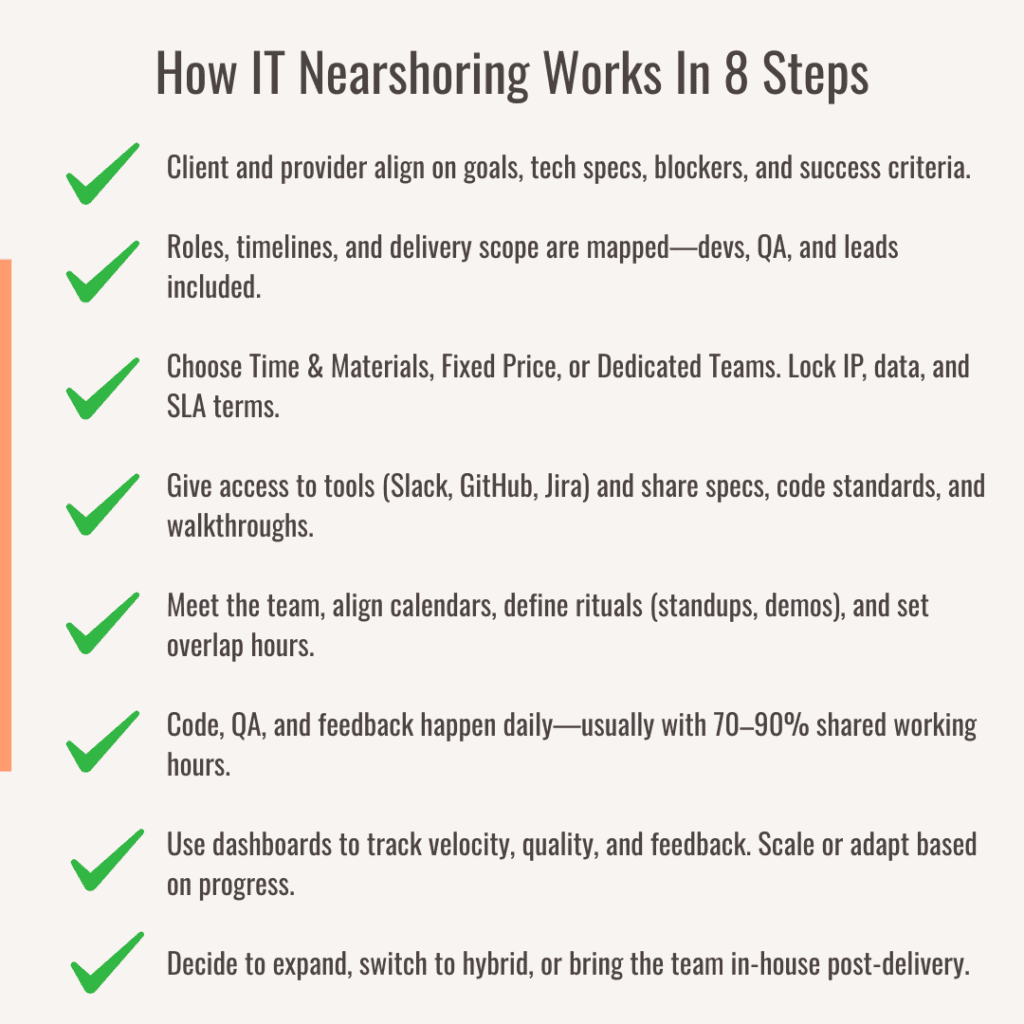
See how the typical IT nearshoring workflow runs from start to finish.
1. Discovery & Requirements Exchange
The client and nearshore provider walk through current gaps, delivery goals, and tech specs. This step often includes scoping sessions to outline the work, surface blockers, and define what success should look like.
2. Solution Mapping & Role Allocation
Based on the brief, the provider proposes a working model. That includes delivery scope, timelines, and a draft team composition—usually a mix of developers, QA, product support, and a delivery lead.
3. Contract Setup & Legal Guardrails
Most nearshoring contracts fall into 3 categories:
- Time & Materials for flexible, evolving projects
- Fixed Price for tight-scope builds or MVPs
- Dedicated Teams for long-term extensions of internal squads
This step also finalizes details like code ownership, termination clauses, data protection standards (GDPR/USMCA), and SLA expectations.
4. Onboarding & Infrastructure Access
Once the paperwork is done, the provider sets up access to tools (e.g., GitHub, Slack, Jira) and shares onboarding assets like product specifications, architecture documents, and coding standards. Initial knowledge transfer often happens over live sessions or walkthrough videos.
5. Team Introduction & Workflow Calibration
The nearshore team gets introduced to internal stakeholders. You sync calendars, set standup schedules, define escalation paths, and agree on delivery rituals—like sprint planning, demos, and retros. Teams also lock in communication hours for real-time overlap.
6. Execution & Daily Collaboration
Work begins using the selected delivery method (Agile, Scrum, Kanban, etc.). Nearshore teams contribute daily, review PRs, and join meetings in real-time. Collaboration usually runs 70–90% in sync with internal hours, which tightens feedback loops and speeds up iteration.
7. Monitoring, Feedback, and Iteration
Team performance is tracked through velocity, quality, and responsiveness. Based on project flow, the client may adjust scope, bring in specialists, or expand the team. Nearshoring providers often offer performance dashboards or weekly reports for added visibility.
8. Transition, Scale-Up, or Handover
Once the product hits milestones or shifts direction, clients decide whether to scale the team, pivot to hybrid models, or gradually transition ownership back in-house. Mature nearshoring setups build this flexibility into the engagement from day 1.
IT Nearshoring Vs Offshoring Vs Onshoring: 7 Key Differences You Need To Know
Compare these 3 outsourcing models and choose one that actually fixes your biggest hiring leaks.
| Nearshoring | Offshoring | Onshoring | |
| Time Zone Overlap | Strong overlap of 70-90% (1–3 hours), supports same-day synchronizations | 10-30% overlap with an 8–12 hour lag, async-only collaboration slows development cycles | 100% overlap, instant feedback and synchronization |
| Hourly Cost | 30–60% less than onshore rates; $35–$65/hour (Latin America, Eastern Europe averages) | $20–$40/hour (Asia averages); 50–70% less than onshore, but often comes with productivity loss | $90–$150/hour (USA, Western Europe averages); Highest cost due to local wage benchmarks |
| Talent Access | Access 1.75M+ developers in LATAM, 1.5M+ in Eastern Europe | Huge global pool of 5M+ developers, but often lacks industry-specific expertise | Limited pool, high competition from enterprise employers |
| Project Speed | 35% faster than offshore due to shared hours and strong English fluency | 20-30% slower due to timezone drag, “hidden time tax” adds up fast | Fastest delivery, but expensive to scale |
| Cultural Fit | High — similar work styles, holidays, and communication norms | Low — more room for missteps in tone, urgency, and expectations | Very high — same cultural context |
| IP Protection & Legal | Strong in LATAM & EU (GDPR-compliant, English contracts) | Varies — risk of weaker IP and data laws in some offshore zones | Very strong — domestic legal system applies |
| Control & Flexibility | Easy to scale; Ramp teams up/down within 2–6 weeks | Ramp-up often 8–12 weeks; vendor lock-in common | Full internal control; but ramp-up usually 3–5 months |
Who Actually Needs IT Nearshoring: 7 Ideal Business Scenarios
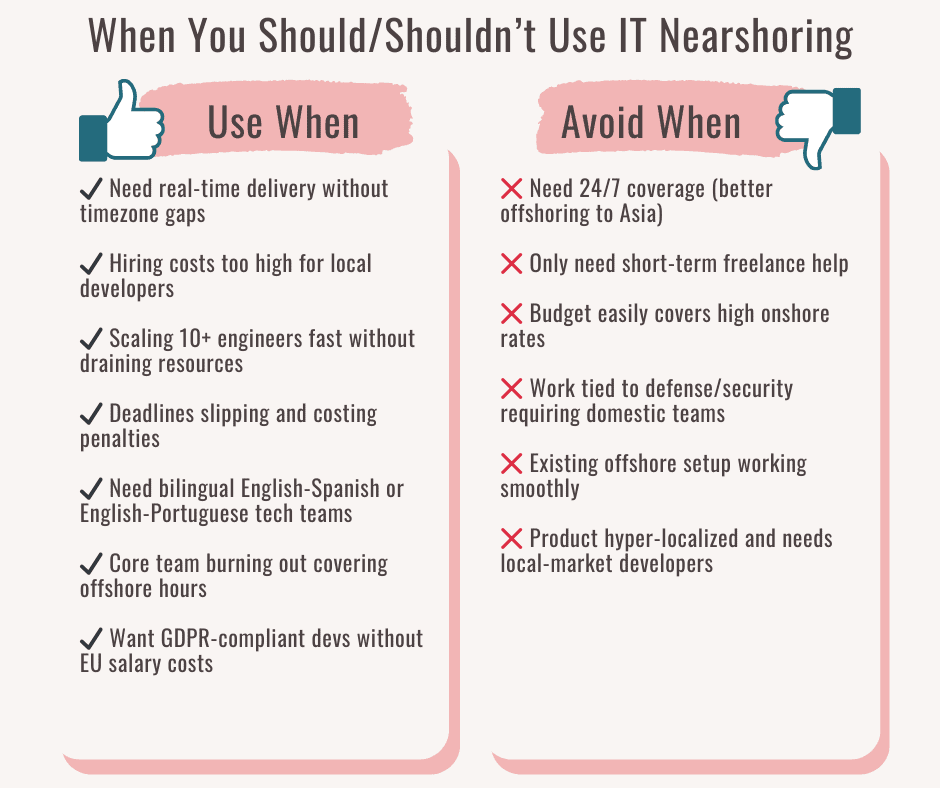
These signs will tell you if IT nearshoring fits—or if you should skip it.
- If your projects lose 20–30% of sprint hours because of timezone gaps, then nearshoring keeps your delivery cycles real-time and cuts handoff delays.
- If local hiring costs ballooned past $120,000/year for mid-level developers, nearshoring trims your tech payroll by 30–60% without gutting quality.
- If your startup needs to scale to 10+ engineers in under 90 days, you need nearshoring pools to ramp without draining in-house resources.
- If missed deadlines keep costing you late penalties or SLA violations, then nearshoring fixes turnaround speeds with 70–90% workday overlap.
- If you need bilingual English-Spanish or English-Portuguese technical teams for the US or LATAM markets, nearshoring gives you ready-made bilingual squads.
- If your core team hits burnout trying to do double shifts for Asia or Eastern Europe partners, nearshoring protects your internal capacity.
- If you need GDPR-compliant development but want to avoid the $130,000+ European engineer salaries, then Eastern European nearshoring fits like a glove.
When IT Nearshoring Might Not Be The Best Fit
- If your project needs deep overnight coverage (e.g., 24/7 cybersecurity monitoring), then offshoring to Asia-Pacific hubs may cover more night shifts.
- If you only need a short-term burst of 1–2 developers for less than 90 days, then hiring freelancers or temp contractors could be cheaper.
- If your budget can easily absorb $90–$150/hour local rates without pressure, then keeping teams onshore gives you maximum control.
- If your work involves government defense contracts, aerospace, or critical infrastructure, then security standards may legally require onshore teams.
- If you already have a well-integrated offshore team of 100+, and switching vendors would add friction, stick to your offshore model to avoid disruption.
- If your customer base is hyper-localized (e.g, highly regional US SaaS products), then domestic-only developers may understand market nuance better.
“Nearshoring works when you treat it as a long-term strategy, not a quick patch for missing roles.”
—Burkhard Berger, Founder & CEO
5 IT Nearshoring Benefits That Will Transform Your Business
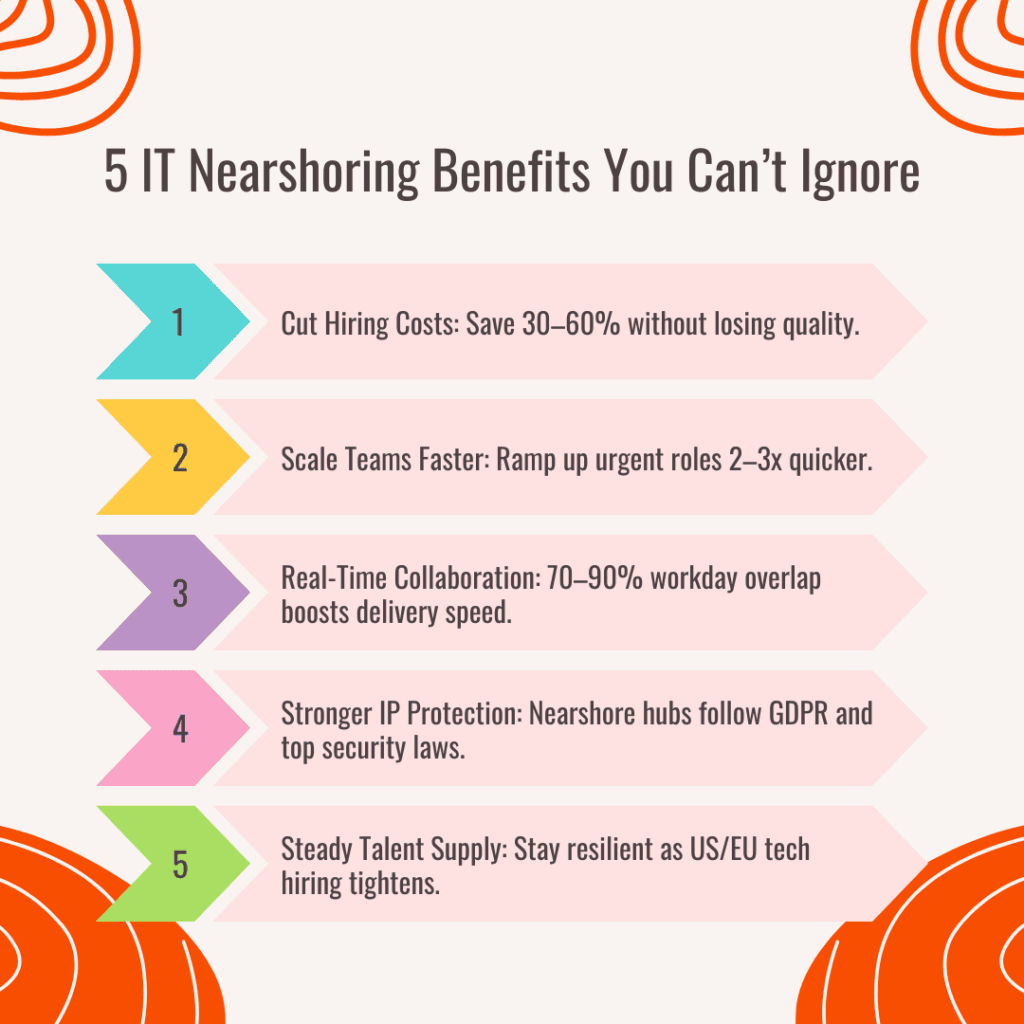
These IT nearshoring benefits can fix real problems quickly, but only if you use them the right way.
1. Slash Hiring Costs Without Sacrificing Skill
Nearshoring lets you tap qualified engineers while saving 30–60% on salaries compared to US or Western Europe rates. You spend less, but you still get developers who hit quality and security standards.
How To Maximize It:
- Compare salary benchmarks from LATAM vs. Eastern Europe before you pick a region.
- Lock rates upfront in local currency to avoid foreign exchange swings.
- Choose onshoring partners who guarantee 90%+ probation success rates to avoid rehire costs.
- Build a cost sheet with fully loaded estimates (salaries, benefits, overhead).
- Add retention bonuses tied to 12–18 month milestones to avoid early attrition.
2. Speed Up Team Scaling By 2-3x
Nearshoring cuts the ramp-up time from 3–5 months (onshore) to just 6–8 weeks. This helps you fill urgent roles quickly without exhausting your internal recruiters or stalling new projects.
How To Maximize It:
- Prioritize vendors with pre-vetted talent pools of 500+ candidates.
- Prebuild 2–3 job descriptions ready for instant publishing.
- Shortlist only those partners who commit to 14–21 day placement timelines.
- Create an internal “Day 1” onboarding checklist to get hires productive within 48 hours.
- Use video screening rounds instead of extra interview stages to move faster.
3. Boost Productivity With Real-Time Collaboration
With nearshoring, you share 70–90% of workday hours. This clears up project standstills and cuts async communication time by up to 35%.
How To Maximize It:
- Set live daily standups within a shared 3-hour window.
- Use project management tools (Jira, ClickUp, or Monday.com) synced with nearshore squads.
- Assign product owners who work within the same timezone block as the nearshore team.
- Define 24-hour SLA response windows for feedback loops.
- Run weekly sprint retrospectives with mandatory overlap attendance.
4. Get Legal Peace Of Mind With Stronger IP Protection
Nearshore hubs like Poland, Mexico, and Colombia operate under GDPR or similar Western privacy laws. You reduce IP theft risks without building a legal fortress.
How To Maximize It:
- Only sign contracts under jurisdictions with GDPR compliance or equivalent.
- Add double-layer NDA and IP assignment clauses to every worker contract.
- Host code repositories on company-owned accounts like GitHub or Bitbucket.
- Run semi-annual security audits using services like Vanta or Drata.
- Vet vendors with ISO 27001 or SOC 2 Type II certifications.
5. Future-Proof Talent Access In Tight Labor Markets
Nearshoring shields you from US and EU hiring volatility. When local markets dry up, nearshoring gives you continuous access to a strong flow of developers without paying panic premiums.
How To Maximize It:
- Diversify your nearshore footprint across 2 regions (e.g., LATAM + Eastern Europe).
- Maintain an active talent bench with 2–3 ready-to-deploy engineers.
- Invest in retention programs like career paths, certifications, or hybrid remote perks.
- Set quarterly reviews with vendors to audit hiring pipeline health.
- Track local labor trends using sources like the Global Talent Competitiveness Index.
🔥 Did You Know?
Argentina has 100,000+ software developers.
Top 5 IT Nearshoring Destinations: A Comparative Analysis To Help You Choose
See how each country stacks up against your needs and narrow choices based on real numbers instead of gut feeling.
| Mexico | Colombia | Poland | Argentina | Costa Rica | |
| Developer Pool | 700,000+ | 150,000+ | 607,000+ | 115,000+ | 30,000+ |
| Average Hourly Rate | $40–$55 | $35–$50 | $45–$60 | $30–$45 | $45–$65 |
| English Proficiency | High (EF EPI Rank: 92/800) | Medium-High (EF EPI Rank: 77/800) | Very High (EF EPI Rank: 16/800) | High (EF EPI Rank: 28/800) | Very High (EF EPI Rank: 38/800) |
| Timezone Overlap (US EST) | 90–100% | 90–100% | 50–70% | 70–90% | 90–100% |
| IP/Data Security | Strong (NAFTA/USMCA protections) | Strong (GDPR-like frameworks) | Very strong (GDPR-compliant) | Strong (personal data protection law) | Very strong (SAFEHARBOR-like laws) |
| Best For | Fast scaling for US SaaS/startups | Agile support teams and cloud development | Complex backend, AI, and fintech projects | Startup MVPs and mobile app launches | High-compliance industries like healthcare and finance |
7 Steps To Implement IT Nearshoring & Ensure A Smooth Transition
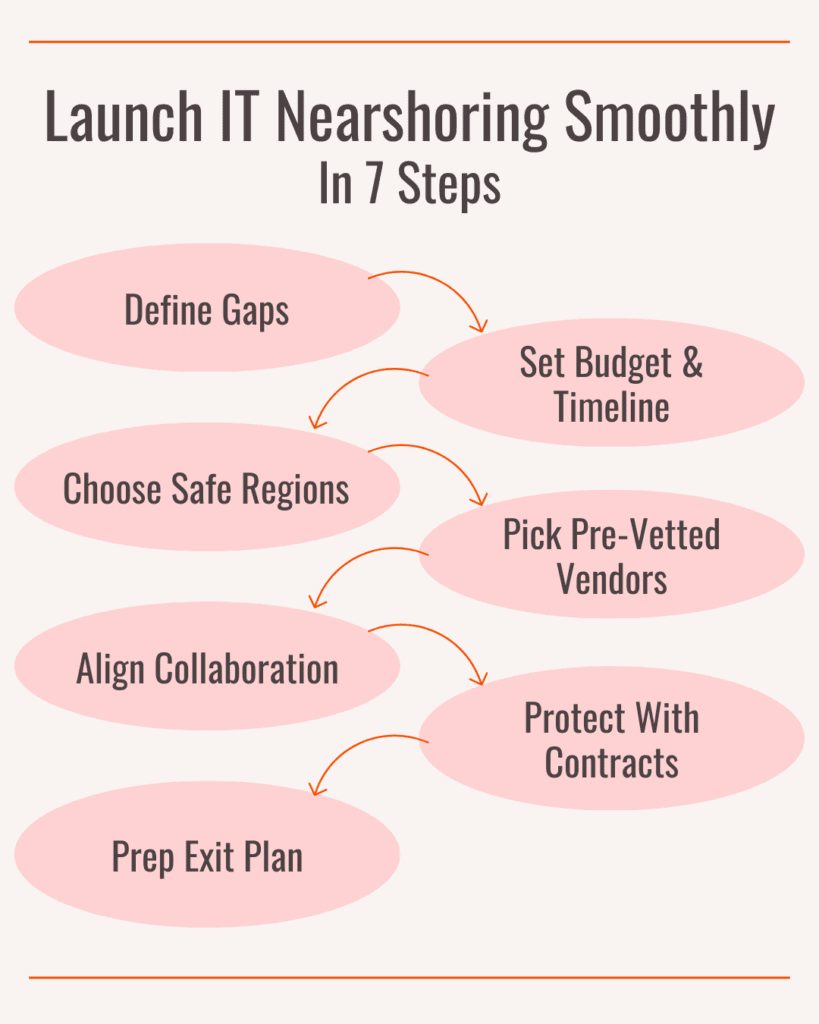
Follow these 7 steps to set up your nearshoring model cleanly, without surprises later.
Step 1: Scope Out Your Real Talent Gaps First
You need clear numbers, not gut guesses, on where your team struggles the most. Identify the specific skill sets, project phases, and hiring timelines before you even look at destinations.
- Audit open roles and overdue projects from the past 12 months.
- Rank missing skills by urgency: critical (0–3 months), mid-term (3–6 months), long-term (6–12 months).
- Set a headcount goal per project, not department.
- Estimate the revenue or project losses caused by open positions.
- Use Talent Compass or LinkedIn Workforce Reports for data validation.
Step 2: Lock Your Budget Range & Timeline Early
Scope creep crushes IT nearshoring projects faster than bad vendors. Set hard budget floors and ceilings before negotiations.
- Break down your budget into salary, benefits, equipment, and operational costs.
- Add a 10–15% buffer for currency swings or local inflation.
- Map out a 12–18 month timeline for scaling up, not just a 90-day sprint.
- Benchmark hourly rates per country using sources like Arc.dev and CodersLink.
- Plan for 1–2 months of overlap costs (your team plus the new one during ramp-up).
Step 3: Shortlist Destinations With Strong Legal Protection
The best IT nearshoring countries combine affordable rates with iron-clad IP, labor, and data laws. Cut risky regions from your list early.
- Cross-check GDPR status or similar compliance laws.
- Review the World Bank’s Doing Business rankings for labor regulations.
- Download our Legal Quickstart Blueprint to quickly vet contract standards, IP clauses, and employment norms.
- Prioritize countries offering English contracts and arbitration options.
- Avoid destinations with more than 2 major labor law changes in the last 24 months.
Step 4: Pick Vendors With Pre-Vetted Talent Pools
If your partner has to recruit from scratch, your launch timeline drags. You need firms with bench strength ready to deploy.
- Demand access to pre-screened CV databases.
- Ask for time-to-hire SLAs (14–21 days max for technical roles).
- Verify that at least 80% of hires pass probation within 90 days.
- Check if they offer replacement guarantees (30–90 days).
- Look for certifications like ISO 9001 for recruitment quality.
Step 5: Nail Down Collaboration Before Day 1
Timezone overlap and real-time collaboration speed up launches by 30–40%. Plan your communication rhythms before onboarding.
- Set shared working windows (at least 3–4 hours daily).
- Agree on tool stacks: Slack, Jira, GitHub, ClickUp.
- Define standup, demo, and sprint review schedules in advance.
- Assign US-based product owners as first-line liaisons.
- Create escalation paths for tech blockers or delays.
Step 6: Draft Contracts That Protect You, Not Just Them
Contracts should go beyond hourly rates. Focus on IP ownership, non-competes, liability caps, and clear offboarding rules.
- Use the Legal Quickstart Blueprint checklist for clauses you must have.
- Write work-for-hire language that assigns code ownership from day 1.
- Set 30-day notice periods for role exits or replacements.
- Mandate GDPR-level data privacy protections in all employment agreements.
- Specify that disputes resolve under New York or Delaware law if possible.
Step 7: Build Your Exit & Backup Plan Early
Even with perfect planning, vendors or markets can shift. Smart nearshoring setups always include a fallback model.
- Keep one secondary vendor pre-qualified with signed MSAs.
- Add rolling 6-month review cycles for vendor performance.
- Stagger onboarding across 2 cities or regions when scaling above 30 hires.
- Document processes internally in case you need to insource later.
- Track KPIs like time-to-fill, turnover rate, and sprint velocity quarterly.
“The best nearshore teams match your pace, process, and expectations from day 1.”
—Christian Cabaluna, Senior Recruiter
5 IT Nearshoring Strategies & Trends You Need To Know To Stay Ahead

Use these 5 strategies to address specific challenges in your operations and stay ahead in IT nearshoring.
1. Automate Talent Matching With AI Tools
Manual screening slows down hiring. AI-driven platforms now match candidates to roles based on skills, experience, and cultural fit, reducing time-to-hire.
- Use HireVue or Pymetrics to assess soft skills and predict job performance.
- Implement AI tools that analyze resumes and match them to job descriptions, cutting screening time by up to 50%.
- Leverage machine learning algorithms to identify candidates who align with your company’s values and work style.
2. Prioritize Cybersecurity In Nearshore Partnerships
With increasing cyber threats, you need to make sure your nearshore partners adhere to strict security protocols.
- Require compliance with standards like ISO 27001 or SOC 2 Type II.
- Conduct regular security audits and vulnerability assessments.
- Ensure data encryption both at rest and in transit.
- Establish clear incident response plans with your partners.
3. Integrate Agile Methodologies Across Borders
Agile practices enhance collaboration and adaptability, especially in distributed teams.
- Conduct joint sprint planning sessions to align priorities.
- Use Jira or Trello for transparent task management.
- Hold daily stand-ups via video conferencing to maintain team cohesion.
- Implement retrospectives to continuously improve processes.
4. Invest In Continuous Learning & Development
Empower your nearshore teams with ongoing training to make sure they stay updated with the latest technologies.
- Provide access to platforms like Coursera or Udemy for skill development.
- Encourage certifications in relevant technologies or methodologies.
- Set aside a budget for attending virtual tech conferences or workshops.
- Implement mentorship programs between onshore and nearshore teams.
5. Establish Clear Communication Protocols
Effective communication bridges the gap between onshore and nearshore teams, which ensures project success.
- Define preferred communication channels (e.g., Slack for quick updates, Zoom for meetings).
- Set expectations for response times to maintain workflow momentum.
- Schedule regular check-ins to address concerns and provide feedback.
- Document decisions and processes for transparency and future reference.
📣 Interesting Fact
Offshoring can reduce costs by up to 40% compared to traditional outsourcing.
3 IT Nearshoring Success Stories: Real-World Case Studies That Will Inspire You
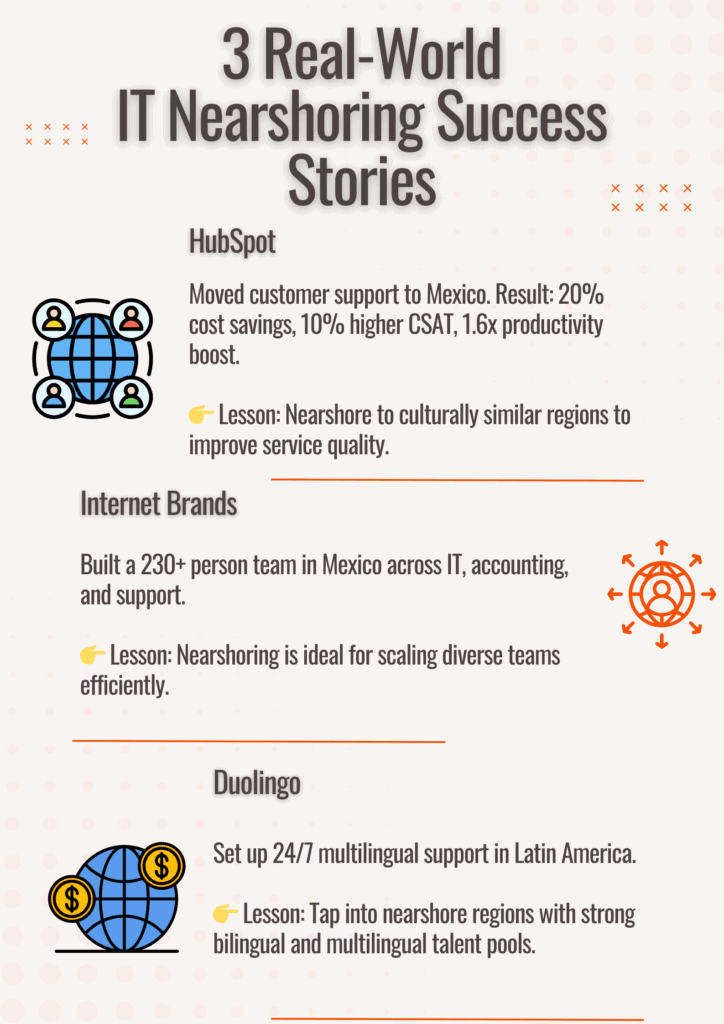
Gather all the actionable insights from these 3 real-world case studies.
1. HubSpot: Enhancing Customer Support Through Nearshoring
Background & Challenge: HubSpot, a leading CRM software company, faced high operational costs and communication delays due to its offshore customer support operations in the Asia-Pacific region
Solution: In 2015, HubSpot transitioned its customer support to Mexico, establishing nearshore teams to leverage geographical proximity and cultural similarities.
Outcome: This move led to a 20% reduction in customer support costs and a 10% increase in customer satisfaction. Additionally, productivity improved by 1.6 times, which prompted HubSpot to expand nearshore operations to Colombia and Costa Rica.
Key Takeaway: If you want to improve customer support efficiency, nearshoring to culturally aligned regions can reduce costs and enhance service quality. Evaluate support metrics and explore nearshore partnerships in regions with strong cultural compatibility.
2. Internet Brands: Scaling Development Teams With Nearshore Partnerships
Background & Challenge: Internet Brands, a US-based digital media company, needed to expand its software development capabilities cost-effectively while maintaining quality.
Solution: Starting in 2009, they partnered with Intugo to build a nearshore development team in Mexico, beginning with 6 PHP developers.
Outcome: Over time, Internet Brands expanded to 230+ employees across 3 Mexican cities, covering more than 60 job profiles, including IT, accounting, and customer service roles.
Key Takeaway: Nearshoring can be a strategic approach if you want to scale diverse teams efficiently. Assess your organizational needs and explore nearshore partners with a track record of supporting multifaceted team expansions.
3. Duolingo: Expanding Multilingual Support Via Nearshoring
Background & Challenge: Duolingo, a language-learning platform, required 24/7 multilingual customer support to cater to its global user base.
Solution: The company established nearshore customer support operations in Latin America and capitalized on the region’s multilingual talent pool and cultural alignment.
Outcome: This strategy helped Duolingo provide round-the-clock support in multiple languages, which enhanced user satisfaction and reinforced its global presence.
Key Takeaway: If you want to offer multilingual support, nearshore to regions with diverse language proficiencies. Identify regions where the workforce possesses the necessary language skills and cultural understanding to meet your support requirements.
5 Common Challenges Businesses Face When Nearshoring IT Projects
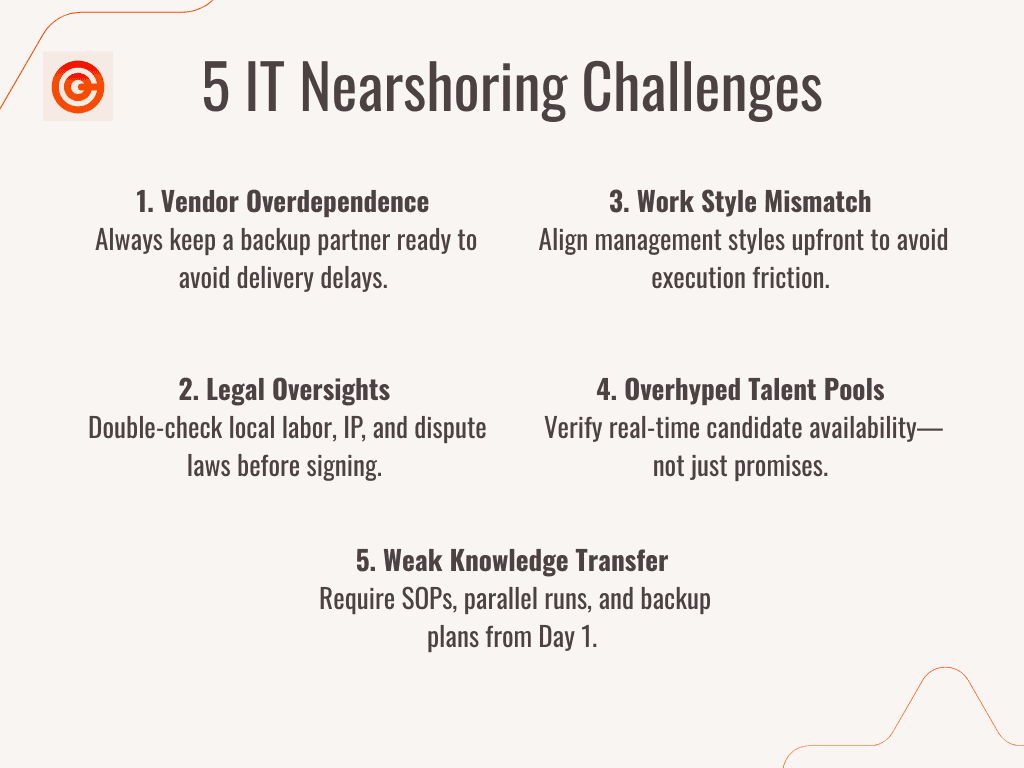
Map out these 5 common pitfalls early and take action to sidestep them.
- Vendor Overdependence: Keep a 2nd vendor on standby with a signed MSA and conduct a readiness audit every 6 months to avoid critical delivery gaps if your primary vendor falters.
- Hidden Legal Gaps: Before you sign contracts, cross-check local labor laws, intellectual property standards, and dispute resolution norms using a compliance checklist based on GDPR, USMCA, or national labor frameworks.
- Work Ethic Mismatch: Run a “management styles” calibration workshop before project kickoff to make sure both your in-house and nearshore teams operate on the same expectations for speed, detail, and escalation.
- Overpromised Talent Pools: Demand real-time access to your vendor’s active talent pool dashboard and ask for proof of candidate availability (CVs, test scores) updated monthly to prevent bait-and-switch staffing.
- Underplanned Knowledge Transfer: Build a transition playbook in advance that requires a 2-week parallel run, documented SOPs for all major tasks, and backup coverage plans for all critical knowledge areas.
💭 Food For Thought
64% of IT leaders globally outsource software development.
Conclusion
Building a better tech team no longer demands draining your budget or stretching projects across three time zones. IT nearshoring shows that speed wins and clarity and collaboration don’t have to come with trade-offs. But finding real A+ talent still decides if nearshoring drives growth or drags you down. That’s where Genius flips the script.
While others sift through chaos, Genius delivers fully vetted, English-fluent, Western-culture talent without the risk or red tape. Ready to move faster with the right team? Tell us what you need.
FAQs
How does nearshoring impact project timelines?
Due to overlapping work hours and fewer communication barriers, nearshoring can lead to more efficient workflows and faster project completion times.
Are there specific industries that benefit most from nearshoring?
Industries requiring real-time collaboration, such as software development, customer support, and design, often benefit significantly from nearshoring due to improved communication and cultural compatibility.
How do I assess the quality of a nearshore partner?
Evaluate their track record, client testimonials, communication practices, and their ability to understand and align with your business goals.
Is language a barrier in nearshoring?
While nearshoring often reduces language barriers compared to offshoring, it’s essential to ensure that the nearshore team has proficiency in your preferred language to maintain clear communication.