You’ve probably heard people mention an “offshore development center” or “ODC” in strategy calls or those LinkedIn posts full of acronyms. But half the time, it sounds more like corporate jargon than something you can actually use.
So what is it really? And should your business even care?
In this guide, we will break down exactly what an offshore development center is, how each model works, and the real-world pros and cons you actually need to think about.
Key Takeaways About Offshore Development Centers
| 2-6 months, depending on model and location | Dedicated development facility in another country with your own team, infrastructure, and processes |
| Primary Benefits | 50-70% cost savings, access to global talent, 24/7 development cycles, IP protection |
| Best For | Long-term projects, companies needing dedicated teams, businesses with specific security requirements |
| Top Locations | Eastern Europe (Poland, Ukraine), Latin America (Mexico, Argentina), Asia (India, Philippines) |
| Setup Time | $50K-$500K+ initial setup, depending on size and model |
| Investment Range | $50K-$500K+ initial setup depending on size and model |
Your Next Must-Read Blogs
🌟 How To Hire Offshore Flutter App Development Experts: Guide
🔥 17 Best Sites To Hire iOS Offshore Development Experts
💯 17 Best Sites To Hire Offshore Magento Development Experts
What Is An Offshore Development Center?

An offshore development center (ODC) is like setting up your own remote tech office in another country, but without having to build one from scratch. It gives you a full team of software professionals who work only on your company’s projects, just like an in-house team would. You stay in control of the work, the goals, and how everything runs.
Common services included:
- Custom software development
- Web and mobile app development
- UI/UX design
- Quality assurance and testing
- DevOps and infrastructure support
- Ongoing maintenance and updates
- Project management and business analysis
4 Offshore Development Center Models & How They Work

Now, let’s break down the different offshore development center models so you can find the best fit for your business:
1. Customer Offshore Development Center Model
In the customer model, you establish your own legal entity in the offshore location and directly employ all team members. This offshore development center model provides maximum control but requires significant upfront investment.
Best For:
- Companies with long-term development plans and high-volume workloads
- Enterprises that need full control over operations, data, and security
- Businesses with the resources to handle local legal, HR, and compliance requirements
Investment: $200,000-$500,000
Setup Time: 4-6 months
2. Contractor Offshore Development Center Model
The contractor model involves partnering with an established offshore development center provider who manages the infrastructure, legal compliance, and administrative tasks while you maintain project control.
Best For:
- Companies that want to scale quickly without setting up a legal entity
- Businesses that prefer to focus on development while offloading admin work
- Teams that need flexibility in team size and minimal operational overhead
Investment: $50,000-$150,000
Setup Time: 2-3 months
3. Build-Operate-Transfer (BOT) Offshore Development Center
The BOT model lets you start with a contractor arrangement and eventually transition to full ownership of the offshore development center as your business grows.
Best For:
- Companies planning long-term offshore operations but wanting a phased approach
- Businesses looking to minimize risk before fully committing to ownership
- Teams that want to learn the offshore environment before taking full control
Investment: $75,000-$300,000
Setup Time: 6-18 months
🤔 Did You Know?
86% of business leaders say service quality is a top factor in offshore partner decisions.
4. Hybrid ODC Model
This model combines elements of both customer-owned and contractor-operated setups. You maintain direct control over the core development team, like product managers, lead engineers, or architects, while a third-party vendor handles administrative support, HR, payroll, and local operations.
It’s a flexible option that gives you strategic oversight and team alignment, without the burden of setting up and running everything yourself.
Best for:
- Companies that want to control product direction but outsource support functions
- Businesses scaling fast but not yet ready for full ownership
- Teams needing a balance of control and convenience
Investment: $30,000-$100,000
Setup Time: 1-2 months
“The strongest offshore teams feel like an extension of your in-house crew, not just freelancers on the other side of the world.”
Burkhard Berger, Founder & CEO of Genius
Top 5 Benefits Of Setting Up An Offshore Development Center

Here are the advantages of an offshore development center:
1. Cost Efficiency
Offshore development centers can deliver cost savings of 50-70% compared to hiring equivalent talent locally. These savings come from:
- Lower labor costs: Software developers in Latin America, Asia, and Eastern Europe cost 50-70% less than their US counterparts
- Reduced infrastructure expenses: Office space, utilities, and equipment costs are significantly lower in offshore locations
- Operational savings: Avoiding local recruitment, benefits, and administrative overhead
2. Access To Global Talent
Offshore development centers provide access to large talent pools in Europe (6 million developers), Asia (6.5 million developers), and Latin America (2 million developers). This global reach helps you:
- Find specialized skills unavailable locally
- Reduce time-to-hire from months to weeks
- Access developers experienced in cutting-edge technologies
3. Scalability & Flexibility
Offshore development centers give you the freedom to scale your team quickly and adjust based on what the project demands without the usual hiring headaches or long-term commitments.
- Rapid team expansion: Add developers to your offshore development center team within 2-4 weeks
- Flexible engagement: Scale your team up during peak development and down during slower periods
- Resource optimization: Easily bring in specialists like DevOps engineers, testers, or designers only when their skills are needed.
4. 24/7 Development Cycle
By placing your offshore development center in a different time zone, you unlock the power of continuous progress. While your in-house team signs off for the day, your offshore team is just getting started, which keeps your projects moving around the clock.
- Continuous development: Work can be passed seamlessly between time zones. This allows overnight progress and minimizes downtime.
- Faster time-to-market: With teams working in shifts, development cycles can shrink by up to 25%, helping you launch faster.
- Round-the-Clock Support: You can also provide real-time customer support or technical assistance across global markets.
5. Intellectual Property Protection
One major advantage of offshore development centers over traditional offshoring is stronger control over your intellectual property. Since the team is dedicated to your company and operates under your rules, your sensitive data is better protected.
- Direct employment: Your offshore team is fully committed to your business, working under your brand, policies, and management just like an in-house team.
- Controlled access: You decide who accesses your code, tools, and data. No third-party vendors or shared resources, which reduces exposure.
- Legal protection: Team members sign clear NDAs and IP agreements that align with your home country’s standards.
3 Challenges Of Offshore Development Centers + Smart Ways To Handle Them

Here are a few common offshore development center hurdles and how you can tackle them with confidence:
1. Communication Barriers
Communication barriers usually happen when teams work across different time zones, use different languages or terminology, or rely too much on written updates without enough real-time interaction.
Misunderstandings can arise from unclear requirements, delayed responses, or assumptions made on both sides. Even small gaps in context or tone can lead to missed deadlines, rework, or frustration. Over time, these breakdowns can slow momentum and hurt team morale if not addressed early.
How to handle:
- Require minimum English proficiency levels during hiring
- Implement structured communication protocols and documentation
- Use collaborative tools for asynchronous communication
- Schedule regular video calls for face-to-face interaction
2. Quality Control
Quality control issues surface when expectations aren’t clearly defined, code reviews are inconsistent, or the offshore team isn’t aligned with your technical standards. This can cause bugs, unstable features, or code that’s hard to maintain.
It usually happens when there’s a lack of documentation, no shared definition of “done,” or limited visibility into day-to-day development. If your offshore team doesn’t receive regular feedback or operate under a clear QA process, quality can slip without anyone noticing until it’s too late.
How to handle:
- Establish clear coding standards and review processes
- Implement automated testing and continuous integration
- Conduct regular code reviews and quality audits
- Provide ongoing training on your development methodologies
3. Legal & Compliance Risks
Legal and compliance risks appear when companies overlook regional laws, data protection rules, or IP agreements in the offshore country. Without proper contracts in place, your business may face exposure to lawsuits, fines, or unauthorized use of your code.
This usually happens when teams move too quickly and skip legal due diligence, use vague contracts, or assume the offshore location follows the same standards as their home country. It’s a risk that’s easy to ignore at the start but costly to fix later.
How to handle:
- Partner with local legal experts in your chosen offshore location
- Ensure GDPR, HIPAA, or other relevant compliance requirements are met
- Establish clear contracts covering IP rights, confidentiality, and termination
- Regular compliance audits and policy updates
😱 This Might Surprise You
Bigger companies are much more likely to outsource than smaller ones.
How To Set Up An Offshore Development Center: 6 Easy Steps

If you’re ready to set up your offshore development center, this step-by-step guide will walk you through the entire process:
1. Define Objectives
- List your primary goals, like reducing development costs, scaling faster, filling talent gaps, or accessing specialized skills.
- Set clear, measurable outcomes like time-to-market, cost savings, or delivery speed.
- Decide if this is a short-term solution or a long-term extension of your in-house team.
- Make sure leadership, tech leads, and project managers are on the same page from day one.
2. Create A Practical Budget
- Estimate total costs. Include salaries, office space (if needed), software licenses, equipment, and partner/vendor fees.
- Plan for hidden expenses. Factor in legal fees, onboarding, training, travel, and any potential currency fluctuations.
- Compare costs across locations. Evaluate multiple regions to find the best balance between talent quality and affordability.
- Allocate 10–20% extra for unexpected changes, scaling needs, or one-time setup costs.
3. Build A Timeline
- Break the process into phases. Include planning, partner selection, hiring, onboarding, and launch.
- Assign target dates to every step to stay organized and avoid delays.
- Research how long recruitment and onboarding take in your chosen region.
- Leave room for unforeseen delays, process tweaks, or regulatory hurdles.
4. Choose The Right Location
- Research the availability of skilled developers, language proficiency, and experience in your tech stack.
- Decide how much real-time overlap you need with your in-house team.
- Choose a country with strong IP laws, low corruption, and reliable infrastructure.
- Factor in salaries, rent, internet, and taxes to estimate overall cost-efficiency.
Here are the top destinations for setting up offshore development centers:

| Destination | Time Zone Overlap (US) | Cost Savings | English Proficiency | Tech Talent Pool |
|---|---|---|---|---|
| Poland | 6-9 hours difference | 50-60% | High | 650,000+ developers |
| Ukraine | 7-10 hours difference | 55-65% | Good | 346,000+ developers |
| Mexico | 0-3 hours difference | 45-55% | Moderate-High | 800,000+ developers |
| Argentina | 1-4 hours difference | 50-60% | High | 115,000+ developers |
| India | 9.5-12.5 hours difference | 60-70% | Good | 1.5M+ developers |
| Philippines | 12-15 hours difference | 50-65% | Excellent | 1.2M+ IT professionals |
| Romania | 7-10 hours difference | 55-65% | Excellent | 250,000+ developers |
5. Build Your Offshore Development Center Team
- List specific positions like frontend/backend developers, QA engineers, UI/UX designers, and project managers.
- Decide whether to hire directly, work with a vendor, or use a hybrid model.
- Assess technical ability and how well candidates align with your company’s values and workflow.
- Build a strong foundation with key team members before expanding to support functions.
Here are the essential roles for your offshore development center:
| Role | Key Responsibilities |
|---|---|
| Project Manager (local leadership) | – Keeps the team aligned with your goals – Manages timelines – Serves as the main point of contact between the offshore team and your headquarters |
| Senior Developers (2-3 team leads) | – Provide technical leadership – Mentor junior staff – Ensure code quality and architecture stay on track with business needs |
| Mid-level Developers (core team) | – Write code – Fix bugs – Build product features with solid technical experience and reliability |
| QA Engineers (quality assurance) | – Test your software for bugs, performance issues, and usability problems – Helping maintain product quality and user satisfaction |
| DevOps Engineer (infrastructure) | – Sets up and maintains servers, deployment pipelines, and cloud environments – Ensure your product runs smoothly and scales properly |
6. Set Up Infrastructure & Technology
- Develop secure development environments. Provide cloud access, VPNs, and version control tools like GitHub or GitLab.
- Standardize communication tools. Use platforms like Slack, Zoom, or Microsoft Teams to streamline daily interactions.
- Give access to the required software and licenses. Equip your team with the same tools used by your in-house staff (e.g., IDEs, testing tools).
- Follow strict access control, backup systems, and compliance with data protection regulations.
“Offshore development center is a strategic way to access high-level talent and scale faster with precision.”
Christian Cabaluna, Senior Recruiter at Genius
How To Measure Offshore Development Center Success: Key Metrics & KPIs
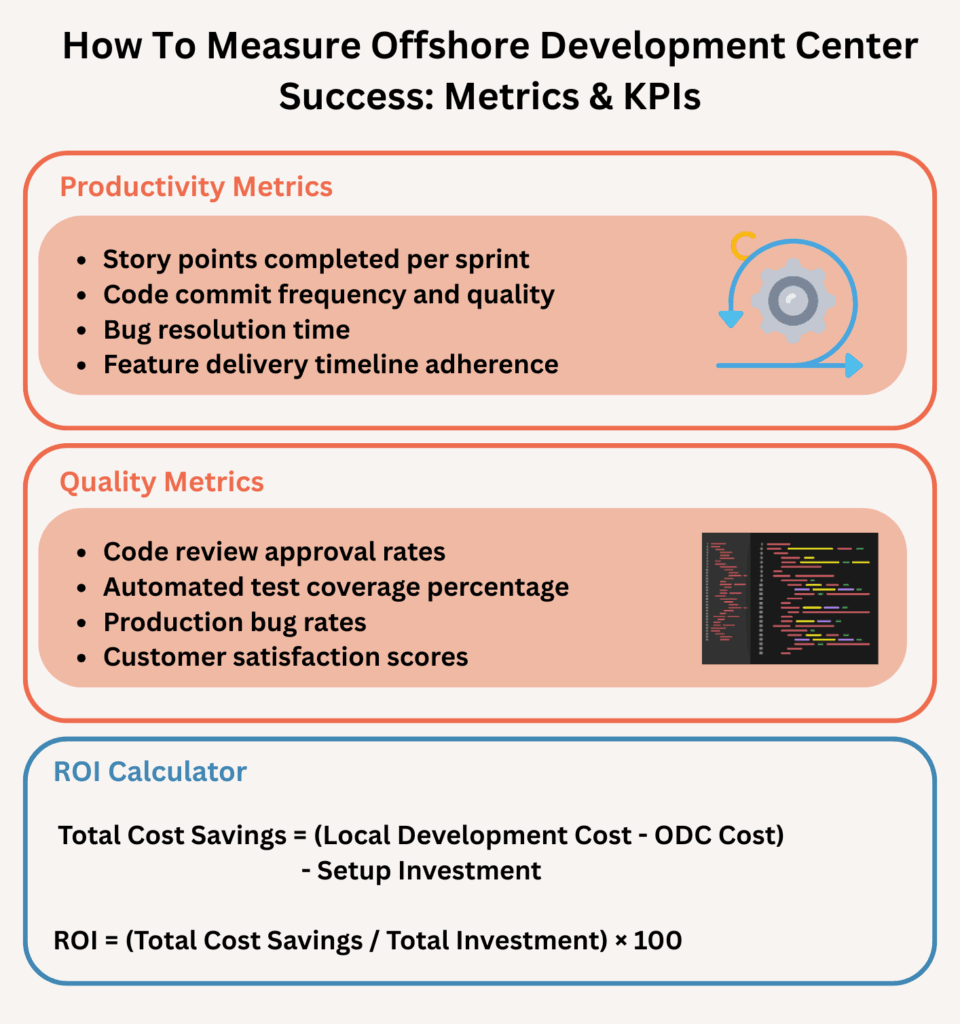
Here are the key metrics you should track to measure the success and performance of your offshore development center:
Productivity Metrics
- Story points completed per sprint: Track the number of story points finished during each sprint from your project management tool. Compare it against planned capacity to gauge team velocity.
- Code commit frequency and quality: Use version control tools (like GitHub or GitLab) to monitor how often developers commit code. Quality can be assessed by reviewing commit size, meaningful messages, and peer review outcomes.
- Bug resolution time: Measure the average time between when a bug is reported and when it’s marked as resolved in your issue-tracking system.
- Feature delivery timeline adherence: Compare the planned delivery date of each feature against the actual completion date. Track the percentage of features delivered on time.
Quality Metrics
- Code review approval rates: Track the percentage of pull requests approved without major revisions using tools like GitHub, GitLab, or Bitbucket. A high rate indicates good initial code quality.
- Automated test coverage percentage: Use testing frameworks and CI tools (like Jest, Mocha, or SonarQube) to calculate what percentage of your codebase is covered by automated tests.
- Production bug rates: Count the number of critical bugs reported in production over a set period (weekly/monthly). Lower rates indicate better QA and stability.
- Customer satisfaction scores: Use surveys like CSAT or Net Promoter Score (NPS) to gather feedback from users after product updates or releases.
ROI Calculation For Offshore Development Centers
ROI = (Total Cost Savings / Total Investment) × 100

Where

Total Cost Savings = (Local Development Cost - ODC Cost) - Setup Investment

ROI Timeline: Most offshore development centers achieve positive ROI within 8-12 months of operation.
🔎 This Is Interesting
Offshoring to Asia creates 8-12 hour time differences with only 33% overlap in working hours.
Conclusion
Here’s the thing: don’t rush setting up an offshore development center. This isn’t like flipping a switch. Take time to plan. Know why you’re doing it, pick the right model, and partner with people who get your goals. If it feels overwhelming, that’s normal. Most smart decisions do.
At Genius, we help you hire US-quality talent offshore for 80% less. We source real A-players from the Philippines and Latin America using our on-the-ground recruiting network, and we back every hire with a 6-month talent guarantee. No monthly fees. No risk. If you don’t hire, you don’t pay. It’s that simple.
Let’s help you build a team that feels in-house and saves you a whole lot in the process.
FAQs
How is an offshore development center different from outsourcing?
An offshore development center gives you a dedicated team that works exclusively for your company, following your processes and goals. Outsourcing usually involves project-based work with less control over staff, tools, and long-term direction.
Do I need to set up a legal entity for an offshore development center?
Only if you choose a customer offshore development center model. If you partner with a third-party provider, they handle legal compliance, HR, and infrastructure, so you don’t need to establish your own local entity.
When should I consider setting up an offshore development center?
Consider setting up an ODC when you’re scaling development, need specialized talent, or want to lower costs long term. It’s best for companies with ongoing projects and a need for team consistency and control.
Can I transition from one offshore development center model to another later?
Yes, many companies start with a managed or BOT model and later shift to a captive setup. This flexible approach lets you test operations before committing to full ownership and long-term investment.