
You needed that app update live last week. Instead, your local developer just asked for another “2 weeks,” and your product manager is now QA-testing himself on weekends. Meanwhile, a startup with half your budget just launched a better version, built entirely by an offshore Flutter app development team that charges $30/hour.
Offshore app development is now more than a cost-cutting stunt. It is how fast-moving companies scale apps, ship features, and skip the hiring circus. This guide hands you the full offshore playbook: where to hire, what to ask, red flags to avoid, and how to manage it all without chasing developers across time zones.
Hiring Offshore Flutter App Development Experts: 5 Key Takeaways

- Start with scope clarity, not resumes. Define your app’s features, budget, and sprint goals in a single page before you even browse developer profiles.
- Match your hiring model to your launch urgency. Use dedicated hires for long-term builds, full-cycle teams for hands-off execution, and staff augmentation for rapid support.
- Shortlist from vetted channels, not marketplaces. Skip cold pitches. Use expert-curated platforms and agencies with real case studies in your industry.
- Run a one-week trial sprint before you commit. Test code quality, communication, and sprint rhythm with a mini feature before you lock contracts.
- Secure everything before kickoff (code, cadence, and contracts). Confirm IP rights, async tools, bug SLAs, and sprint demos upfront to avoid scope creep and rework later.
Check Out These Popular Reads
📣 Offshore IT Development: Your Complete Starter Guide (2025)
📢 Offshore Java Development: Easiest Planning & Hiring Guide
🎯 Offshore WP Development: Benefits, Setup, Best Practices
What Is Offshore Flutter App Development & Why Do Businesses Prefer It?

Offshore Flutter app development is hiring remote teams in lower-cost countries to build mobile applications using Flutter, a cross-platform framework by Google. It lets you build iOS and Android apps with a single codebase, while cutting down both hiring time and budget.
Here’s why companies prefer it:
- Save 40–70% on development costs by hiring in countries like India, the Philippines, or Eastern Europe.
- Launch apps 30–50% faster with 24-hour development cycles across time zones.
- Skip long hiring cycles and get vetted Flutter talent in days, not months.
- Get cross-platform apps for iOS and Android with a single team and codebase.
- Scale teams up or down without payroll overhead or full-time contracts.
Offshore Flutter App Development vs Nearshore: Which Is Better?
| Offshore Flutter Development | Nearshore Flutter Development | |
| Average Hourly Rate | $20–70/hour (India, Eastern Europe, Southeast Asia) | $30–80/hour (Latin America, Eastern Europe) |
| Time Zone Overlap (US) | 2–4 hours average | 4–8 hours average |
| Cultural Fit | Moderate (depends on vendor & SOPs) | High (especially in LATAM) |
| Team Availability | High: Larger talent pools | Medium: More competitive sourcing |
| Hiring Speed | Fast (2–7 days via vetted platforms) | Medium (1–2 weeks) |
| Use Case Fit | MVPs, rebuilds, feature extensions | Real-time apps, smaller time-critical projects |
🚨 Did You Know?
Offshore software development teams offer 25% faster time-to-market.
7 Steps To Hire The Best Offshore Flutter App Development Company Or Expert Quickly

Use these exact steps to avoid repeating your past problems.
Step 1: Lock Your Scope, Timeline, & Budget In 1 Document
Define what success looks like. You cannot screen developers if you do not know what you are building or how fast it must launch.
- Write a one-pager that outlines the app’s core features, platforms (iOS, Android, web), and third-party integrations.
- Set a launch target (e.g., 12 weeks) and break it into 2-week sprints.
- Define a rough budget range (e.g., $25,000–$40,000 for MVP or $70,000+ for a full app).
- Note non-negotiables: security needs, HIPAA/GDPR compliance, and admin panel features.
- Add team expectations: daily standups, demo frequency, and async updates.
Step 2: Pick A Hiring Model That Matches Your App Type
Different app goals need different team setups. Choose based on delivery speed, budget control, and scope fluidity.
- Use dedicated developers for long-term control on in-house terms (usually $2,500–$4,000/month offshore).
- Use full-cycle teams if you lack tech leads or want PMs and QA baked in.
- Use staff augmentation if you just need to plug a skill gap in an existing team.
- Choose the fixed-price model only when the scope is 100% defined and locked.
- Choose time & materials when the project needs flexibility or frequent pivots.
Step 3: Shortlist Developers From Proven Hiring Channels
Skip cold LinkedIn DMs and patchy freelancer platforms. Go where vetted talent already exists.
- Look for agencies with case studies in your vertical (e.g., fintech, healthtech).
- Use expert-curated platforms to get pre-vetted profiles.
- Stick to regions with reliable overlap, like India, Latin America, and Eastern Europe.
- Check if the team offers a free discovery call or prototype phase.
- Avoid generic “Flutter experts” with no mobile-specific portfolio.
Step 4: Screen Portfolios Like A Product Owner
Skip pretty UI mockups. Focus on results, app complexity, and development workflows.
- Ask for links to published apps on iOS and Android stores.
- Request screenshots of admin dashboards, analytics, and DevOps pipelines.
- Confirm what part of the app they built (frontend, backend, or full stack).
- See if they worked with similar features (offline sync, animations, and API integrations).
- Note how they handled app performance, crash rates, and release cadence.
Step 5: Run A Trial Project Before You Commit
Use a one-week mini-sprint to test real collaboration, not just resumes.
- Assign a feature like login, home screen, or API fetch.
- Give them UI designs and access to your repository.
- Track how many hours they spend and how often they push code.
- Review the codebase for Flutter conventions and reusable widgets.
- Evaluate async communication: do they block on feedback or self-resolve?
Step 6: Ask Developer-Centric Questions During Interviews
Generic questions will get you generic results. Dig into their decision-making with questions like:
- Walk me through how you optimized app performance in your last project.
- How do you manage Flutter version upgrades when plugins break?
- What is your process for testing across Android and iOS devices?
- How do you handle animation jitter or UI glitches in older phones?
- What is your approach to repository branching and pull request reviews?
Step 7: Lock Contracts, Timelines, & Post-Launch Support
Before kickoff, fix terms for delivery, revisions, and support. Vague contracts bleed money.
- Use NDAs and MSAs (Master Services Agreement) to protect IP and source code rights.
- Define post-launch bug SLAs (e.g., critical bug fix in under 48 hours).
- Lock pricing model: milestone-based or monthly.
- Clarify communication cadence: daily sync, weekly sprint demo, and async channels.
- Get Git access, design files, test devices, and CI/CD setup ready before onboarding.
“Offshoring is about consistent output, structured processes, and teams that scale without friction. It’s not just cheaper code.”
— Burkhard Berger, Founder & CEO
6 Steps To Manage An Entire Offshore Flutter App Development Team Without Hurdles
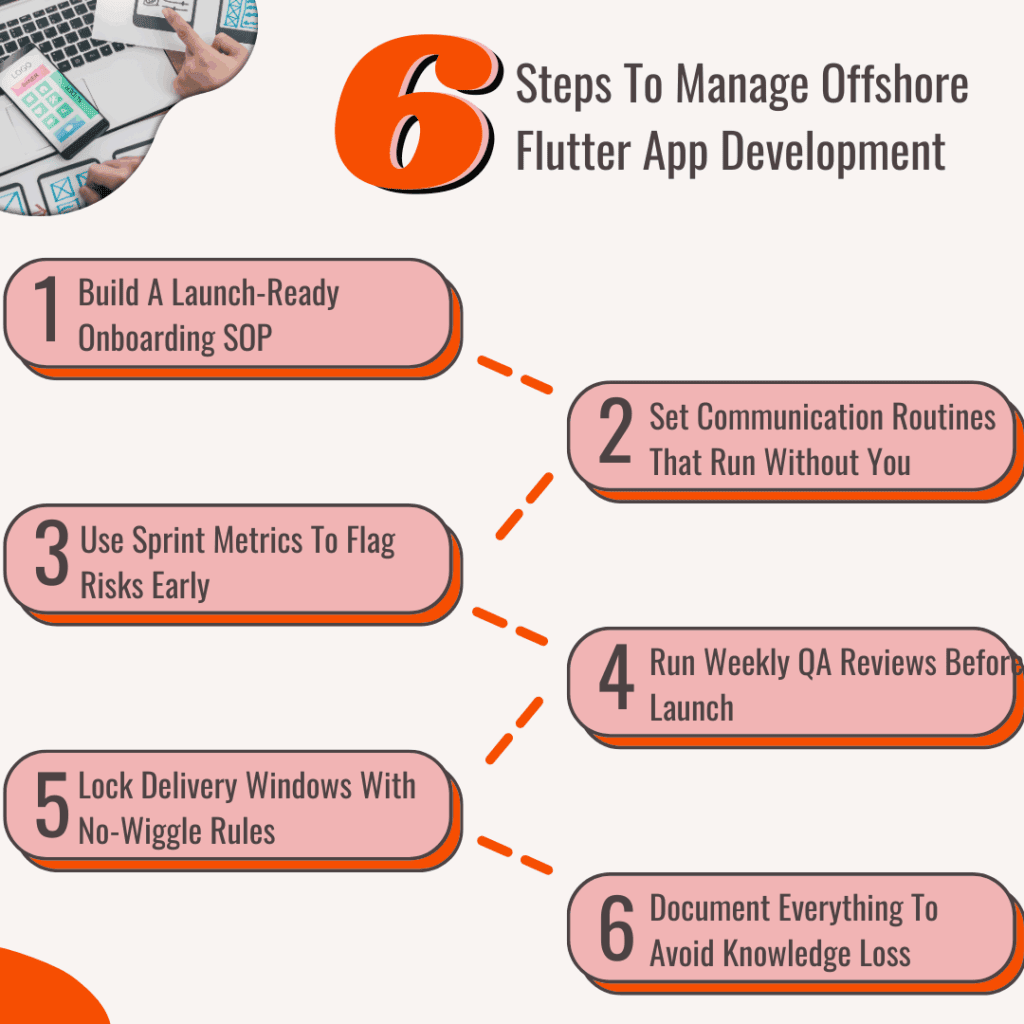
Use these 6 management steps to avoid deadline creep and endless back-and-forth.
Step 1: Build A Launch-Ready Onboarding SOP
The first 48 hours decide whether your offshore team hits the ground running or stalls for weeks. You need a setup process that removes every blocker upfront.
- Share Git repository access, staging environment, and API documents during onboarding.
- Give UI handoff via Figma or Zeplin with expected delivery timelines.
- Set default communication rules: Slack for async, Notion for docs, and Loom for walkthroughs.
- Create a test device list with OS versions and form factors.
- Use a single document to define your tech stack, CI/CD pipelines, and app structure.
Step 2: Set Communication Routines That Run Without You
Avoid the “waiting for your reply” spiral. Make sure your team knows what to send, when, and how.
- Schedule 15-minute daily check-ins at overlap hours.
- Lock weekly demo slots to show real app progress, not just talk.
- Ask for async status updates via Notion or ClickUp every 48 hours.
- Record sprint kickoff and demo videos so non-overlapping stakeholders can catch up.
- Define who owns what: one lead developer, one QA, one PM (even if shared).
Step 3: Use Sprint Metrics To Flag Delivery Risks Early
Gut feelings are not scalable. Data-backed tracking catches problems before they turn into timeline blowups.
- Track story points completed per sprint to spot velocity drops.
- Monitor PR merge time and CI build failures for code health.
- Create burndown charts in Jira or ClickUp and review weekly.
- Log blocked tasks with owner names and unblock timelines.
- Color-code progress: green (on track), yellow (at risk), and red (blocked).
Step 4: Run Weekly QA Reviews Before It Hits Users
Do not wait for customers to report bugs. Make QA a baked-in process, not a last-minute scramble.
- Test new features on 3 real devices and 1 emulator at a minimum.
- Use a QA checklist: UI rendering, animation smoothness, responsiveness, and edge cases.
- Log bugs in ClickUp with screen recordings and expected vs actual behavior.
- Tag issues by severity: blocker (fix within 24 hours), high (48 hours), and low (backlog).
- Review code coverage weekly (aim for 80%+ for critical paths).
Step 5: Lock Delivery Windows With No-Wiggle Rules
Soft deadlines create hard problems. Ship on rhythm, not hope.
- Define non-negotiable release windows (e.g., biweekly Thursdays 6 pm EST).
- Freeze code 48 hours before release for final QA.
- Use GitHub Actions or Bitrise for CI/CD automation.
- Roll out hotfix windows only for high-severity bugs post-release.
- Assign an owner for release prep, logs, and post-mortem documents.
Step 6: Document Everything So Nothing Slips Through
People go on leave, shift roles, or roll off projects. Solid documentation stops knowledge leaks.
- Use Notion or Confluence to store all API docs, QA protocols, and development guides.
- Record all sprint demos and save links in 1 master document.
- Track decision logs: who changed what, when, and why.
- Create a shared glossary for product terms, acronyms, and internal tools.
- Review and update documents every sprint (mark stale ones).
6 Offshore Flutter App Development Post-Launch Support Services You Can Ask For

Use this checklist to decide exactly which support services to lock in your post-launch contract.
- Bug fixing by severity: Set strict SLAs: critical bugs (under 24 hours), major issues (48 hours), and minor ones (next sprint).
- SDK & OS update handling: Require updates for Flutter SDKs and platform dependencies within 5 days of release to prevent app failures.
- Crash & performance monitoring: Use tools like Sentry or Firebase Crashlytics and request biweekly reports on crash rate, load speed, and memory use.
- App store compliance checks: Have the team review App Store and Google Play policy changes monthly to avoid update rejections.
- Feature tweaks from user feedback: Set up a monthly task pool (10–15 hours) for user-driven micro-features, text edits, or UX fixes.
- Team transition documentation: Request demo recordings, shared documents, and a decision log so any new developer can onboard in under 2 days.
How Much Does Offshore Flutter App Development Cost? Your Complete Pricing Breakdown

Offshore Flutter app development costs $20-$70/hour, based on region, skill level, and engagement model. A typical MVP costs $25,000–$40,000, while full-scale apps with backend, CI/CD, and QA can cross $70,000.
Here’s a simple cost snapshot you can use to budget for your offshore Flutter app development:
| What You Get | Estimated Cost | |
|---|---|---|
| Hourly Rates | Vetted Flutter developer (offshore) | $20–$70/hour |
| Monthly Hire | Full-time offshore developer | $2,000–$6,000/month |
| MVP Project | Basic app with 2–3 features | $25,000–$40,000 (fixed) |
| Full App Build | Mid-to-large app with backend | $40,000–$120,000 (project) |
| Hidden Costs | PM overhead, timezone, and support fees | Add a 10–20% buffer |
💭 Food For Thought
74% of employers say offshore development solves talent gaps.
5 Top Regions To Consider For Your Offshore Flutter App Development Projects

Use this table to learn exactly where to hire, what it costs, and what tradeoffs to expect.
| Region | Typical Hourly Rate | Why Choose It |
|---|---|---|
| India | $20–$40/hour | Large talent pool, strong English, fast onboarding |
| Philippines | $25–$45/hour | High communication skills, reliable work ethic |
| Eastern Europe | $30–$60/hour | Strong engineering quality, EU data compliance |
| Latin America | $30–$70/hour | Best timezone overlap with US, cultural familiarity |
| Southeast Asia | $20–$35/hour | Low cost, rising talent pools, solid infrastructure |
5 Key Benefits Of Offshore Flutter App Development You Don’t Want To Miss

Use these benefits of offshore Flutter app development to rethink your current setup.
1. Cuts Development Costs By Up To 70%
Offshore Flutter teams charge $25–$70/hour compared to $80–$150/hour in the US. That means your $100,000 app could cost $30,000–40,000 offshore with no quality loss.
Full-time offshore developers cost $2,000–6,000/month, often with PM and QA bundled. This also cuts overheads like payroll tax, benefits, and bench time. You only pay for output, not idle hours.
2. Ships Faster With 24-Hour Development Cycles
Offshore teams can push code while your local team sleeps. This doubles output speed, especially when you pair US-based product leads with Indian or Eastern European developers.
Typical launch timelines drop from 6+ months to under 3 months for MVPs. Weekly sprints can cover more ground with round-the-clock issue resolution. Bugs get fixed overnight, not next week.
3. Gives You Access To Global Flutter Specialists
You are no longer limited to your city or country. Offshore lets you pick from seasoned Flutter experts in regions like India, Eastern Europe, and Latin America.
Many have 5–10 years of Dart experience and a proven record in shipping production apps. Agencies often provide specialists in UI, backend, and DevOps under 1 contract. You hire a capability, not just a coder.
4. Helps You Build For iOS & Android With One Team
Flutter lets you write a single codebase that runs on both iOS and Android. Offshore teams build, test, and ship it all without the need for separate native experts. T
his cuts your QA load in half and slashes maintenance costs long-term. Cross-platform output stays consistent across devices. You move faster and save 30–40% on rework and platform-specific bugs.
5. Easily Scales Teams Up Or Down On Demand
Offshore teams adjust to your project needs. Need 2 extra Flutter developers for a release sprint? Scale up in days. Need to pause work for a month post-launch?
Pause without worrying about layoffs or sunk costs. Most vendors offer contracts with no long-term lock-in, which is perfect for startups and growth-stage companies. You scale based on app velocity, not payroll pressure.
“When we vet offshore Flutter developers, we prioritize delivery history over self-proclaimed expertise. A GitHub repo says more than any resume.”
— Christian Cabaluna, Senior Recruiter
Who Should Consider Offshore Flutter App Development & Who Needs To Avoid It
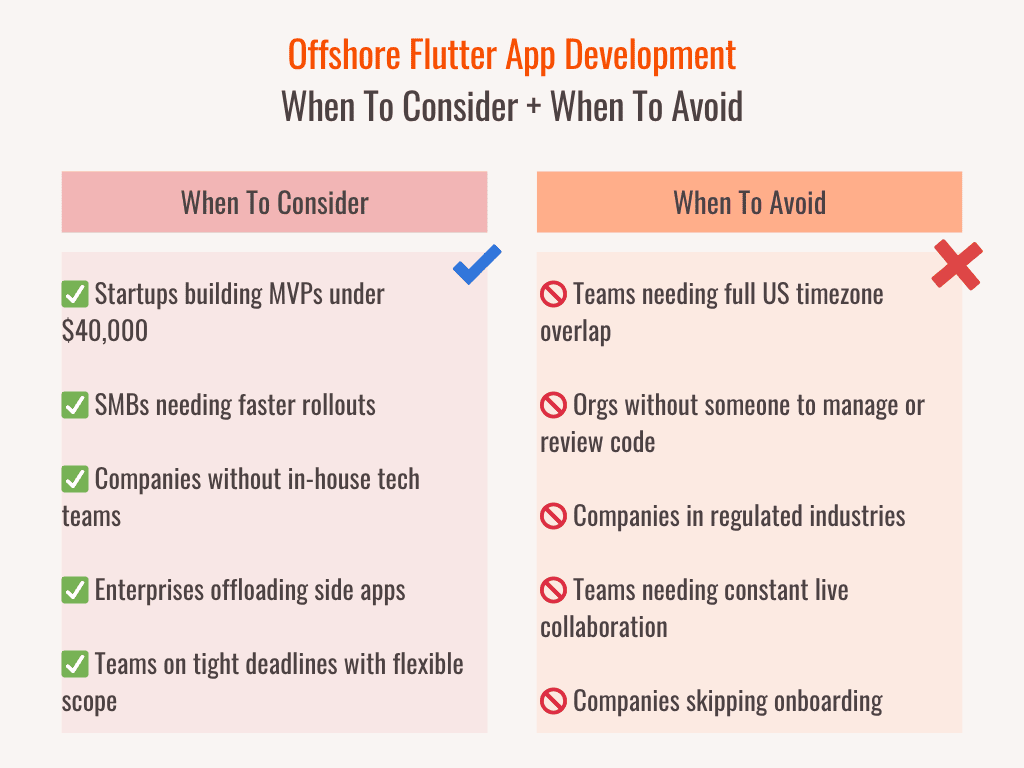
Use this checklist to decide if offshore Flutter app development actually fits your product roadmap, resources, and delivery timeline.
Offshore Flutter App Development Works Best For
- Startups building MVPs under $40,000: Build Android and iOS with one team in under 12 weeks.
- SMBs that need faster feature rollouts: Ship weekly using 24-hour development cycles with offshore teams.
- Companies with no in-house tech team: Vendors often include PM, QA, and DevOps support.
- Enterprises offloading non-core app work: Delegate side apps at $25–$50/hour with no long-term lock-in.
- Teams with tight deadlines & flexible scope: Scale up to 10 Flutter developers in under 5 days.
Offshore Flutter App Development Is Not A Fit If You
- Need full-time US timezone overlap daily: Only LATAM offers partial overlap; Asia gives 2–3 hours max.
- Don’t have anyone to manage scope or review code: Offshore teams still need direction and approvals.
- Work in highly regulated sectors with local data laws: Compliance needs may limit offshoring.
- Rely heavily on real-time in-person collaboration: Async setups break without structure or planning.
- Expect plug-and-play output without onboarding: No documents or access = missed sprints and delays.
⁉️ Interesting Fact
80% of North American companies are using or exploring nearshore development.
5 Red Flags To Avoid When You Offshore Flutter App Development
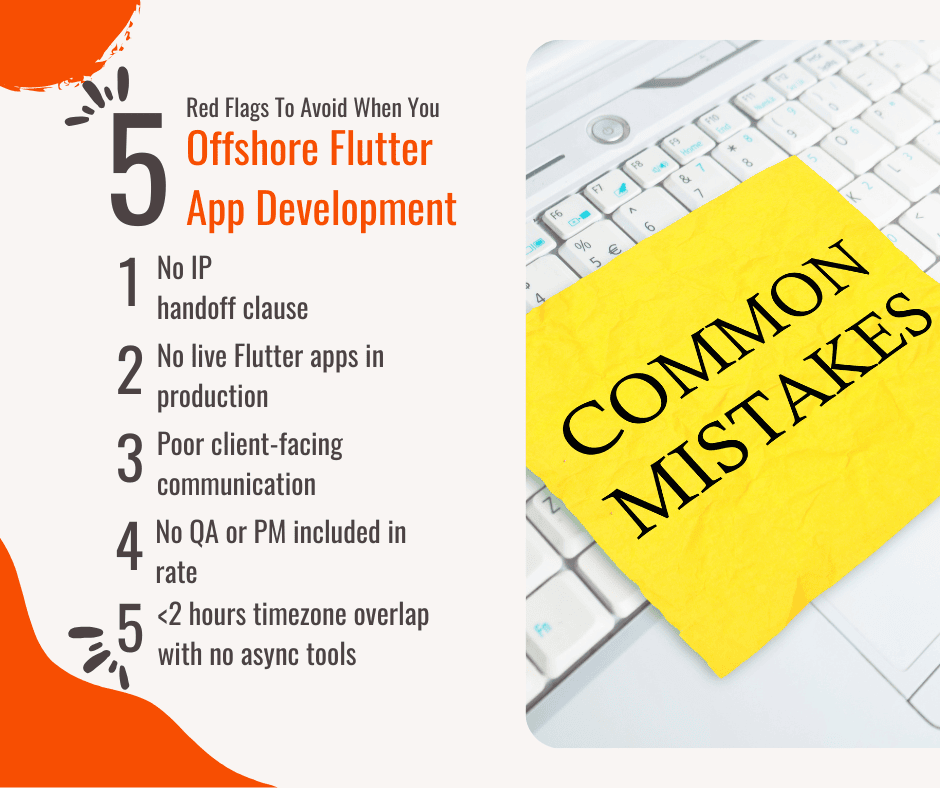
Zoom in on these 5 critical red flags before you finalize your offshore Flutter app development team.
- No IP handoff clause in the contract: If your agreement does not state that all code and assets transfer to you post-project, you risk vendor lock-in.
- How to Fix: Always request an IP clause under a Master Services Agreement (MSA) and confirm code ownership in writing.
- Generic developers with 0 Flutter apps in production: Plenty claim “Flutter expertise” without shipping a single app.
- How to Fix: Ask for live links from App Store and Google Play, or skip. No published apps = no real-world proof.
- No native English speaker on the client-facing side: If the PM or lead developer struggles with clarity, sprint delays follow.
- How to Fix: You need fluent communication to avoid rework. Test this early on a discovery call.
- Contracts that list only developer hours, not QA or PM: If QA, PM, and support are not baked in, expect to pay 15–20% more later.
- How to Fix: Ask for a breakdown of roles upfront and confirm if the listed rate includes them.
- Timezone overlap of less than 2 hours with no async workflow: Without overlap or a working async system (e.g., Notion, Loom, or ClickUp), issues pile up.
- How to Fix: Set up clear async routines with daily updates, task ownership, and recorded context for every decision.
Conclusion
Offshore Flutter app development is a system that works when you vet properly, set expectations upfront, and avoid the shortcuts that kill 90% of offshore projects. If any part of this guide felt like a wake-up call, good. That means you are finally getting clear on what it takes.
But let us be honest: reading is the easy part. The hard part is sorting through 300+ profiles to find that ONE Flutter developer who gets it. That is where Genius comes in. We do the grunt work (local recruiting, tech testing, and cultural screening), so you skip the guesswork. What you get is pure output: real experts, full-time, $12,000/year, zero fluff.
Want someone you’d rehire before the sprint ends? Hire with Genius.
FAQs
What types of mobile apps are best suited for offshore Flutter app development?
Cross-platform apps like eCommerce stores, delivery platforms, social media tools, and internal business apps are ideal. Flutter’s shared codebase speeds up development for apps that target both iOS and Android.
How do offshore Flutter app development teams typically handle UI consistency across devices?
They use Flutter’s widget-based architecture and run regression tests on multiple screen sizes, resolutions, and OS versions. This ensures consistent layouts and animations across Android and iOS.
How can I verify if an offshore Flutter developer understands state management?
Ask them to explain the difference between Provider, Bloc, and Riverpod, and when to use each. A strong answer includes performance tradeoffs, scalability, and real use cases.
Can offshore Flutter teams build apps that support offline functionality?
Yes. They often use local storage (e.g., SQLite, Hive) and sync logic to allow offline usage. Then, when online, they sync data using APIs or background services.