
Your product roadmap is solid. But your Java build? Stuck. Because local hiring is slow, expensive, and honestly, broken. You need code shipping in days, not resumes trickling in for weeks. Offshore Java development is now more than a budget play; it is how smart companies stay fast, lean, and fully staffed.
This guide hands you the full Java offshoring playbook: how to plan it, hire right, avoid the usual traps, and scale like you have an army on standby. Just exactly what you need to get your next Java project built right, without the drama.
Offshore Java Development: 5 Key Takeaways To Remember

- You can save 50–70% on Java development without cutting quality. Offshore developers cost $25–70/hour, compared to $80–150/hour in the US.
- You can ship 30–50% faster with 24-hour delivery cycles. Offshore teams push code while your local team sleeps. With a 12-16 hour gap, you unlock daily progress without burning out internal engineers.
- You can scale up Java builds in under 14 days. Offshore vendors preload talent and handle the hiring load. Even full project teams can be live in 2 weeks.
- You can build across time zones without spinning up new offices. Offshore teams help you roll out region-specific platforms without adding legal entities or in-country staff.
- You can prevent 90% of offshore risks with airtight vendor controls. Lock in SLAs, test coverage thresholds, time-tracking, and post-release support.
Here Are Some More Reads You’ll Like
🎯 Offshore Drupal Development: Benefits & A+ Companies (2025)
🌟 17 Best Sites To Hire A+ Offshore Web Developer In 2025
💻 Offshore WP Development: Benefits, Setup, Best Practices
What Is Offshore Java Development & Why Does It Matter?

Offshore Java development is hiring Java developers in lower‑cost countries, like India, Ukraine, Latin America, or Southeast Asia, for full‑time or project‑based roles. Companies use this model to get the same high‑quality work at a fraction of local costs.
Here’s why offshore Java development matters:
- Save up to 70% on salary and overhead compared to US‑based teams.
- Speed up delivery with 24‑hour offshore development cycles.
- Scale instantly when projects spike without internal HR delays.
- Access niche skills in microservices, cloud, and DevSecOps.
- Free up local teams to focus on core product and strategy.
Offshore Java Development vs Nearshore vs Onshore
Use this comparison table for offshore, nearshore, and onshore development to pick the right model based on your current needs.
| Offshore | Nearshore | Onshore | |
|---|---|---|---|
| Hourly rates | $25–$45 (India), $30–$70 (Ukraine) | $40–$55 (Mexico/LatAm) | Cost‑first, large-scale |
| Working hours overlap | 4–6 hours | 6–8 hours | 8 hours |
| English proficiency | Moderate to high | High | Native |
| Travel & cultural risk | High | Medium | Low |
| Ideal use case | Cost‑first, large scale | Mix of cost + communication | Sensitive data + innovation |
5 Easy Steps To Plan An Offshore Java Development Setup

Use these steps for clarity, control, and speed during the setup phase.
Step 1: Clarify Your Java Project Scope
This step sets the foundation. Define what you want your offshore team to deliver and the tech they need.
- List core deliverables: backend systems, cloud applications, mobile integrations, and APIs.
- Identify tech stack: Core Java 11+, Spring Boot, Hibernate, CI/CD tools, cloud platforms.
- Estimate team size: 1–3 developers per 5000 lines of code per month.
Step 2: Select The Best Offshore Region
Picking the right region impacts cost, communication, and speed. Evaluate based on rates and skills.
- Compare rates: India $25–45/hr, Ukraine $30–70/hr, Mexico $40–55/hr, Southeast Asia $15–40/hr.
- Benchmark English: LATAM and Eastern Europe score highest on client ratings.
- Check maturity: Look at local data‑protection laws and tech market depth.
Step 3: Choose The Engagement Model
The structure of your team shapes outcomes and flexibility.
- Use a dedicated team for long engagements or deep integration.
- Opt for staff augmentation when you need a few extra hands short term.
- Launch a full offshore development center (ODC) for large programs with compliance needs.
Step 4: Build Project Planning Pillars
Solid planning keeps scope, budget, and timing realistic.
- Define milestones with deliverables and shared code checkpoints.
- Allocate 15–20% of the budget to testing, security, and DevSecOps setup.
- Set a realistic timeline (1 month of code + 2 weeks of testing per module).
Step 5: Prepare For Integration from Day 1
A smooth start keeps momentum and engagement high.
- Gather tools: Slack, Jira, Git, Zoom, Jenkins for CI/CD.
- Create a 30‑60‑90 day plan with weekly check‑ins, code reviews, and team rituals.
- Set legal guardrails: define IP ownership, non‑disclosure agreements, and service level agreements.
📢 Did You Know?
Global teams using Follow-the-Sun workflows complete work 22% faster.
5 Steps To Hire Offshore Java Developers Who Actually Deliver

Follow this step-by-step process to improve your current talent process and hire the best offshore Java development team.
Step 1: Craft A Job Brief That Pulls Top Java Talent
Explain exactly what you need so applicants know if they fit. Focus on core skills and real deliverables.
- Specify must‑have technical skills, like Java 11+, Spring Boot, REST API design, Hibernate, CI/CD pipelines, Docker or Kubernetes, and AWS/GCP.
- List practical responsibilities, like writing unit tests, fixing bugs within 24 hours, or deploying microservices every 2 weeks.
- Attach a sample of your codebase or architecture diagram so candidates understand your environment.
- Include non‑technical expectations, like clear English communication and willingness to pair‑program at least 4 hours a week across time zones.
Step 2: Source Developers Through Proven Channels
Go where results appear, not just where people post resumes. Compare agencies, platforms, and ODCs by track record.
- Shortlist 3 to 5 vendors based on verified Java expertise and budget alignment.
- Use platforms with proven vetting pipelines (results in 4 days and 90%+ retention).
- Ask each vendor for case studies showing cost savings, time-to-delivery, and code quality metrics.
- Confirm each has a dedicated technical manager who handles onboarding, feedback loops, and performance checks.
Step 3: Test Candidates With Real Tasks & Live Coding
Let them show their hands-on skills before you offer them the job. Functional work reveals far more than interviews.
- Assign a 2- to 4-hour small task that mirrors your real work (e.g., build a REST endpoint with Spring Boot).
- Run a 30-minute pair-programming session that covers error handling, code style, and feedback interaction.
- Check the candidate’s Git history and test results for clarity, commit quality, and test coverage.
- Have an existing team member grade the code using a short rubric (code readability, error handling, test coverage, and documentation).
Step 4: Lock In Contracts That Protect Your Project
Get legal terms up front so you never scramble halfway through development.
- Include a team stability clause, which requires a 60-day notice before any developer replacement.
- Define service level agreements with delivery cadence, code quality thresholds, uptime percentages, and testing standards.
- Add IP and NDA clauses that clearly assign code ownership and protect your data.
- Set exit terms that allow you to walk away with code and documentation if requirements are not met.
Step 5: Onboard Them Like You Would Your In‑house Team
Treat offshore hires as part of your company from the start. That connection boosts accountability and delivery.
- Set up access to your repository, ticketing system (e.g., Jira), CI/CD, deployment pipeline, and chat tools before day one.
- Introduce your core team, architects, and product owner in a kickoff call that covers values, process, and ground rules.
- Assign clear first tasks with acceptance criteria, expected outcomes, and code review deadlines.
- Hold weekly retrospectives during the first month to check in, gather feedback, and refine workflows together.
“Offshore Java development is about continuity, speed, and developers who can walk into your stack and start pushing features on day one.”
— Burkhard Berger, Founder & CEO
Offshore Java Development: 4 Essentials For Building A High-Performing Team

Use this checklist to structure your offshore team the right way from the start.
1. Ideal Team Setup By Project Size
| Project Scope | Team Size & Roles |
|---|---|
| MVP or pilot build | 1 Java developer, 1 QA, 1 project manager |
| Medium project | 2–3 Java developers, 1 QA, 1 DevOps, 1 PM |
| Scalable platform | 4–6 Java developers, 1 Java architect, 2 QA, 1 DevOps, 1 PM, 1 UI/UX |
| Enterprise system | 7–12 Java developers, 2 architects, 3 QA, 2 DevOps, 1 PM, 1 business analyst |
2. Required Tech Expertise
- Languages & frameworks: Java 11+, Spring Boot, Hibernate, JSF, and Struts.
- APIs & integrations: REST, SOAP, OAuth, and GraphQL.
- Databases: PostgreSQL, MongoDB, Oracle, and MySQL.
- Cloud & DevOps: AWS, Azure, Docker, Kubernetes, Jenkins, and Terraform.
- Testing: JUnit, Mockito, Selenium, and Postman.
- Code quality: SonarQube, static analysis, and 80%+ test coverage baseline.
3. Tools For Collaboration & Delivery
| Function | Toolstack |
|---|---|
| Task management | Jira, Trello |
| Code versioning | GitHub, GitLab, Bitbucket |
| Communication | Slack, Zoom, Microsoft Teams |
| CI/CD pipeline | Jenkins, GitHub Actions, GitLab CI |
| Documentation | Confluence, Notion, Google Docs |
4. Soft Skills That Matter
- Timezone flexibility: Minimum 4-hour overlap with client timezone.
- Clear communication: Fluent written and spoken English.
- Ownership mindset: Proactive bug fixing and delivery updates.
- Adaptability: Picks up new frameworks and tools within 1–2 sprints.
- Reliability: Low churn rate and consistent sprint delivery.
7 Times When Offshore Java Development Is The Smartest Move + When To Avoid It

Use these 2 lists to decide if offshoring fits, or if it might stall your progress.
When Offshore Java Development Works
- Your budget is under $50,000 per build, and you need full-stack delivery with backend depth.
- You need a team in under 14 days, not after 2 months of local recruitment.
- You run a product with 3+ updates per quarter and want to reduce downtime between sprints.
- You already use cloud-native tech like AWS, Kubernetes, or microservices at scale.
- Your in-house engineers are stuck on maintenance, and you need to free them up for roadmap features.
- You operate across time zones and want overnight code pushes or 24-hour release cycles.
- You are scaling globally and need localized Java builds for different markets without spinning up internal teams.
When Offshore Java Development May Not Work
- You need same-day delivery or live collaboration across 8+ hours daily.
- You have not documented your system architecture, which makes onboarding a challenge.
- You handle sensitive data (HIPAA, financial, or defense) with strict onshore-only compliance rules.
- You only need 1–2 weeks of support, like a one-off plugin or patch fix.
- You lack internal project managers or tech leads to review code and enforce delivery milestones.
- You are experimenting with bleeding-edge Java tech and need close pairing with R&D engineers.
ℹ️ Interesting Fact
Over 66% of US companies with 50+ employees outsource services.
How Much Does Offshore Java Development Cost & How to Save Without Sacrificing Results
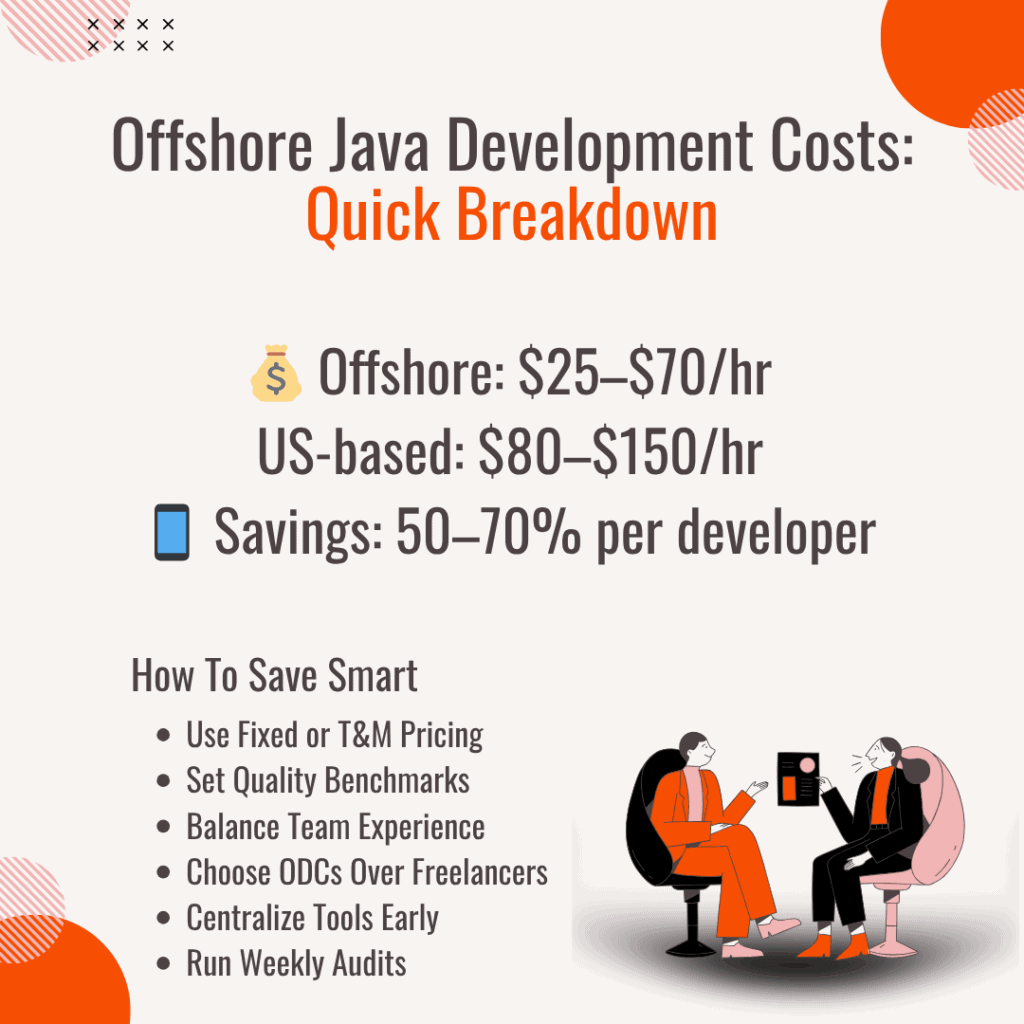
Most offshore Java developers cost $25–$70 per hour, depending on region, tech stack, and experience level. By comparison, US-based Java developers often cost $80–150 per hour, which doesn’t include benefits or overhead. That puts total savings between 50–70% per developer, without cutting output quality if you structure it right.
Here’s how you can save up without cutting corners:
- Pick fixed or time-based pricing by scope: Use fixed-price for clear deliverables (e.g., CRUD API), and time-and-materials for anything with unknowns. This avoids ballooning costs when specifications shift.
- Set up quality benchmarks in your contract: Add thresholds like 80% minimum test coverage, SonarQube checks, and delivery time limits to prevent sloppy work that creates rework later.
- Avoid false savings from junior-heavy teams: Low rates mean nothing if velocity drops. Use a 1 senior per 3 juniors ratio to keep pace and prevent bottlenecks during debugging or feature integration.
- Use offshore development centers instead of freelancers: With a vetted offshore partner, you skip overhead, prevent churn, and cut project management costs by 20–30% through team consistency and shared rituals.
- Centralize your tool stack: Set up GitHub, Jira, Zoom, and Jenkins before kickoff. You avoid miscommunication delays and reduce onboarding waste by up to 15% across the first 30 days.
- Audit delivery timelines weekly: Run short retrospectives and burndown reviews every Friday. It catches delivery slips early, before they turn into scope change fees or QA backlogs.
6 Benefits Of Offshore Java Development Beyond Cost

Use these to spot untapped advantages beyond just saving money.
1. Helps Ship Code While You Sleep
Offshore teams work while your local office shuts down. With a 12- to 16-hour timezone gap, you get daily code commits without burning out your in-house team. This speeds up delivery by 30–50% using a follow-the-sun cycle. You finish sprints faster without hiring a second shift.
2. Taps Frameworks You Cannot Find Locally
Java talent pools offshore often include developers trained in niche stacks like Vaadin, JSF, Play, and Grails. These frameworks are rare in the US but still widely used in Eastern Europe and South Asia. Instead of training in-house, you plug into deep skills right away. This is especially useful for legacy upgrades or hybrid systems.
3. Scales Without HR Bottlenecks
You skip job ads, interviews, and onboarding delays. Offshore partners fill roles in under 14 days, even for senior developers or full project squads. This lets you scale delivery instantly, without tying up internal HR. Most providers preload CVs and only send candidates with live availability and verified Java projects.
4. Reduces Burnout Across Core Teams
Offshore developers take on testing, documentation, bug-fixing, and maintenance. This offloads 30–40% of the work your local engineers usually hate. The result? Your core team focuses on roadmap features and architecture, not patching up legacy modules every sprint.
5. Builds Across Borders Without New Offices
Need localized platforms for Brazil, Germany, or India? Offshore teams let you roll out region-specific Java builds without opening a legal entity or flying staff in. They already know the regulatory rules, language nuances, and local market integrations. You go global without scaling overhead.
6. Locks In Business Continuity Plans
Many offshore vendors run hybrid models with backup teams across countries like Ukraine, India, and the Philippines. If one region faces disruption, work shifts to another in under 72 hours. That gives you built-in resilience against political shifts, blackouts, or disasters, without lifting a finger internally.
“The best offshore Java hires know how to build at speed, debug under pressure, and communicate like they are in the next room.”
— Christian Cabaluna, Senior Recruiter
5 Risks Of Offshore Java Development + How To Fix Them

Use this list to pressure-test your current process.
- No disaster recovery in the development pipeline: If a development environment fails or goes offline, it can stall delivery for days.
- How to fix: Require all vendors to maintain daily backups and a full disaster recovery mirror that restores systems within 12 hours.
- Vendor overpromises during pre-sales: Sales teams often pitch senior developers but assign junior replacements post-contract.
- How to fix: Ask for LinkedIn profiles, GitHub links, and current client feedback for every assigned team member before you sign anything.
- Lack of internal QA before delivery: Some teams push code straight to client repositories without internal testing.
- How to fix: Require vendors to run every feature through QA tools like Selenium or Postman, and send test coverage reports with each release.
- No monitoring on production handovers: Once code goes live, offshore teams often go silent on performance issues.
- How to fix: Add a 30-day post-release monitoring clause in your contract and tie final payment to error-free uptime tracked by tools like New Relic.
- Fake time logs in hourly billing models: Some offshore teams inflate hours with idle time or reused code.
- How to fix: Use time-tracking tools with screen capture (e.g., Hubstaff or Time Doctor) and cross-check velocity with your own burndown charts weekly.
💭 Food For Thought
Offshoring can reduce costs by up to 40% compared to traditional outsourcing.
5 Offshore Java Development Trends That Are Shaping The Future For Businesses

Review each shift and decide which ones to bake into your backlog this quarter.
| What To Do | How To Do It + Tools | |
|---|---|---|
| Java goes serverless | Cut idle cloud spend by up to 35% when you move stateless functions to AWS Lambda or Google Cloud Functions. | Package micro-tasks with GraalVM native images; cap cold-start time under 200 ms. |
| Carbon-aware builds | Large clients now demand proof of green coding. Track energy use per commit. | Hook Eclipse IDE to the open-source Green Coder plug-in and target a 15% drop in CPU cycles. |
| Observability from sprint 1 | Logs alone no longer pass audits. Ship code with full traces and metrics. | Embed OpenTelemetry agents and send data to New Relic or Grafana Cloud; budget 2 hours per service for setup. |
| Java–Kotlin pairing | Kotlin adoption rises 20% year-on-year for cleaner syntax and null safety. Mix both to speed feature velocity. | Refactor high-churn modules to Kotlin while core remains in Java; aim for a 30% cut in boilerplate lines. |
| Edge-ready JVMs | Retail and IoT firms push logic to edge nodes for sub-50 ms latency. Use lightweight JVMs to cope with low RAM. | Deploy Azul Prime or BellSoft Liberica Lite on devices with 256 MB memory; run OTA updates every 14 days. |
Conclusion
Offshore Java development is more than just the cheaper path—it is the faster one, the smarter one, and the only one that still makes sense when you are under pressure to build without delay, budget bloat, or hiring bottlenecks. From regional rate benchmarks to airtight onboarding flows, this guide has unpacked every lever you can pull to get results faster and cheaper, without lowering the bar on quality or control.
But the real challenge is finding offshore Java developers who actually deliver. That is where Genius wins. We are the boots-on-the-ground headhunters who reject 249 candidates to find the ONE you would hire on the spot at 80% less.
Spend less time sifting through profiles and more time shipping code. Hire with Genius today.
FAQs
What types of Java projects work best with offshore teams?
Offshore teams work best for long-term builds, backend-heavy systems, enterprise apps, and cloud-native architectures. Use them when your project involves frameworks like Spring Boot, microservices, or API integrations.
How do I evaluate offshore Java developer productivity?
Track output using sprint burndown charts, Git commit velocity, and test coverage benchmarks. A productive developer averages 500–700 lines of reviewed Java code per week.
Are offshore Java developers experienced with legacy systems?
Yes. Many offshore developers regularly work on Java 8 and older frameworks like Struts, JSF, and JSP. This makes them suitable for modernizing monoliths or integrating with outdated infrastructure.
Can I hire offshore Java developers for part-time or flexible roles?
Yes. Many providers offer 20–30 hours per week models or on-demand project sprints. This works well for non-core modules, seasonal load spikes, or maintenance cycles.