

Offshore Node development isn’t just for companies with 10 floors and a legal department. It is for anyone who is tired of the same hiring dead ends and overpriced devs who ghost mid-sprint. But there is a catch – if you don’t plan it right, it can crash and burn.
This offshoring guide shows you how to set it up like it is meant to be done. You get field-tested methods to build a lean, legit offshore Node.js setup. So if you are done googling around and ready to make offshore actually work for your Node projects, start here.
Offshore Node Development: 5 Quick Tips To Remember

- Lock your scope before you look for teams: Vague specifications are the fastest way to delay delivery. Break backend tasks into clear modules and define endpoints upfront using tools like Swagger or Postman.
- Start with a paid pilot, not promises: Run a 2–4 week trial project with clear success metrics to evaluate speed, quality, and communication before you scale your offshore setup.
- Hire for Node.js-first thinking, not just JavaScript: Skip generic “full-stack” resumes. Choose engineers who have built with Express, handled event queues, and deployed modular backends before.
- Use time zones to double your velocity: Offshore teams 8 to 12 hours ahead let you run daily hand-offs and finish features while your local team sleeps.
- Track sprint health, not just output: Use tools like SonarQube and CodeClimate to monitor test coverage and code duplication. Faster delivery means nothing if the code breaks under pressure.
Here Are Some More Helpful Reads
🔥 Offshore Big Data Development: Your Complete Starter Guide
📣 .NET Offshore Development Services: A Quick Starter Guide
🚀 How To Build An Efficient Mobile App Development Offshore
What Is Offshore Node.js Development & Why Is It Exploding?

Offshore Node.js development is hiring backend developers who use Node.js from lower-cost countries to handle your server-side code. It’s more than just outsourcing. It’s a targeted strategy for event-driven, API-heavy applications built by remote teams optimized for Node’s strengths.
Here’s why offshore Node development is booming right now:
- 20+ million websites rely on Node.js, with nearly 37% of developers actively using it.
- Global IT outsourcing spend jumps approximately 9% YoY, pushing offshore to a projected $152 billion in 2025.
- Hiring locally costs $117,000–$180,000 annually; offshore experts deliver equivalent results at $25,000–$55,000.
- US/UK face Node.js developer shortages while offshore regions (India, Eastern Europe, LATAM) offer deep pools and fast onboarding.
- Node.js’s non-blocking, event-driven model handles concurrent tasks efficiently, which is perfect for remote teams to push live changes without downtime.
What Sets Offshore Node Development Apart
See how offshore Node development offers a combination of speed, cost, and fit.
- Node’s async and microservices architecture fits naturally into distributed work, avoiding bottlenecks familiar in thread-based systems.
- Developers can collaborate in real time with frameworks like Express and GraphQL, streamlining sprint hand-offs.
- Cloud-native structure and microservices enable modular builds. Offshore teams can independently own, update, and deploy services without stepping on each other’s toes.
💭 Food For Thought
Nearshoring provides a 75% overlap in working hours.
9 Steps To Launch Offshore Node Development The Right Way

Use these steps to fix gaps in your team and implement offshore node development without hurdles.
Step 1: Map Your Backend Scope Without Guesswork
Start with a clean specification, not just “backend development.” Offshore teams move faster when your API endpoints, features, and architecture are locked in. A vague scope often means delays, miscommunication, and ballooning costs.
- Break the scope into modules with clear boundaries (e.g., authorization, billing, notifications).
- Use visual tools like Swagger or Postman to define APIs upfront.
- Set sprint-ready milestones. Think 2-week blocks with shippable features.
- Share existing documents, Figma flows, or product decks to reduce onboarding time.
- Use benchmarks from past sprints to forecast development hours and budget.
Step 2: Pick A Model That Matches Your Timeline
You do not need a 10-person team if your MVP is still under construction. Choose between dedicated, project-based, or hybrid setups based on complexity, speed, and budget constraints.
- Use project-based if you have fixed specifications and timelines under 12 weeks.
- Use dedicated teams if you plan to scale or build multiple features in parallel.
- Hybrid models work best for teams that need full-time backend support plus short-term specialists.
- Dedicated developers cost more monthly but pay off in velocity and retention.
- Avoid agencies that push retainers before validating their Node.js expertise.
Step 3: Hire For Node.js Fluency, Not Just JavaScript
Not every JavaScript developer understands how to build scalable, backend-first services. Look for experience in real-world Node.js use cases like asynchronous APIs, microservices, and event queues.
- Ask for code samples or GitHub repos featuring Express, NestJS, or Koa.
- Prioritize developers with experience in streaming, real-time systems, or serverless.
- Validate if they have handled load balancing or rate-limited APIs before.
- Choose agencies with Node-first portfolios, not just “full-stack” generalists.
- Require a paid tech test focused on concurrency, error handling, and scaling.
Step 4: Pressure Test The Stack Before You Scale
Most failed builds start with an overloaded or mismatched tech stack. Make sure your backend architecture supports microservices, CI/CD, and scaling from day one.
- Confirm your stack is compatible with event-driven Node.js (e.g., Kafka, RabbitMQ).
- Test local + staging pipelines with GitHub Actions or Jenkins.
- Run early stress tests on API routes to catch bottlenecks.
- Use Postman or Apache JMeter to simulate 500+ concurrent users.
- Ask offshore developers how they handle retries, rate limits, and failover in production.
Step 5: Fix Time Zones Before They Break You
Time zone mismatches kill sprints. Asynchronous teams only work when hand-offs, demonstrations, and updates are baked into your routine.
- Choose developers with at least 3 hours of daily overlap with your work hours.
- Lock in demonstration rituals every Friday with a clear checklist.
- Use Loom to record walkthroughs and unblock teammates during sleep hours.
- Create a shared weekly cadence in Notion or Jira with status updates and blockers.
- Track message latency on Slack. The reply time should stay under 2 hours on average.
Step 6: Use Tools That Offshore Teams Already Know
Do not waste the first 2 weeks onboarding developers onto tools they have never used. Choose industry standards that support visibility, version control, and sprint rhythm.
- Use GitHub or GitLab for codebase control; never email ZIP files.
- Use Jira or Linear for sprint planning with development tags and blockers.
- Use Slack or Discord for asynchronous conversations with channel history.
- Use Figma for product flow walkthroughs during onboarding.
- Automate deployments with GitHub Actions, Heroku Pipelines, or Docker workflows.
Step 7: Run A Paid Pilot Before You Commit
Commitment without proof is how bad hires happen. A pilot phase gives you a clear signal on how the team handles pressure, feedback, and code quality.
- Limit the pilot to 2–4 weeks with a single, self-contained feature (e.g., payments).
- Set success metrics: delivery time, test coverage, and number of revisions.
- Run daily asynchronous updates with clear blockers and next steps.
- Use code reviewers outside the offshore team to evaluate output.
- Decide within 5 days of completion whether to scale, extend, or replace.
Step 8: Track The Right Numbers, Not Just Output
Velocity means nothing if quality drops. Track both code health and project velocity to spot burnout or bad structure early.
- Use tools like SonarQube or CodeClimate to monitor test coverage and duplication.
- Define story point targets per sprint and track team velocity trends.
- Use uptime monitors for critical endpoints and scheduled jobs.
- Track pull request turnaround time. Under 24 hours keeps the velocity high.
- Use burndown charts and retrospective reports to adjust the sprint load.
Step 9: Plan For Retention From Day One
Offshore teams are not “fire-and-forget.” If you want continuity beyond the MVP, invest in how your offshore developers stay engaged.
- Set up quarterly performance reviews with raises and learning incentives.
- Build a development wiki to reduce repeated onboarding every few months.
- Give offshore developers Git access, product context, and customer feedback.
- Share your product roadmap so they can suggest architectural upgrades early.
- Reward on-time delivery with bonuses or visibility in all-hands updates.
“When backend failure starts blocking growth, you need precision hiring that restores momentum fast—not more resumes.”
— Burkhard Berger, Founder & CEO
6 Services That Are Typically Included In Offshore Node Development
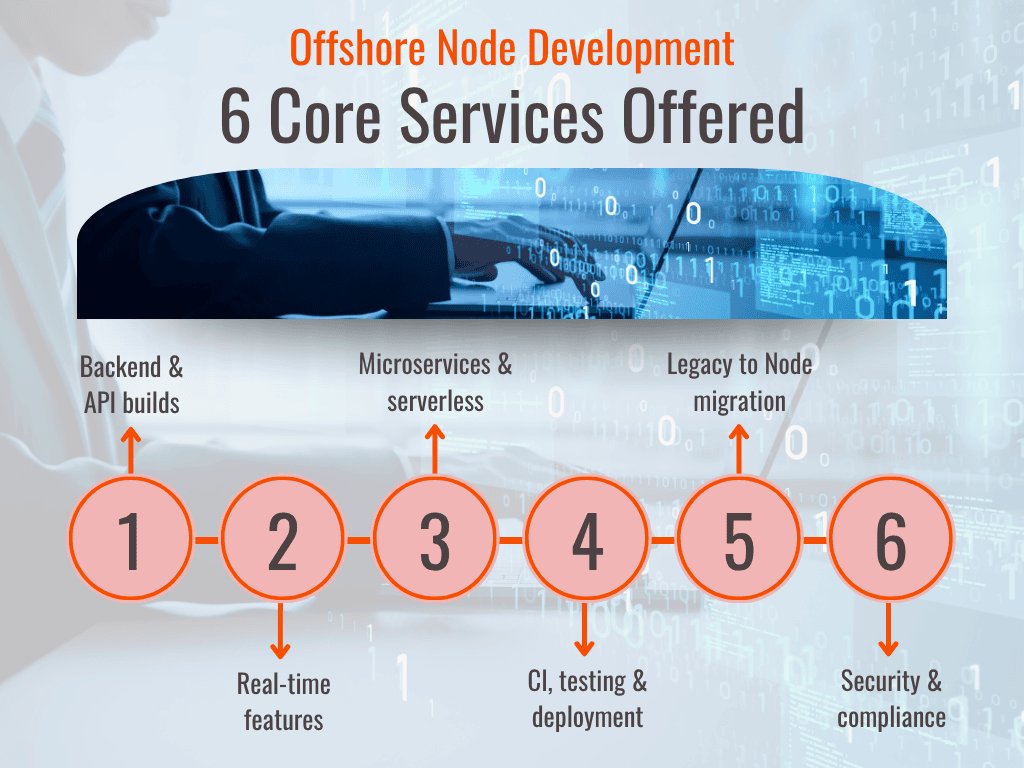
Use this list to cross-check which backend services your offshore team should actually provide.
- Backend architecture & API development: Offshore teams plan and build RESTful or GraphQL APIs, database layers, and core server logic that supports scalable backend infrastructure.
- Real-time features for chat, dashboards, or live updates: Developers set up socket-based communication, data streams, and live UI synchronization using tools like Socket.IO or WebSockets.
- Microservices & serverless functions: Codebases are split into lightweight services deployed across containers or cloud functions for faster deployment and modular scaling.
- Continuous integration, testing, & cloud deployment: Teams configure CI pipelines, automated tests, and deployment to AWS, Google Cloud, or Azure with Docker, Kubernetes, and GitHub Actions.
- Legacy system upgrades or migration to Node.js: Offshore developers rewrite outdated backend code and move logic to Node.js while preserving data integrity and API contracts.
- Security, compliance, & backend performance: Includes encryption setup, authentication protocols, load testing, uptime monitoring, and compliance with standards like SOC 2 or GDPR.
8 Offshore Node Development Benefits Any Business Can Enjoy
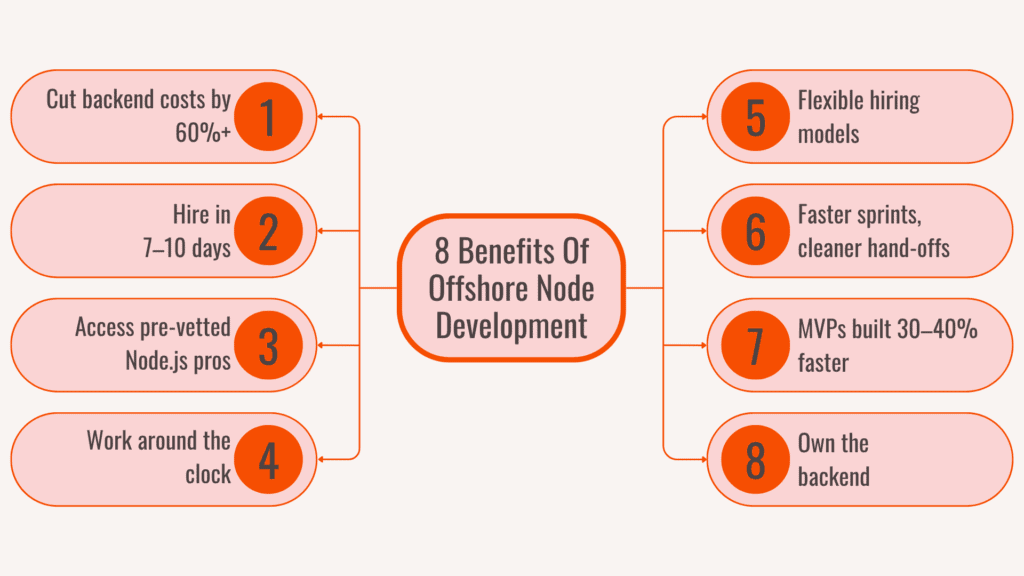
Use this list to check where your current backend strategy falls short.
- Cuts backend costs by over 60%: Offshore developers charge between $25,000 and $55,000 per year, compared to $117,000 or more for in-house hires in the US, without reducing backend quality.
- Makes your hiring timeline days, not months: Offshore teams can start within 7 to 10 days, while local recruitment often takes 6 to 8 weeks due to skill shortages and long interview cycles.
- Gives you access to developers who already know Node.js inside out: Offshore talent pools in India, the Philippines, and Eastern Europe include engineers fluent in Express, event queues, GraphQL, and scaling logic, with no onboarding required.
- Helps you build around the clock: With teams in time zones 8 to 12 hours ahead, you get daily hand-offs that keep your project moving while your local team sleeps.
- Matches your build speed with your hiring model: Offshore agencies offer project-based, full-time, and hybrid setups, so you are not locked into long contracts or forced to overhire.
- Gives you clean hand-offs & faster sprints: Modular backend builds and real-time tools let distributed teams work in parallel without collisions or delays.
- Speeds up MVP cycles without local overhead: Offshore developers build prototypes 30% to 40% faster on average by skipping US hiring delays and using prebuilt API libraries and tested boilerplate.
- Shifts backend ownership without micromanagement: Offshore teams use version control, demonstration rituals, and shared tools so your core team can stay focused on the roadmap and growth.
📢 Did You Know?
Nearshore outsourcing in Latin America is growing at 20% per year.
5 Top Countries To Consider For Offshore Node Development This Year
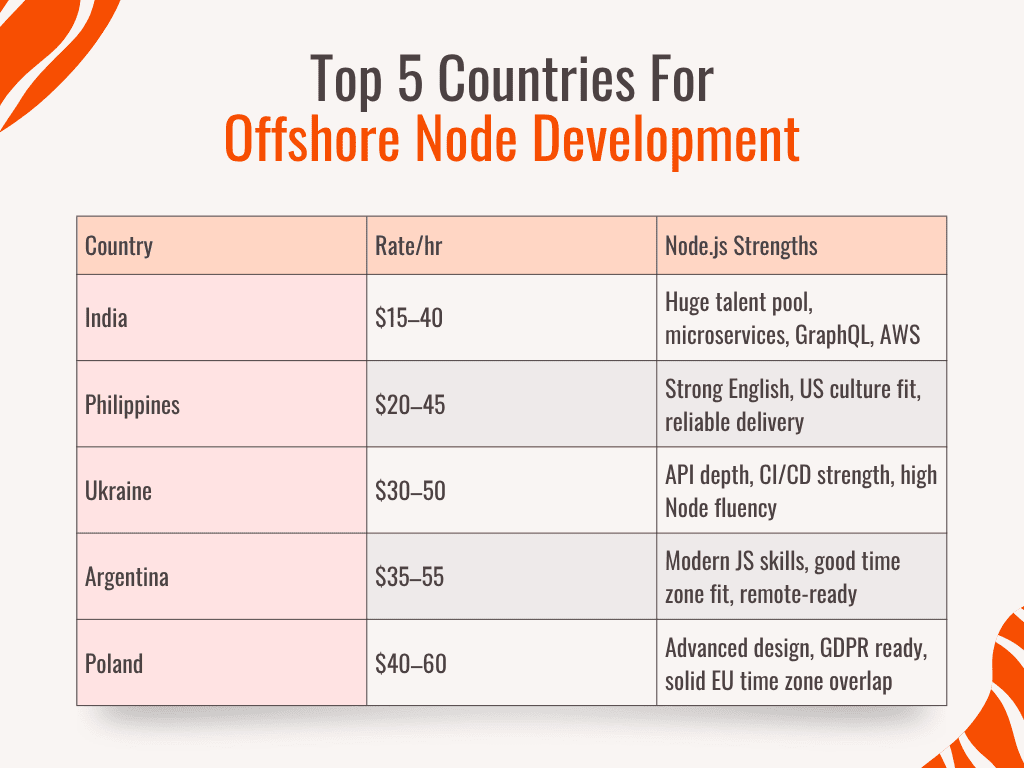
Use this table to decide where your offshore Node development team should come from.
| Country | Average Hourly Rate | Node.js Strengths |
|---|---|---|
| India | $15–$40 per hour | Large pool of backend engineers skilled in microservices, GraphQL, and AWS. |
| Philippines | $20–$45 per hour | Strong English fluency, cultural fit for US-based teams, and reliable sprint delivery. |
| Ukraine | $30–$50 per hour | High Node.js fluency, deep API experience, and strong CI/CD practices. |
| Argentina | $35–$55 per hour | Modern JavaScript expertise, flexible time zones, and solid remote work setups. |
| Poland | $40–$60 per hour | Advanced system design, GDPR compliance, and stable code delivery in EU time zones. |
3 Top Offshore Node Development Agencies That Will Help You Win
Go through this offshoring companies list and match each agency to the exact friction point in your pipeline.
1. Genius: Offshore Talent Without The Middleman Markup

Core Services: Genius connects businesses with top-tier remote talent from the Philippines and Latin America. Key roles include Node.js developers, software engineers, data analysts, and full technical teams.
Best For:
- Startups and midsize companies with lean engineering budgets.
- Teams that need fast, vetted Node.js hires without long-term contracts.
- Businesses that want to scale product teams without giving up equity or control.
Sourcing & Vetting Process: Genius runs a strict 12-phase screening pipeline. Candidates must pass live coding tests, behavioral interviews, English assessments, and cultural fit evaluations. Only the top 1% move forward.
Time-To-Hire & Hiring Model: Receive pre-vetted candidates in under 7 days. Choose from flexible hiring models: full-time, part-time, or freelance. No subscriptions and no monthly fees.
Guarantees: 6-month “Perfect Hire Guarantee” that includes onboarding support and a one-time flat fee with zero hidden charges.
Who It’s Not For:
- Companies that need full-time on-site developers.
- Teams that are unwilling to manage distributed talent.
2. Intellectsoft: Big-League Engineering For Complex Projects

Core Services: Intellectsoft delivers full-cycle software development, from ideation to deployment. They also offer engineering consulting and legacy system modernization.
Best For:
- Enterprises that need a scalable Node.js architecture.
- Companies that want to launch AI, Internet of Things, or mobile products.
- Teams with compliance-heavy software demands.
Sourcing & Vetting Process: Their in-house engineers are hired through a multi-level recruitment process that includes technical evaluations, live system design interviews, and a security clearance layer for sensitive projects.
Time-To-Hire & Hiring Model: Expect a project kickoff in 10 to 14 days. Most clients work with dedicated teams on a long-term, fixed-rate basis.
Guarantees: Custom service-level agreements based on project scope, with milestone-based payments and post-launch support.
Who It’s Not For:
- Small teams that want to build a basic minimum viable product.
- Companies that are on very limited budgets.
3. Infinum: Smart Product Teams For Fast-Moving Companies

Core Services: Infinum designs and builds mobile, web, and Internet of Things platforms. They also help modernize legacy apps and run digital product audits.
Best For:
- Product-driven companies that want great design and scalable code.
- Founders who want to launch cross-platform apps with real-time features.
- Businesses that need both frontend and backend Node.js expertise.
Sourcing & Vetting Process: Infinum hires globally through a centralized screening team that evaluates technical depth, architecture fluency, and prior experience building user-centric software.
Time-To-Hire & Hiring Model: Most teams spin up within 2 weeks. Clients engage on a fixed-cost or time-and-materials model depending on project scope.
Guarantees: They offer a dedicated success manager and milestone-based quality reviews during the project lifecycle.
Who It’s Not For:
- Teams that only need backend development with no design input.
- Companies that require ultra-low-cost builds with minimal feature sets.
📣 Interesting Fact
Between 53% and 60% of offshore development revenue comes from large companies.
Offshore Node Development vs In-House Node Development: Cost & ROI Breakdown

Use this table to pressure test your current budget, timelines, and scaling strategy.
| In-House (US) | Offshore (India, Philippines, Ukraine) | |
|---|---|---|
| Annual Salary Range | $117,000 to $180,000 | $25,000 to $55,000 |
| Hiring Time | 6 to 8 weeks | 7 to 10 days |
| Team Ramp-Up Time | 3 to 5 weeks onboarding | 5 to 7 days with pre-vetted candidates |
| Sprint Throughput | 1 to 2 features per sprint | 2 to 4 features with parallel cycles |
| Time Zone Coverage | 8 hours/day | Up to 16 hours/day with hand-offs |
| Infrastructure Overhead | High (office, benefits, tools) | Minimal (remote stack, no office costs) |
| Code Delivery Speed | Standard (1x velocity) | 30% to 40% faster via async workflows |
| Scalability | Linear and expensive | Modular, rapid, and low-risk |
| Retention Risk | High in competitive markets | Lower with flexible contracts |
| 3 to 5 weeks of onboarding | Internal HR and IT burden | Often built-in with vendor SLAs |
“Offshore Node.js hiring is timeline control—not just cost optimization. You are solving for velocity without losing quality.”
— Christian Cabaluna, Senior Recruiter
5 Offshore Node Developer Red Flags & How To Avoid Them

Use this checklist to cut unqualified developers within the first 72 hours of your evaluation process.
- No standalone Node.js portfolio: Ask for 2 to 3 live backend projects built with Express, NestJS, or Koa. Skip anyone who only sends GitHub boilerplate or frontend-heavy code.
- Overpromised timelines with no delivery logic: Ask for a feature-level Gantt or sprint chart before you sign. Timelines without breakdowns mean they plan to improvise under pressure.
- Weak API or microservices history: Request a diagram that shows how they handle service-to-service communication, load balancing, and rate limits. If they hesitate, they have not done it.
- Thin or outdated documentation habits: Look at past projects for README files, schema notes, and API changelogs. Less than 2 hours of documented setup is a blocker for scale.
- Low asynchronous communication fluency: Test how they reply across time zones using Slack or Loom. If responses take over 4 hours or lack next steps, your sprint will stall midweek.
Conclusion
If your roadmap has stalled or your budget is buckling under local salaries, this offshore node development guide is your reset button. Every tip here is designed to help you avoid the usual chaos and launch with speed, quality, and control.
And if you are tired of ghosted interviews, bloated retainers, or recycled resumes, skip the agency noise. Genius gives you direct access to offshore Node.js developers vetted across 12 layers, from async skills and real-world backend builds to timezone coverage and code fluency. No fluff. No subscription. Just the top 1% talent on standby.
Get your backend moving again and hire with Genius today.
FAQs
What makes Node.js ideal for offshore backend development?
Node.js uses a non-blocking, event-driven model that enables remote teams to handle concurrent tasks without lag. This makes it ideal for offshore developers working in parallel across time zones, especially when managing APIs, data streams, or microservices.
Can I integrate offshore Node.js teams with in-house engineers?
Yes, offshore Node.js teams can work alongside in-house engineers using shared tools like GitHub, Jira, and Slack. Set up clear hand-off times, document processes in a shared workspace, and run weekly demos to ensure smooth collaboration.
How long does it take to set up an offshore Node development team?
If you are working with a pre-vetted offshore partner, you can launch a Node.js team within 7 to 10 days. Hiring independently can take up to 4 to 6 weeks, depending on sourcing, interviews, and trial testing.
How to ensure quality in offshore Node development?
Use a structured vetting process that includes technical assessments, code reviews, and trial tasks. Monitor quality with tools like SonarQube, implement sprint rituals, and run frequent performance check-ins tied to clear delivery metrics.