

It is 11:42 pm. You are still staring at a tax return that should have been filed yesterday. Your in-house team is maxed out, your freelancer just ghosted you mid-project, and your best staffer quietly mumbled, “I need a break” before logging off. If this sounds familiar, offshore tax preparation is your way out.
However, most firms don’t even realize offshoring is an option until they are already behind. And by then, they are rushing into it without a plan, which almost always backfires.
This guide solves all that by showing you how to choose the right offshore partner and stay 7216-compliant. We will walk you through hiring, onboarding, performance tracking, and how to dodge the tax offshoring mistakes that tank most first attempts.
Offshore Tax Preparation: The 5 Core Details You Shouldn’t Miss
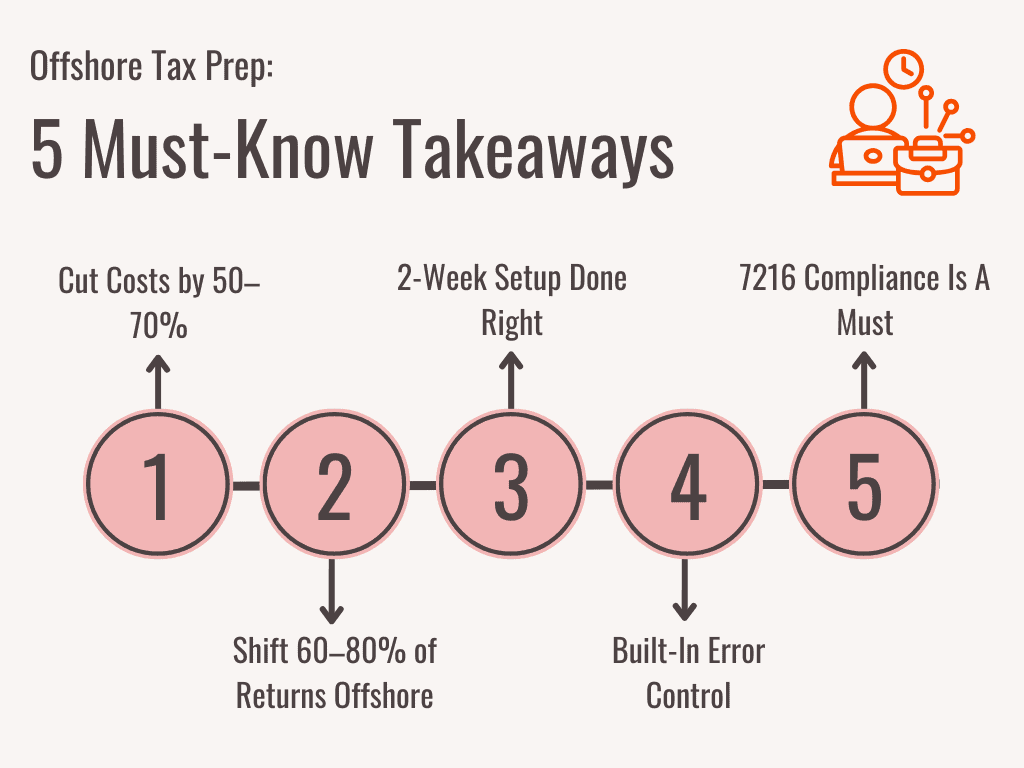
- Prep costs drop by 50%-70% without sacrificing IRS compliance: Offshore teams in the Philippines, India, or Latin America work inside your system at $8–$20/hour, which gives you the same output at a fraction of the cost.
- 60%–80% of recurring returns shift offshore without delays: Build embedded teams that prep, review, and file tax returns overnight. This cuts in-house load and eliminates the crunch during peak season.
- Setup takes less than 2 weeks when done right: Map your return types, assign role-based access, and use dummy files for test runs so your offshore partner can hit the ground running without guesswork.
- Review loops catch errors before your clients ever see them: Use a 2-step signoff process, track edit patterns per preparer, and assign one senior reviewer per 8–10 team members to hold the quality bar.
- IRS 7216 consent is non-negotiable and trackable: Get client signoff during onboarding, use e-signature tools with timestamped logs, and pair every offshore NDA with audit-ready security protocols.
Here Are Some More Helpful Reads
🔥 Offshore Big Data Development: Your Complete Starter Guide
📣 How To Build An Offshore Accounting Team That Delivers
🚀 14 Benefits Of Offshore Bookkeepers & How To Avoid Risks
What Is Offshore Tax Preparation & Why Does It Matter?

Offshore tax preparation is handing off US tax return prep to professionals in lower-cost countries like the Philippines, India, or LATAM (Latin America). Unlike one-off outsourcing, it builds long-term capacity with embedded teams who operate on your systems and your timeline, which makes it more than just farming out tasks.
Here’s why offshore tax preparation really matters:
- Cuts prep costs by 50%–70% compared to hiring locally, without sacrificing IRS compliance.
- Reduces team burnout during peak season by shifting 60%–80% of recurring prep work abroad.
- Adds capacity in under 2 weeks with vetted professionals trained on 1040s, 1120s, FBAR, and more.
- Improves turnaround by 30%–50% with 24-hour global workflows and overnight filing cycles.
- Protects margins for CPA firms and tax businesses that need to scale without long-term payroll overhead.
Offshore Tax Preparation Setup: 6 Steps You Must Follow To Do It Right
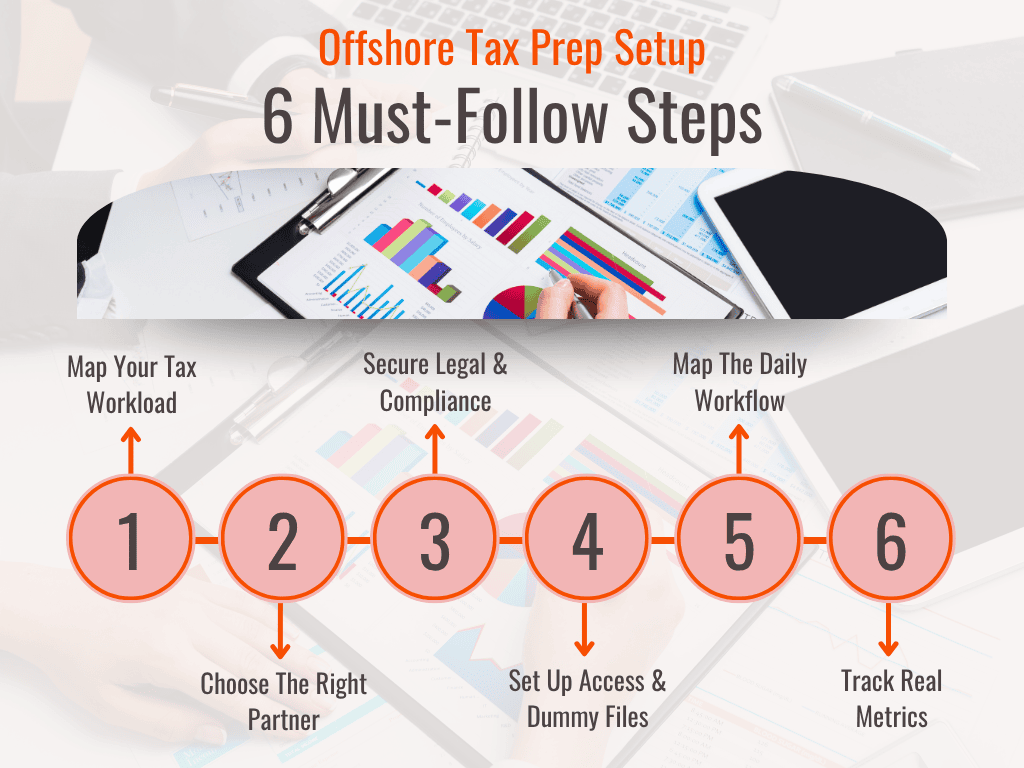
Use these 6 steps to build a secure, efficient offshore tax preparation setup that holds up during peak season.
Step 1: Map Your Tax Workload Like A Hiring Blueprint
Identify what types of returns you need help with, how many you file each month, and where your team gets stuck. This gives you a data-backed starting point to scope offshore work without guesswork.
- List entity types (1040, 1120, 1065, FBAR, etc.) and volume per month or quarter
- Flag recurring bottlenecks like reconciliation, multi-state returns, or 5471 filings
- Set turnaround goals (e.g., 48 hours per return)
- Quantify staff time saved per task moved offshore
- Highlight tools currently in use (Drake, Lacerte, ProSeries, etc.)
Step 2: Pick A Partner Who Already Works Like You Do
Skip vendors who only offer generic services. Focus on partners who understand US compliance and already support CPA firms at scale.
- Filter for firms with 1040, 1120, and 1065 experience at volume (500+ returns/year)
- Confirm they hire IRS-trained staff familiar with US GAAP and FATCA
- Request references from US-based clients with similar return types
- Ask for a mock return using your preferred software
- Check if they offer per-return, FTE, and hybrid billing models
Step 3: Lock In Security, Consent, & Legal Paperwork
Compliance doesn’t stop at the IRS. You need airtight documentation to protect client data and meet legal obligations.
- Collect signed IRS Form 7216 consent for each client (email + PDF)
- Use NDAs for every offshore staff member with access to tax data
- Confirm the provider’s SOC 2 or ISO 27001 certification
- Review their file-sharing protocol (password-protected, timestamped, no public links)
- Map legal restrictions if clients are in states with stricter consent rules (e.g., CA, NY)
Step 4: Set Up Tools, Access & Dummy Files Before Launch
The most common delays happen when offshore teams wait for logins or can’t test workflows. Set everything up before you delegate a single return.
- Create role-based logins for tax software, cloud storage, and secure email
- Use dummy data to test form access, macros, or templates
- Record Loom walkthroughs for each workflow and folder structure
- Track onboarding status in ClickUp, Asana, or Google Sheets
- Schedule a pre-launch dry run (e.g., prepare 1 test return end-to-end)
Step 5: Draw A Daily Workflow Map (With Owner Tags)
Without clear ownership, tasks get dropped. Build a workflow that shows exactly who does what, by when, and where review checkpoints fall.
- Break down each return into prep, review, edit, and file stages
- Assign turnaround times (e.g., prep in 24 hours, review in 8)
- Use a status tracker with due dates and owner tags
- Mark escalation points (e.g., missing data, client delays)
- Add review layers based on complexity (e.g., 1040 vs. 5471)
Step 6: Monitor Metrics That Show Real Progress
Your offshore setup needs visibility. Skip vanity metrics. Track what actually proves value and flags issues early.
- Average turnaround time per return type
- Error rate per preparer or return
- Time to onboard each new team member
- Percentage of returns filed on or before the deadline
- Internal satisfaction score from in-house reviewers
💭 Food For Thought
70% of companies offshore work primarily to save costs.
Managing Offshore Tax Preparation Teams: 5 Steps From Onboarding To Review
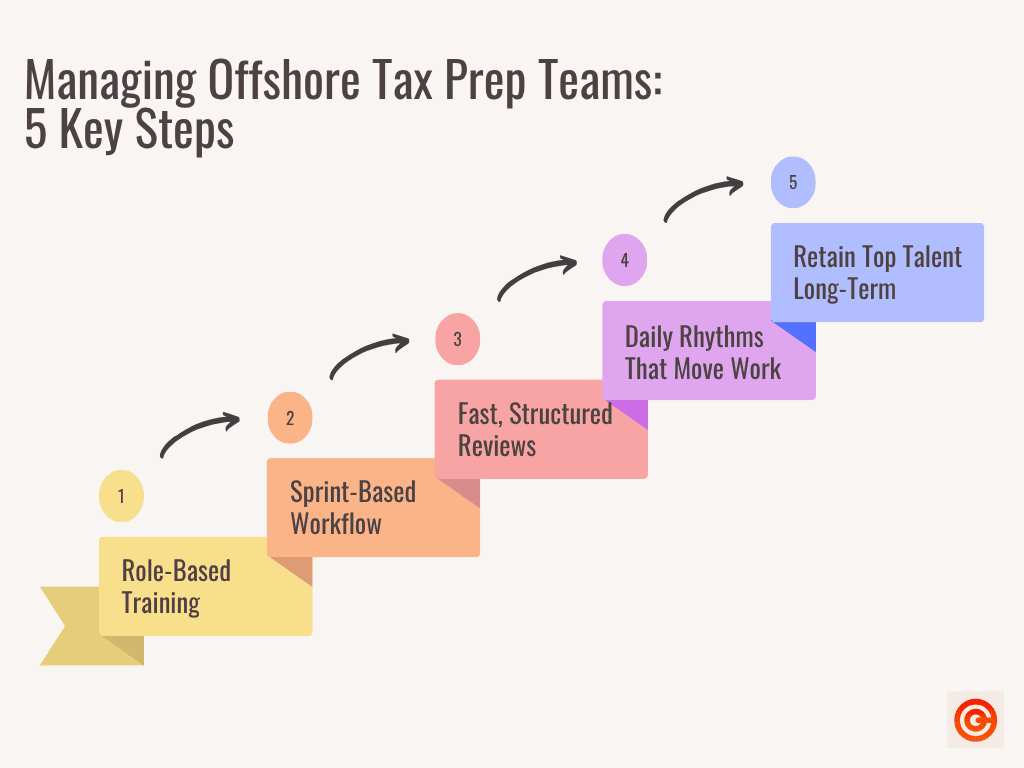
Step 1: Build A Role-Based Training Ramp
Generic onboarding slows teams down. Give each offshore role its own track with the right tools, forms, and responsibilities.
- Break roles into preparer, reviewer, researcher, and team lead
- Assign return types by level (e.g., junior → 1040s, senior → 1120s, 5471s)
- Build short-form training via Loom videos (maximum 5 minutes per topic)
- Track progress with ClickUp or Notion boards by role
- Run return simulations using past, anonymized filings
Step 2: Break Work Into Sprint Cycles
Treat offshore returns like sprint tasks, not a never-ending queue. It helps you spot delays and balance team load.
- Set 5-day sprints for weekly return volume (with percentage targets)
- Break each return into subtasks: data intake, prep, review, recheck, file
- Use Kanban boards (e.g., Trello, ClickUp) to track daily movement
- Tag blockers like “missing docs” or “awaiting approval” early
- Hold quick asynchronous (async) standups via Slack or daily checklists
Step 3: Set Up A Review Loop That Flags Issues Fast
Returns don’t need a full audit every time, but they do need structured checks. Build a system that catches errors before clients do.
- Assign a senior reviewer per 8–10 preparers
- Create review templates by return type (e.g., 1040 vs. 1120S)
- Track corrections per preparer in a central log
- Use 2-step signoff for high-risk returns (e.g., FBAR, multi-state)
- Add random spot checks weekly for quality consistency
Step 4: Build Cross-Team Habits That Keep Work Moving
Offshore teams need rhythm just like in-house teams do. The fastest firms bake momentum into the workweek through rituals that reduce delays and keep everyone focused.
- Start each week with a 15-minute goal sync (volume, deadline flags, team capacity)
- Set a daily cutoff for file handoffs (e.g., 3 pm US time = 1 am India)
- Use end-of-day Slack check-ins to confirm prep → review → file cycles
- Add a shared backlog board for escalations, client follow-ups, or stalled returns
- Post weekly wins (e.g., 50+ returns filed, 48-hour turnaround hit) to reinforce outcomes
Step 5: Keep Great Teams By Making It A 2-Way Relationship
Offshore teams aren’t plug-and-play. You keep top talent when they feel part of the long game.
- Hold quarterly 1:1s with each team member (async or video)
- Send quarterly performance feedback + bonus eligibility
- Invite offshore leads to internal team updates and retrospectives
- Share anonymized client feedback to reinforce wins
- Offer $50–$200 spot bonuses for milestone achievements
IRS 7216 Consent & Offshore Tax Prep Compliance: 6 Best Practices

Use these 6 best practices to stay fully compliant under IRS Section 7216.
1. Make IRS 7216 Part Of Onboarding, Not An Afterthought
Collect consent at the same time as your engagement letter using dual-format delivery (PDF + e-sign). Store signed forms in your DMS (document management system) with timestamps and user ID logs.
2. Use A Short Video Script To Explain Consent Clearly
Send a one-minute explainer video to clients before the 7216 form to avoid confusion or drop-off. Cover who accesses the data, what country they’re in, and how data stays secure. Use Loom or a branded recording tool with your firm logo.
3. Map Out State-level Consent Rules On Day One
States like California and New York may require extra client disclosures. Create a Notion tracker that flags which clients need supplemental language based on ZIP code.
4. Control File Access With Role-Based Permissions
Never rely on open folder sharing. Use tax software that supports tiered access control (e.g., Drake, Canopy) and grant offshore users time-restricted permissions.
5. Use NDAs That Reference 7216 Requirements Explicitly
Offshore team NDAs should cite IRS consent rules by section. Include disciplinary action clauses for mishandling client data to reinforce legal accountability.
6. Log Every 7216 Touchpoint For Audit Defense
Track email opens, clicks, and completed signatures via your e-signature platform (e.g., HelloSign, DocuSign). Download monthly logs and back them up with your tax year documentation.
“We’ve seen firms double client capacity just by offloading 60% of prep work offshore. The secret is building the right systems from day one.”
— Burkhard Berger, Founder & CEO of Genius
6 Strategies To Hire An Offshore Tax Preparer Without Losing Control
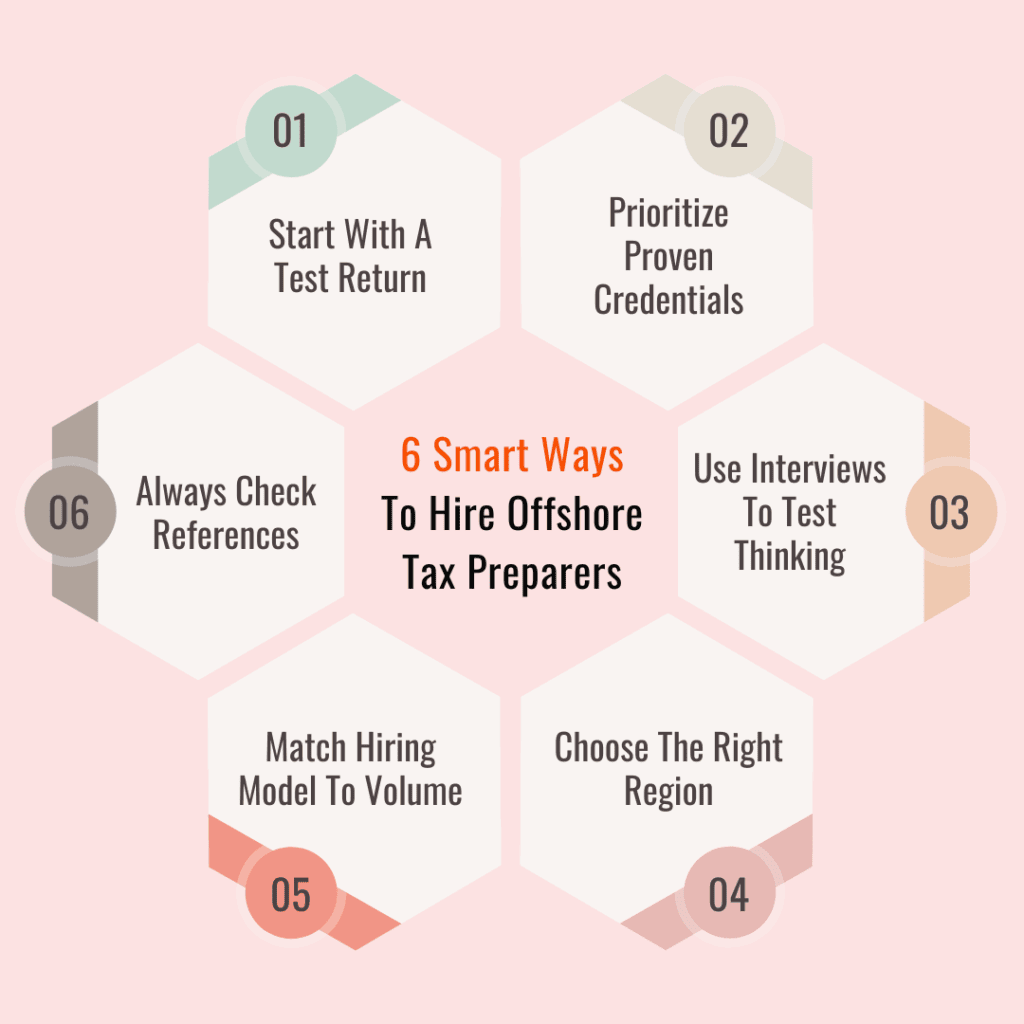
Use these strategies to set a higher bar for your offshore tax preparer search.
1. Set The Baseline With A Short Test Project
Before you commit to interviews or contracts, assign a real-world task. Choose a 2–3 hour mock return (1040 or 1120) using your software and SOPs. Evaluate accuracy, communication speed, and how well they follow your instructions.
2. Pick Credentials That Actually Prove Readiness
Don’t chase letters alone. Look for enrolled agents (EAs), CPAs with US tax prep history, or preparers with 3+ tax seasons handling 1040s, 1120s, FBARs, and multi-state returns. Ask for anonymized samples or verified return logs.
3. Use Interviews To Stress-Test Communication, Not Just Experience
Host 15-minute async or live interviews. Focus on how they walk through logic, handle client pushback, and explain US tax workflows. Share a real case scenario and ask how they’d fix issues or flag risk areas.
4. Stack The Odds With Countries That Already Serve US Clients
Shortlist countries with US GAAP familiarity and 24-hour workflow potential. Philippines, India, and Latin America cover 90% of the current offshore tax prep market. Filter for firms with at least 500+ US returns/year.
5. Lock In The Right Model For Your Volume
Choose FTEs (full-time equivalents) if you need 200+ returns/month, project-based contracts for seasonal spikes, and hybrid setups if you want flexibility with control. Define hours, return types, and expected handoff timelines before you start.
6. Don’t Skip Reference Checks From US-Based Firms
Ask for 2–3 references from CPA firms in similar niches (e.g., multi-state business returns, expat filings, real estate holdings). Verify if the offshore team met SLAs, managed complexity, and stayed within scope without micro-management.
📢 Did You Know?
Knowledge-intensive services now represent 67% of all offshoring arrangements.
Offshore vs Nearshore vs Onshore Tax Preparation: Comparing Cost, Speed, & Quality
Use this table to check where your current setup falls short and where it makes sense to shift volume.
| Offshore (India, Philippines, LATAM (Latin America)) | Nearshore (Mexico, Colombia, Costa Rica) | Onshore (United States) | |
|---|---|---|---|
| Hourly Rate (FTE model) | $8–$20/hour | $15–$30/hour | $50–$100/hour |
| Per-Return Pricing | $25–$60 for 1040s $60–$120 for 1120s | $40–$80 for 1040s $80–$150 for 1120s | $150–$400 for 1040s $300–$600+ for 1120s |
| Turnaround Speed | 24–48 hours (overnight cycle) | 48–72 hours | 3–7 business days |
| Team Availability | 24/7 (timezone offset = overnight prep) | US-overlapping hours | US business hours only |
| Compliance & Certifications | SOC 2, ISO 27001, 7216, GDPR common | SOC 2 and NDA standards | Full IRS, 7216, and state-level coverage |
| Tax Software Expertise | Drake, ProSeries, Lacerte, UltraTax | QuickBooks, Drake, Xero | All standard US platforms |
| Typical Use Cases | High-volume prep, peak-season scaling | Client communication support, mid-level prep | Complex returns, client-facing advisory |
| Hiring Speed | 7–14 days | 5–10 days | 3–6 weeks |
| ROI Benchmark | Up to 70% cost reduction with no drop in compliance | 40–60% cost savings | High cost, high control |
| Best Fit For | CPA firms with 500+ returns/year, peak load relief | Firms that need time-zone overlap + bilingual support | Advisory-heavy teams, complex filings |
7 Key Offshore Tax Preparation Services You Can Outsource
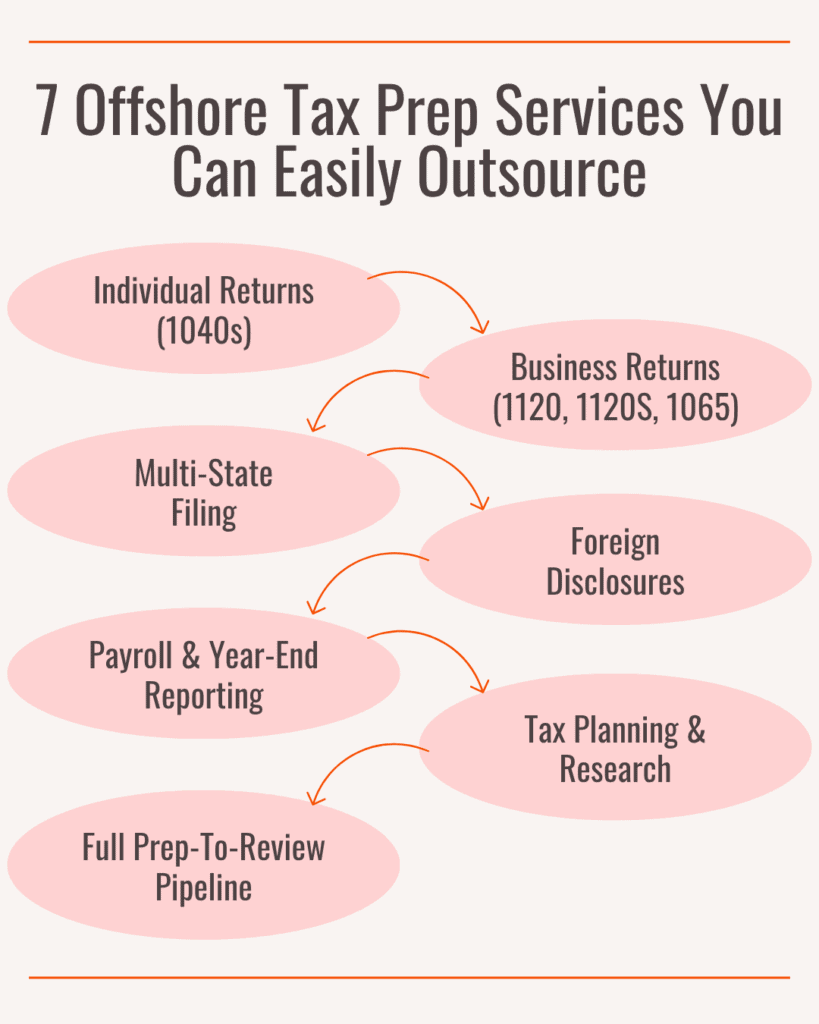
Use this list to assign the right return types to offshore professionals.
1. Individual Tax Return Preparation (1040s)
- 1040, 1040-NR, and amended returns (1040-X)
- Coverage: high-volume, low-complexity returns, including W-2, 1099, and basic Schedule C
- Turnaround: 24–48 hours per return
2. Business Tax Returns (1120, 1120S, 1065)
- Includes C-corporations, S-corporations, and partnerships
- Add-ons: Schedule K-1 prep, depreciation schedules, basis tracking
- Ideal for firms processing 200+ returns per season
3. Multi-State Tax Preparation
- Handles registrations, apportionment, and nexus filings across 5–20+ states
- Use case: eCommerce, remote-first teams, or franchises
- Risk coverage: cross-checks with state-specific thresholds
4. Foreign & Specialty Disclosures
- FBAR (FinCEN 114), Form 8938 (FATCA), Form 5471, 3520, and 8621
- Offshore teams cross-train on IRS audit triggers for each form
- Used by firms supporting expats, foreign entities, or crypto holders
5. Payroll, Sales, and Year-End Reporting
- W-2, 1099-NEC/MISC, 941/940 quarterly filings
- Offshore teams manage input → reconciliation → e-file + mailing prep
- Best for SMBs or contractors with 10–500 employees or vendors
6. Tax Planning and Research Support
- Handles notice response drafts, research memos, and year-end planning packs
- CPA support includes entity structure reviews and SALT (state and local tax) strategies
- Best used by advisory firms or planning-heavy practices
7. Preparer → Reviewer → Advisor Pipeline Support
- Tiered staff structure: entry-level preparers, mid-level reviewers, senior tax advisors
- Cuts your local review load by up to 60% during peak weeks
- Used by firms building end-to-end offshore support, not just task-based prep
6 Benefits Of Offshore Tax Preparation Outsourcing For CPA Firms & Businesses

Use this benefits list to flag the areas where offshore tax prep can give you the biggest lift.
- Shrink overhead without shrinking capacity: Cut up to 70% in prep costs by using vetted professionals who work inside your systems but cost $8–$20/hour instead of $60+. It frees up your budget without freezing growth.
- Stop losing sleep over turnaround times: Use timezone offsets to your advantage. A return uploaded at 6 pm US time comes back ready by 9 am, so you run 24-hour prep cycles without asking your in-house team to stay late.
- Plug tax timezoneaps without a 6-month hiring cycle: Skip the interviews, salary negotiations, and onboarding delays. Offshore teams with IRS, FATCA, and multi-state return experience start in under 14 days.
- Burnout-proof your peak Season: Shift 60%–80% of prep work abroad and free up local staff to handle reviews, client calls, or notices. Keeps morale up when volume spikes.
- Protect margins while you grow: Offload volume without adding permanent payroll or full-time roles. Hybrid offshore models let you scale up during tax season and scale back down when it’s over.
- Turn compliance into a repeatable system: Use partners already trained on 7216, FBAR, and 5471 forms. Offshore teams that specialize in high-risk returns cut review time and error rates by up to 50%.
“Offshore teams with the right credentials can start in under 14 days and perform like they’ve been with you for years.”
— Christian Cabaluna, Senior Recruiter at Genius
6 Offshore Tax Preparation Risks: What To Expect & How To Avoid Mistakes
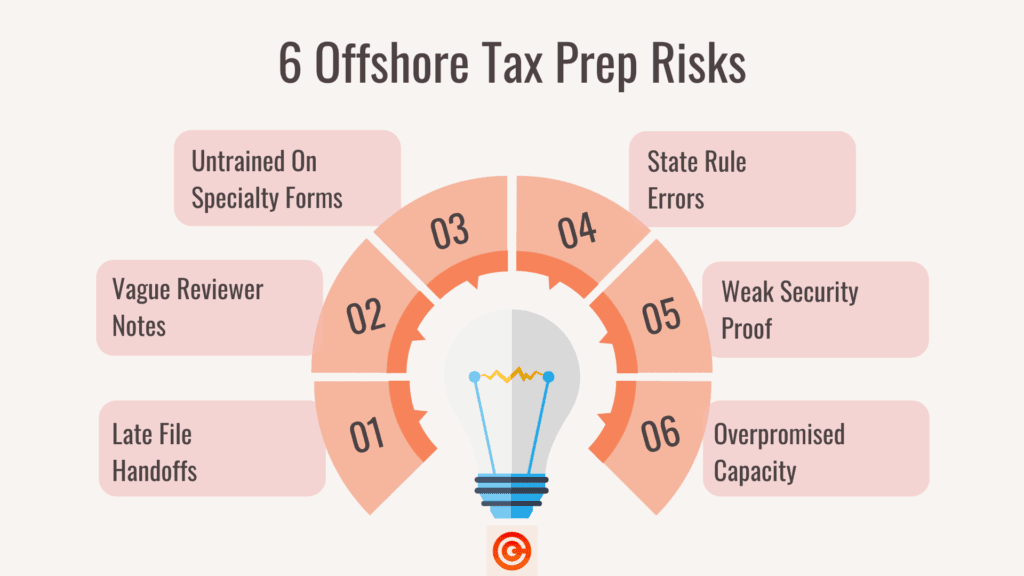
Use this list of risks to plug the exact gaps that derail offshore tax prep before they cost you clients.
- Late handoffs that stall the workflow: Returns hit bottlenecks when US teams upload files after 6 pm Pacific time. Set an internal cutoff for offshore handoffs at 3 pm so prep starts the same night without delay.
- Inconsistent reviewer notes: Vague feedback increases the need for rework. Use templated review formats by return type (e.g., 1040, 1120, FBAR) and track edit reasons to spot patterns per preparer.
- Untrained teams on specialized forms: Mistakes on 5471s or 3520s trigger audits. Only assign foreign disclosures to offshore staff with IRS training and 100+ verified filings per form type.
- Missteps on state-specific rules: Many offshore teams miss apportionment thresholds or local deadlines. Provide cheat sheets by ZIP code for multi-state clients and audit 1 in every 10 returns for compliance.
- Security promises with no proof: SOC 2 and ISO 27001 are not optional. Ask for dated audit certificates, verify security logs weekly, and block file access after local working hours.
- Overpromising on volume capacity: Some vendors say yes to everything but break during peak load. Cap weekly handoffs at 80% of stated capacity for the first 2 months and scale only after consistent delivery.
📣 Interesting Fact
BPO accounts for 35% of the global offshoring market.
3 Real-Life Offshore Tax Preparation Success Stories You Can Learn From
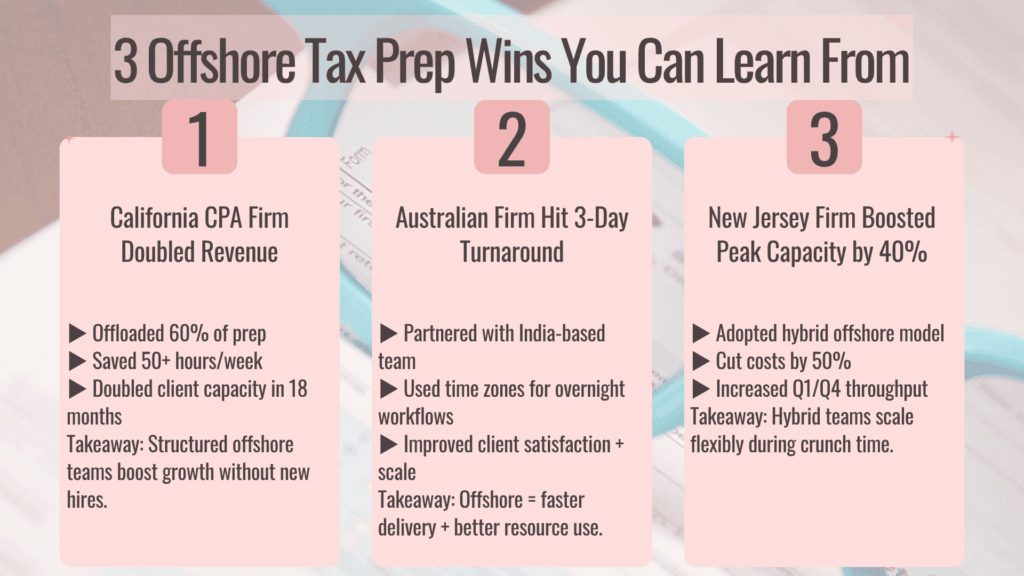
See these real-world examples to understand how strategic offshore tax preparation can address your specific challenges.
1. California CPA Firm Doubles Revenue by Offloading 60% of Prep Work
Company Background: Oakland Financial Partners, a 5-person CPA firm based in California, specializes in tax preparation and bookkeeping services.
Problem: The firm struggled with capacity constraints, consistently working overtime during tax season. Hiring local talent proved expensive and challenging, leading to the necessity of turning away new clients during peak periods. Rising salaries and overhead costs further squeezed profit margins, contributing to staff burnout.
Solution: They implemented offshore accounting services, initially hiring a single tax preparer. Over time, they expanded this to a team of 3 preparers managed by an offshore tax manager, which created a structured hierarchy.
Outcome: Within 18 months, the firm doubled its revenue. The offshore team handled 80% of routine filings, saving the onshore team over 50 hours weekly and doubling client capacity.
Key Takeaway: Establish a structured offshore team to significantly enhance capacity and revenue without increasing local headcount.
2. Australian Accounting Firm Achieves Consistent 3-Day Turnaround With Indian Offshore Team
Company Background: A mid-sized Australian accounting firm, which faced increasing client demands and a shortage of skilled local professionals.
Problem: The firm experienced delays in tax preparation due to limited local talent and escalating operational costs. These challenges hindered their ability to meet client expectations and expand their services.
Solution: They partnered with an offshore team in India, leveraging the time zone difference to enable overnight processing of tax returns. This collaboration allowed for a continuous workflow and efficient use of resources.
Outcome: The firm consistently achieved a 3-day turnaround for tax returns, enhancing client satisfaction and enabling the firm to take on more clients without compromising quality.
Key Takeaway: Leverage offshore teams in different time zones to significantly improve turnaround times and operational efficiency.
3. New Jersey CPA Firm Gains 40% Capacity During US Tax Season Using Hybrid Workflow
Company Background: A mid-sized CPA firm in New Jersey that offers comprehensive tax services to a diverse client base.
Problem: The firm faced seasonal overloads during Q1 and Q4, leading to staff burnout and the need to decline new client engagements. They also struggled with maintaining profitability due to high local staffing costs.
Solution: They adopted a hybrid staffing model, combining their onshore team with an offshore partner to handle tax preparation and bookkeeping tasks. This approach allowed them to scale their workforce according to seasonal demands.
Outcome: The firm achieved a 50% reduction in operational costs and a 30% faster turnaround time. During peak seasons, they increased their capacity by 40%, which allowed them to serve more clients effectively.
Key Takeaway: Implement a hybrid staffing model to enjoy the flexibility to scale operations and improve efficiency during peak periods.
Conclusion
Offshore tax preparation is about buying back time, protecting your team from burnout, and scaling your tax workflow without stacking more salaries. If you’ve made it this far, you now have the blueprint: from hiring and compliance to review systems and turnaround metrics.
And when you’re ready to build that offshore team? Do it with someone who already knows where the best ones are. Genius connects you with pre-vetted tax professionals across the Philippines and Latin America (LATAM) who exceed your expectations from week one.
Start with better talent, better systems, and better margins. Hire with Genius today.
FAQs
Which countries are most commonly used for offshore tax preparation?
Firms often choose the Philippines, India, and countries in Latin America (like Colombia or Mexico) due to lower labor costs, strong English fluency, and growing pools of IRS-trained talent.
Do offshore tax preparers need access to our full client database?
No. Most setups use role-based logins so offshore staff only see what they need to work on, like a single return, form type, or task. You can limit access further by setting time-based or IP-restricted permissions.
How quickly can an offshore tax prep team get started?
Setup usually takes 7–14 days. That includes tool access, dummy file tests, and a dry-run project. Some firms start with a trial task before they scale to full volume.
Is offshore tax prep only useful during tax season?
Not at all. While many firms use offshore teams to handle seasonal spikes, others run year-round support for bookkeeping, quarterly filings, payroll tax, and multi-state returns.