
Your finance team is drowning in month-end closes that take 2 weeks instead of 2 days, and your CFO is personally reconciling bank statements at 11 pm because there is nobody else left to do it. Everyone keeps suggesting offshoring finance as the fix, but the last thing you need is another vendor relationship that promises the world and delivers Excel sheets full of errors.
Here’s the thing: offshoring finance operations isn’t the disaster everyone warns about, but it’s also not the instant miracle cure that sales teams pitch. When done right, offshoring transforms your entire financial backbone without the drama. This guide cuts through the noise to show you exactly how to build an offshore finance team that actually works.
Offshoring Finance At A Glance: The 5 Most Important Takeaways
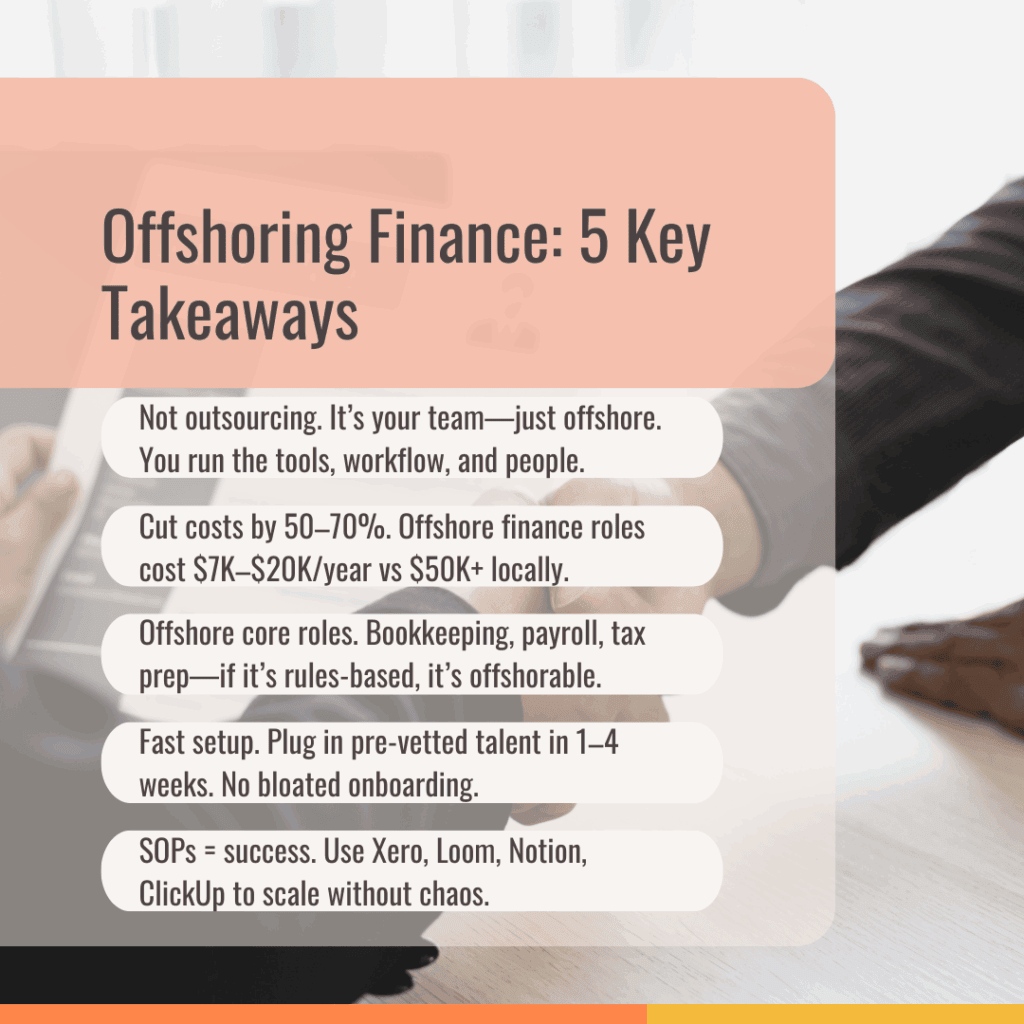
- It’s not outsourcing; it’s your team, just offshore. You still manage the people, tools, and workflow. The only thing that changes is the zip code (and the cost).
- You save 50–70% on finance payroll without losing control. Offshore roles cost $7,000–$20,000/year vs $50,000+ locally with the same tools, turnaround, and compliance standards.
- You can offshore core roles like bookkeeping, payroll, reporting, and tax prep. If it’s rules-based, recurring, and SOP-ready, it’s offshorable.
- The setup takes 1–4 weeks if you use pre-vetted talent. No bloated onboarding phases or drawn-out vendor contracts; just embedded hires who plug into your system fast.
- Success depends on documented workflows and async tools. No SOPs = chaos. Use tools like Xero, Loom, Notion, and ClickUp to build a finance engine that scales.
Check Out These Related Reads
🔥 14 Benefits Of Offshore Bookkeepers & How To Avoid Risks
📣 17 Best Offshore Accounting Services In 2025 (Full List)
🏅 10 Benefits Of Offshore Accounting vs Risks For Startups
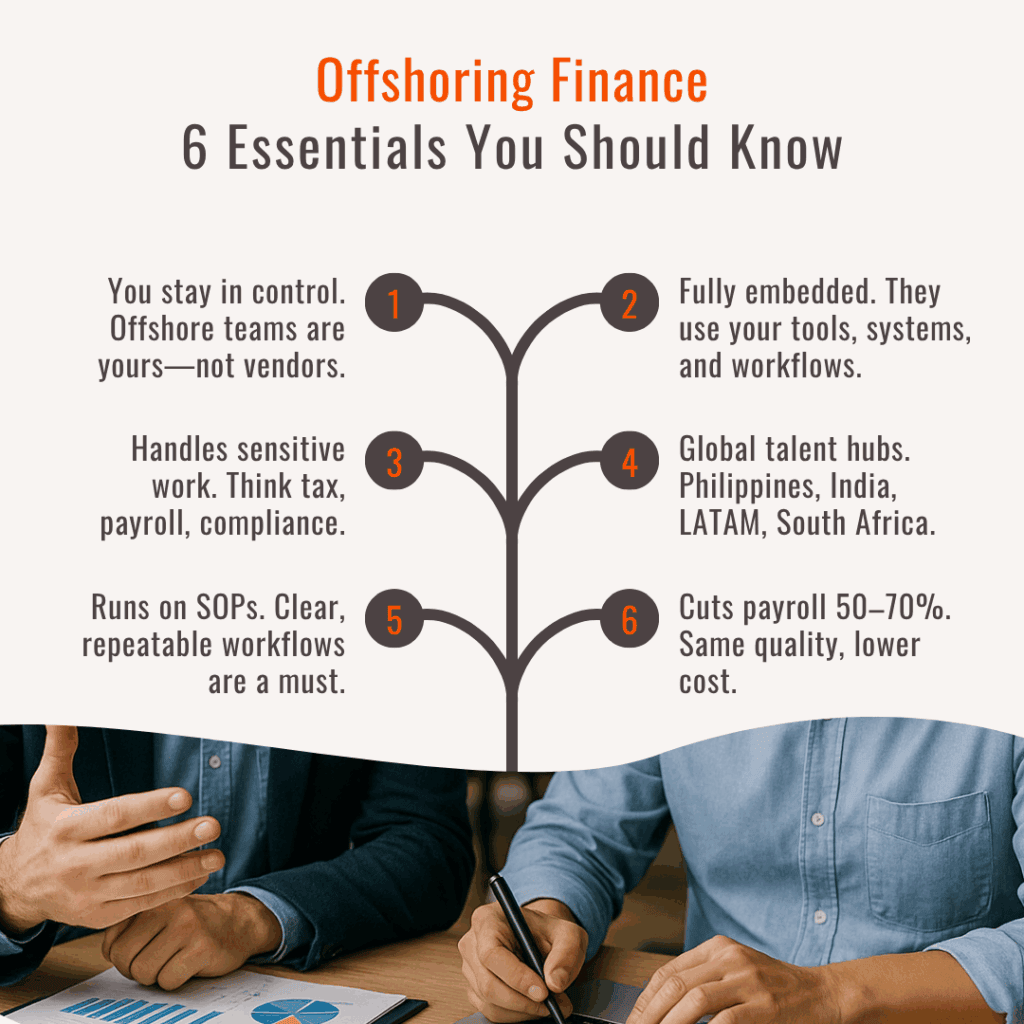
What Is Offshoring Finance? 6 Key Components You Must Know
Offshoring finance is moving core finance operations, like bookkeeping, payroll, compliance, or reporting, to a lower-cost country, while still keeping those tasks under your company’s control. It’s not outsourcing. It’s still your team, just based elsewhere, with better cost-efficiency, wider talent access, and faster turnaround.
It’s a strategic way to scale your finance team without piling on local overhead, long hiring cycles, or burnout. Think: same tasks, same quality standards, same tools, just done remotely by embedded team members who work while your local team resets.
Here are the 6 key components you must know:
- Ownership stays in-house: You manage the offshore team directly, not a vendor
- Embedded team structure: Offshore staff work within your systems, tools, and processes
- High-trust functions: Finance tasks offshored often include sensitive work, like tax, payroll, and compliance
- Geographic leverage: Common locations include the Philippines, India, South Africa, and Latin America
- SOP dependency: Offshoring only works when your finance process is clear, repeatable, and documented
- Cost delta: Offshoring cuts payroll costs by 50–70%, with no quality loss if done right
Offshoring Finance vs Outsourcing Finance vs Offshore Banking
| Offshoring Finance | Outsourcing Finance | Offshore Banking | |
|---|---|---|---|
| Definition | Building your own remote finance team in another country | Hiring a third-party firm to handle finance tasks | Managing funds in foreign bank accounts |
| Control Over Output | High – you direct the team, tools, and SOPs | Medium – vendor controls how work is done | Low – bank controls operations |
| Tasks Covered | Bookkeeping, payroll, FP\&A, reporting, tax prep | Same tasks, but done externally | Asset storage, currency diversification |
| Cost Savings (Average) | 50–70% vs onshore hires | 40–60%, but often less transparent | Varies – not labor-related |
| Team Integration | Feels like in-house staff | Feels like an external service | No team element |
| Compliance Risk | Moderate – mitigated with SOPs, secure tools | Moderate – depends on vendor quality | High – flagged for regulatory scrutiny |
| Setup Time | 1–4 weeks (faster with pre-vetted candidates) | 2–6 weeks (vendor onboarding phase) | Varies by jurisdiction |
| Best For | Startups, SMBs, and CFOs who want control + scale | Firms that need short-term or non-core finance help | High-net-worth asset protection |
| Example | Hiring 2 remote AP clerks in the Philippines via Genius | Partnering with a finance BPO in India | Opening an HSBC Expat account in Jersey |
How Offshoring Finance Works: 7 Steps For Flawless Execution

Walk through these steps to offshore the right way, without killing quality or control.
Step 1: Lock Down Your Finance Pain Points
Don’t start with roles. Start with bottlenecks. Find out what’s costing your team hours, not what looks nice on a team chart.
- Pull a 2-week audit of finance tasks across your team
- Flag any tasks that take over 10+ hours/week
- Tag recurring tasks like AP/AR, reconciliations, payroll
- Use a tool like Clockify or ClickUp time tracking to get real data
- Prioritize pain points that delay the monthly close or affect compliance
Step 2: Decide If You Need Full-Time, Part-Time, Or Project Help
Offshoring doesn’t mean full-time by default. Start lean, test fit, then scale what works.
- Use a “10-hour rule”: if a task takes 10+ hours weekly, it’s offshorable
- Hire part-time (10–20 hrs/week) for functions like reporting or FP&A
- Hire full-time for roles like payroll, AP, or compliance
- For tax prep, consider seasonal project-based hires (Feb–Apr)
- Use trial sprints (5–10 hours) to test skills before full onboarding
Step 3: Choose a Model: In-House Remote vs. Third-Party BPO
You can build your own offshore team or use a managed vendor. Both work if your needs are clear.
- Go in-house for tighter control and an embedded team culture
- Use BPOs for faster ramp-up and bundled compliance
- Consider hybrid: Embedded bookkeepers, outsourced audit support
- Evaluate your budget: In-house is cheaper long-term, BPO is easier short term
- Use a headhunter if you want embedded finance hires without building operations from scratch
Step 4: Select The Right Country For Finance Tasks
Not every region is built for every role. Pick your geography based on task type and turnaround needs.
- Philippines: Great for GAAP compliance, payroll, AP/AR
- India: Deep bench for FP&A, tax prep, financial modeling
- South Africa: Strong English support for payroll and invoicing
- Latin America: Same-day timezone support for US teams
- Use country scorecards to compare costs, skills, and coverage hours
Step 5: Set Up Your Asynchronous (Async) Tech Stack
Your tools decide how smoothly your offshore finance engine runs. No tools = chaos.
- Use QuickBooks, Xero, or NetSuite as your system of record
- Document SOPs in Notion, Google Docs, or Scribe
- Track tasks in ClickUp or Asana with set weekly cadences
- Use Loom for process walkthroughs instead of long calls
- Centralize communications in Slack or MS Teams with clear channels by function
Step 6: Build A Review System That Catches Errors Early
Offshoring fails when quality checks are missing. Add checkpoints, not micromanagement.
- Use a 2-level review for tax, reporting, and reconciliations
- Set weekly or monthly close reviews tied to specific KPIs
- Create templated checklists for each repeatable task
- Train your offshore team on US GAAP or IFRS standards
- Add audit trails with timestamps in tools like Xero or ApprovalMax
Step 7: Scale What Works & Trim What Doesn’t
After 60–90 days, review what’s working. Double down on what saves time or cost. Kill what creates friction.
- Use finance KPIs (e.g., days to close, error rates, processing speed)
- Expand headcount for roles that free up your onshore team the most
- Trim back functions where costs outweigh time saved
- Add multi-role pods (e.g., one payroll + one AR + one compliance hire)
- Consider moving to 24/7 operations with staggered time zone support
“Offshoring finance is about cutting friction, not cutting corners. The right hire saves more than just your money; they save your sanity.”
— Burkhard Berger, Founder & CEO of Genius
3 Real-World Offshoring Finance Examples To Learn From

Take a close look at these case studies to spot patterns and benchmark your expected impact.
1. US CPA Firm Cuts Payroll Costs by 60%
Background: Oakland Financial Partners is a small, 5-person CPA firm that serves 120+ SMB clients in California.
Problem: Their staff hit capacity during tax season; hiring locally cost ~$70,000/year per accountant and triggered burnout. Growth stalled while overhead climbed.
Solution: They hired 2 offshore accounting assistants in the Philippines under direct management.
The outcome:
- Payroll expense dropped by ~$50,000 per role (≈ 70% savings)
- Revenue grew 100% within 18 months
- Tax season burnout reduced by 75%
- Client request backlog reduced by 60%
Key Takeaway: Offshore with embedded team members to slash payroll by 60–70% and double your service capacity.
2. US SaaS Startup Slashes Finance Costs by 70%
Background: Early-stage US SaaS company with limited internal finance headcount.
Problem: Monthly bookkeeping, tax, and reporting tasks took days for overworked in-house staff. Local CPA roles cost $4,200/month. Revenue growth stalled due to time spent on admin.
Solution: Hired an offshore CPA trained in US GAAP and IRS tax codes at $1,250/month. The setup was completed in just 2 months.
The outcome:
- Saved $35,400 in annual labor costs
- Cut the monthly close by 2 days
- Improved financial visibility with cleaner reports
- Freed up senior staff to focus on growth
Key Takeaway: Replace one local CPA with an offshore CPA and recapture over 60% in hiring expense, while regaining high-value working hours.
3. Australian Accounting Startup Buils An Entire Firm Offshore From Day 1
Background: Australia-based accounting startup built entirely on Philippine finance staff, growing fast since 2016.
Problem: Traditional high overhead and talent shortages drove a lean startup model.
Solution: Established a Philippines-based finance team that integrates with Australian partners and follows offshore-first workflows.
The outcome:
- Ranked among Australia’s fastest-growing startups in 2016–17
- Won industry awards for innovation and workplace quality
- Maintained rapid scaling with low burnout and low overhead
Key Takeaway: Start with offshore-first finance operations and scale growth with lower cost and embedded global talent.
📢 Did You Know?
63% of financial firms now partner with nearshore outsourcing providers.
6 Benefits Of Offshoring Finance That Make It Worthwhile

Highlight your biggest pain spot as you dive into the benefits.
1. Offers Payroll Savings That Stun
Offshoring finance slashes labor costs by 50–70% compared to local hires. You keep full-time roles offshore at $10,000–15,000/year instead of $35,000–50,000/year onshore. That frees up 6-figure dollars to reinvest in growth, hiring, or software.
- Pay less than $15,000/year for qualified offshore roles
- Save $25,000–35,000 per role annually
- Reallocate savings to high-impact projects
2. Unlocks Fast Hiring In Global Talent Pools
Hiring locally takes 6–12 weeks. Offshore hiring reduces that to 2–4 weeks with vetted, finance-trained candidates. Many offshore experts bring their own licenses (Xero, Loom, Slack), so there’s no tool setup needed.
- Cut hiring time by 60–80%
- Onboard ready-to-go talent with licenses included
- Fill seasonal spikes without local headcount
3. Turns Your Finance Clock Into A 24/7 Engine
Thanks to timezone differences, offshore teams handle finance tasks overnight and hand them back ready for review. Your month-end close moves from days to hours, not weeks. Continuous cycle means faster decisions and no project clog.
- Workflow runs 24 hours, global clock work
- Close cycle shrinks by 30–50%
- Urgent tasks finish hours later, not days
4. Grants Access To Built-In Tech & SOP-Level Workflows
Usual pain: tool overload, SOP gaps, and chaos. Offshore experts arrive with software licenses and SOP discipline. They run your finance with documented processes like a plug-and-play module.
- No need to buy extra Google Docs, Loom, Slack, or bookkeeping platforms
- Solid SOPs ready from day one
- Errors drop with a structured workflow
5. Gives You A Steady Financial Coverage That Just Works
Local teams collapse during vacations, holidays, or illness. Offshore finance teams cover these gaps seamlessly, without the need for local pressure. That means uninterrupted workflows and reliable close cycles.
- Finance work continues during local downtime
- Offshore jump-in keeps processes steady
- The risk of deadline delays drops significantly
6. Provides Strategic Advantages You’ll Actually Feel
Offshoring frees your onshore team to focus on growth-related finance, like strategy, cash management, and advisory. You diversify risk with geography, boost insights from global talent, and gain flexibility to scale fast.
- Free up 10–20 hours/week for strategic planning
- Lower risk in hiring and labor law disputes
- Tap global finance insights and benchmarks
6 Risks Of Offshoring Finance & How To Avoid Them
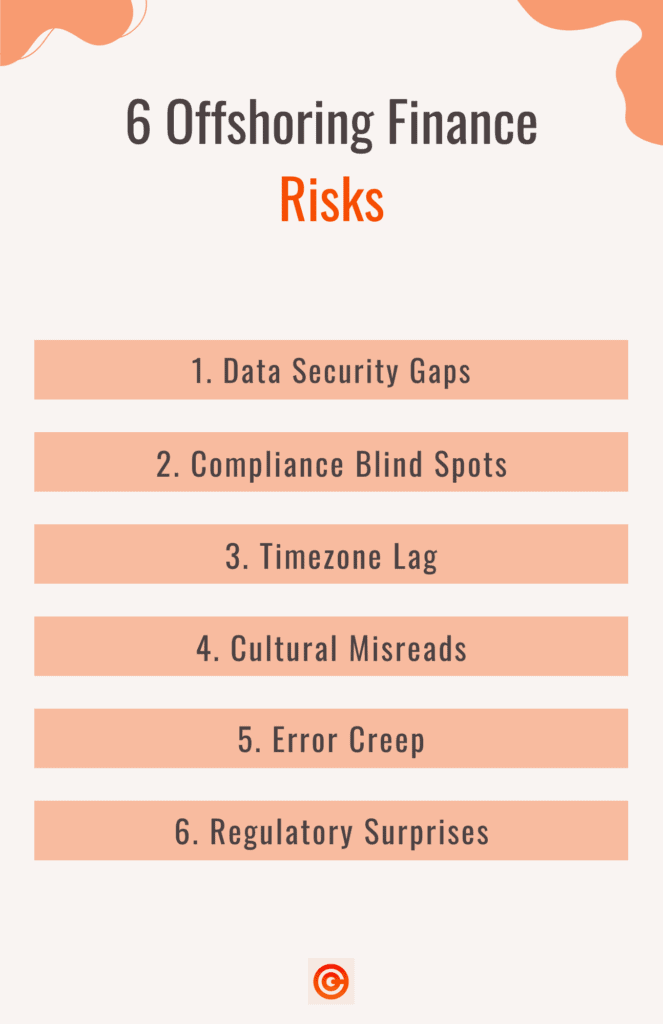
Let’s look at which risks apply to your setup and how exactly you can block them.
1. Your Data Is Only As Safe As Their Servers
Offshoring moves sensitive financial data to remote servers, which may use weaker security controls than you’re used to.
- Choose providers with SOC 2 or ISO 27001 certification
- Encrypt all data in motion and at rest
- Rotate access credentials every 90 days
2. Compliance Can Slip Through The Cracks
Different countries follow different rules around GAAP, GDPR, or SOX mandates. Non-compliance can cost you fines up to 4 % of your revenue.
- Train your offshore team on your core financial regulations, and audit quarterly
- Require proof of compliance for each team member on every cycle
3. Time Zones Create Hidden Lag
If your team operates 6 hours apart, finance delays can stretch 4–8 hours per task.
- Protect overlapping hours (e.g., 10 a.m.–2 p.m. your time)
- Use SOP-triggered handoffs to ensure work runs 24/7 without confusion
4. Misreads Happen When Cultures Clash
Language quirks or indirect communication often mean misinterpretation or lost context.
- Set onboarding goals for cross-cultural clarity
- Log all written feedback in shared documents
- Review progress weekly until clarity reaches 90%
5. Errors Snowball Without Review Layers
Without oversight, error rates can rise above 3% in month-end closes.
- Institute a 2-step review process
- Add KPIs like “15-minute reconciliation error resolution”
- Automate error flagging where available
6. Regulations Don’t Care Where You Work From
Want to work with providers based in non-OECD countries? You might face unexpected tax or data-export regulations.
- Ask for granular disclosure on jurisdictional rules
- Budget a 5 % contingency for regulatory costs
- Insert compliance clauses into vendor contracts
🔥 Interesting Fact
37% of small businesses outsource their accounting and IT services.
5 Finance Tasks You Can Offshore Without Losing Control

Use this table to find out which finance tasks you can offshore without losing control.
| Why It Works Offshore | What You Can Expect | Repeatable and software-driven (e.g., Xero, QuickBooks) | |
|---|---|---|---|
| Bookkeeping & AP/AR | Repeatable and software-driven (e.g. Xero, QuickBooks) | 50–70% lower hourly rates; 2–3 day task turnaround | Monthly review of statements |
| Payroll Processing | Highly regulated but rule-based — easy to SOP/document | Save 30–50% vs. local rates; timely, rule-compliant pay runs | Post-run validation checks |
| Tax Prep & Compliance | Offshore talent often CPA-qualified with GAAP/IFRS exposure | 30–40% cost reduction; seasonal or ongoing capacity | Quarterly audit checkpoints |
| Financial Reporting & Analysis | Offshore analysts handle P&L, cash flow, and forecasts using templates | Faster monthly close, better visibility for the exec team | Dashboard gatekeepers |
| FP&A & Budgeting | Data-heavy, model-based — perfect for remote analysts | Budget ready in 3 weeks; 10 hours/week saved internally | Template and review loop |
“Most founders need one offshore hire who actually understands finance and gets things done from day one.”
— Christian Cabaluna, Senior Recruiter at Genius
Where Offshoring Finance Happens: Top 6 Destination To Consider
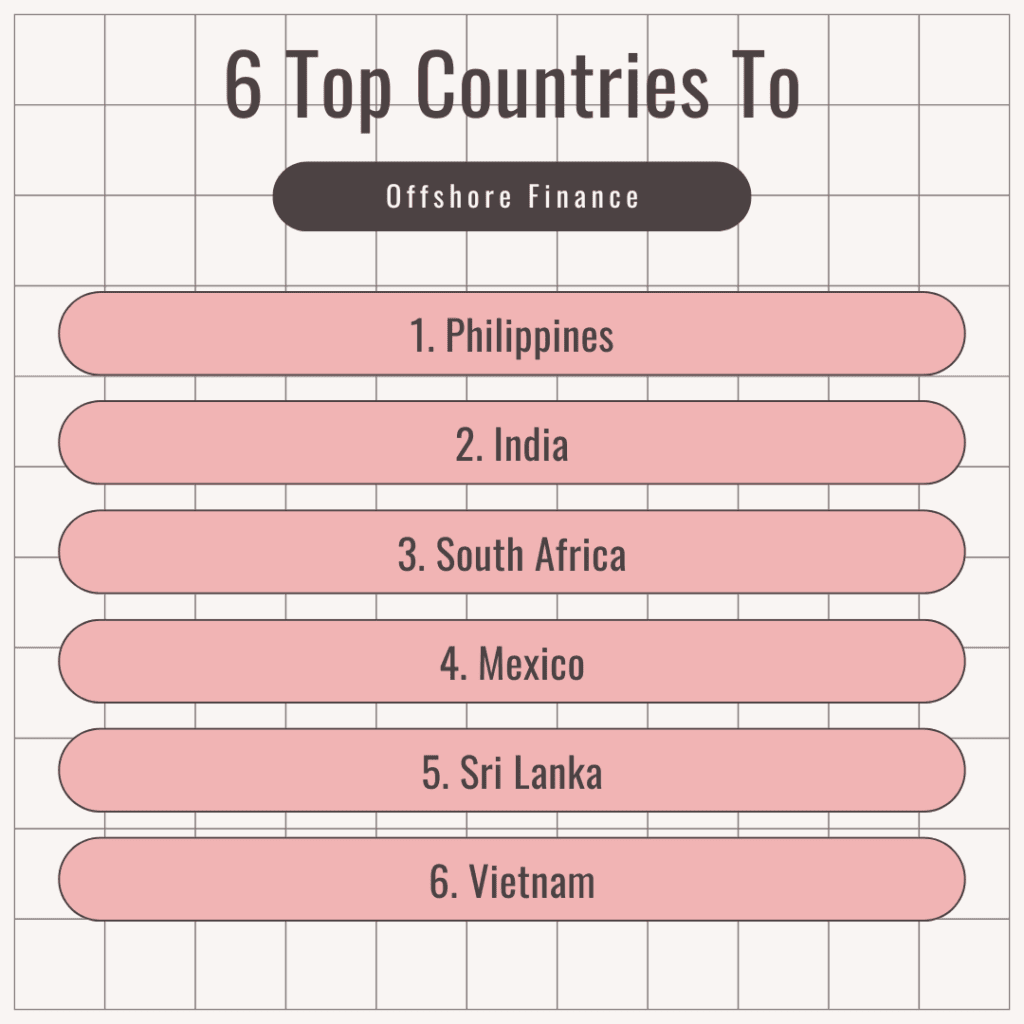
Use this table to shortlist which countries fit your offshoring finance setup.
| Average Salary (USD/year) | Strengths | Best For | Risk Profile | |
|---|---|---|---|---|
| Philippines | $9,000–$15,000 | US GAAP knowledge, QuickBooks/Xero tools | AP/AR, bookkeeping, payroll | Low (SOC2-ready firms) |
| India | $7,000–$14,000 | Deep FP\&A bench, tax prep scale | Payroll, reporting, and IFRS familiarity | Moderate (process-heavy) |
| South Africa | $10,000–$18,000 | Payroll, reporting, and reconciliations | Payroll, reporting, reconciliations | Low–Moderate |
| Mexico | $11,000–$20,000 | Real-time timezone, strong accounting base | Tax prep, bookkeeping, real-time close | Moderate (small pool) |
| Sri Lanka | $6,000–$12,000 | Emerging audit, finance tech skills | Reconciliations, ledger maintenance | Moderate–High |
| Vietnam | $7,000–$13,000 | Fast training curve, growing BPO presence | Data entry, AP/AR | Moderate |
8 Strategic Questions To Ask Before Offshoring Finance
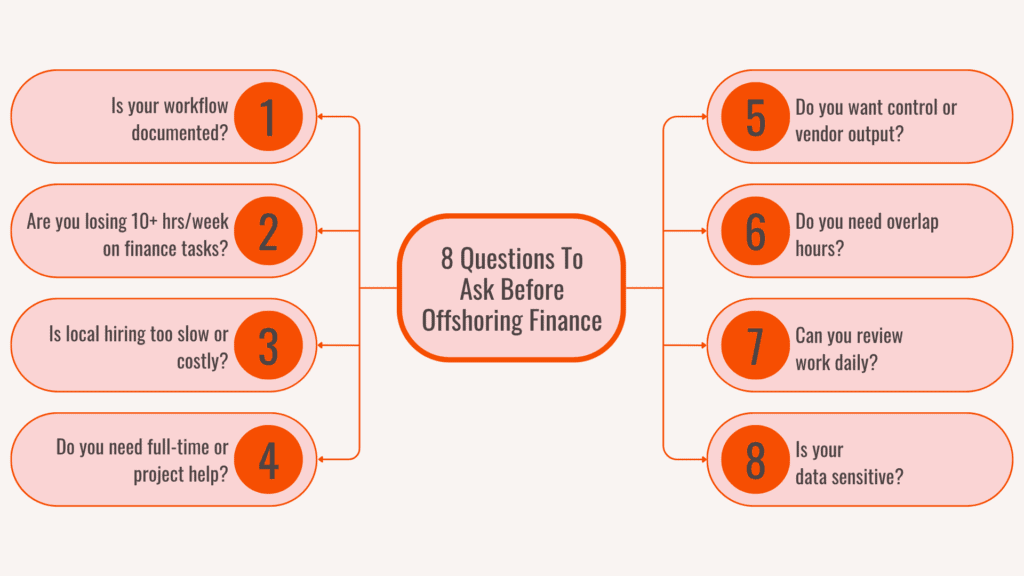
Use this list to pressure-test your setup before you offshore anything.
1. Is your finance workflow documented?
- If you don’t have SOPs or checklists for recurring tasks like AP/AR, reconciliations, or month-end close, offshore hires won’t have a map to follow.
2. Do you spend 10+ hours/week on recurring finance tasks?
- If your internal team loses 2+ hours/day to routine finance work, offshoring will free up time fast.
3. Is your local hiring pipeline stuck or too expensive?
- If it takes 30+ days to fill a finance role or costs more than $5,000 to hire, you’re ready to offshore.
4. Do you need full-time help or project-based support?
- If a task takes 10+ hours/week, go full-time. For seasonal work like tax prep, test with a scoped project sprint.
5. Do you want direct control or vendor-led output?
- If you want to manage tools, workflows, and quality yourself, skip BPOs and hire embedded offshore team members instead.
6. Do you need real-time support or async handoffs?
- If tasks require overlap hours with your onshore team (e.g., payroll approval), choose a location with 4–6 hours of timezone overlap.
7. Can you review work within 24 hours?
- If you don’t have time for daily reviews, build a QA checklist or assign review pods before scaling offshore.
8. Do your tasks involve sensitive financial data?
- If yes, check for SOC 2, ISO 27001, or GDPR compliance before hiring offshore talent or signing with a vendor.
6 Offshoring Finance Trends To Look Out For

Use this list to update your offshoring strategy for what’s next.
- AI now handles cleanup work: Use AI tools to auto-flag mismatched transactions, duplicate entries, and minor tax errors before they hit your team. Most offshore accountants now expect access to tools like Vic.ai, Dext, or Xero Analytics.
- Hiring moves to async-first teams: Global finance pods now work around the clock using shared tools and SOPs, not Zoom. Build your stack around async tools like Loom, ClickUp, and ApprovalMax before you expand your team.
- Nearshore hubs are rising fast: LATAM countries like Colombia and Mexico are replacing India for real-time timezone support. Pick nearshore for urgent approvals, payroll runs, or investor-ready reporting.
- Offshore firms now bundle licenses: Top offshore hires already bring tools like QuickBooks, Hubstaff, Slack, and even Notion access. Ask upfront, because this saves you $200–$500/month in extra seat costs.
- Compliance is under a global microscope: EU, US, and APAC regulations now penalize non-compliant data handling. Stick to vendors or hires with SOC 2, ISO 27001, or GDPR-ready setups. Require proof, not promises.
- Finance BPOs now offer fractional roles: Instead of hiring a full AP team, you can now book part-time finance talent (10–15 hours/week) on rolling contracts. This offshoring model works well for month-end close, reporting, or cleanup work.
💭 Food For Thought
67% of all offshoring arrangements now involve knowledge-intensive services.
6 Scenarios Where Offshoring Finance Helps + When To Avoid It

Use these lists to see if offshoring finance will solve your problem or just add another one.
Offshoring Works When
- You spend 10+ hours/week on finance admin
- Each local hire costs $50,000+ per year
- Hiring takes 30+ days
- Month-end close drags past Day 10
- Your team lacks tax or GAAP expertise
- You already use tools like Xero or ClickUp
Offshoring Fails When
- You don’t have documented SOPs
- Finance tasks take under 5 hours/week
- You need real-time collaboration daily
- Your industry has strict live compliance
- Your tools live in spreadsheets or email
- Your operations team is already overwhelmed
Conclusion
Offshoring finance is the fix when your local team is drowning, and your payroll budget is maxed out. You now have the blueprint: what it is, where it works, how to do it right, and what pitfalls to dodge. Whether you’re trying to fix month-end chaos, cut costs, or finally build a finance pod that scales, it’s all here. If anything still feels unclear, skim again with fresh eyes; your next move might already be mapped out.
If you’re serious about offshoring finance but don’t have weeks to vet 250+ candidates or rewrite your SOPs, skip the trial-and-error. Genius is a headhunting agency built to find offshore finance talent who work like they’ve always been part of your team. No churn, no timezone drama, no fluff. Just A+ hires who clear your backlog and free your focus.
Need the fastest path to a finance team that runs while you sleep? Hire with Genius today.
FAQs
How long does it take to set up offshore finance operations?
It takes 1–4 weeks to set up if you hire pre-vetted offshore talent. BPOs may take longer (around 2–6 weeks), due to vendor onboarding.
Can small businesses benefit from offshoring finance?
Yes. SMBs often offshore to save $25,000–$35,000 per role annually and reduce month-end close times without expanding local headcount.
Is it safe to offshore sensitive financial data?
Yes, if you hire talent or vendors with SOC 2, ISO 27001, or GDPR compliance. Always confirm their data handling protocols upfront.
What’s the average salary for offshore finance roles?
Offshore finance professionals typically cost $7,000–$20,000/year, depending on the country, seniority, and skill set.