
You finally got your offshoring playbook dialed in, and now the ground is shifting again. Costs are creeping up, your C-suite wants “resilience,” and you are stuck putting out fires before 9 am. The offshoring vs reshoring conversation isn’t hypothetical anymore—it is on your desk, and the stakes are real.
That is exactly why this guide exists. We break down offshoring vs reshoring through real operational trade-offs, not just headline labor rates like other “expert” guides out there. You will get side-by-side comparisons, industry-specific examples, and a practical decision-making framework to help you decide whether to reshore or keep working with offshoring companies.
Offshoring Vs Reshoring: Core Differences At A Glance
| Offshoring | Reshoring | |
| Cost Focus | Lower direct costs | Lower hidden costs |
| Talent Access | Larger global pool | Easier vetting & retention |
| Speed & Delivery | Longer lead times | Faster fulfillment |
| Risk Management | Shared with partners | Direct control |
| Compliance | Multi-country complexity | Simplified domestic compliance |
| Customer Perception | May face stigma | Boosts brand loyalty |
| Tax Benefits | Global tax strategies | Local incentives |
| Tech Vs Labor | Labor arbitrage | Automation investment |
| Sustainability | Higher emissions footprint | Lower carbon impact |
| Agility | Scales fast | Pivots fast |
| Control | Vendor-dependent | In-house ownership |
| Market Strategy | Faster foreign expansion | Deeper local presence |
| Collaboration | Async & timezone-spread | Real-time teamwork |
| Talent Pipeline | Supports foreign jobs | Strengthens domestic talent |
| Cultural Fit | Needs onboarding focus | Naturally embedded values |
Here Are Some More Helpful Reads
🔥 Offshoring Types: Clear Side-By-Side Comparison + Use Cases
📣 RPO Compliance: Ultimate Guide To Safe Hiring Practices
🚀 What Is RPO for Small Companies: Benefits + When To Use It
Offshoring Vs Reshoring: What They Mean & Why This Choice Matters Now

Offshoring means sending work overseas to cut costs or access talent. Reshoring means bringing that work back home to boost control, speed, or compliance. With rising global instability and pressure to strengthen supply chains, this decision now impacts more than your bottom line—it affects business continuity.
What Is Offshoring?
Offshoring is when a company moves specific operations to another country, usually to save on labor or production costs. It’s often used to scale quickly or access skilled talent not readily available at home.
Strategic Use Cases: IT development, customer support, back-office processing
Trending In Sectors Like: SaaS, eCommerce, fintech, manufacturing
Common Countries Used: Philippines, India, Vietnam, Mexico, Poland
What Is Reshoring?
Reshoring is when you move business operations back to the company’s home country. It’s often done to regain control, reduce risk, or qualify for local incentives and credits.
Strategic Use Cases: Product assembly, regulated manufacturing, high-touch services
Trending In Sectors Like: Healthcare, aerospace, defense, electric vehicles
Offshoring Vs Reshoring: 15 Key Differences That Actually Matter

Use this list to compare offshoring vs reshoring and choose based on your current needs.
1. Cost Savings Vs Total Cost Of Ownership
In Offshoring:
You spend less on salaries and infrastructure, especially in labor-heavy roles. But costs can spike from long lead times, shipping delays, quality issues, and rework.
In Reshoring:
Upfront costs run higher, especially labor and facilities. But you cut down on shipping, customs, compliance headaches, and rework. You also move faster, which saves money long-term.
What To Choose When:
| Offshoring | Reshoring |
| You need to cut direct labor and overhead costs fast | You want to reduce hidden costs (quality issues, rework, delays) |
| You’re scaling fast and labor-intensive | You need tax breaks, credits, or subsidies |
| Your market tolerates longer delivery windows | You’re optimizing for long-term unit economics |
2. Access To Global Vs Local Talent Pools
In Offshoring:
You tap into large global labor pools, especially for tech, customer experience, or back-office work. You fill seats faster and run 24/7.
In Reshoring:
You work with a smaller, often more expensive talent pool. But it’s easier to verify skills, retain top talent, and build cultural consistency across your teams.
What To Choose When:
| Offshoring | Reshoring |
| You need hard-to-find tech or design skills not available locally | You need niche regulatory expertise |
| You’re building 24/7 or multilingual support | You’re hiring for roles tied to local compliance |
| Your in-house team is at capacity and can’t scale | You want to grow an internal leadership pipeline |
3. Speed Vs Proximity: Lead Times & Delivery
In Offshoring:
Goods or services come with long lead times. Time zones and shipping lanes add friction. Expect 3–8 weeks for physical goods, or up to 24 hours for async service loops.
In Reshoring:
You cut lead times in half or more. Teams share business hours, delivery routes are short, and last-minute changes don’t derail schedules.
What To Choose When:
| Offshoring | Reshoring |
| Your product has long life cycles and flexible timelines | You need same-day or just-in-time delivery |
| Your processes are predictable and low-touch | You’re in a time-sensitive industry (e.g., healthcare, defense) |
| You’re working on back-office or async tasks | You want full visibility into production and distribution |
4. Managing Risk Vs Controlling Risk
In Offshoring:
You depend on international policies, customs, border logistics, and political stability. Supply chain disruptions take longer to resolve.
In Reshoring:
You control more of the workflow. It’s easier to enforce standards, audit performance, and react to change without middlemen.
What To Choose When:
| Offshoring | Reshoring |
| You’ve built multi-vendor redundancy into your offshore setup | You need to control for supply chain shocks or political instability |
| You have strong local partners who can manage on-ground risks | You operate in high-risk sectors (e.g., medical, aerospace) |
| You’re diversified across multiple regions | Your risk tolerance is low due to regulation or brand |
5. Local Compliance Vs Global Complexity
In Offshoring:
You deal with different labor laws, data privacy rules, and industry certifications. This adds legal and compliance overhead.
In Reshoring:
You simplify compliance with familiar local laws and better access to legal support. You avoid international missteps.
What To Choose When:
| Offshoring | Reshoring |
| You’ve validated offshore partners who comply with local laws | You operate in sectors with strict legal requirements |
| You operate in low-risk sectors without tight compliance needs | You need to keep data or production onshore by law |
| You’ve built internal controls for cross-border governance | You want direct control over audits and inspections |
6. Perceived Value Vs Proven Loyalty
In Offshoring:
Products and services may carry a stigma depending on the region. Some customers associate offshore with cost-cutting.
In Reshoring:
You get a marketing boost from “locally made” or “domestically delivered.” In some industries, this improves customer trust.
What To Choose When:
| Offshoring | Reshoring |
| Your brand positions globally | Your brand leans on “made local” credibility |
| Customers care more about affordability than origin | You market in regions with national sourcing preferences |
| You offer digital or intangible services | You’re rebuilding trust after past offshore issues |
7. Global Tax Strategy Vs Local Incentives
In Offshoring:
You can benefit from tax treaties, SEZs (Special Economic Zones), and offshore tax structures. But it comes with scrutiny and more accounting complexity.
In Reshoring:
You may qualify for R&D tax credits, reshoring incentives, or funding tied to domestic production. These often offset high labor costs.
What To Choose When:
| Offshoring | Reshoring |
| Your host country offers tax holidays, SEZs, or corporate incentives | You qualify for reshoring-specific incentives (e.g., CHIPS Act) |
| You’ve structured operations to benefit from tax treaties | You benefit from domestic R&D tax credits |
| Your repatriation strategy is well optimized | You want to simplify tax filings across jurisdictions |
“Offshoring works when scale is the priority. Reshoring wins when precision and speed matter more than headcount.”
—Burkhard Berger, Founder & CEO
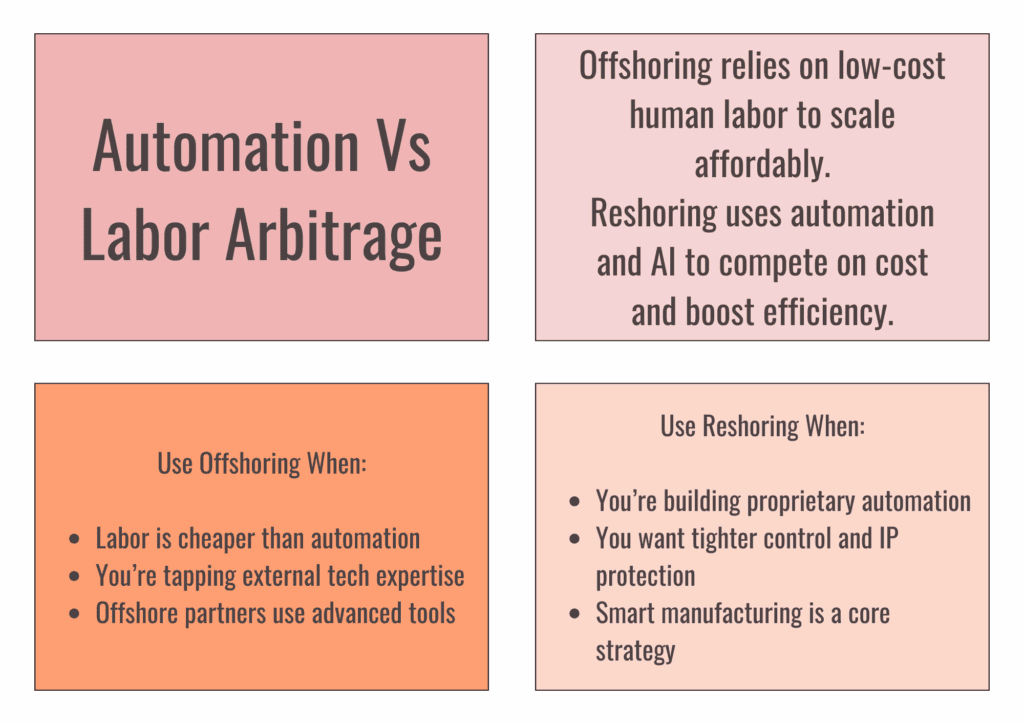
8. Automation Investment Vs Labor Arbitrage
In Offshoring:
You rely on low-cost human labor instead of automation. It works well when the cost gap is wide, but it makes scaling harder over time.
In Reshoring:
Automation helps you compete with offshore labor costs. Robotics, AI, and advanced tooling close the cost gap and boost efficiency.
What To Choose When:
| Offshoring | Reshoring |
| You need to access external expertise in automation or AI | You’re integrating automation in-house for control |
| Your offshore partner already uses advanced tech stacks | You want to create proprietary systems for IP protection |
| You’re digitizing operations and need fast pilots | You’re investing in smart manufacturing |
9. Low-Cost Production Vs Green Impact
In Offshoring:
Longer shipping routes and energy use increase emissions. Environmental reporting can be tricky depending on local laws.
In Reshoring:
You shrink your carbon footprint. It’s easier to audit vendors, enforce standards, and meet sustainability goals.
What To Choose When:
| Offshoring | Reshoring |
| You’ve offset emissions through verified green supply partners | You need to reduce carbon footprint visibly and fast |
| You use shipping routes with optimized fuel efficiency | You serve eco-conscious customers who ask for traceability |
| You outsource to countries with eco-certifications | You want to reduce packaging, shipping, and transit waste |
10. Scaling Fast Vs Pivoting Fast
In Offshoring:
You scale up fast when you need hundreds of roles or factories overnight. But pivoting is hard due to distance and vendor layers.
In Reshoring:
You move slower at first, but pivot fast. Closer teams mean quicker adjustments, faster testing, and tighter feedback loops.
What To Choose When:
| Offshoring | Reshoring |
| You need scalable operations without upfront investments | You need to respond to market shifts immediately |
| You need 24/7 availability across global markets | You want to experiment quickly with product variations |
| You operate in a modular service delivery model | You’re dealing with frequent demand fluctuations |
11. Vendor Dependency Vs Internal Control
In Offshoring:
You lean on third-party vendors. This helps when you don’t want to build everything in-house, but limits hands-on control.
In Reshoring:
You control processes, people, and performance directly. It’s more work, but gives you better oversight and accountability.
What To Choose When:
| Offshoring | Reshoring |
| You have mature vendor governance systems | You want full visibility from raw material to delivery |
| Your offshore vendors provide transparent dashboards | You’re managing sensitive goods that require tracking |
| You have contracts that enforce accountability | You’re running lean inventory strategies |
12. International Markets Vs Domestic Depth
In Offshoring:
You plant your flag in international markets. Proximity helps you grow faster in regions like Asia, LATAM, or Eastern Europe.
In Reshoring:
You double down on home market depth. It’s easier to learn what works, move fast, and build local market share.
What To Choose When:
| Offshoring | Reshoring |
| You want to enter new foreign markets fast | You’re focused on strengthening local market share |
| You need a local presence for regional sales or service | You’re prioritizing brand equity in your home country |
| You’re following customers into growth markets | You want to localize faster than global competitors |
13. Async Collaboration Vs Real-Time Operations
In Offshoring:
Teams work across time zones. You need airtight processes, clear documentation, and async tools like Loom and Jira.
In Reshoring:
You move in real-time. Daily standups, fast problem-solving, and live collaboration help teams move faster.
What To Choose When:
| Offshoring | Reshoring |
| You’ve built structured async workflows and clear escalation paths | You want real-time collaboration and quick decision cycles |
| You have experienced offshore leads who manage locally | You’re building leadership bench strength internally |
| You’ve trained global teams on cross-cultural management | You face communication delays or misalignment offshore |
14. Overseas Impact Vs Domestic Talent Pipelines
In Offshoring:
You boost employment abroad. But it may raise concerns about local job creation and long-term domestic talent development.
In Reshoring:
You invest in local talent. This builds goodwill, partnerships with schools, and stronger national recruitment ecosystems.
What To Choose When:
| Offshoring | Reshoring |
| You’re in a saturated job market with high wage competition | You want to create local employment and community impact |
| You can’t fill roles fast enough in your region | You qualify for workforce training grants |
| You need multilingual or niche skill sets | You’re solving retention or turnover issues abroad |
15. Company Fit Vs Company Values
In Offshoring:
You find great skill sets, but company values may not always translate. You need robust onboarding and culture-sharing practices.
In Reshoring:
Shared language, context, and cultural norms make it easier to reinforce company values across every role.
What To Choose When:
| Offshoring | Reshoring |
| You’ve vetted offshore partners for values and culture fit | You want stronger cultural alignment across all teams |
| You’re hiring globally but still screen for mission fit | You run purpose-driven hiring and internal mobility |
| You use localized benefits that reflect team values | You tie values to employer branding in your region |
💭 Food For Thought
Offshoring can slash costs by up to 40% compared to traditional outsourcing.
Reshoring Vs Offshoring: Pros & Cons Comparison

Use these pros and cons of offshoring vs reshoring to make a well-informed decision.
Advantages Of Reshoring
- Enhanced Quality Control: Establish in-house quality assurance teams to monitor and maintain production standards closely.
- Reduced Lead Times: Implement just-in-time manufacturing to respond swiftly to market demands.
- Stronger Intellectual Property Protection: Utilize domestic legal frameworks to safeguard proprietary technologies and processes.
- Access To Skilled Labor: Partner with local educational institutions to develop training programs tailored to your industry needs.
- Positive Brand Perception: Leverage “Made in [Home Country]” branding to appeal to local consumer preferences.
Pros Of Offshoring
- Cost Savings: Negotiate favorable terms with suppliers and take advantage of lower labor costs abroad.
- Access To Global Talent Pools: Establish partnerships with international recruitment agencies to tap into specialized skill sets.
- 24/7 Operations: Utilize time zone differences to maintain continuous production cycles.
- Scalability: Leverage larger labor markets to scale operations quickly in response to demand.
- Market Expansion: Position manufacturing facilities closer to emerging markets to reduce shipping times and costs.
Disadvantages Of Reshoring
- Higher Labor Costs: Invest in automation technologies to offset increased wage expenses.
- Infrastructure Limitations: Collaborate with local governments to improve or develop necessary infrastructure.
- Limited Economies Of Scale: Focus on niche markets where customization and quality are valued over mass production.
- Regulatory Compliance Costs: Stay informed about local regulations and engage compliance experts to navigate legal requirements efficiently.
- Initial Capital Investment: Seek government incentives or subsidies that encourage domestic manufacturing.
Cons Of Offshoring
- Communication Barriers: Implement cross-cultural training programs to enhance communication between teams.
- Quality Control Challenges: Conduct regular audits and establish clear quality standards with offshore partners.
- Intellectual Property Risks: Use international legal agreements and patents to protect proprietary information.
- Political & Economic Instability: Diversify supply chains to mitigate risks associated with geopolitical uncertainties.
- Longer Lead Times: Develop robust logistics strategies to manage and reduce shipping delays.
Offshoring Vs Reshoring: Real-World HR Cost Differences Beyond Wages
Use this table to see where your true HR overhead hides in offshoring vs reshoring.
| HR Cost Factor | Offshoring | Reshoring |
| Onboarding | Lower initial onboarding costs, but longer ramp-up due to timezone and documentation gaps | Higher upfront onboarding cost, but faster ramp-up due to proximity and shared language/context |
| Training & Upskilling | Recurring need for upskilling due to fast-changing tech stacks; often requires third-party L&D vendors | Typically, 2–3 months to productivity due to async workflows and remote onboarding friction |
| Attrition Rates | Attrition often >25% in BPO-heavy markets; constant churn raises backfill costs | Attrition is typically 8–15%, depending on industry; more predictable and easier to diagnose |
| Time To Productivity | Lower without strong local employer branding; offshore teams may feel disconnected from the HQ vision | 1–1.5 months on average due to faster team syncs and co-located onboarding support |
| Managerial Bandwidth | High; offshore leads often manage more people across multiple shifts, which adds coordination drag | Lower; direct manager oversight and fewer timezone gaps reduce load and task-switching |
| Recruitment Cost Per Hire | $1,000–$2,500 depending on role complexity and market demand in countries like India or the Philippines | $3,500–$5,000 due to tighter labor markets and longer hiring cycles in domestic locations |
| Cultural Integration Programs | Mandatory for most roles to minimize misalignment and friction; budget for 2–3 cultural workshops/year | Often optional; shared culture and norms reduce the need unless roles vary by region |
| Employee Engagement | Higher due to greater engagement with the brand mission and frequent in-person team interactions | Higher, due to local labor law variations, benefit structures, and cross-border contracting |
| Legal/Compliance Overhead | Higher, due to local labor law variations, benefits structures, and cross-border contracting | Lower; legal frameworks and compliance protocols are standardized and well-supported |
| Turnover Risk Mitigation | Requires incentive-heavy retention strategies, especially for mid-level roles in competitive markets | Can integrate long-term career paths, internal mobility, and performance-based incentives |
Offshoring vs Reshoring: When Each Strategy Makes Sense

Use this to make a confident, data-backed call between offshoring and reshoring.
When To Choose Offshoring
- If you need to reduce operating costs by 30–50%, then move labor-intensive work to BPO hubs like the Philippines, India, or Mexico.
- If your team can’t keep up with volume or timezone coverage, then expand your headcount with 24/7 support from overseas teams.
- If you’re hiring for roles with high turnover (e.g., customer support), then tap into larger labor pools with faster backfill cycles.
- If you want global market access within 6–12 months, then open an offshore delivery center closer to key international customers.
- If you’re running on tight burn rates, then offshore support or non-core functions to extend your runway without shrinking your roadmap.
- If you need 200+ roles in under 3 months, then offshore for the immediate labor scalability that reshoring can’t match.
- If your business model depends on multilingual service, then offshore to regions like Eastern Europe or LATAM to unlock native fluency at scale.
When To Choose Reshoring
- If your industry requires 100% traceability or audit control, then reshore to ensure compliance across highly regulated workflows.
- If lead time costs are eating into margins, then reshore to cut fulfillment windows in half and boost speed-to-delivery.
- If you’re seeing more chargebacks or warranty claims, then reshore to improve product QA loops and enable in-person resolution faster.
- If brand trust or “Made in [country]” claims drive conversions, then reshore for a marketing lift with consumers who buy local.
- If you’re hiring for complex, cross-functional roles, then reshore to make collaboration smoother across product, operations, and design teams.
- If your IP risks exposure abroad, then bring innovation teams back onshore where legal protections and security layers run deeper.
- If state-level tax incentives cover 15–25% of costs, then reshoring becomes a net financial gain, especially in sectors like clean energy or semiconductors.
“Choosing between offshoring and reshoring is about how fast you need to move and what kind of control you can actually manage day-to-day.”
—Christian Cabaluna, Senior Recruiter
Offshoring Or Reshoring? 7 Steps To Make The Right Choice For Your Business

Use this structured approach to assess critical factors that influence your business operations.
Step 1: Set Clear Operational Priorities
Identify the primary objectives that drive your decision, whether it’s cost reduction, quality improvement, speed to market, or risk mitigation.
- List and rank your top three operational goals.
- Determine the acceptable trade-offs for each goal.
- Use a decision matrix to align goals with potential outcomes.
Step 2: Calculate The Total Cost Of Ownership (TCO)
Assess all costs associated with offshoring and reshoring, beyond just labor expenses.
- Include logistics, tariffs, taxes, and compliance costs in your analysis.
- Factor in costs related to quality control and potential rework.
- Use TCO calculators or financial modeling tools for accurate estimates.
Step 3: Analyze Regulatory & Tax Implications
Understand the legal and fiscal environments of potential locations.
- Research local labor laws, environmental regulations, and industry standards.
- Identify available tax incentives or subsidies for domestic operations.
- Consult with legal and tax professionals to navigate complex regulations.
Step 4: Assess Supply Chain & Geopolitical Risks
Evaluate the stability and reliability of supply chains in different regions.
- Map out your current supply chain and identify potential vulnerabilities.
- Monitor geopolitical developments that could impact operations.
- Develop contingency plans for disruptions in supply or logistics.
Step 5: Conduct A Pilot Program
Test the feasibility of offshoring or reshoring through a controlled pilot.
- Select a non-critical product line or service for the pilot.
- Set clear metrics for success, like cost savings or lead time reduction.
- Monitor performance closely and gather feedback for analysis.
Step 6: Develop A Decision Framework
Create a structured approach to guide your final decision.
- Use weighted scoring models to compare options based on predefined criteria.
- Involve cross-functional teams to provide diverse perspectives.
- Document assumptions and rationale for transparency and future reference.
Step 7: Plan For Long-Term Adaptability
Make sure your chosen strategy remains viable amid changing conditions.
- Regularly review and update your strategy based on market trends and internal performance.
- Invest in technologies that enhance flexibility, like automation or digital platforms.
- Establish key performance indicators (KPIs) to monitor ongoing effectiveness.
📣 Interesting Fact
80% of top global leaders rely on offshore teams for daily operations.
The Hybrid Model: Combining Offshoring & Reshoring For Resilience

The hybrid model integrates offshoring and reshoring to balance cost savings with operational control. For example, a company might offshore customer service to benefit from lower labor costs and reshore research and development to maintain innovation quality and protect intellectual property. This approach helps you leverage global efficiencies without compromising on critical functions.
Industries That Use Both:
- Technology: Firms often offshore software development to access specialized skills and reduce costs, while keeping product design and R&D in-house to maintain quality and innovation.
- Manufacturing: Companies may produce components offshore but assemble final products domestically to meet quality standards and respond quickly to market demands.
- Automotive: Manufacturers might source parts from international suppliers while they conduct final assembly near key markets to reduce shipping times and costs.
Implementation Best Practices
- Assess Core Competencies: Identify which operations are critical to your value proposition and consider keeping them in-house or reshoring.
- Evaluate Cost-Benefit: Analyze the total cost of ownership, including hidden costs like quality control and logistics, when you decide which functions to offshore.
- Leverage Technology: Use digital tools to manage and coordinate between offshore and onshore teams and ensure seamless communication and workflow.
- Monitor & Adapt: Regularly review the performance of both offshore and onshore operations, and prepare to adjust strategies in response to changing market conditions or operational challenges.
Offshoring Vs Reshoring: 3 Real-World Examples To Help You Decide

Use these real-life reshoring and offshoring examples to see how each strategy has played out for companies similar to yours.
1. Bath & Body Works: Streamlining Production For Faster Delivery
Background: Bath & Body Works faced long lead times, with products traveling over 13,000 miles from multiple countries, which increased delays and inefficiencies.
Solution: They consolidated production into a single “beauty park” in Ohio and brought all manufacturing steps under 1 roof.
Outcome: This move reduced the time to get products to distribution from 3 months to just 21 days.
Takeaway: If your supply chain is stretched thin and causing delays, consolidate operations domestically to enhance efficiency and responsiveness.
2. Google: Expanding Development Capabilities
Background: Despite having a vast team of developers, Google sought to enhance its cloud services.
Solution: They acquired CloudSimple and established a software development team in Eastern Europe.
Outcome: This move significantly reduced business expenses and bolstered their VMware migration solutions.
Takeaway: Offshoring can be a strategic move to access specialized skills and reduce costs, even for companies with extensive in-house capabilities.
Automation Missteps: The Importance Of Skilled Planning
Background: A company attempted to reshore operations by investing heavily in automation without adequate planning.
Solution: They implemented advanced machinery but lacked a team with efficient production planning capabilities.
Outcome: The initiative failed and transformed a potentially profitable move into a loss-making enterprise.
Takeaway: Before you invest in automation as part of reshoring, make sure you have skilled personnel to manage production planning and operations effectively.
📢 Did You Know?
66% of US companies with 50+ employees outsource services.
10 Key Questions To Ask Yourself Before You Choose Between Offshoring & Reshoring
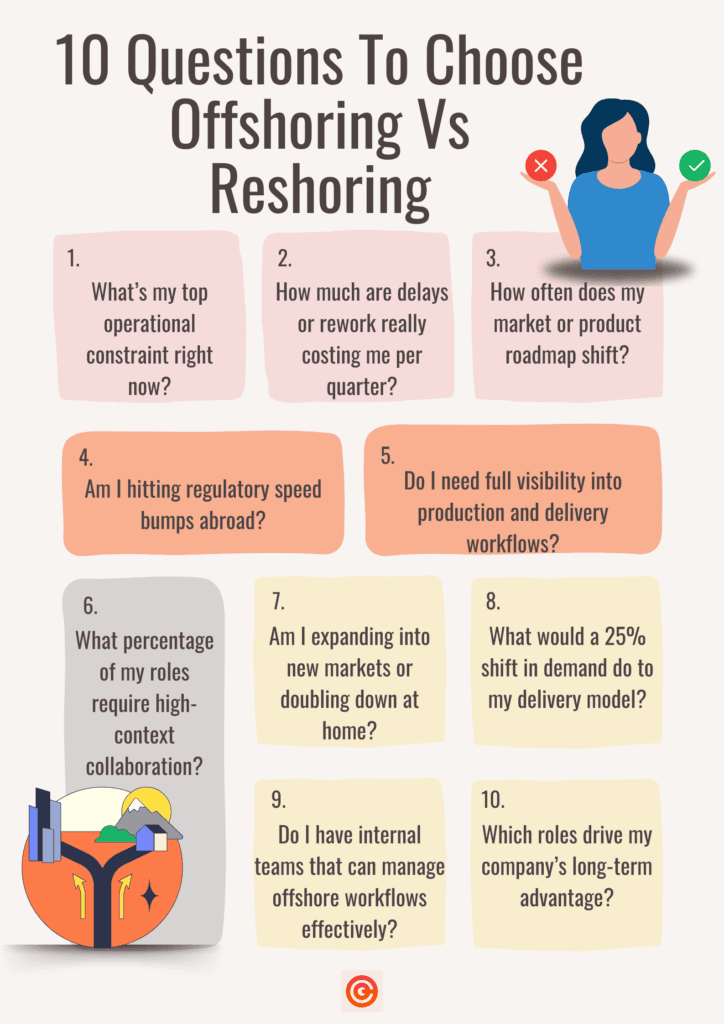
1. What’s my top operational constraint right now—cost, control, or capacity?
- If cost is killing growth, offshoring may unlock headcount. If speed or quality is the issue, reshoring might give you the control you need.
2. How much are delays or rework really costing me per quarter?
- If indirect costs like shipping delays or quality issues keep piling up, reshoring can recoup those losses by cutting lead times and errors.
3. How often does my market or product roadmap shift?
- If your business pivots often, reshoring gives you more flexibility and tighter feedback loops for faster iteration.
4. Am I hitting regulatory speed bumps abroad?
- If compliance keeps slowing you down or adding hidden costs, reshoring could simplify oversight and reduce legal risk.
5. Do I need full visibility into production and delivery workflows?
- If vendor handoffs or timezone gaps keep causing fires, reshoring may help centralize accountability and tighten operations.
6. What percentage of my roles require high-context collaboration?
- If most of your work relies on real-time teamwork, reshoring helps teams move faster across fewer communication layers.
7. Am I expanding into new markets or doubling down at home?
- If you’re chasing growth in new regions, offshoring helps establish a presence. If home market share is the goal, reshoring helps go deeper.
8. What would a 25% shift in demand do to my delivery model?
- If demand fluctuates often, reshoring gives you the ability to pivot faster. If demand is stable and high-volume, offshoring can scale cheaper.
9. Do I have internal teams that can manage offshore workflows effectively?
- If not, reshoring removes coordination drag. If yes, offshoring opens up access to talent and savings with lower risk.
10. Which roles drive my company’s long-term advantage?
- If innovation or service quality drives your edge, keep those functions close. Offshore the rest.
Conclusion
The offshoring vs reshoring decision isn’t black and white—it’s a business lever. You’ve seen how real companies run both models, why some work and others backfire, and what trade-offs actually move the needle. Whether you’re chasing scale, speed, savings, or resilience, every insight here helps you choose with a sharper lens.
But here’s the truth no one likes to say out loud: none of this matters if you don’t have the right people. That’s where most companies trip. They choose the right model but miss the talent that makes it work. At Genius, we help you skip the sourcing headaches and go straight to vetted A+ performers. No noise. No “hope it works.” Just skilled professionals who raise your bar, not your blood pressure.
Stop overthinking the hire and start thinking about what gets done. Start hiring with Genius today.
FAQs
How does offshoring affect product lifecycle management?
Offshoring can extend product lifecycle timelines due to longer development and feedback loops. Reshoring gives more room to iterate quickly if your product roadmap shifts often.
Can reshoring help with intellectual property protection?
Yes. When innovation and IP are at stake, reshoring places your critical assets under domestic legal frameworks, reducing exposure to IP theft or misuse abroad.
What infrastructure changes should I consider before reshoring?
Reshoring often needs upgrades in automation, warehousing, and logistics. Review your domestic facilities’ readiness before bringing operations back.
How do currency fluctuations impact offshoring vs reshoring?
Offshoring adds FX risk, especially for long-term vendor contracts. Reshoring reduces exposure to currency swings but may lock you into higher baseline costs.