Creator platforms build tools for creators, and the people who shape those tools are product managers. When some of them leave for brands that run their own creator programmes, it is tempting to blame pay or the pull of a bigger name. The evidence is thinner than the story. We found no study showing that product managers leave creator platforms for in-house creator teams, so this guide does not claim to explain a proven pattern.
It does two things instead. It sets out what research and surveys say about why product managers leave in general, and it looks at the growth of in-house creator teams as a possible pull. It then shows where creator-side product work gets its value, what platforms can do to keep their product managers, how to measure the result and a table of warning signs. We read “in-house creator teams” as brand-side teams that run creator programmes. The link between the two sets of evidence is our reasoning, and we label it as such. It is general information, and results will differ by company and team.
What the Evidence Says About Why Product Managers Leave
Work Institute’s 2026 Retention Report, built mainly on exit interview data from 2025, ranks career as the top reason employees leave, at 19.2%, with management at 9.2%. It classes 74.69% of all reasons as preventable, although that label is Work Institute’s own. The findings cover all jobs, not product roles, and exit interviews miss the people who stayed.
Two surveys look at product roles directly. Ginny Nelson of Pragmatic Institute asked 76 product people why they quit. The leading answers were poor company culture (20%), lack of room for advancement or growth (17%) and changes after a merger or acquisition (17%). The sample is small, mostly in healthcare technology and drawn from the author’s network. A Product School poll by Jovana Zoric gathered over 750 votes from six Facebook groups, with several answers allowed. Bad management and leadership drew 431 votes, lack of challenge and growth 129 and lack of role clarity 55. It is a convenience sample, and votes are not people. Both publishers sell product training.
None of this is specific to creator platforms, but the themes repeat: growth, management and clarity about the job. Those are the factors a platform can influence, and they are where the rest of this guide focuses.

Why In-House Creator Teams Are Growing
Brands are building their own creator capability. Linqia’s 2025 State of Influencer Marketing survey of over 200 US enterprise marketers found that 42% had dedicated influencer teams, up from 24% in 2023, and that only 9% used PR, media or creative agencies for execution, down from 20%. Linqia sells influencer services and the news summary we read gives no methodology, so treat it as an indication.
ValueYourNetwork, a French influencer agency, argues in a September 2026 article that many brands now run a hybrid model. It describes a first in-house hire as one manager who covers strategy, creators, budgets, contracts and measurement. It also quotes a CreatorIQ figure that 72% of brands run influencer work in-house, but gives no sample or method, and it says no reliable public threshold shows when an in-house team pays off.
The same article says the first step is a single accountable owner and an operating framework covering approvals, contract clauses, disclosure rules and reporting. That detail matters here. Brand-side creator roles are often defined around clear ownership, which is the thing a product manager on a platform may find harder to point to.
What this shows is that brand-side creator roles are multiplying and that they own strategy, contracts and measurement. It does not show that product managers move into them. If some do, a plausible pull is ownership of outcomes close to revenue, but that is our inference. For market context, see the creator economy statistics. Our guide to partnership managers who close creator deals covers one of the roles these teams hire.
Where Creator-Side Product Work Gets Its Value
Creator-side product work is often narrow and specific. OpeninApp, which presents itself as a link shortener and app opener for creators, is one example. Its homepage lists support for YouTube, Instagram, Telegram, LinkedIn and “100+ more platforms”, and its site description on the FAQ page reads “Open links where they are supposed to be opened”. The homepage claims “over 4 Million creators”, but another page says 3 million and neither is sourced, so we do not rely on either. The site says nothing about product teams, so what follows is our reasoning, not its claim.
A tool like this earns its value in a small place: a link that opens where the creator’s audience actually is. A product manager can see that value only if the team ties each feature to something a creator can observe. When that tie is weak, the work can feel like a utility layer. A role that owns a creator programme’s strategy and measurement can then look closer to results. That is one plausible reading, and no source we found tests it.
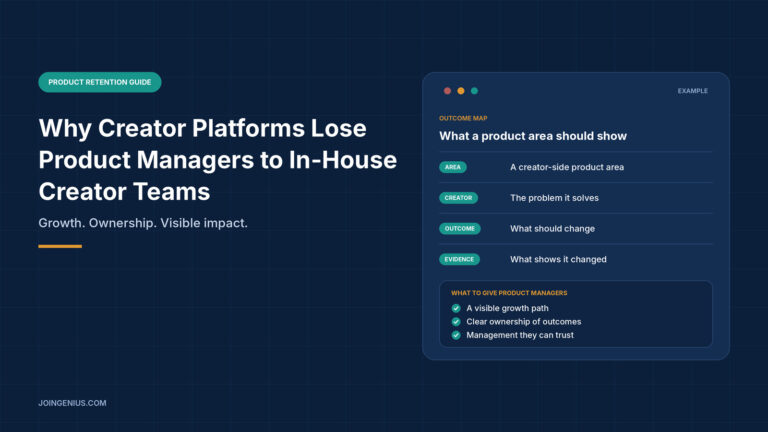
So test it inside your own team. Run an outcome map for each product area. Name the creator problem it solves, the outcome that should change, the evidence that it did and the next step the work leads to. A product manager who can answer all four probably sees the value of the work, and one who cannot may be telling you something. The same logic applies on the creator side, as the guide to retaining content creators when platform algorithms shift explains.

What Platforms Can Do
The research points to three levers, and none needs a large budget. We found no study showing that they stop product managers leaving for in-house teams, so treat them as sensible steps.
Growth comes first, because career was the top reason in the Work Institute data and growth appears in both product surveys. Write down what the next level requires, and show product managers the route. The career progression framework is a useful starting point. Management comes second. Bad management drew the most votes in the Product School poll, so check that managers hold regular one-on-ones and give real decisions to the people they lead. Stay interview questions help you hear what keeps someone and what would make them leave.
Clarity comes third. Lack of role clarity drew 55 votes, so name one owner for each product area and one outcome for each owner. Pay is not absent from the picture. Work Institute puts total rewards at 7.7%, behind career and management, but if brand-side offers sit far above yours, no non-pay fix will close the gap. Compare what each side offers in ownership and growth as well as salary.
Measure Whether It Works
Track product-team exits separately from the rest of the company, and record the reason and the destination each time: another platform, a brand-side creator team or something else. Destination is the missing piece in this topic, and your own data is the only place it will show up. A few exits will look like a pattern when they are not, so avoid reading too much into a single quarter. If leavers scatter across many destinations, the in-house pull may be small. If most go to brand-side creator teams, ask them what they were offered, and treat their answers as accounts given after the fact, not proof.
Use exit interview questions to ask what pulled the person away, and be clear on the difference between exits and wider churn; see turnover vs attrition. Then calculate the employee retention rate for the product team over a year, and compare it with the rest of the company before deciding that you have a product-specific problem.
Warning Signs Your Product Team May Be Heading for the Exit, and What to Do About Each
Check this table each quarter and after every product-team exit. One sign means fix one thing. Three or more mean pause and rework your approach before you hire replacements.

Keep the Work Visible
Creator platforms may well lose product managers to brand-side creator teams, but the research cannot yet tell you how often or why. What it does show is that growth, management and clarity decide who stays. Map each product area to a creator outcome, give product managers a visible path and record where leavers go. If the data shows a pull toward in-house teams, you will know what to offer in response.