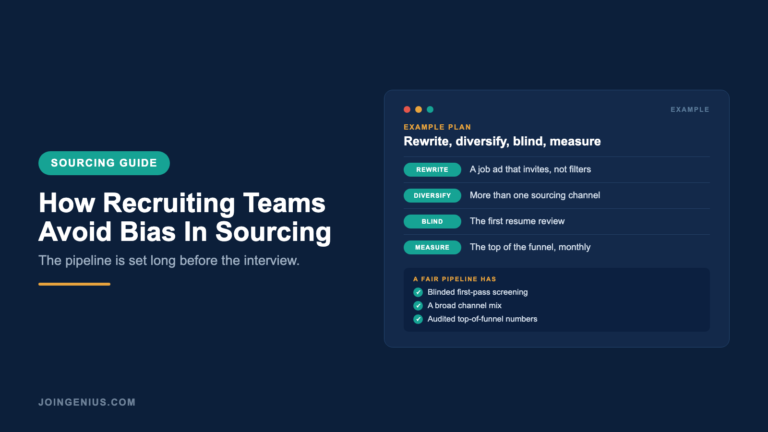
Most bias in hiring is set before anyone sits down for an interview. By the time a shortlist reaches a hiring manager, the pool it came from has already been shaped by whatever tool filtered the first thousand profiles. Learning to avoid bias in early-stage sourcing is where the real work of fair hiring lives.
Fixing the interview is cheap and feels like action, but the pipeline it draws from is where the actual losses happen. The same logic sits behind modern AI-assisted hiring workflows, where a biased sourcing step gets quietly multiplied by every downstream decision. This guide covers where bias creeps in during sourcing, and the practical habits that keep it out.
Why Sourcing Is Where Bias Starts
The earliest stages of hiring look neutral because they are mostly automated, which is exactly why they are the most dangerous. A tool that silently filters out whole groups of people will never show up on a diversity dashboard that only tracks finalists.
Automated Screening Is Not Neutral
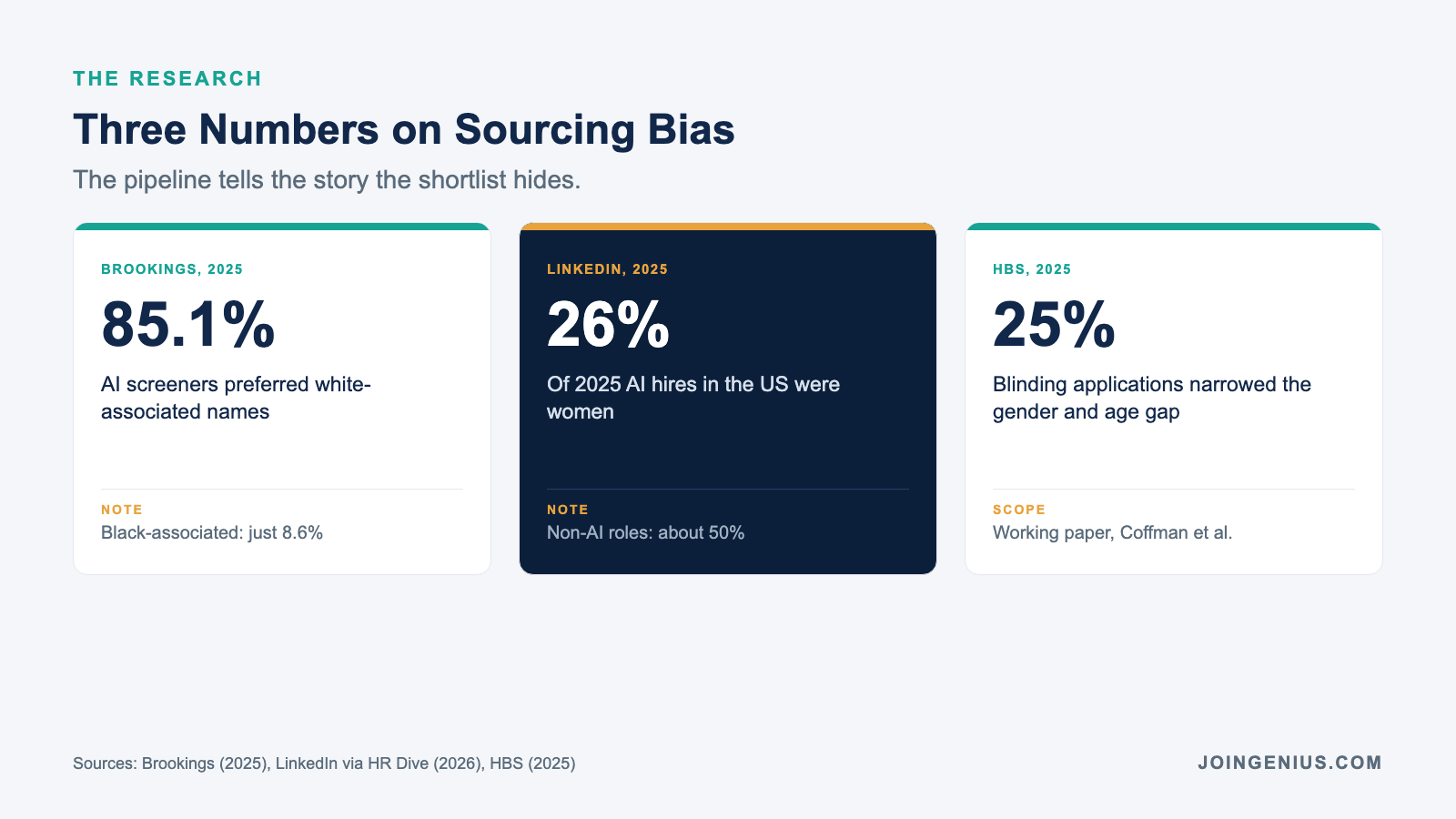
The latest evidence is blunt. A 2025 University of Washington study, covered by Brookings, found that AI resume screeners preferred white-associated names 85.1% of the time and Black-associated names only 8.6%, with men’s names picked over women’s in nearly every head-to-head test. The tool meant to save sourcing hours was quietly rebuilding the bias it was supposed to remove.
Search Terms Shape The Pool
A sourcer who types in a job title plus a few preferred schools has already defined the pool. Those filters feel precise, but they inherit every bias in the market they draw from. Each extra “preferred” keyword narrows the pipeline toward the people who already dominate the role, not the ones who could do it well.
Channel Bias Is Real
Every sourcing channel over-represents some groups and under-represents others, and most teams never check which. A pipeline built from one university’s alumni list or a single referral network will look diverse on the surface and still miss entire populations of qualified people. The channel sets the ceiling before you have talked to anyone.
A single-source pipeline is a bias problem waiting for someone to notice.
Where Bias Creeps In Before You Interview
Bias at the sourcing stage is hard to see because the people it filters out never knew they were in the running. The damage shows up months later as a strangely homogeneous slate of finalists.
The Resume Itself Signals Group
Names, universities, hobbies, and even address lines carry signals that trigger assumptions. Human reviewers scanning dozens of resumes a day lean on those shortcuts whether they intend to or not. The result is a predictable kind of pipeline where the same background keeps advancing, and the broader market gets ignored.
Nobody is doing this on purpose, which is exactly what makes it so hard to catch.
Outcomes Prove The Pipeline Is Leaking
The outcome data is impossible to argue with. LinkedIn research covered by HR Dive found that in 2025, women were just 26% of hires into AI roles, against roughly half of hires into non-AI roles. That gap did not open at the offer stage. It was mostly set by who got into the sourcing funnel in the first place.
Job Descriptions Pre-Filter Applicants
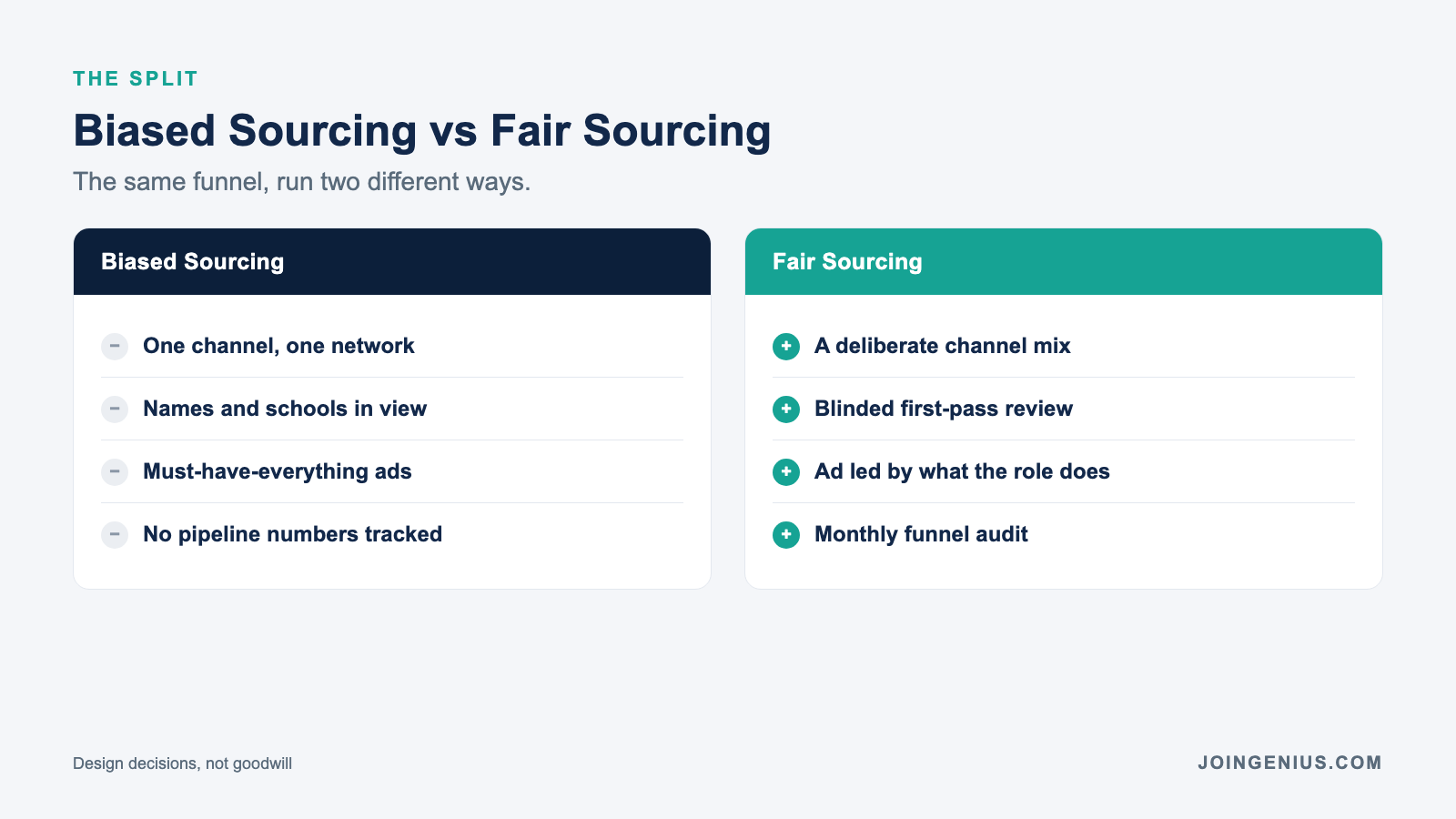
The job ad itself is a sourcing tool. Masculine-coded language and long lists of must-haves push qualified women and underrepresented candidates to self-select out before they apply. By the time the ad goes live, half of your potential pipeline has already decided this role is not for them.
Writing the ad with the people you are missing in mind is the cheapest sourcing fix there is.
How To Reduce Bias At The Sourcing Stage
The techniques are not complicated or expensive. They are deliberate choices that most teams simply never get around to making, and they belong in your core sourcing stack.
Blind The Early Review
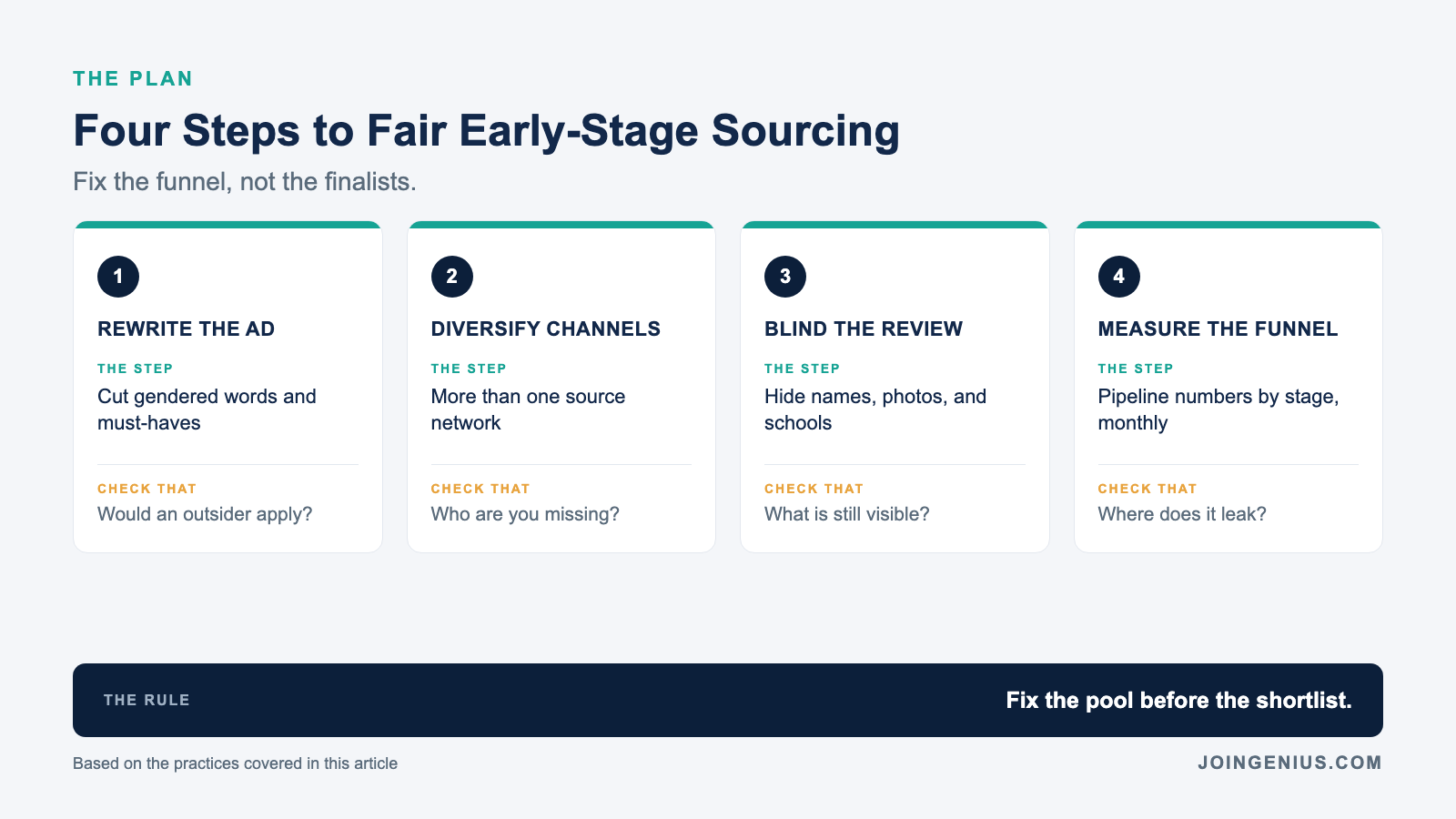
Removing names, photos, and schools from the first resume screen is one of the few interventions with strong evidence behind it. A 2025 Harvard Business School working paper found that blinding the application process narrowed the gender and age gap by about 25%.
It also drew a bigger and more talented applicant pool. The cost of trying it is a weekend of workflow changes.
Rewrite The Job Description First
Before you source a single candidate, read the ad as the people you are not hearing from would. Cut gendered language and trim the must-haves to five or six items. A clearer, shorter ad pulls in a broader pool without changing a single sourcing tactic.
Lead with what the role does, not a wish-list that reads like a filter.
Diversify The Channels, Not Just The Slate
If every pipeline flows from the same two sources, you are not sourcing broadly. Add targeted channels like professional communities, specialist job boards, and alumni networks from a wider set of schools. The slate at the end is only as diverse as the channels at the start, and a healthy sourcing strategy treats this as a design decision.
Measure Your Sourcing Pipeline For Bias
You cannot fix a pipeline you do not watch. Measurement at the top of the funnel is what tells you whether your changes are working, or whether you are just moving the problem around.
Track The Funnel, Not Just The Offers
Pull your sourcing numbers by stage, from first touch to shortlist, and look at the composition of each. If the pipeline is balanced at outreach but skewed by the shortlist, you have a screening problem. If it is skewed from the start, you have a sourcing problem. This is where real recruiting metrics earn their keep.
Audit The Aggregate, Not The Individual
To check whether a sourced pipeline looks balanced, run the aggregate first names through a gender API, then compare the distribution against the market you are sourcing from. This is a measurement about the pool, not a decision about any one candidate.
The number tells you whether the top of the funnel reflects the labor market, or whether it is already slipping before anyone has been interviewed.
Watch For Drop-Off, Not Just Composition
A balanced top of funnel can still leak at every stage. Track where each group drops off between touches and interviews, and investigate the stage where the gap widens. Bias is almost always a specific step, not a vague atmosphere.
Find the step, fix the step, and the pipeline numbers will follow.
Signals worth watching every month:
| Metric | What it tells you |
|---|---|
| Pipeline composition | How balanced the top of funnel is |
| Channel mix | Whether one source is dominating |
| Stage-by-stage drop-off | Where candidates fall out |
| Response rate by group | Whether outreach is landing evenly |
None of these metrics are hard to pull once you decide they matter.
Build This Into How Sourcing Runs
A one-off audit changes nothing. Fair sourcing holds up only when the practices are part of the normal week, not a special project a diversity lead has to defend every quarter.
Make It Standard, Not Optional
Bake blinded first-pass reviews, a job-ad check, and a channel audit into every requisition’s intake process. If every open role goes through the same steps, bias stops being a question of goodwill and starts being a question of process.
Process survives turnover, moods, and busy weeks; goodwill does not.
Train The Sourcers, Not Just The Interviewers
Interview training gets most of the attention, but sourcers make more judgments per hour than anyone else on the team. A short, specific training on how search terms, channel choices, and tool defaults shape the pool pays back faster than almost any other DEI spend.
Report The Top Of The Funnel To Leadership
If leaders only ever see hiring outcomes, they only ever manage hiring outcomes. Put sourcing-stage numbers on the same dashboard they already read, and the top of the funnel starts getting the attention the bottom has had for years. The pipeline you measure is the pipeline that improves.
Conclusion
Interview bias gets the headlines, but sourcing bias writes the shortlist. The teams that get this right do not run anti-bias workshops; they rewrite job ads, diversify channels, blind early reviews, and watch the funnel every month.
None of this requires a bigger budget. It requires treating sourcing as the design decision it already is, instead of a search box someone fills in at the start of a req.
Running all of this well takes real recruiter hours that most in-house teams do not have, especially for high-volume or technical requisitions. At Genius, we help companies hire the top 1% of recruiting and talent operations specialists from the Philippines and Latin America, at around 80% less than comparable local hires.
You get people who can run sourcing audits and build fair pipelines as the default, with no monthly agency fees and a 6-month replacement guarantee. If bias is leaking into your sourcing because nobody has the time to watch it, see how we can staff that work.