A research team decides to build a knowledge graph. The grant deadline is in six months. The role is posted the same week. Three months later, the role is still open. The team is debating whether to hire knowledge graph specialists or graph data engineers, because the shortlisted resumes use different titles for the same work.
That is the opening scene for most research teams trying to hire knowledge graph specialists in 2026. The role sits at the intersection of ontology design and graph databases, plus whatever the lab’s own domain is. Our write-up on how to source founding engineers covers the deep-specialist pattern. This piece covers the knowledge-graph version.
Why The Role Is Hard To Hire In The First Place
The demand curve for knowledge graph specialists is a function of two things. First, enterprise interest in knowledge graphs is accelerating. Second, the training pipeline that produces people who can design one has not caught up.
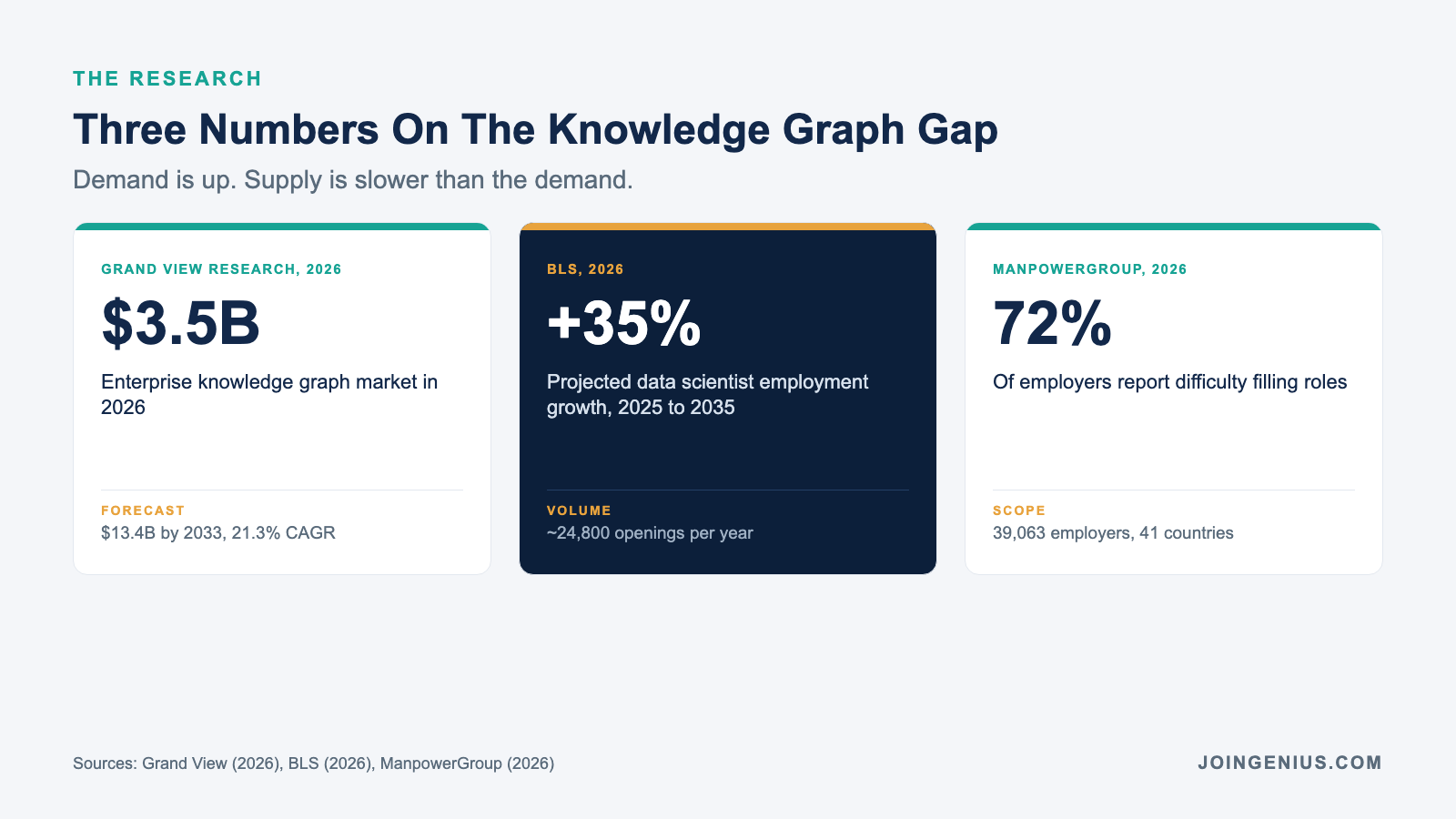
Grand View Research values the enterprise knowledge graph market at $3.5 billion in 2026, projected to reach $13.4 billion by 2033 at a 21.3% CAGR. GraphRAG and agentic AI are the main drivers. Research teams and corporate R&D groups all want the same handful of people.
The supply side is slower. The BLS projects data scientist employment to grow 35% from 2025 to 2035, with roughly 24,800 openings a year. Knowledge graph work is a sub-specialty of that pool. The sub-specialty does not grow 35%. It grows more slowly, because the training programs that cover ontology engineering are rare.
The training is slow for a reason. Ontology engineering was a corner of computer science for twenty years before LLMs made it mainstream. The people who went deep on it are mostly in their forties and placed years ago. The twenty-somethings fluent in graphs picked it up on their own in the last three years.
The hiring environment reflects it. ManpowerGroup’s 2026 Talent Shortage Survey of 39,063 employers found 72% report difficulty filling roles, with AI model and application development the single hardest-to-find skill. Knowledge graph work sits inside that bucket on most teams. Our AI statistics overview tracks the broader shift.
What Research Teams Keep Getting Wrong In The Job Spec
The job description is where most of these searches break. Four errors show up again and again.
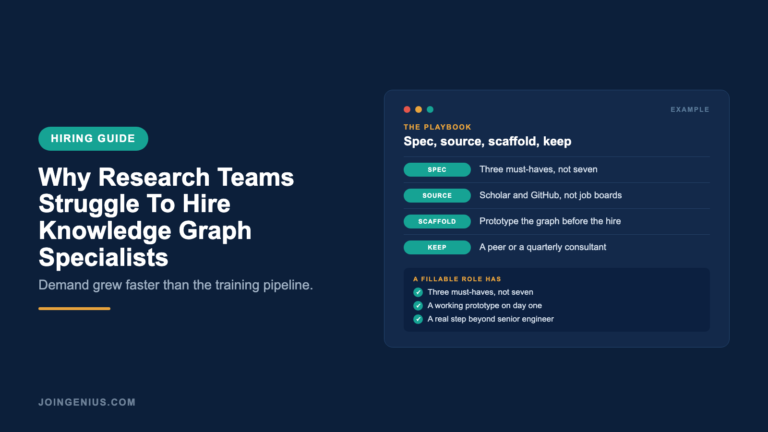
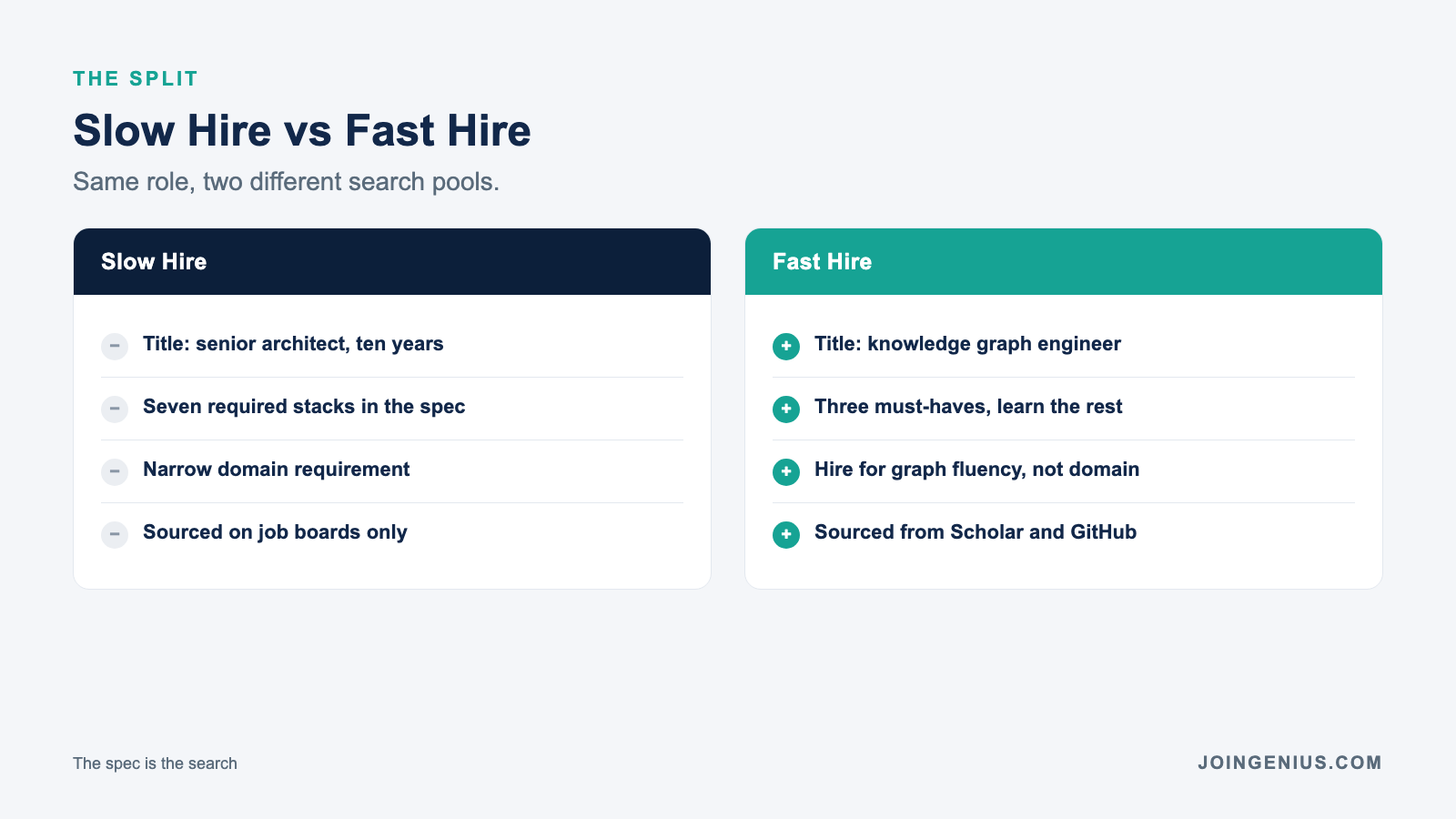
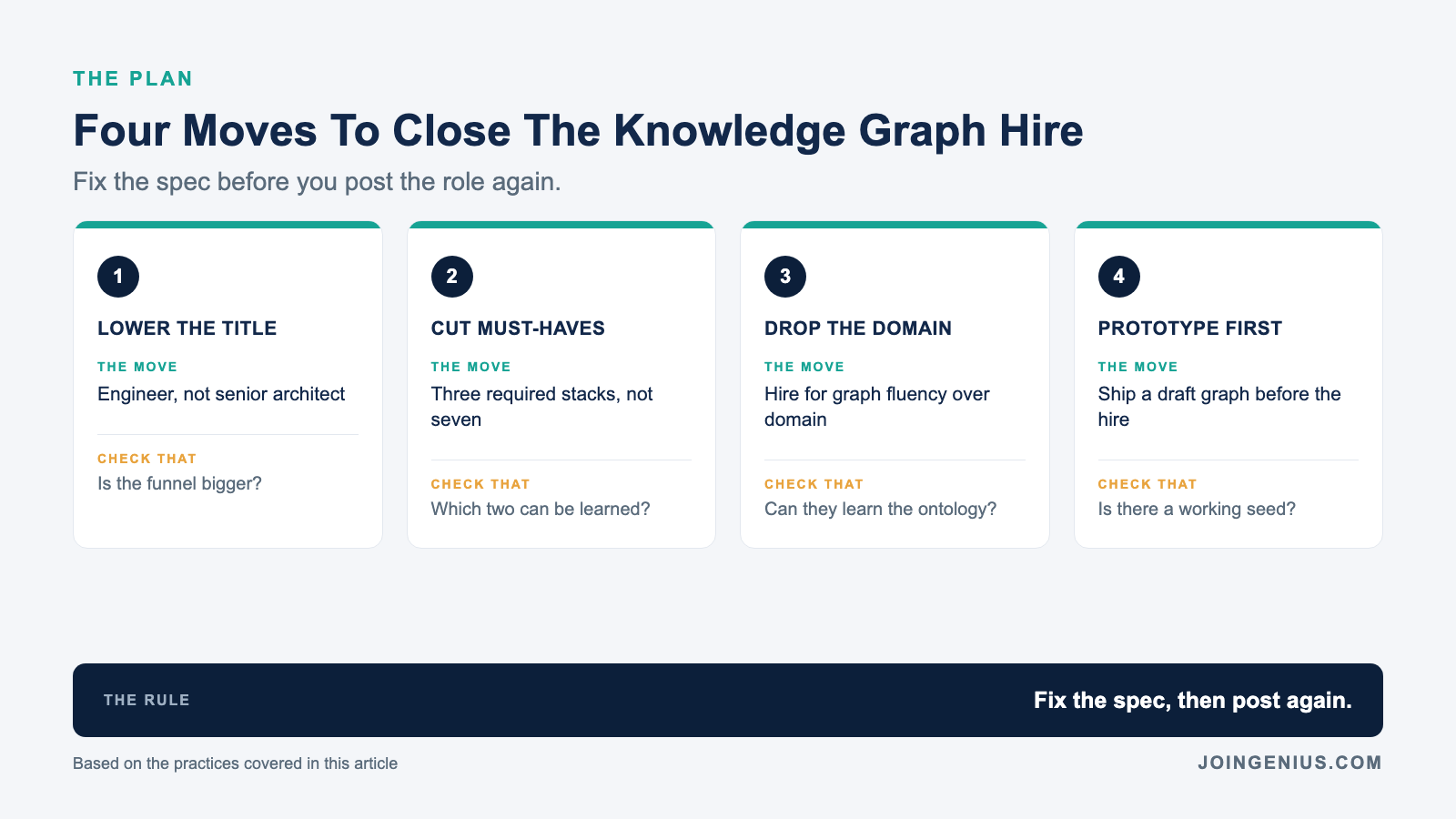
The first is title inflation. Writing “senior knowledge graph architect with ten years in semantic web” narrows the applicant pool to a few dozen people, most of whom already work at Google or a national lab. Lowering the title to “knowledge graph engineer” opens the funnel by an order of magnitude without changing the work.
The second is overloaded must-haves. A spec that lists seven required stacks like Neo4j and SPARQL alongside OWL and SHACL filters out the strong generalists who would learn two of them on the job. Three must-haves work. Seven does not.
The third is a narrow domain requirement. A biomedical lab asks for “biomedical knowledge graph experience” when the real need is someone who can learn their ontology. Domain learning is six months. Graph fluency is three years. Hiring on the shorter curve is the right move.
The fourth is comp. The spec quotes a data scientist salary band for a role that competes with ML research engineers. The market clearing price for a senior knowledge graph engineer in 2026 is closer to a staff ML engineer than a senior data scientist. Teams that underprice watch their offers get declined without feedback.
Our list of talent sourcing tools is a useful filter before the spec is even posted. A better spec means fewer rounds, which means a shorter time-to-fill. The specialist search already runs long. Shorter rounds matter.
Where To Look For Real Candidates
Dedicated knowledge graph specialists post less often than data scientists. They surface through adjacent signals, not through job-board titles.
The first signal is academic. People who published on ontology engineering or semantic web between 2020 and 2025 and then left academia for industry are the strongest hires. Google Scholar is a better sourcing tool for this role than LinkedIn. Export the author list from recent conference proceedings and cross-reference with LinkedIn. The shortlist writes itself.
The second signal is adjacent. ML engineers who built RAG pipelines in 2024 and 2025 and had to design the retrieval schema from scratch picked up most of what a knowledge graph specialist needs. Their resumes do not say “knowledge graph.” They say “retrieval” or “embedding.” The work is 70% the same.
The third signal is community. Neo4j user groups and Protégé contributor lists are small enough that one afternoon on GitHub produces more leads than a two-week LinkedIn sponsored post.
The common thread is that the people doing the work rarely call themselves what the job post asks for. Hiring teams that search by title are searching the smallest possible pool. Teams that search by publication history or by stack choices are searching the actual pool.
Here is the signal shortlist in one view.
| Signal | Where To Look | What To Pull |
|---|---|---|
| Academic | Google Scholar and recent conference proceedings | Papers on ontology or semantic web |
| Adjacent | LinkedIn and RAG-focused teams | ML engineers with retrieval schema work |
| Community | Neo4j user groups and GitHub | Contributors to Protégé or open graph tools |
How To Lower The Specialist Bar With The Right Tools
The best hiring move for a research team on a six-month deadline is to lower the specialist bar before posting the role. A lot of the work a dedicated specialist used to do can now be done by a generalist with the right tools.
Text-to-graph tools let non-specialists prototype a working knowledge graph before the first hire lands. InfraNodus turns a corpus of research notes into a visual network of concepts and surfaces the gaps between clusters, giving the team something to work with on day one. Our breakdown of AI in talent acquisition covers the broader pattern.
The prototype matters because it changes the role you are hiring for. A team that already has a working graph needs an engineer who can scale and productionize it. A team that has nothing on day one needs an architect who can design it from zero. The second role costs twice as much and takes twice as long to fill.
Lowering the bar does not mean skipping the hire. It means hiring at mid-level instead of principal and promoting the role as a product-build opportunity. Mid-level engineers who get to own a knowledge graph build from month one accept lower comp than principals who inherit a scale problem.
The pattern repeats across most hard-to-fill specialist roles. Build the version that proves the concept. Hire the person who ships the real one.
How To Keep The Specialist You Finally Hire
Hiring the specialist is only half the problem. Keeping them is the other half. Knowledge graph specialists leave for the same two reasons any specialist leaves. The work gets repetitive, or the career path flattens.
Interesting work on these teams means new ontologies and new queries, not maintenance tickets on a graph someone else designed. If the hire is spending 80% of their time patching ETL jobs, they will take the next offer that includes a greenfield build.
A career path means something above “senior knowledge graph engineer.” Knowledge architect or graph platform lead are real next steps with budget authority attached. Our breakdown of why ops hires don’t stay past 18 months walks the same curve for a different role.
The second retention lever is a peer. One specialist on a team of generalists stays about eighteen months. Two specialists on the same team stay longer because they finally have someone who understands the work. If budget allows only one hire, pair them with a quarterly external review from a graph consultant.
The budget math on the second specialist is simpler than it looks. One mid-level hire plus a quarterly consultant costs less than a senior who leaves at month twelve. The specialist search ran six months the first time. The replacement search will run longer.
The structure that keeps a knowledge graph specialist also keeps the rest of the research team happier. A graph that non-specialists can read is a graph that gets used. A graph that only one person understands is a liability waiting for a resignation.
Conclusion
Research teams struggle to hire knowledge graph specialists because demand grew faster than the training pipeline. Most job specs ask for a profile that barely exists outside a handful of national labs. The fix is a better spec and better sourcing signals, plus a tool that lets a generalist prototype the graph before the specialist arrives.
If adding specialist or operations talent without the overhead of local hiring is on the table, Genius is the easiest route. We vet the top 1% of applicants across the Philippines and LATAM and place them full-time at roughly 80% less than an equivalent local hire.
No monthly agency fees. Every hire ships with a six-month replacement guarantee if the fit is wrong. The specialist search already runs long. We make sure the next hire you compare them against is already filtered and ready to work.