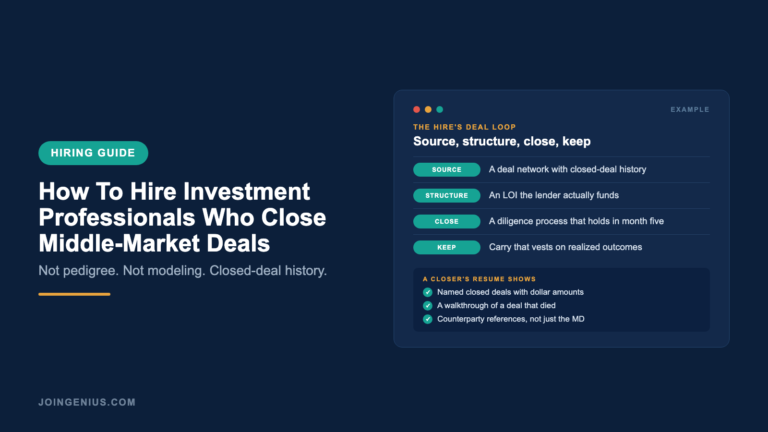
Hiring investment professionals who actually close middle-market deals is not the same job as hiring the bulge-bracket associate everyone else is competing for. The pedigree screen that works for a Goldman analyst filters out the person who will originate, structure, and ship a $40 million transaction with a founder who has never sold a company before. Two different jobs, two different hiring loops.
That gap shows up in the close rate. Modern recruiting workflows have widened the signal gap between pedigree and performance, and the firms building deal teams in 2026 are the ones that stopped running the resume filter they ran in 2015. Below, we cover why middle-market hiring is different, the skills that actually predict closed deals, where to source the people who close, and the interview, reference, and compensation moves that keep them.
Why Hiring for Middle-Market Dealmaking Is Different
The classic analyst-to-associate pipeline was built for a world where every deal looked the same. The middle market does not work that way and the hiring loop that assumes it does keeps missing.
The Reps Who Close Here Don’t Come From Bulge Bracket
A seven-figure sell-side at a boutique and a $20 billion take-private are the same job in title and nothing else in execution. The associate who ran the Excel at Morgan Stanley has never personally called a $15 million EBITDA founder on a Tuesday morning. The person who closes in the middle market has, usually dozens of times.
The Deal Economics Change Every Hiring Decision
A middle-market firm cannot carry seven associates per MD. The hire has to be a closer, not a staffer, and the loop that selects for closers looks nothing like the one that selects for staffers.
Compensation Has Decoupled From Big-Firm Benchmarks
Base plus bonus plus carry at a lower-middle-market firm now sits in a band most big-firm benchmark tables miss by a wide margin. Teams that paste the Heidrick comp sheet into their offer letter either overpay the wrong person or underpay the right one.
The Skills That Actually Predict Closed Deals
The dealmaking research is clear, and most hiring loops ignore most of it. The best interview signal for a middle-market investment professional comes from the behaviors that actually show up on closed-deal postmortems.
Sourcing Chops, Not Modeling Chops
A beautiful LBO model has never closed a deal on its own. The person who sources the deal, holds the founder relationship through due diligence, and keeps the lender honest at the finish line is the person who closes. The modeling is table stakes, not the signal.
Reading Operators Beats Reading Decks
Middle-market founders do not pitch like Fortune 500 CFOs. The investment professional who can sit across from a $40 million-revenue owner, read the real reason they are selling, and build trust in 20 minutes closes deals the pedigree hire cannot. A sharp talent acquisition strategy for deal teams has to filter for this before anything else.
Negotiation Stamina Beats Pedigree
Middle-market deals die in month five of a six-month process. The professional who still runs the Thursday call with the same energy they had on day one is the one who gets the deal to close. The one who quietly checks out at month four is the one your diligence quality drops under.
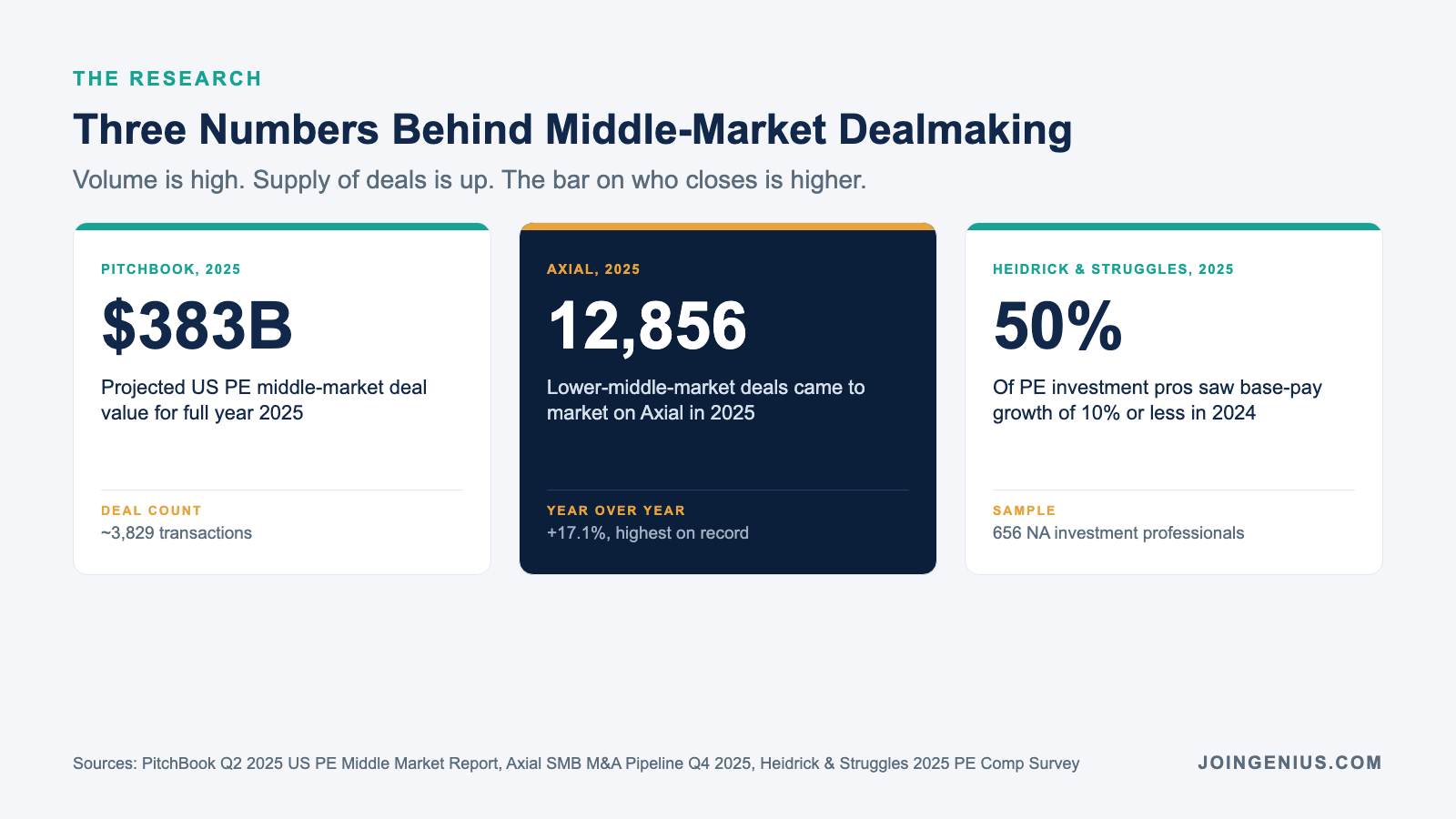
PitchBook’s Q2 2025 US PE Middle Market Report counted 978 closed or announced middle-market deals in Q2 2025 alone and projected roughly 3,829 transactions worth $383 billion for the full year — on pace to be the second-best year on record. Deal volume is high. The bar on who can actually close is higher.
Where to Find the People Who Close
Three sourcing channels produce most of the closers in the lower and core middle market. Firms that ignore them keep posting on LinkedIn and keep hiring the wrong person.
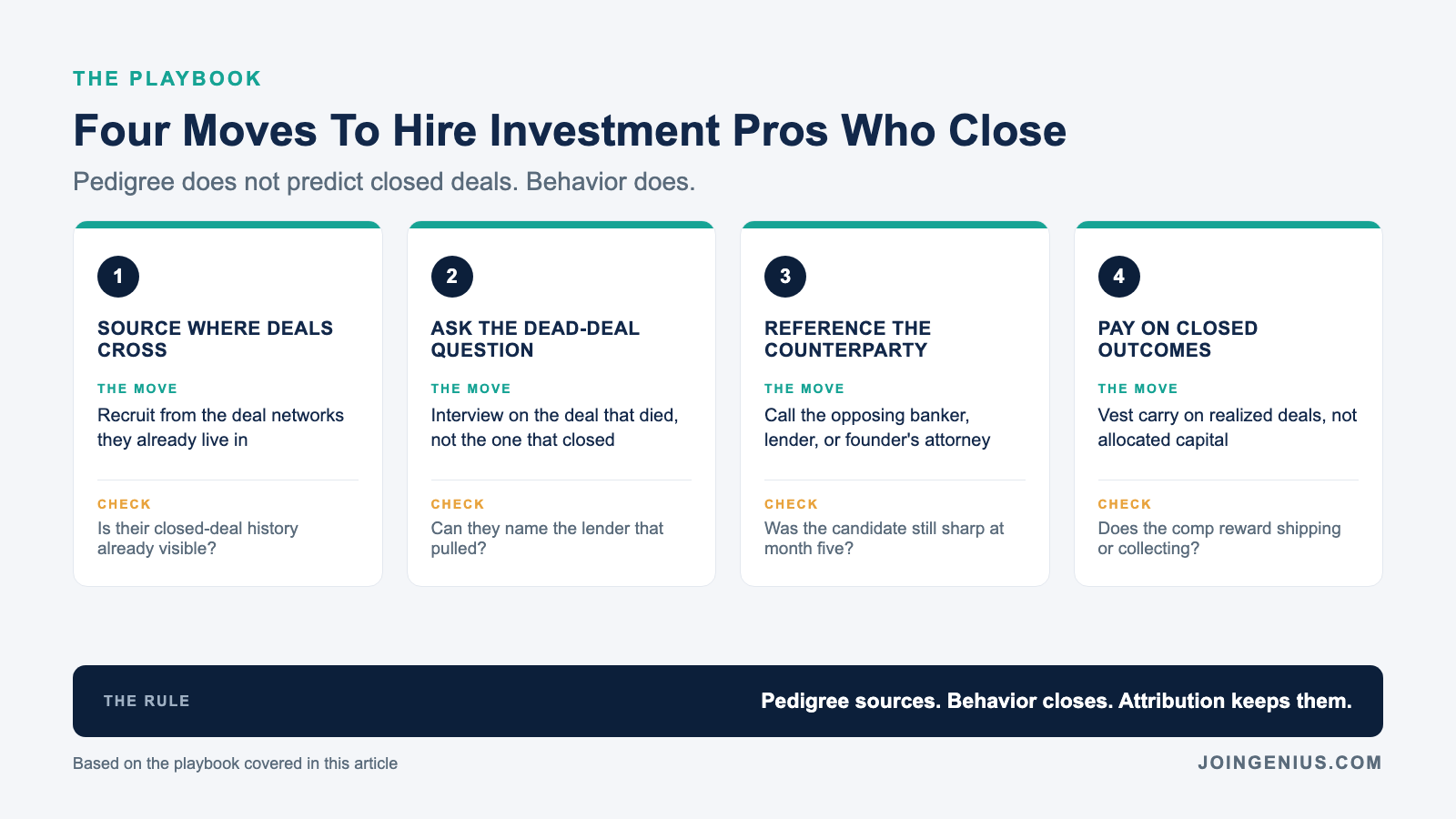
Sourcing From Deal Networks They Already Work In
The strongest middle-market professionals already live inside the platforms where deals cross — teams that recruit from a dedicated deal network are hiring people whose closed-deal history, buy-side relationships, and sector reputation are already visible, which collapses the vetting cycle from months to weeks.
The Lower-Middle-Market Referral Network
The second channel is the senior banker at the boutique who just lost a deal to a strategic. They know who worked hardest on it and who did not. One warm introduction from that banker is worth 40 inbound LinkedIn applications.
Why Boutique IB Alumni Convert at a Higher Rate
An analyst who spent two years at a 15-person M&A boutique has already touched every stage of a close. The same analyst at a 400-person firm has probably only built models. The ones who converted at the boutique are the ones to prioritize. Sourcing founding engineers uses the same filter — depth of ownership over size of logo.
Axial’s SMB M&A Pipeline Q4 2025 report counted 12,856 lower-middle-market deals coming to market on the platform in 2025 — a 17.1% year-over-year increase and the highest annual total on record. Independent sponsors drove 27% of closed deals over the trailing 12 months, more than any other buyer type.
The Interview Questions and Reference Checks That Work
A good question set for a middle-market hire is defined by what it leaves out. These four questions, run well, beat sixteen case studies run on autopilot.
Ask About the Last Deal That Died
Not the one they closed. The one that died in week 20. The candidate who can walk through the diligence failure, name the lender who pulled, and explain what they would do differently is the candidate who has actually run a deal. The one with no dead deals has never carried one.
Ask Who Made the First Call
Sourcing credit gets claimed sloppily on resumes. Ask who personally picked up the phone and called the founder for the first time. The candidate who hesitates is the candidate who was staffed on the deal, not the one who originated it.
Reference-Check the Deal, Not the Candidate
Call the counterparty’s banker, the lender’s analyst, or the founder’s attorney. Ask what the candidate was like at month four of the process. The reference from the candidate’s own MD will always be glowing — the reference from the counterparty is where the signal lives.
Stop Testing LBO Models in a Vacuum
A clean three-statement model under time pressure selects for test-takers, not closers. Give the candidate a real teaser from a recent deal and ask what they would do first on Monday. The answer tells you how they think when the clock is real.
How to Compensate, Measure, and Retain Them
A great hire still leaves at month 18 if the comp, the measurement, and the attribution are sloppy. The retention step is where most middle-market firms quietly leak their best people.
Carry That Vests on Closed, Not Allocated
A carry package that pays on committed capital instead of realized deals attracts the professional who collects allocations and leaves. Pay on closed outcomes and you select for the person who stays until the deal actually ships.
Measure the Pipeline, Not the Meetings
The associate who had 60 meetings and zero closed deals is not a better associate than the one who had 12 meetings and three closes. A healthy approach to talent acquisition analytics for deal teams means tracking sourced-to-signed conversion by associate, not top-of-funnel vanity.
Make Attribution a Written Rule
Deal credit disputes burn the top quartile of a deal team faster than any comp issue. Write the attribution rule before the first deal — who gets sourcing credit, who gets execution credit, who gets carry — and stop relitigating it on every close.
A Short Hiring Signal Table
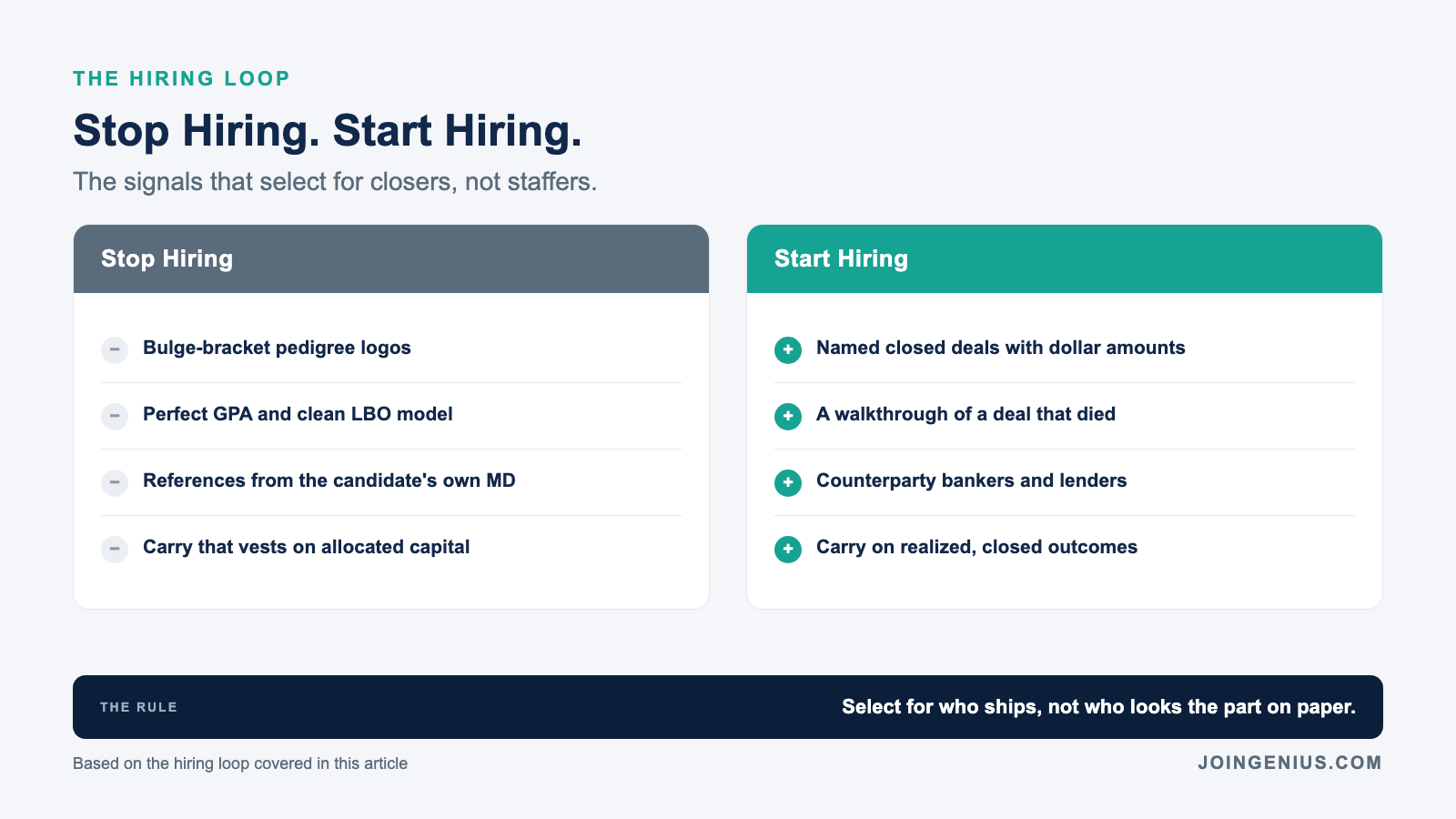
| What to Check | Weak Hiring Signal | Strong Hiring Signal |
|---|---|---|
| Resume emphasis | Pedigree logos and perfect GPA | Named closed deals with dollar amounts |
| Interview depth | A clean LBO model | A walkthrough of a deal that died |
| Reference source | The candidate’s own MD | A counterparty banker or lender |
| Compensation hook | Base plus bonus plus allocation | Base plus bonus plus carry on closed outcomes |
Heidrick & Struggles’ 2025 North America PE Compensation Survey, based on 656 investment professionals across associate through managing partner levels, found 50% reported a base-pay increase of 10% or less in 2024 — and 75% said their bonuses remained discretionary rather than formulaic. The comp pressure is cooling and the stakes on each hire are rising.
Conclusion
Middle-market dealmaking is a different job from bulge-bracket investment banking, and the hiring loop has to match. A pedigree screen filters out the person who will actually close. A dead-deal question, a counterparty reference, and a carry package tied to realized outcomes select for the person who stays and ships.
We built Genius so growing firms can staff that kind of loop with professionals they otherwise would not meet. We place the top 1% of operations, analytics, and investment-support talent from the Philippines and Latin America, at around 80% less than comparable local hires. The relationship stays direct, with no monthly agency fees and a 6-month replacement guarantee on every placement. If the next deal-team hire is the one your current pipeline keeps missing, see how we source and place the talent that closes.