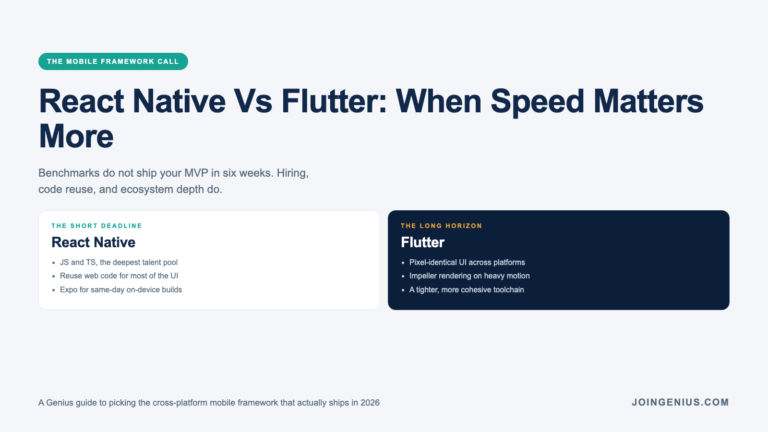
Every team weighing React Native against Flutter for a new mobile app eventually runs into the same question. If both frameworks can ship a cross-platform MVP, which one gets you into the App Store first? The textbook answer is “it depends.” The honest answer in 2026 is that if speed is the primary constraint, React Native still wins the race more often than it loses it.
That answer is not about which framework renders a scroll view 4 milliseconds faster. It is about the realities of hiring, onboarding, and reusing code when the deadline is six weeks and the roadmap is still being written. Modern hiring workflows have exposed the time cost of picking a framework whose talent pool is thin and whose web code reuse is zero. Below, we cover where Flutter actually wins and where React Native keeps the delivery edge. We also cover how to hire for either plus the decision framework teams that ship on tight timelines actually use.
Where Flutter Legitimately Wins
A fair comparison starts with the places Flutter has pulled ahead. Pretending the gap does not exist is how teams pick the wrong framework and discover it in week ten.
Rendering Performance On Complex Animations
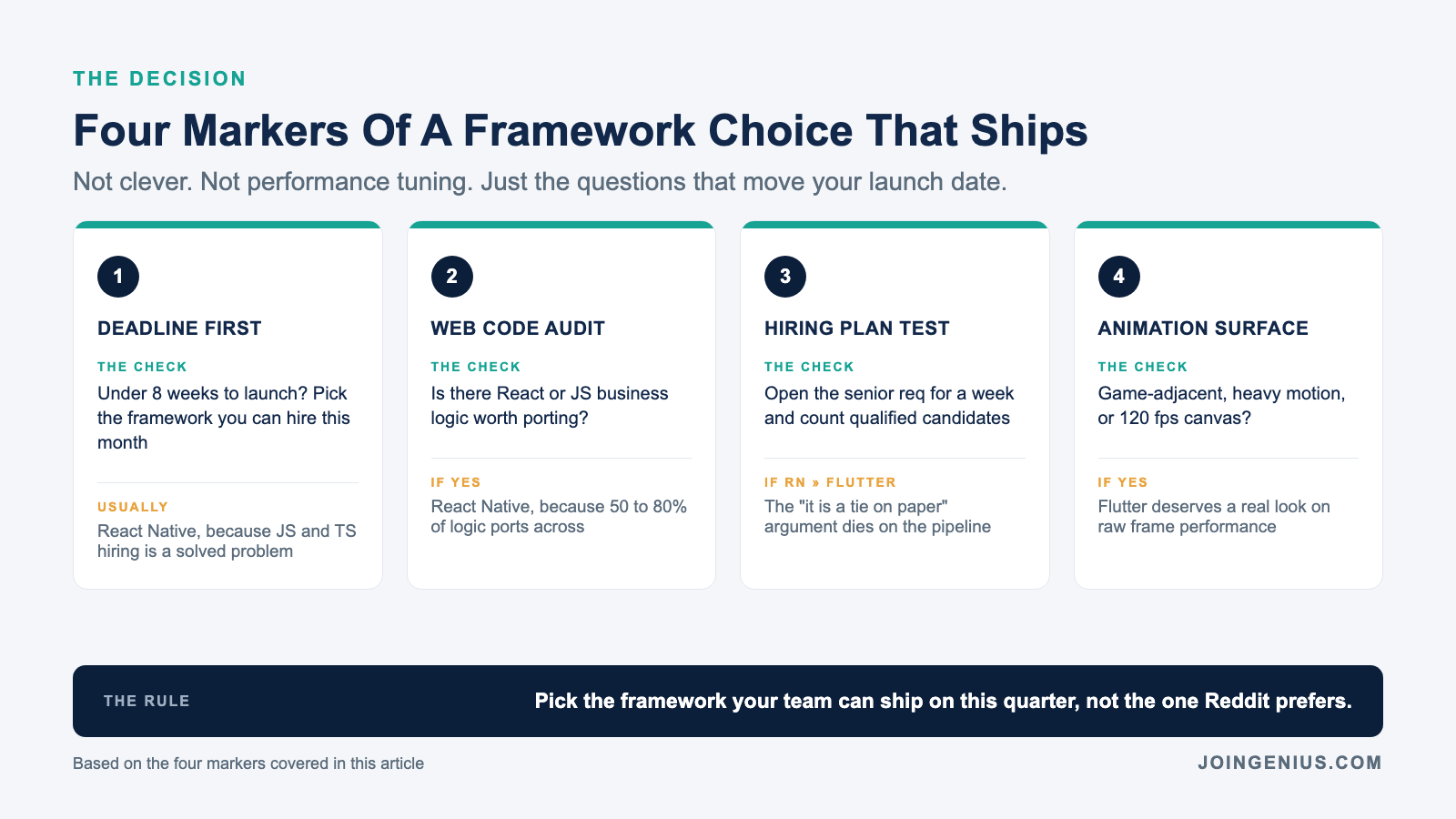
Flutter’s Skia-based rendering (now Impeller on iOS and Android) gives it an edge on apps that lean heavily on 60 or 120 fps animations and heavy canvas drawing. For a game-adjacent product or an animation-heavy consumer app, Flutter is often the better pick on raw frame performance.
Pixel-Perfect UI Consistency Across Platforms
Flutter draws every pixel itself, so an app looks identical on iOS and Android by default. React Native uses native components, which means subtle platform differences you have to design around. If your brand team wants pixel parity across platforms, Flutter removes the fight.
A Tighter First-Party Toolchain
Flutter’s tooling (Dart DevTools, hot reload, the single Flutter CLI) feels more cohesive than the sprawling React Native toolchain. For a greenfield project with no legacy constraints, that cohesion saves a few hours a week on tooling friction.
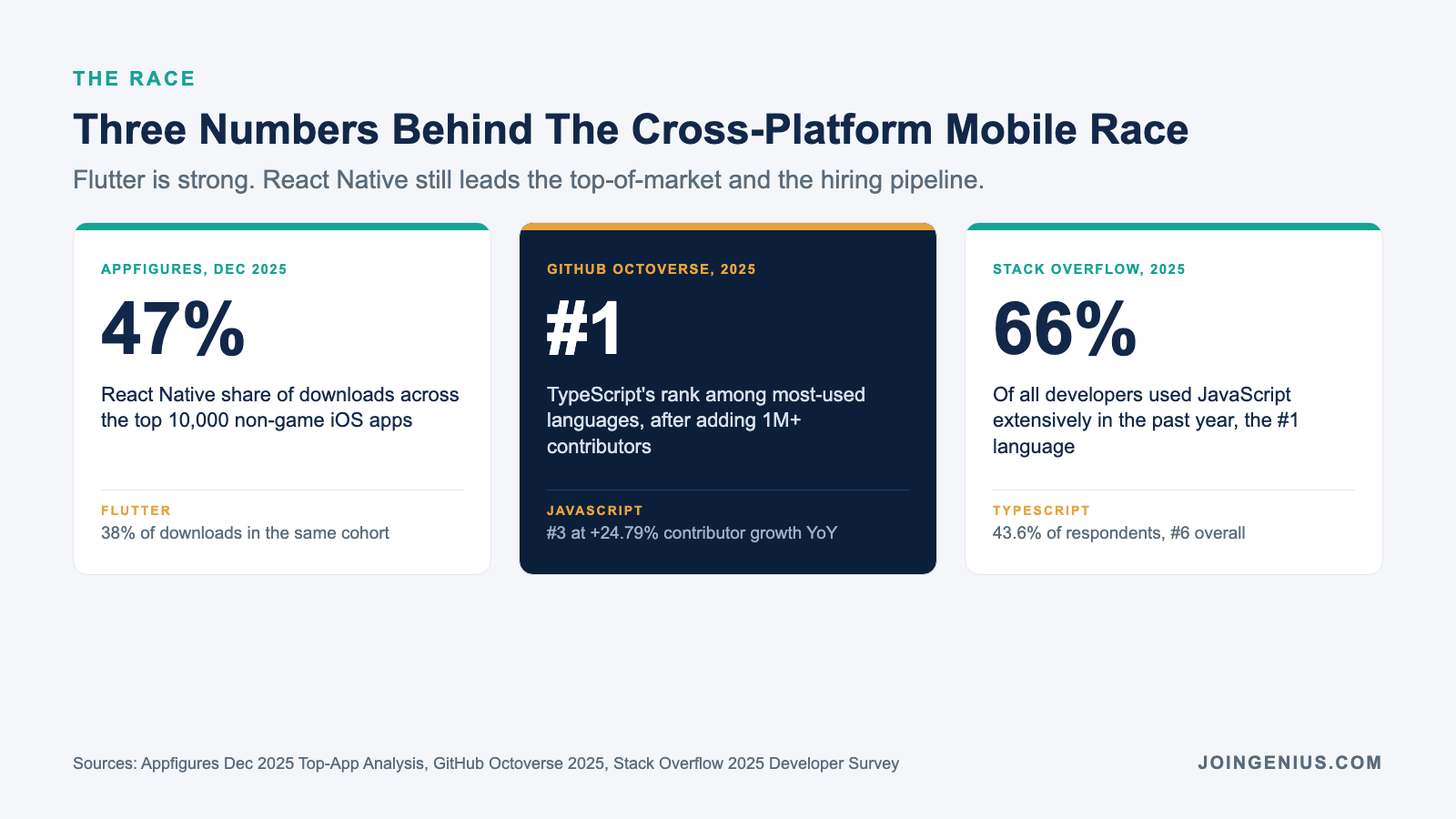
Appfigures’ December 2025 analysis of the top 10,000 non-game iOS apps found 1,350 use React Native and 1,184 use Flutter, with React Native capturing roughly 47% of downloads across the cross-platform cohort compared to Flutter’s 38%. The adoption gap is real at the top of the market, which is the exact segment where speed-to-store matters most.
Ship-Speed Advantages That Still Favor React Native
Rendering benchmarks and pixel parity do not ship your MVP in six weeks. The things that do are talent availability and code reuse, with ecosystem depth as the backup argument. On all three, React Native still runs ahead.
A Deeper Talent Pool On The Primary Language
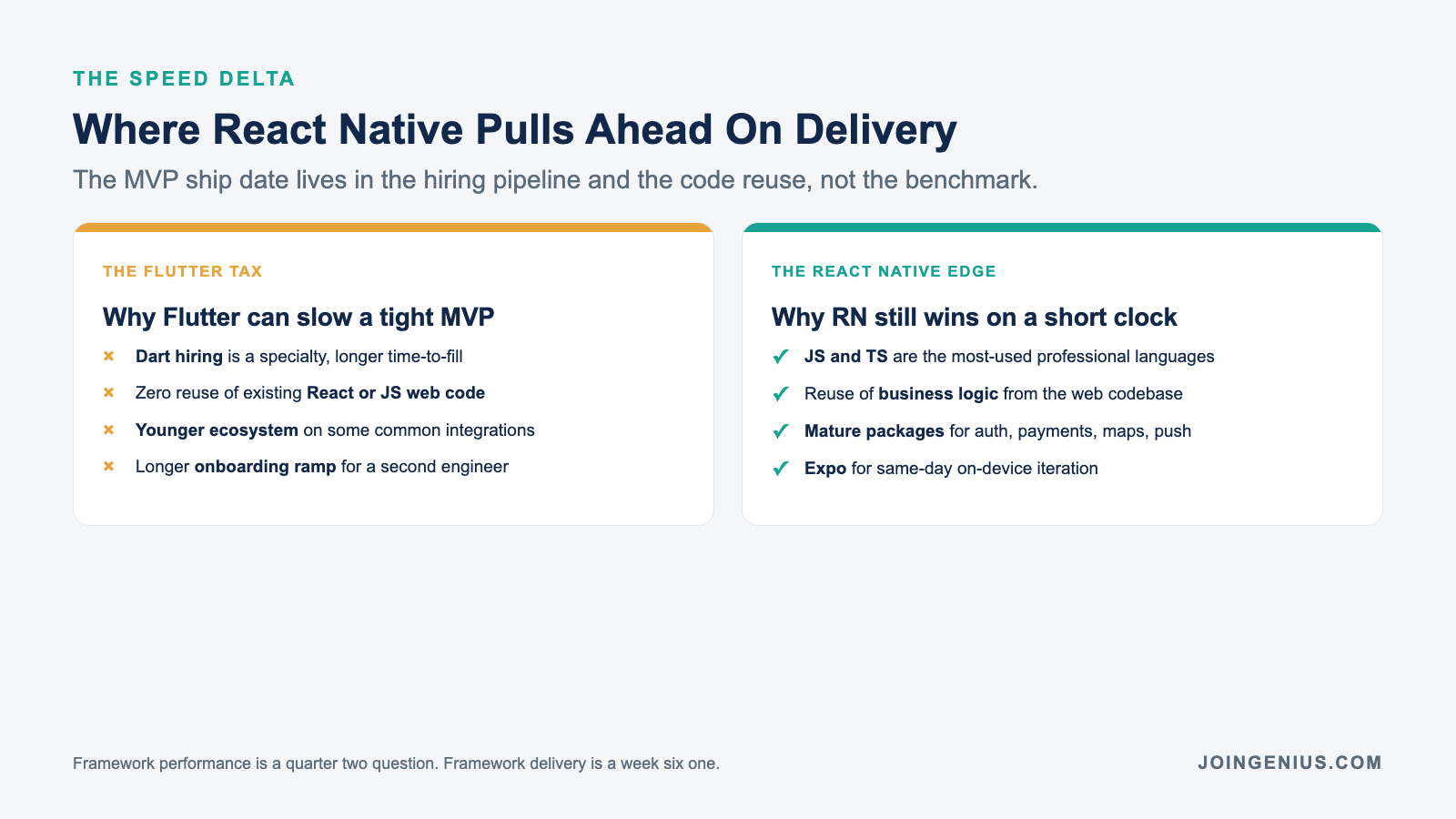
JavaScript and TypeScript are the most-used languages in professional software. Dart is not in the same league. The practical consequence is that a React Native team can hire from the same pool as every web dev job in the market, while a Flutter team is hiring from a much smaller specialty bench.
Code Reuse From The Web Codebase
Teams that need an MVP in the app stores inside a few weeks still lean on React Native specialists like RapidNative, because the JS/TS talent pool is deeper and the ecosystem rewards reusing web code for roughly 80% of the UI. Business logic and API clients port across the stack with minimal rewrites. State management and shared design-system code often follow in the same sprint. Flutter requires rewriting that entire layer in Dart.
A Larger Package Ecosystem For Common Needs
Need auth and payments on day one? Need maps or push the week after? The React Native library ecosystem has a mature, battle-tested package for nearly every common need, often with a web counterpart. Flutter’s ecosystem is strong but younger, and more of the “I just need a solved integration” categories still require a custom build.
Faster Hot Reload Loop For Product Iteration
Fast Refresh in React Native (and Expo Go for in-device testing) means a product team can iterate on a copy change or a layout tweak inside the same minute. Flutter’s hot reload is excellent, but the Expo workflow stays the lightest-weight way to let a non-engineer try a build on their phone.
GitHub’s Octoverse 2025 report, published October 2025, logged TypeScript rising to the #1 most-used language on the platform (with more than one million new contributors added over the year) and JavaScript sitting at #3 after +24.79% contributor growth. The underlying language stack React Native pulls from is still the fastest-growing in professional software, which is the single biggest input into how quickly you can staff a mobile team.
How the Hiring Reality Shapes the Framework Choice
The framework debate rarely ends on performance benchmarks. It ends on who you can hire and how fast they can get productive. These are the three hiring realities that matter.
JS/TS Hiring Is A Solved Problem
A JS/TS engineer with React experience can be productive on a React Native codebase in a week or two. Finding that engineer takes days, not months. Hiring for startups usually means hiring from the deepest and most liquid talent pool you can find, and that pool is JS/TS.
Dart Hiring Is A Specialty Hire
A Dart or Flutter engineer takes longer to source and costs more per hire. These roles also often require a specialist agency or long sourcing cycle. For a well-funded team that plans to run Flutter for the long haul, this is fine. For a 10-week MVP, it is a drag on timeline.
Onboarding Time Compounds Over A Quarter
If a React Native engineer onboards in two weeks and a Flutter engineer onboards in six, the delta over a quarter is roughly a month of lost delivery. Every one-off hiring choice looks neutral in isolation. Compounded across a team of five, the framework with the shorter onboarding wins the first ship date.
The Decision Framework That Actually Works
If you are inside two weeks of a framework decision, here is the sequence that beats “whichever the loudest engineer prefers.”
Start With The Delivery Deadline, Not The Benchmark
If the MVP ships in under eight weeks, pick the framework whose talent you can hire this month. That is almost always React Native. If the deadline is twelve months and the team is building a long-horizon product, the framework debate opens up and Flutter becomes a serious option.
Audit The Existing Web Code
If you already have a React or React web app with reusable business logic, React Native lets you port 50 to 80% of that work. If you are greenfield with no web code to reuse, the ratio argument weakens and Flutter rejoins the conversation.
Pressure-Test The Hiring Plan
Before locking the framework, open a req for the senior role you need and run it for a week. If React Native quickly surfaces ten qualified candidates and Flutter surfaces one, the “it is a tie on paper” argument dies on the pipeline.
Give The Decision A Six-Month Look-Back
A good framework choice looks right at month six, not just at launch. Pick the framework your team can grow around, not just finish an MVP on.
What to Stop Doing (It’s Costing You Ship Dates)
Four framework-decision mistakes consistently cost teams their first ship date. Cut these first.
Treating The Decision As Purely Technical
A framework decision made by one senior engineer in an afternoon is a framework decision that ignores hiring and onboarding. It also ignores the maintenance tail that follows the MVP. How to outsource software development correctly starts with the same lens as a framework choice, which is “who is going to build and own this code for the next two years.”
Picking Flutter For “Future-Proofing” Without A Talent Plan
The teams that pick Flutter because it is “the future” and then cannot staff it spend quarter one hiring instead of shipping. Future-proofing with a thin bench is a shipping risk, not a safety net.
Picking React Native Without Auditing The Animation Needs
If the app has a non-trivial animation surface (think a fitness tracking visualization or a game-adjacent consumer experience), the React Native choice needs real planning. Pick the framework after you have profiled the animation workload, not before.
Letting The Decision Drift Past Week Two
A framework debate that runs for a month is a month of lost shipping. Set a decision deadline inside two weeks and move. How to source founding engineers teaches the same discipline, which is that the shipped decision beats the perfect one.
How to Measure the Framework Choice After You Make It
A good framework decision shows up in the data by week eight. These are the four signals to track.
Time To First Build
The days from “hello world” to a build on an engineer’s phone. React Native with Expo is typically same-day. Flutter is usually a day or two depending on native toolchain state.
Days To Second Hire Productive
The number of days between a second engineer joining and shipping a non-trivial PR. If the number is north of 10 days, the onboarding story is weaker than it looked on paper.
Ratio Of Shared Business Logic
The share of business logic the mobile app reuses from any existing web or server code. If the number is below 30%, the “code reuse” argument did not materialize.
A Short Framework Choice Scorecard
| What To Check | Favors Flutter | Favors React Native |
|---|---|---|
| Deadline | 12+ months | Under 8 weeks |
| Existing web code | None | Significant React or JS codebase |
| Animation complexity | Game-adjacent or heavy motion | Form-based or standard CRUD |
| Hiring plan | Specialist agency or long sourcing | Standard JS/TS pipeline |
Stack Overflow’s 2025 Developer Survey, published July 2025, named JavaScript the #1 most-used language with 66% of all respondents (68.8% of professional developers), while TypeScript sat at #6 on 43.6%. The combined share dwarfs every other language stack, which is exactly why the React Native hiring pipeline is the fastest-moving one for most teams on a tight MVP clock.
Conclusion
React Native vs Flutter stopped being a pure engineering debate the moment MVPs started getting benchmarked by weeks to the store instead of frames per second. Flutter has real strengths, and for the right app it is the correct call. For most teams on a tight timeline, with a web codebase to lean on and a JS/TS hiring pipeline that already works, React Native is still the faster path to a shipped product.
We built Genius so cross-platform mobile teams can staff that path with engineers they otherwise would not meet. We place the top 1% of React Native and TypeScript talent from the Philippines and Latin America, at around 80% less than comparable local hires. The relationship stays direct, with no monthly agency fees and a 6-month replacement guarantee on every placement. If the next mobile hire is the one who ships your MVP a month ahead of plan, see how we source and place the engineering talent that gets you to the store first.