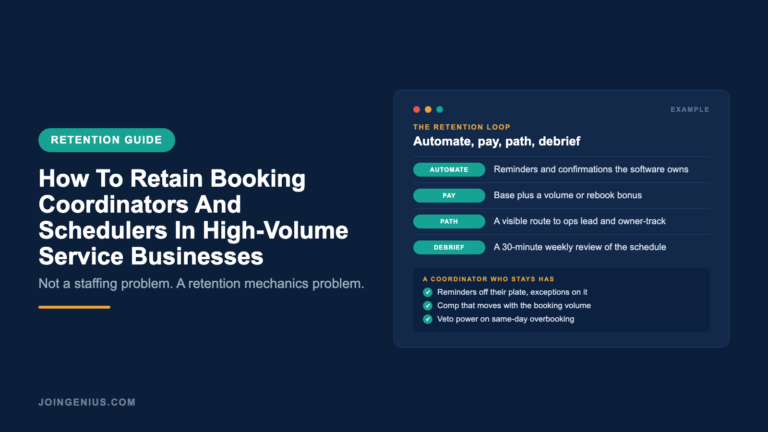
Booking coordinators burn out and quit faster than any other operations role in a high-volume service business, and most owners never see it as a system problem. One strong scheduler walks out in month seven. The owner backfills, loses two weeks of booked revenue to no-shows while the new hire learns the software, and tells themselves it’s a staffing issue. It’s rarely a staffing issue. It’s a retention mechanics issue, and every month without the fix compounds the cost.
That cost keeps rising. Modern hiring workflows have made the role harder, not easier — more channels to monitor, more clients expecting an instant reply, more interrupts per hour. Below, we cover why coordinators churn faster than any other seat, the research on what actually keeps them, the playbook the highest-retention salons, clinics, and service shops run, and the moves to stop making before the next good coordinator writes their notice.
Why Booking Coordinators Churn Faster Than Any Other Operations Role
The classic ops playbook assumes a coordinator is interchangeable. One leaves, you hire another, nothing breaks. That has never been true and the data has only made it worse.
They Sit at the Volume Peak
The booking coordinator takes the first call, the last cancellation, and every rebooking in between. On a Monday morning, that is 60 to 120 interrupts in a four-hour window. No other operations role carries that density.
Every Interrupt Lands on Them
The chef gets to cook. The therapist gets to see the client. The coordinator gets interrupted by every single one of them, plus the phone, plus the inbox. The role is defined by context switching and context switching is the thing that burns people out fastest.
Compensation Lags the Workload
A booking coordinator at a high-volume clinic in 2026 does three times the work the role was scoped for in 2019, often at the same hourly rate. The gap between the complexity of the job and the number on the paycheck is where resentment compounds, and resentment is what gets written on the two-week notice.
The Research on What Actually Keeps Them
The retention literature on front-office and coordinator roles points to the same three levers, and most service businesses only pull one of them well.
Reduce the Repetitive Reach-Outs
Every manual reminder, confirmation, and rebooking email is time the coordinator does not get back. The teams that automate the repetitive layer first keep the coordinator for the parts of the job only a human can do — the recovery call, the apology, the judgment case.
Give Them Real Career Visibility
A coordinator who sees a 24-month path to operations manager stays. A coordinator who sees only “senior coordinator” at the top of the ladder leaves. The ones who stay are the ones who know what they are climbing toward.
Pay for the Chaos, Not Just the Seat
A flat hourly rate ignores the Monday morning that handles 140 calls. A base plus a volume-indexed bonus pays the coordinator for the reality of the job. Low morale at work is almost always traceable to the gap between what the role does and what the comp recognizes.
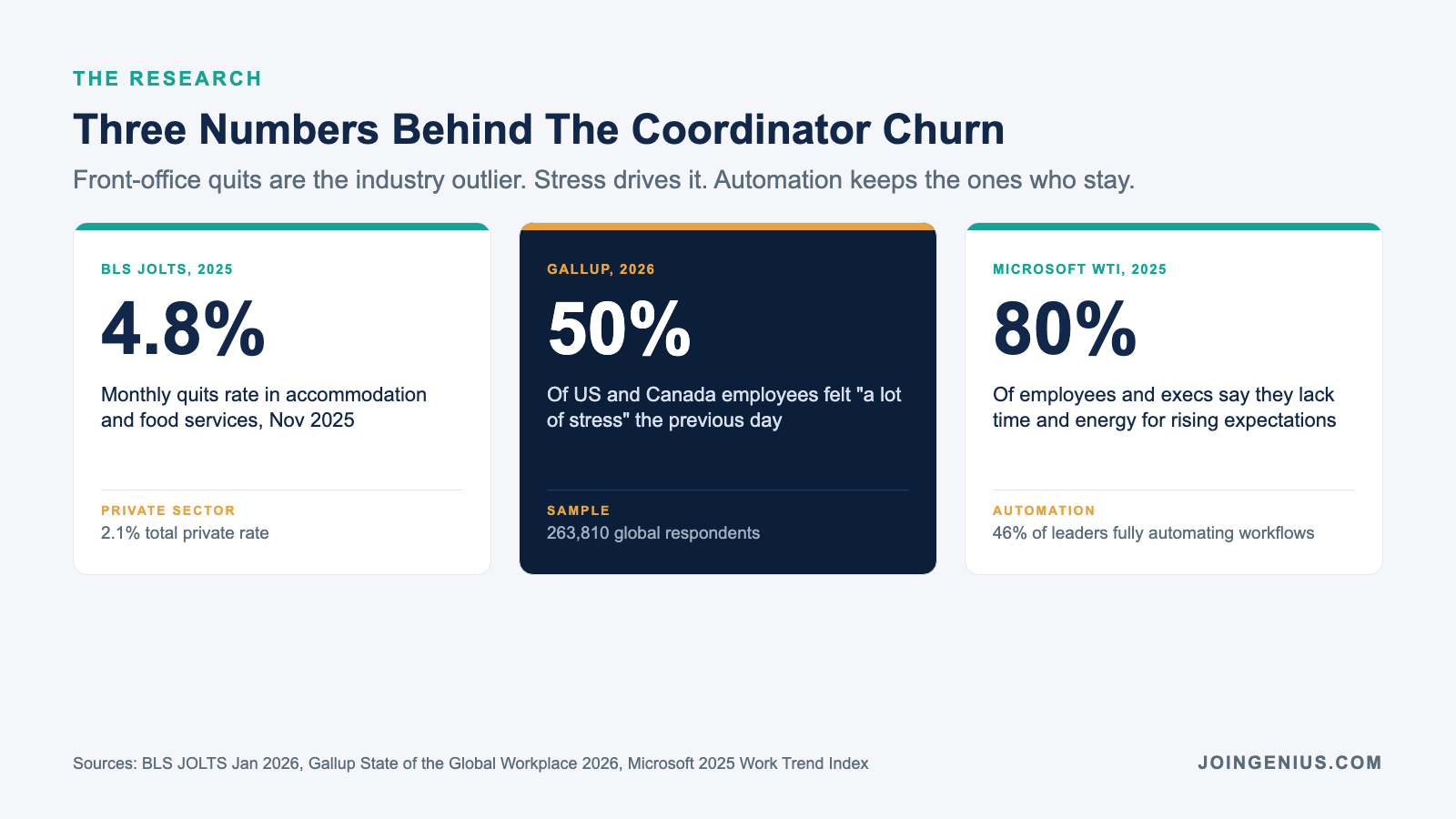
US Bureau of Labor Statistics data from the JOLTS release published January 2026 shows the quits rate in accommodation and food services hit 4.8% in November 2025 — more than double the 2.1% rate for total private employment, and the highest of any major industry. The front-office seat is the exit lane, and the data is explicit about it.
The Playbook High-Retention Teams Actually Run
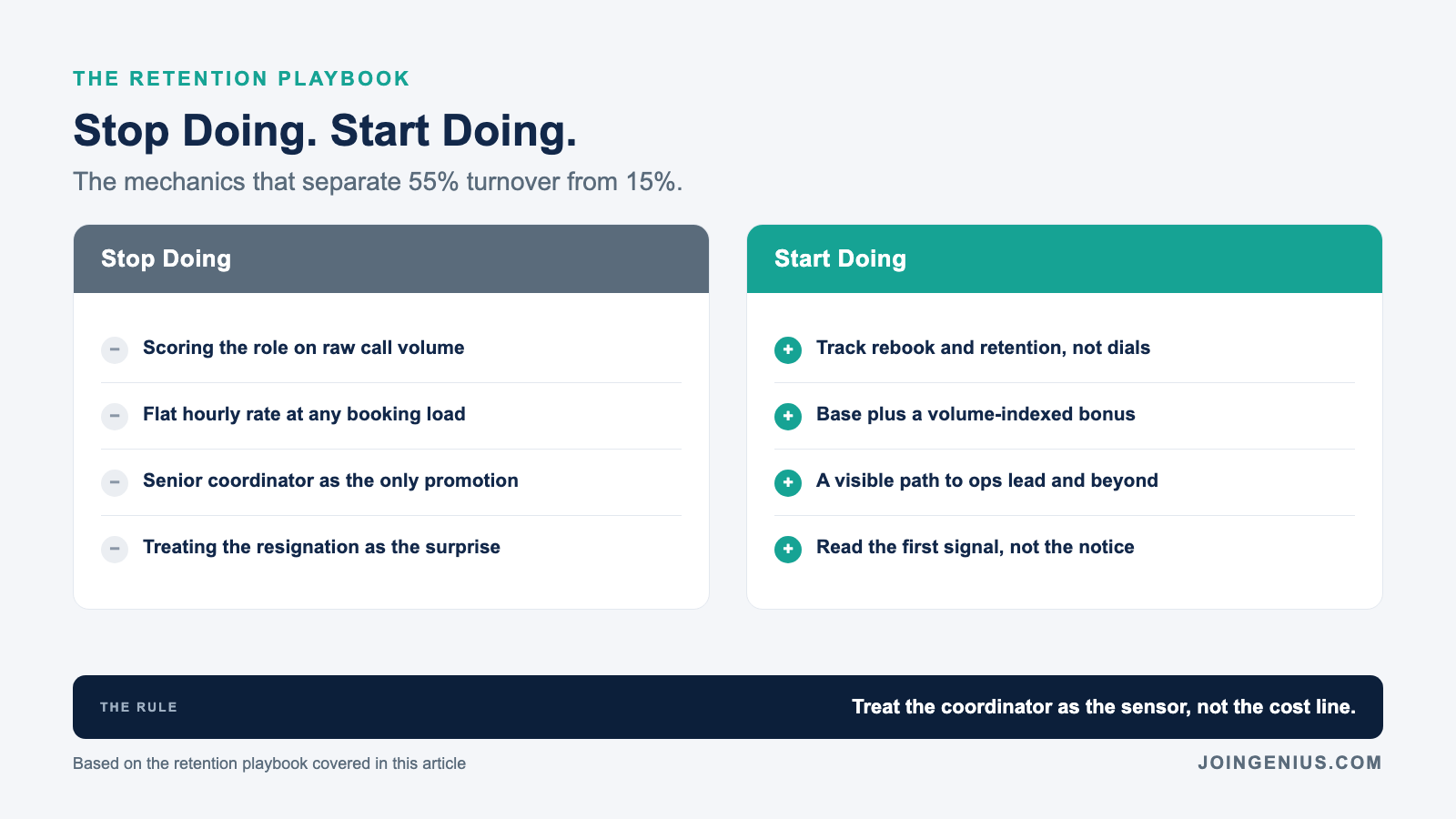
Four moves separate a shop with 55% annual coordinator turnover from one with 15%. Not one of them is clever and all of them are routinely skipped.
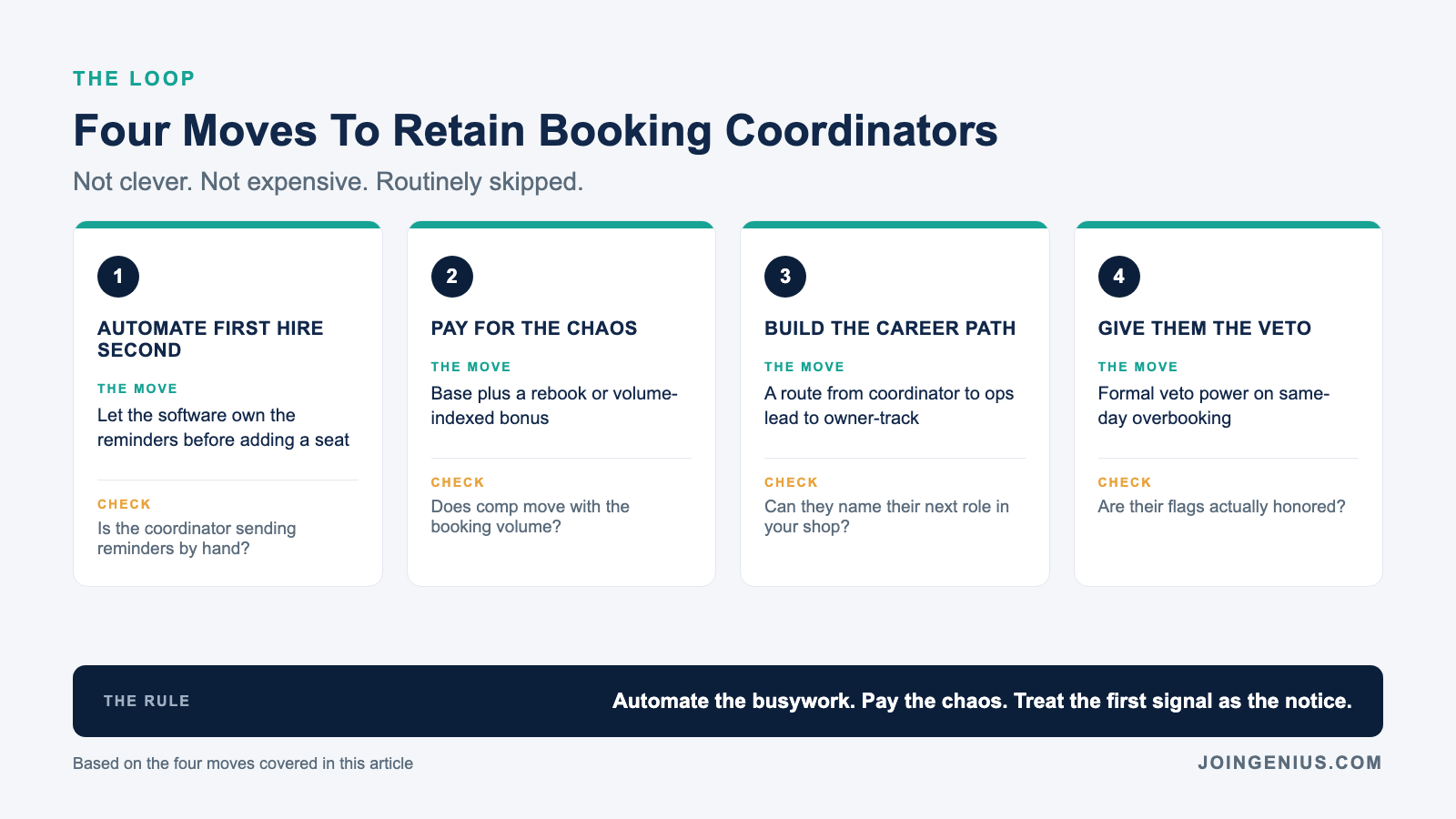
Automate the Reminder Flow Before Hiring Another Seat
The owner who adds a second coordinator before automating the reminder flow is spending twice to solve the wrong problem. The reminders, the confirmations, and the rebooking emails are what the software should own. The coordinator should own the exceptions.
Hand Them a Platform That Does the Repetitive Work
A coordinator working from a shared inbox and a paper book is a coordinator looking for a new job by month five. Teams that give the role a dedicated scheduling platform — with branded booking pages, two-way calendar sync, automated email and text reminders, and client self-service — move the busywork off the human and keep the human for the parts of the job that actually need judgment.
Build a Weekly Debrief
The coordinator sees every bad slot, every chronic no-show, and every double-booked service, and nobody asks. The teams that run a 30-minute weekly debrief with the coordinator catch the operational drift before it becomes a client complaint, and the coordinator stays because the role is treated as the sensor it actually is.
Give Them Veto Power on the Overbooking
The coordinator knows the booking is going to fail. The owner adds the slot anyway. By the fifth time this happens, the coordinator has stopped flagging it. Hand the role a formal veto on same-day overbooking and the quality of the schedule rises, along with the retention rate.
Microsoft’s 2025 Work Trend Index Annual Report, based on 31,000 workers across 31 countries, found 80% of employees and executives say they lack the time and energy to meet rising expectations — and 46% of leaders report their organizations are already fully automating workflows with AI agents. The teams that moved first are not hiring more coordinators. They are keeping the ones they have.
What to Stop Doing (It’s Pushing Them Out)
The moves that quietly inflate the turnover rate are rarely the ones owners audit. These are the four to cut first.
Measuring Them on Call Volume Alone
A coordinator who takes 200 calls and loses 40 clients is not a better coordinator than the one who takes 120 calls and keeps 118. A sharp view of support metrics that matter means tracking resolution, retention, and rebook rate — not raw dial counts that reward speed over outcome.
Running Them on a Flat Hourly Rate
A base that does not move with the booking volume is a comp plan that rewards leaving. Add a monthly rebook or retention bonus and the coordinator starts owning the outcome, not just the shift.
Promoting Them Only to Senior Coordinator
If the only career move inside the shop is “senior” in front of the same title, the strongest coordinators leave for operations manager roles elsewhere. Build a path from coordinator to ops lead to owner-track and the strongest people stay to walk it.
Treating a Resignation as a Surprise
The coordinator who gave two weeks’ notice signaled it three months ago, in the way they talked about Monday mornings. The owner who misses that signal keeps missing it. Treat the first sign as the actual notice.
How to Measure and Keep the Rate Low Over Time
A fix only compounds if you can see it. The measurement step is where most high-volume shops quietly leak visibility on the retention rate.
Track Coordinator Tenure by Cohort, Not Just Average
An average tenure of 14 months can hide a bimodal reality — half the hires leave in month four, the other half stay for three years. The cohort view tells you where the attrition cliff actually sits, which is the only place a fix matters.
Measure the Repetitive Work Load Weekly
Count the reminders, confirmations, and rebookings the coordinator runs by hand each week. If the number is not trending down quarter over quarter, the retention rate will not improve.
Make the Exit Interview Specific
“Why are you leaving” never produces the real answer. “What was the Monday that made you decide” produces the answer that actually improves the shop. Non-cringey team-building and clear retention signals both start from the same place — asking a question specific enough to get a real answer.
A Short Retention Diagnostic Table
| What to Check | Weak Retention Signal | Strong Retention Signal |
|---|---|---|
| Reminder flow | Coordinator sends them manually | Automated, with coordinator for exceptions |
| Compensation hook | Flat hourly, no volume index | Base plus rebook or retention bonus |
| Career path | Senior coordinator as the ceiling | Operations lead and owner-track visible |
| Weekly debrief | None, or ad hoc | 30 minutes, same day, same questions |
Gallup’s State of the Global Workplace 2026 report, based on 263,810 global respondents, found 50% of US and Canada employees experienced “a lot of stress” the previous day — the highest share of any Gallup region. For the booking seat sitting at the volume peak, that number is almost certainly higher, and the retention cost shows up in the next quit.
Conclusion
Booking coordinators do not quit because the work is beneath them. They quit because the mechanics around the work treat them as a cost line instead of a sensor. Automate the repetitive layer, pay for the chaos, build a real career path, and the coordinator who was going to walk at month seven stays long enough to become the ops lead who runs the next three.
We built Genius so high-volume service businesses can staff that kind of role with coordinators they otherwise would not meet. We place the top 1% of operations, scheduling, and customer-support talent from the Philippines and Latin America, at around 80% less than comparable local hires. The relationship stays direct, with no monthly agency fees and a 6-month replacement guarantee on every placement. If the next coordinator you hire is the one you want to keep for three years, see how we source and place the operations talent that stays.