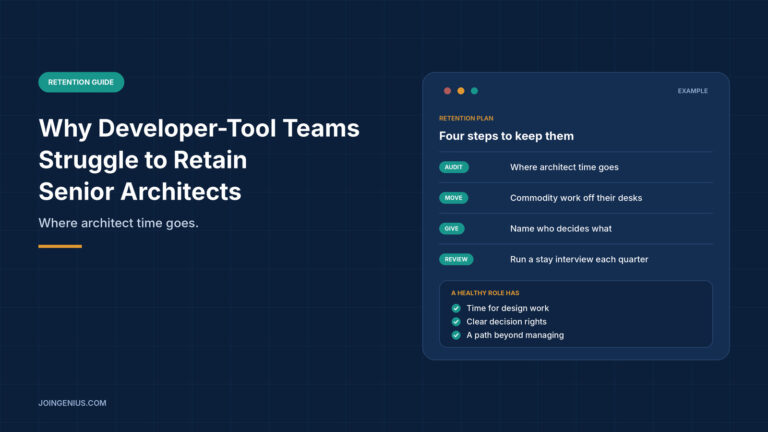
An architect at a developer-tool company designed the public API three years ago. Now she spends most weeks updating a hand-built list of countries, currencies and time zones that three internal services depend on. A customer reports that a currency code changed, and the fix lands on her desk because nobody else understands how the pieces connect. She takes a call from a recruiter who describes a role that is mostly design. That is an illustration, not a case study, but it shows how a senior person can drift away from the work they were hired to do.
This guide explains why developer-tool teams struggle to retain senior architects. It covers what the role involves, what research says about technical debt and turnover, where architect time and authority tend to go, one way to protect design time, a four-step plan and a table of warning signs. We found no study of why architects at developer-tool teams leave, and “senior architect” and “developer-tool team” are our labels, not standard categories. The advice rests on general software research, selection research and our reasoning.
What the Role Involves
In our usage, a senior architect at a developer-tool company decides how a product’s interfaces, data models and versions fit together and what the team will promise to the developers who build on it. Those choices are visible to customers, which raises the cost of getting them wrong. Developer-tool teams add a twist: their customers are developers, who notice every renamed field and removed endpoint. Our reasoning is that versioning, deprecation and compatibility decisions therefore carry more weight than at many other companies, and the architect who owns them can become the person everyone calls. That is an inference, not a finding. Titles vary, so write the job around the decisions. Our guide to hiring frontend architects covers one version of the role, and our piece on retaining senior developers covers the wider group.
What the Research Says
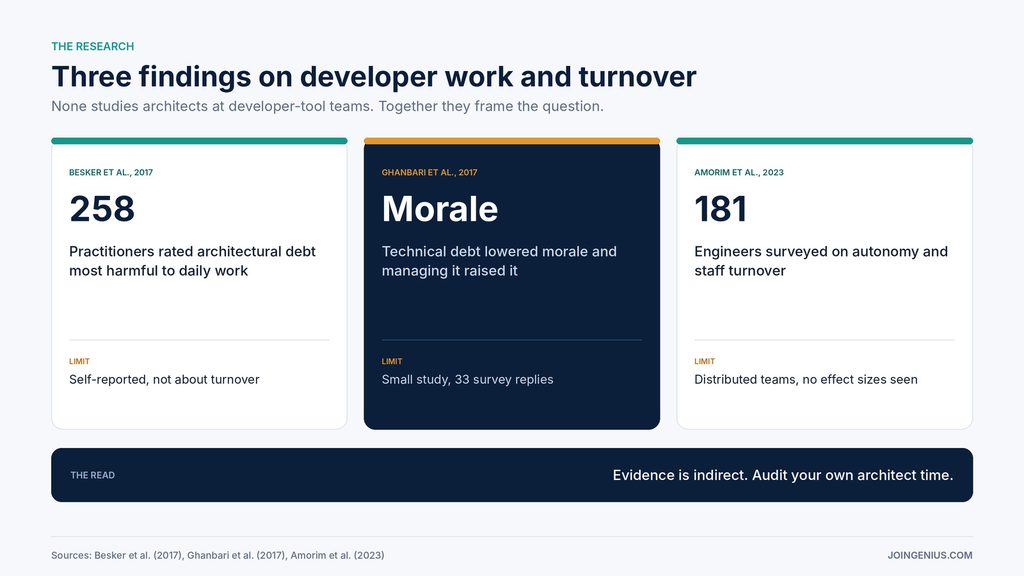
Nothing we found measures architect turnover directly, so we use three nearby studies. Each has limits, and none shows that any change keeps an architect.
Terese Besker, Antonio Martini and Jan Bosch surveyed 258 practitioners for a 2017 paper. The Chalmers record says respondents experienced architectural technical debt as the type with the highest negative impact on daily work, and that it affected all roles with no significant difference between them. We read the record, not the full paper, so we report no time figures. These are self-reported perceptions, and the paper is not about turnover.
Hadi Ghanbari and colleagues, including Besker, Martini and Bosch, ran an exploratory 2017 study with eight interviews and an online survey of 33 professionals. They conclude that technical debt reduces developers’ morale and that managing it increases morale. The sample is small, and morale is not the same as leaving.
Luis Amorim, Ivaldir Farias Júnior and Marcelo Marinho surveyed 181 software engineers in 2023 about autonomy and turnover in distributed teams. They identify recognition, communication, collaboration, trust and task balance as autonomy factors that affect turnover. We saw no effect sizes, and the study covers distributed projects only.
Our reasoning is that an architect who spends the week on rework, with little say over what gets built, meets several of these conditions at once. That is an inference, not a finding.
Where Architect Time and Authority Go
We see four common drains, and they are our reasoning, not measured causes.
- Glue work. Connecting services and keeping them connected, because the architect knows how and nobody else has the context.
- Commodity upkeep. Maintaining data or code that is not what the product is for.
- Thin authority. Owning design decisions that a manager can overrule late.
- A narrow path. Seeing management as the only way to grow.
None of these is dramatic on its own. Together they can turn a design role into a maintenance role without anyone deciding it should. A senior engineer who sees no senior technical track may leave for one. Our career progression framework guide can help you write that track down. A first step is to ask architects directly, and our list of stay interview questions is a starting point. We would add three of our own: which task would you stop doing tomorrow, which decision were you last overruled on and what would you build with a free month? These questions are our suggestions, and the answers show where time and authority are leaking.
Keep Architects Off Reference Data Maintenance and On Design Decisions
Some work looks small and never ends. Country names, currency codes and flags change in the real world, and a product that stores its own copy has to follow. REST Countries’ country data changelog lists changes such as Zimbabwe’s currency code moving from ZWL to ZWG and Nauru’s name field changing to Naoero, which shows how reference data keeps shifting after an integration ships, even though the vendor says its /v5 endpoint stays additive and breaking changes go to a new major version.
That is one vendor’s record. It shows that the churn exists, not what it costs your architects, and the same changelog notes changes, such as the format of flag color data, that could affect integrations built on the old shape, though it does not call them breaking. We have not tested the vendor’s versioning promise.
Our suggestion is a simple rule. Keep in house what makes your product different, and consider handing shifting commodity data to a provider or a named owner. If you buy it in, put a thin adapter and a few tests between the provider and your code, check the provider’s versioning policy and decide who watches the changelog. The goal is not a vendor. It is that no senior architect becomes the silent owner of upkeep. Buying adds a dependency, so weigh it against the time you free.
Hire for the Real Work Too
Retention starts at hiring. If the role is mostly design but the interview talks only about design, a new architect may find a different job on day one. Describe the upkeep honestly, and let candidates see a real decision and a real piece of maintenance.
Selection research supports a shared, scored task, with a limit. A HumRRO summary of Sackett, Zhang, Berry and Lievens (2022) reports revised validity estimates in which structured interviews were highest at .42 and work sample tests were .33. The authors argue that earlier estimates were inflated by range restriction corrections, and they note that structured interview validity varies considerably. These figures concern job performance in general, not architects or retention. They support a modest point: the same realistic task, scored the same way, beats improvising. Our interview guide covers how to structure the conversation, and our HR scorecard guide can help you set up the scoring sheet.
Pay for the time on any take-home, since unpaid tests ask people to work for nothing and may put off experienced candidates. That is our view, not a finding.
A Four-Step Plan to Keep Architects
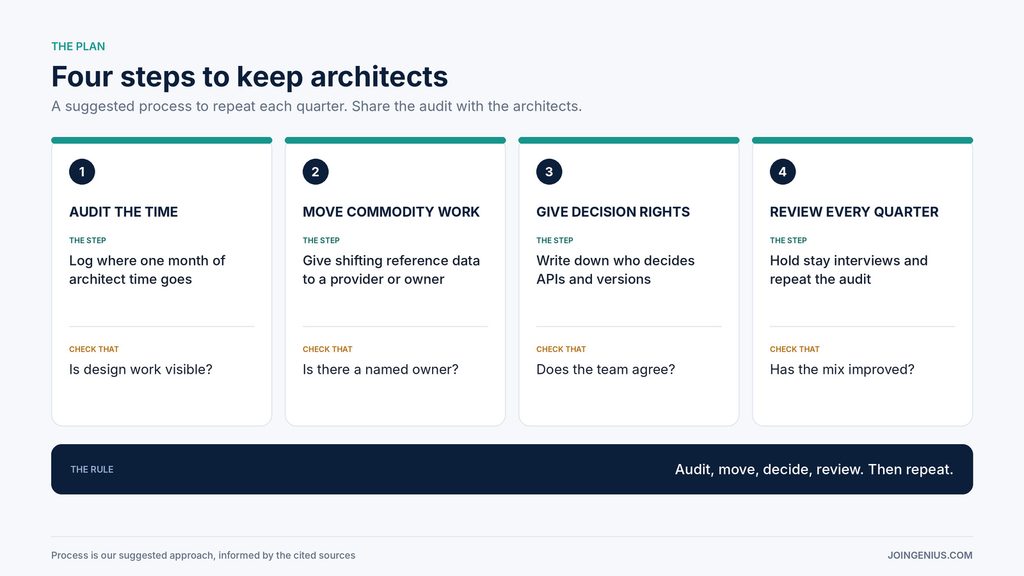
Use this four-step plan each quarter. It is our suggested process, informed by the sources above.
- Audit the time. Log where one month of architect time goes.
- Move commodity work. Give shifting reference data to a provider or a named owner.
- Give decision rights. Write down who decides APIs, versions and deprecations.
- Review every quarter. Hold stay interviews and repeat the audit.
The last step matters because roles drift, and a plan that is never revisited slowly puts the upkeep back on the same person.
Measure Whether It Works
Track the share of architect time spent on design decisions compared with upkeep, how many decisions wait on the architect and how many senior people leave and why. Use stay interview notes for the why, and share the audit results with the architects so they can correct them. Small teams produce noisy numbers, since one departure can swing a quarter, so judge over a year and read the notes before the chart. These measures are our suggestions, not findings. Our guide to employee retention rate explains how to calculate the headline figure.
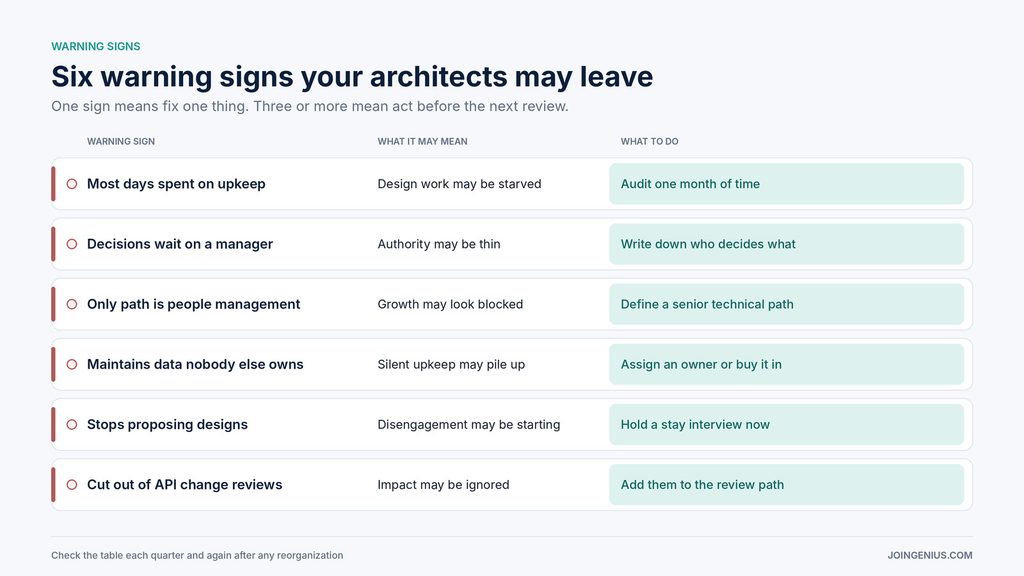
Warning Signs Your Architects May Leave, and What to Do About Each
Check this table each quarter. One sign means fix one thing. Three or more mean act before the next review.
Protect Design Time, Then Check It
Senior architects tend to stay where they spend their time on decisions that matter, with the authority to make them. Audit where the hours go, move shifting commodity work to an owner or a provider, write down who decides what and review it every quarter. We found no study proving that this plan keeps architects, but each step replaces a guess with something you can check. If the next audit shows more design time and fewer silent chores, you have a better reason to expect your architects to stay than any perk could give you.