A company posts a role for a firmware engineer who has worked with a specific real-time operating system. The job board’s AI ranks hundreds of profiles and shows the top twenty. The engineer who spent six years on exactly that system, but whose profile says “embedded software” and uses the system’s older name, is not among them. The recruiter never learns the person existed. That is an illustration, not a case study, but it describes how niche candidates can disappear.
This guide explains why AI-powered job boards can still miss niche technical candidates and how to close the gap. It covers where candidates get filtered out, what semantic scoring changes, what it does not fix, a test you can run on any tool and a table of warning signs. We found no study that measures how often AI job boards miss niche technical candidates, so the advice rests on related research and our reasoning. It is general information, and results vary by tool and role.
Why Niche Technical Candidates Slip Through
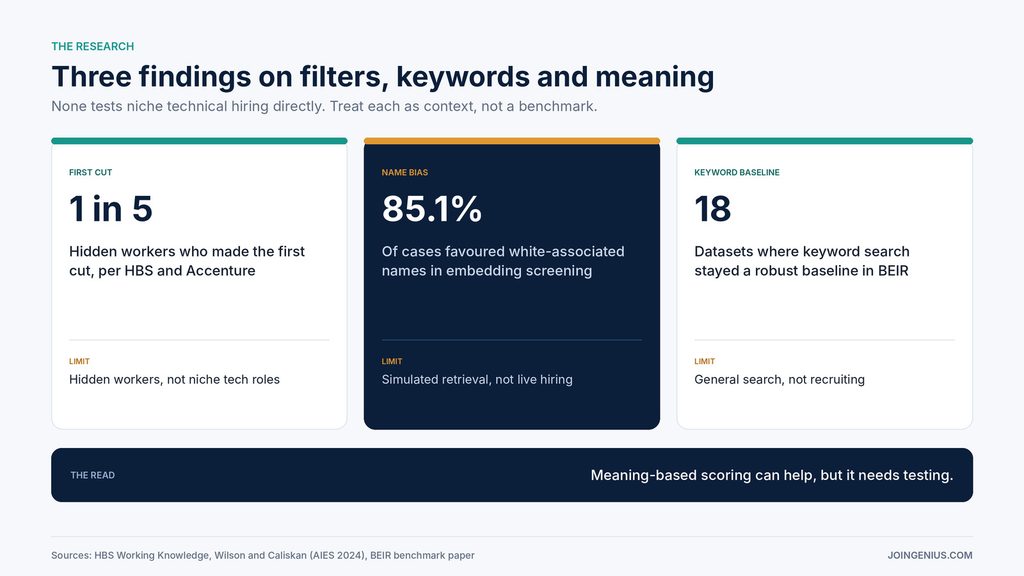
The closest evidence comes from Harvard Business School’s Project on Managing the Future of Work, which worked with Accenture on a report about “hidden workers”. In a summary by Joseph Fuller, the report surveyed 8,720 hidden workers and 2,275 executives in the US, UK and Germany. It says “The majority of employers acknowledged that their hiring systems rejected potentially productive applicants.” Of employers using a recruitment management system, 94% of those hiring middle-skill roles and 92% of those hiring high-skill roles relied on it for a first cut or ranking, and only one in five hidden workers made that first cut.
Read it with care. The summary gives no response rates or sampling method, and the report covers hidden workers in general, such as people with employment gaps, not niche technical hiring or job boards. It does show that automated first cuts are common and that they can filter out people who could do the job.
For niche roles, we can add reasoning. A candidate may describe the same skill in different words from the job post, use an older product name, list a project instead of a skill or hold a title that does not match the post. A tool that rewards exact overlap sees a weak match. That is our inference, and it is why vendors have moved toward scoring on meaning.
Match on Meaning, Not Keywords: How Semantic Scoring Surfaces Niche Candidates
Semantic scoring turns the text of a job post and a profile into numbers that capture meaning, then compares how close they are. A profile that says “GPU programming” can then sit near a post that asks for “CUDA kernels,” even though the words differ. The advantage for niche roles is that the engineer with the older name and the unusual title can still rank, because the system compares what the text is about.
Expertini is one example of a vendor built around this idea. Its listing on Capterra describes an applicant tracking system, with a job board, built on three principles: semantic understanding, deterministic candidate match scoring and human decision-making. The listing says matching “reads for evidence of a skill, not keyword overlap” and that the score comes from “a fixed, published formula outside the model.” The wording appears to be written by the vendor, so we treat all of it as a claim.
A fixed formula matters for a practical reason. If a recruiter can see how a score is built, they can ask why a candidate ranked low and check whether the answer is sensible. We found no independent evaluation of how Expertini’s scoring performs on niche roles. Its Capterra listing shows only a small number of reviews, and reviewers raise concerns about search filters and expired job listings alongside praise for matching. That is thin evidence in either direction, so test the tool on your own roles before you rely on it.
Research on semantic matching in recruitment is also encouraging, with caveats. A 2025 paper in Information Sciences by Mohammed-Hassan Ajjam and Hamed Al-Raweshidy reports that its semantic model “consistently outperforms keyword-based matching across diverse job domains.” The model is built on TF-IDF vectorization, cosine similarity and domain-specific keyword weighting, which are closer to weighted word statistics than to the language models many vendors advertise. We read only the abstract, and the results are the authors’ own. It shows that the label “semantic” covers a wide range of methods, so ask a vendor which one it uses.
What Semantic Matching Does Not Fix
Meaning-based scoring is not automatically better, and two findings explain why. The BEIR benchmark, which tested ten retrieval systems across 18 datasets and nine tasks, concluded that “BM25 is a robust baseline,” a keyword method, and found that dense retrieval models often underperformed other approaches when tested on data they were not trained on. BEIR covers general search tasks, not recruitment. But niche technical vocabulary is exactly the kind of text a general model may not know well, so it is a reason to test, not a proof of failure.
The second finding concerns bias. Kyra Wilson and Aylin Caliskan of the University of Washington audited embedding models in a simulated retrieval setting, using over 500 publicly available resumes and 500 job descriptions across nine occupations. They report that the models favoured white-associated names in 85.1% of cases and female-associated names in only 11.1%. It was a simulation, not a live hiring process, but it shows that scoring on meaning can carry bias into a ranking. Our guide to auditing your recruiting pipeline for demographic blind spots explains how to look for it.
So semantic scoring can help a niche candidate surface, and it can also hide one for new reasons. The way to know is to test.
Close the Gap: Test Your Tool on a Niche Role
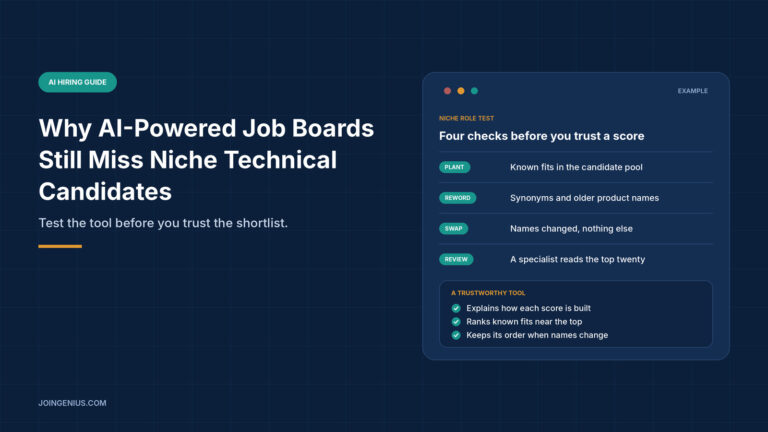
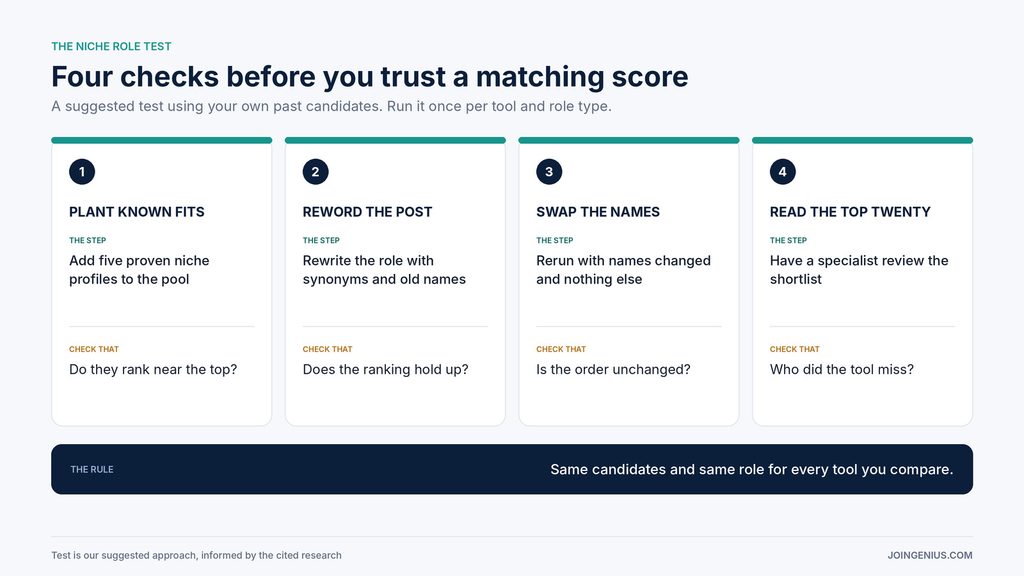
Run this four-part test on any matching tool before you trust its ranking. Use a role you hire for often and candidates whose quality you already know.
- Plant known fits. Add five or more proven niche profiles, such as past hires who performed well, to a pool of ordinary candidates and see where they rank.
- Reword the post. Rewrite the job description using synonyms, older product names and different titles, and check whether the same candidates still rank well.
- Swap the names. Rerun the ranking with names changed and nothing else. If the order shifts, the tool is reacting to something it should not.
- Read the top twenty. Ask a specialist to review the shortlist and a sample below the cut, and note who the tool missed.
Use the same candidates and the same role for every tool you compare, and keep the results in a short HR scorecard so the decision is not based on a demo.
Measure Whether It Works
Track the share of your known-good candidates that land in the top twenty, how often recruiters override the ranking and how long it takes to reach a shortlist the hiring manager accepts. A single role proves little, so repeat the test across a few role types before you reach a conclusion. Our overview of AI recruiting tools lists the main options, and the data on how many companies use AI in hiring gives context for how common the problem could be.
A tool is only half the answer. For rare skills, a human sourcer still matters, and the guide to building a technical talent pipeline covers channels beyond job boards. The piece on sourcing robotics engineers who know ROS, Arduino and Jetson shows how specific a niche search can get. If the job post itself is vague, no matcher will help, which is the point of our guide on why technical hiring fails when job descriptions hide the reality.
Warning Signs Your Matching Tool Is Missing Niche Candidates, and What to Do About Each
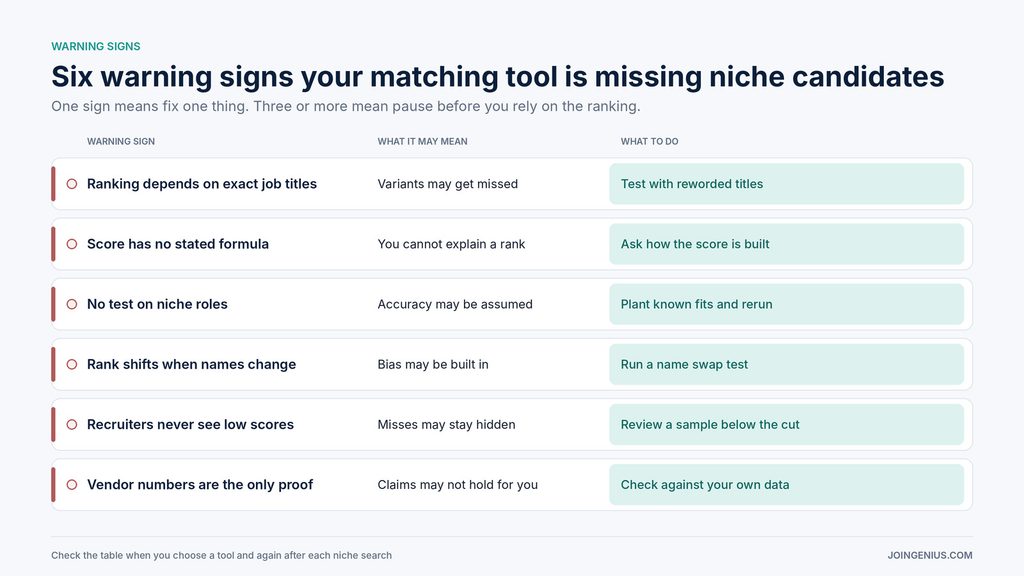
Check this table when you choose a tool and again after each niche search. One sign means fix one thing. Three or more mean pause before you rely on the ranking.
| Warning sign | What it may mean | What to do |
|---|---|---|
| Ranking depends on exact job titles | Variants may get missed | Test with reworded titles |
| Score has no stated formula | You cannot explain a rank | Ask how the score is built |
| No test on niche roles | Accuracy may be assumed | Plant known fits and rerun |
| Rank shifts when names change | Bias may be built in | Run a name swap test |
| Recruiters never see low scores | Misses may stay hidden | Review a sample below the cut |
| Vendor numbers are the only proof | Claims may not hold for you | Check against your own data |
Test the Tool Before You Trust the Shortlist
Semantic scoring can help a niche candidate rank where keyword matching would not, but it is not a guarantee, and the research on bias and unfamiliar vocabulary says to check. Plant known fits, reword the post, swap the names and have a specialist read the list. If the tool passes on your own roles, you have a better reason to trust its shortlist than any vendor claim.