
You burn 3 weeks chasing an Android developer, and they still ghost you mid-sprint. And the worst part? The quotes you got for a basic build came back at $180,000. In all of this, offshore Android development sounds like the lifeline you need, but then you hit timezone silence and a vendor who doesn’t even understand your app at all.
This guide breaks the noise. You’ll get a clear, no-fluff roadmap to offshore Android development: what it costs, where it actually works, which offshoring companies deliver, and how to hire developers with real Kotlin chops. From rate benchmarks to skill checklists to model breakdowns, this is the playbook you hand to your CTO.
Offshore Android Development: The 5 Core Details You Need

- What it actually means: Offshore Android development is building your app with a full-cycle Android team in a lower-cost country, often for 60–70% less than onshore rates.
- What models exist: You can hire dedicated teams, commit to a fixed-scope build, go sprint-by-sprint with time & materials, plug gaps with staff augmentation, or test first through trial-to-hire.
- What it should cost: Expect $20K–$500K for a full Android app, depending on scope, complexity, and region, plus $2K–$10K/month for post-launch maintenance.
- Where it works best: Asia, Latin America, and Eastern Europe lead the way for budget, skill coverage, and time zone fit, each with distinct strengths you’ll want to match to your use case.
- What to watch out for: Scope creep, timezone silence, code quality gaps, and IP risks are common but all avoidable with structured hiring, async workflows, and sprint-level oversight.
Check Out These Related Popular Reads
🔥 IT Offshoring: Benefits, Risks, Companies, & When to Use It
🎯 Business Process Offshoring: Explained With Real Cases
📣 Offshoring Vs Reshoring: 15 Key Differences You Should Know
What Is Offshore Android Development & How Does IT Differ From Onshore/Nearshore?

Offshore Android development is hiring a remote Android development team located in a different country, typically one with significantly lower labor costs. These teams handle everything from app ideation to deployment and post-launch support.
It’s more than just cost-cutting; it’s about access to niche expertise, flexible scaling, and around-the-clock productivity.
Use this table to compare offshore Android development with nearshore and onshore development.
| Offshore Android Development | Nearshore Android Development | Onshore Android Development | |
|---|---|---|---|
| Team Location | Different continent (e.g., US → India, Philippines) | Nearby country (e.g., US → Mexico) | Same country or city |
| Hourly Rates | $15–$45/hour (average) | $30–$65/hour (average) | $80–$150/hour (average) |
| Time Zone Overlap | Partial (a few hours of overlap daily) | Moderate to full overlap | Full overlap |
| Communication Gaps | Higher risk without SOPs and async tools | Low to moderate risk based on the team | Minimal |
| Cultural Fit | Varies by region; requires vetting for business norms | More cultural similarity | High alignment with business culture |
| Team Availability | 24/7 development cycles are possible | Extended overlap for daily syncs | Standard 9–5 work hours |
| Use Case Fit | MVPs, cross-platform apps, full-scale builds, and extensions | Long-term partnerships and agile extensions | Compliance-heavy builds and apps with unstable specifications |
| Best For | Startups, scaleups, cost-conscious enterprises | Mid-size companies and US/EU teams that want to overlap | Regulated industries and projects that require in-person oversight |
How Offshore Android Development Works: 5 Engagement Models To Consider
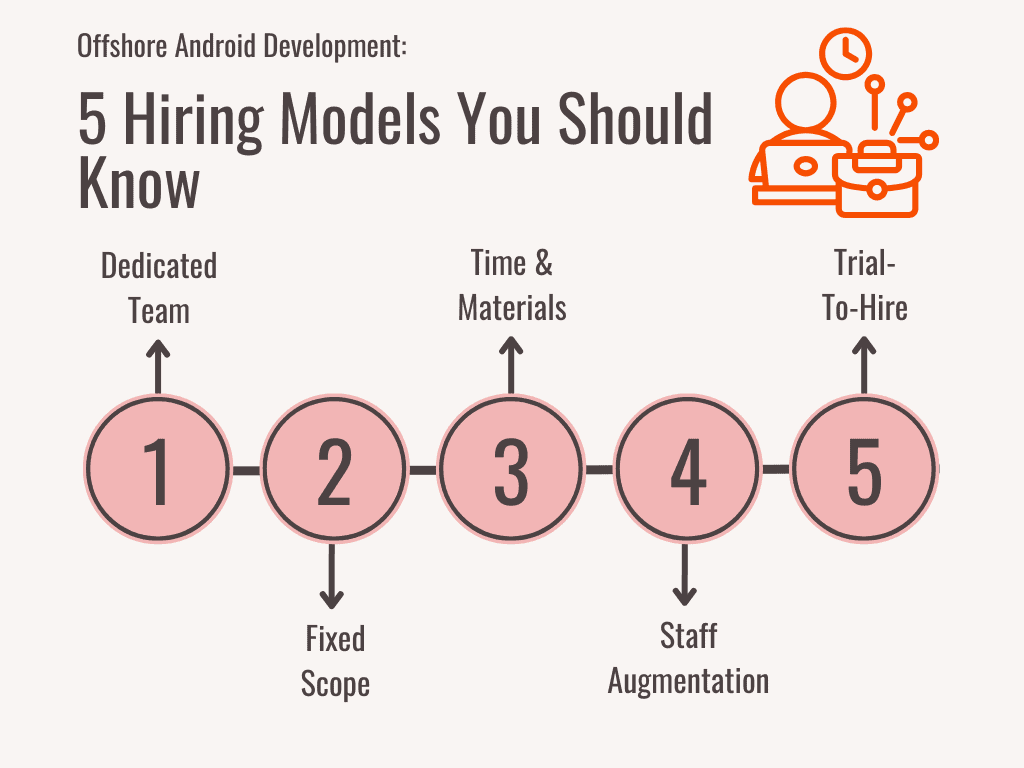
Let’s understand how offshoring works and how you can find the model that matches your Android development goals.
1. Dedicated Teams: Your Remote Development Squad On Standby
How it works: You get a full-time Android development team (developers, QA, and PMs) that works exclusively on your product. They function as a remote extension of your in-house team.
Best for:
- Long-term Android roadmaps (6+ months)
- Multiple app iterations and maintenance cycles
- Products with shifting priorities or unknown scope
- Companies that need fast onboarding with deep skill retention
- Tech leads who want full codebase control
Avoid if:
- Your project has a fixed feature list and a short timeline
- You lack internal resources to manage a team
- You can’t commit to full-time engagement
- Your product doesn’t require continuous iteration
- You need instant results from day 1
Structure & ownership:
- Your PM leads sprint planning and backlog
- The vendor manages payroll, HR, and infrastructure
- You control code reviews and QA benchmarks
- The same developers stay for the full project term
- Knowledge stays centralized over time
Scope & flexibility: Scale the team up or down within 1–2 sprints. You can shift features or timelines without renegotiating contracts.
2. Fixed Scope: 1 Contract, 1 Deliverable
How it works: You define the feature set, timeline, and budget upfront. The offshore team ships a complete Android app based on agreed specifications.
Best for:
- MVPs and proof-of-concept builds
- Corporate clients with strict approval workflows
- Projects with crystal-clear specifications and limited scope creep
- Budget-sensitive builds
- Short-term engagements (4–12 weeks)
Avoid if:
- You expect major mid-build pivots
- You lack finalized wireframes or Project Requirements Documents (PRDs)
- You want regular feedback loops
- Your product includes integrations or dependencies
- You plan to iterate based on user feedback
Structure & ownership:
- Vendor PM manages delivery
- Your role: provide input only at milestones
- Team composition is fixed
- You get a single deployable build
- QA and staging are often handled by the vendor
Scope & flexibility: Rigid. Any scope changes trigger a change request and cost increase.
3. Time & Materials: Pay As You Build
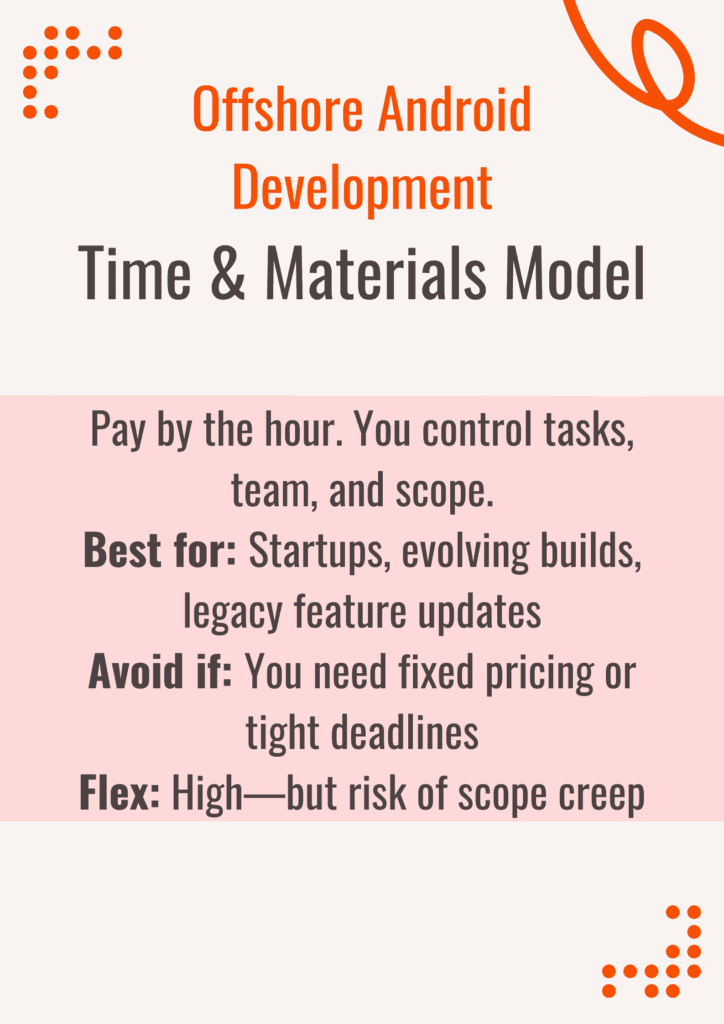
How it works: You pay hourly or daily rates for developers. You control scope, tasks, and timelines, but pay for time spent instead of deliverables.
Best for:
- Startups that want to validate product-market fit
- Projects with fluid specifications
- Companies that want to test features before they scale
- Teams with internal project managers (PMs) or tech leads
- Feature extensions on legacy apps
Avoid if:
- You lack clear sprint planning and estimation
- You’re sensitive to scope creep
- You need price predictability
- You have tight launch deadlines
- You prefer not to manage day-to-day output
Structure & ownership:
- You assign tasks via your own PM
- Developers track hours via tools like Jira or Clockify
- Your QA team or vendor QA tests features
- You control commits and release approvals
- The vendor may rotate resources based on demand
Scope & flexibility: Maximum flexibility. But costs rise fast if the scope is poorly managed.
Most teams waste weeks on devs who can’t ship or sync. The right Android offshore partner gives you velocity without volatility.
— Burkhard Berger, Founder & CEO of Genius
4. Staff Augmentation: Fill One Gap, Not Build A Team
How it works: You hire specific Android experts (e.g., a Kotlin developer or QA lead) who join your in-house team on a contract basis.
Best for:
- Teams with core engineering in place
- Temporary gaps in seniority or specialization
- Sprints that need more velocity
- One-off code refactoring or SDK upgrades
- Companies that want to add mobile capacity without full-time hires
Avoid if:
- You lack technical oversight internally
- You want full-stack or end-to-end support
- You want to build from scratch
- You need team-level coordination
- You don’t want to handle daily task distribution
Structure & ownership:
- You manage day-to-day work
- Developers follow your tools, workflow, and standups
- Vendor handles contracts and payments
- No project delivery responsibility on the vendor
- Minimal ramp-up if you already have SOPs
Scope & flexibility: Easy to swap in/out per sprint. But resource continuity depends on your process clarity.
5. Trial-To-Hire Model: Test First, Commit Later
How it works: You start with a part-time engagement (2–4 weeks) to vet the offshore team or individual developer. If things click, you extend to full-time.
Best for:
- Companies new to offshoring
- Critical features that require high accountability
- Teams that value hands-on vetting
- Hiring for long-term roles
- Reducing onboarding risks
Avoid if:
- You need immediate full-time output
- You’re on tight launch deadlines
- Your decision-making process is slow
- You can’t assign real work for trials
- You expect trial resources to lead the architecture
Structure & ownership:
- You manage delivery and vet performance
- The vendor provides structured reports or trial results
- Developers join the existing team and workflow
- Post-trial conversion is often pre-approved
- Risk-free offboarding if the trial fails
Scope & flexibility: Limited during the trial phase. Full flexibility begins after post-hire confirmation.
🚨 Did You Know?
Over 66% of US companies with 50 or more employees outsource services.
3 Popular Offshore Android Development Destinations: What Should You Pick?

Use this table to filter locations based on your budget and product complexity.
| Latin America | Asia | Eastern Europe | |
|---|---|---|---|
| Top Countries | Argentina, Brazil, Colombia, Mexico | India, Vietnam, Philippines | Ukraine, Poland, Romania |
| Average Hourly Rate | $30–65 | $15–40 | $35–70 |
| Time Zone Overlap (US) | 4–8 hrs/day | 0–4 hrs/day | 6–9 hrs/day |
| English Proficiency | High (EF EPI Rank: 1–3) | Moderate (EF EPI Rank: 20–30) | High (EF EPI Rank: 7–10) |
| Android Talent | Strong (React Native and Kotlin) | High (Java, Kotlin, and full-stack) | Robust (Jetpack, Compose, and Firebase) |
| Pros | Near-US hours, strong culture fit, and agile teams | Lowest costs, massive talent pool, and flexible contracts | Strong technical depth, high code quality, and stable teams |
| Cons | Limited enterprise experience and rising demand | Time zone gap and potential communication gaps | War-related disruptions and slower onboarding |
| Best For | US-based startups & scaleups with lean teams | MVPs, feature builds, and cost-driven projects | Enterprise-grade apps and security-heavy builds |
6 Key Offshore Android Development Benefits You Can Enjoy
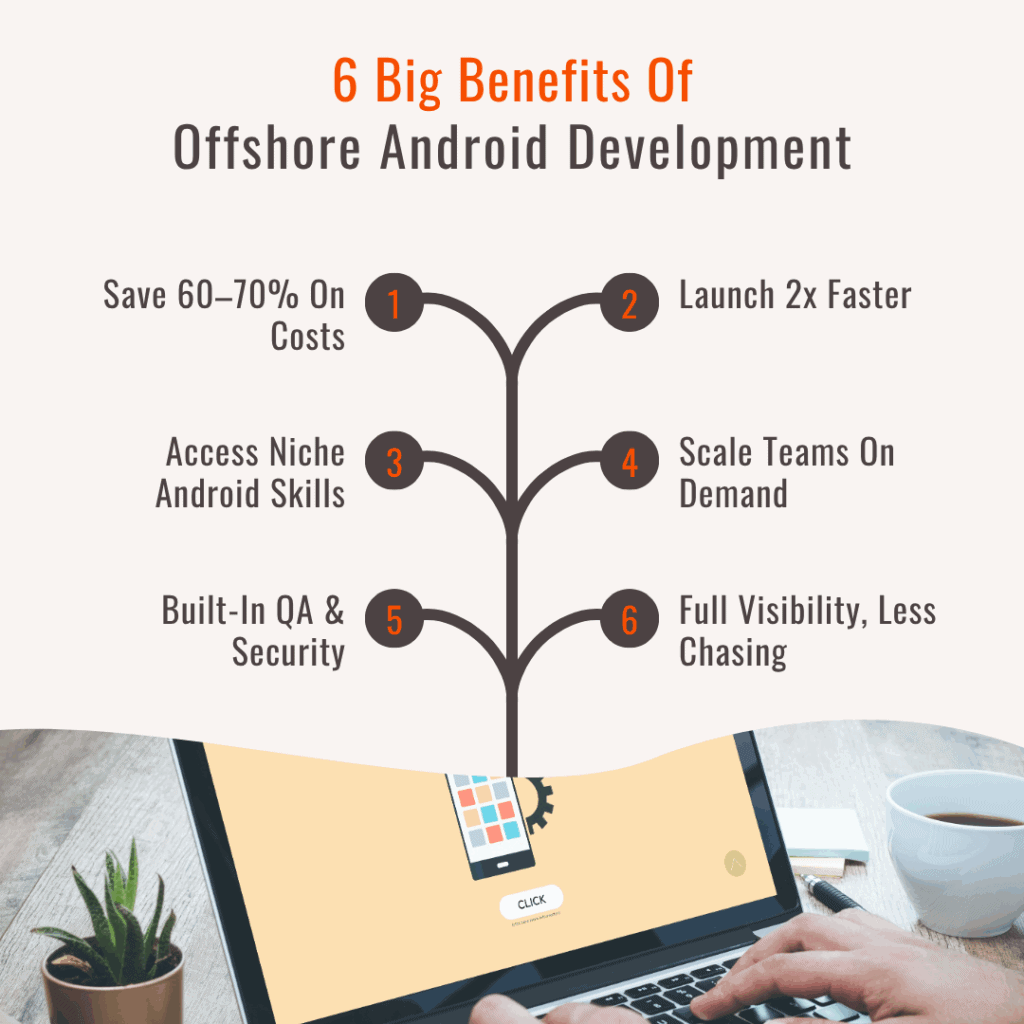
Scan these benefits of offshoring Android development to see where it will give you the biggest lift.
1. Cut Build Costs by 60–70% Without Cutting Corners
Offshore Android developers from Asia or Latin America charge $15–$45/hour, compared to $100+/hour in the US. You get senior Kotlin and Jetpack talent at a fraction of the cost. Most vendors also bundle PMs, QA, and DevOps into fixed rates, so you avoid stacking fees. For end-to-end builds, that’s a 6-figure difference without quality loss if you vet properly.
2. Release Faster With 24/7 Development Cycles
Offshore teams can push code while your in-house team sleeps. That means critical features don’t sit idle overnight. With 4–8 hours of overlap and proper async tools (Jira, Slack, Loom), you can ship 2x faster without burning out internal teams. This model works best when your roadmap includes rapid iterations or tight investor deadlines.
3. Plug Into Skills You Can’t Hire Locally
Need a Jetpack Compose expert? Or someone who’s shipped Android apps with ARCore or IoT device control? Offshore markets give you access to niche skills that your local job board just can’t offer. You skip the 90-day recruiter cycle and plug in vetted talent that already knows the frameworks, toolkits, and constraints of Android-specific builds.
4. Scale Up Or Down Without Process Breakage
You can expand from one developer to a full team of 5–10 in under 2 weeks when the vendor already has pre-vetted talent. That’s critical when scope changes mid-sprint or your product moves from MVP to production. Offshore teams often include elastic bench strength, so you don’t need to re-interview every time you grow.
You pause or downsize just as quickly without legal or severance headaches.
5. Get QA, Security, & Compliance Baked In
Top vendors offer built-in security reviews, Play Store compliance checks, and automated regression tests per sprint. This eliminates the need for separate security audits or extra QA hires. It’s especially valuable for fintech, health, or enterprise-grade apps that can’t afford bugs or data leaks post-launch.
6. Visibility & Control Without Micromanaging
Modern offshore teams use GitHub for source control, Jira for sprint planning, and tools like Linear, Slack, and Loom for async updates. You get commit-level transparency, sprint burn-downs, and weekly demos without the need to chase updates. If your current developers are slow to report or over-rely on calls, this alone makes offshore a smoother ride.
What Should You Look For In Offshore Android Developers? 6 Key Skills That Are Non-Negotiable

Run each candidate through this checklist before you onboard anyone.
- Kotlin-first approach: Ask for apps built entirely in Kotlin. Don’t settle for Java holdovers. Kotlin reduces null-pointer crashes, works faster with Jetpack, and cuts boilerplate code by 40% or more.
- Full Android SDK fluency: Check that they’ve used key components like ViewModel, WorkManager, and Room. Have them walk you through lifecycle handling and background sync in one of their past projects.
- Jetpack + Compose mastery: Look for experience shipping at least one production app using Jetpack Compose. It shows they know how to write modern UIs declaratively and reduce code by up to 30%.
- API & backend integration: Ask how they’ve handled Firebase, RESTful APIs, and OAuth2 flows. Bonus if they’ve worked with real-time data (like Firestore or WebSockets) and handled rate limiting or token refresh.
- Toolchain confidence: They should already be using Android Studio, Git, Postman, and JIRA or Trello. Ask for a repository link that shows branching discipline, commit clarity, and PR hygiene.
- Cross-platform thinking: Even if you’re focused on Android, prioritize developers who’ve built with Flutter or React Native too. These developers can prepare your stack for future iOS or tablet versions without rewrites.
📢 Interesting Fact
1.57 million Filipinos are employed full-time in BPO firms.
5 Scenarios When Hiring Offshore Android Developers Is Your Best Option + When To Avoid

Run through the lists below to find out if offshore Android development actually fits your roadmap.
Hire Offshore Android Developers If
- Your local burn rate caps you at 1–2 hires, but your product needs 5.
- If your velocity depends on headcount but your budget doesn’t stretch beyond $150K/year, offshore gives you full-stack Android coverage (Kotlin, Jetpack, QA, PM) for that same cost.
- If your velocity depends on headcount but your budget doesn’t stretch beyond $150K/year, offshore gives you full-stack Android coverage (Kotlin, Jetpack, QA, PM) for that same cost.
- You need a 3-month delivery window, not 6.
- Offshore teams with ready-to-deploy Android talent reduce hiring lead time from 6–8 weeks to 5–10 days. You skip sourcing, notice periods, and onboarding deadweight.
- Offshore teams with ready-to-deploy Android talent reduce hiring lead time from 6–8 weeks to 5–10 days. You skip sourcing, notice periods, and onboarding deadweight.
- Your Android stack needs rare skill pairs.
- Examples: Compose + ARCore, Firebase + offline-first, Jetpack + Flutter fallback. Most local markets don’t offer these combinations without 3–6 months of headhunting.
- Examples: Compose + ARCore, Firebase + offline-first, Jetpack + Flutter fallback. Most local markets don’t offer these combinations without 3–6 months of headhunting.
- You’ve already burned cycles on in-house false starts.
- Offshore vendors with prebuilt workflows, release templates, and design-to-development pipelines keep your roadmap from stalling out, especially if this is your 3rd or 4th attempt.
- Offshore vendors with prebuilt workflows, release templates, and design-to-development pipelines keep your roadmap from stalling out, especially if this is your 3rd or 4th attempt.
- You’re preparing for external funding or audits.
- Audit-friendly commits, Sprint burn-downs, repository hygiene, and automated test coverage from a top offshore team can turn your build into a due diligence asset instead of a liability.
Hiring An Offshore Android Developer Will Backfire If
- Your product decisions are still in flux.
- If you’re debating feature scope, design direction, or monetization models, even the best offshore team won’t deliver what you haven’t finalized.
- If you’re debating feature scope, design direction, or monetization models, even the best offshore team won’t deliver what you haven’t finalized.
- You have zero backend or API infrastructure ready.
- Most offshore Android developers won’t (and shouldn’t) build your server from scratch unless you’ve scoped and secured backend capacity first.
- Most offshore Android developers won’t (and shouldn’t) build your server from scratch unless you’ve scoped and secured backend capacity first.
- You treat developers as task-doers, not collaborators.
- If your team expects yes-men or copy-paste engineers, you’ll waste talent and stall progress. Offshore works best when paired with clarity and ownership.
- If your team expects yes-men or copy-paste engineers, you’ll waste talent and stall progress. Offshore works best when paired with clarity and ownership.
- You expect a perfect match with no trial.
- Without a trial-to-hire model or test sprint, you’ll risk mismatched communication styles, development speed, or UI judgment. Vet before you commit.
- Without a trial-to-hire model or test sprint, you’ll risk mismatched communication styles, development speed, or UI judgment. Vet before you commit.
- You plan to offload project leadership entirely.
- If you don’t have anyone to drive sprints, prioritize features, or test releases internally, offshore teams will build, but just not what you need.
Offshore Android development only works when you treat hiring like matchmaking. Speed’s great, but fit is what makes it stick.
— Christian Cabaluna, Senior Recruiter at Genius
7 Steps To Offshore Android Development: Your Hiring Process Checklist

Follow these steps to build offshore firepower without rework, delay, or legal risk.
Step 1: Set The Android App Specifications In Stone First
If your scope is vague, your build will stall. Lock your app goals, features, and must-have integrations before you even contact vendors.
- List your core features, integrations, and must-support Android versions in a PRD
- Prioritize 5–7 features into “must-have” vs “later” buckets
- Decide on launch platform: phone-only vs tablet vs cross-platform
- Estimate your budget per phase: MVP, beta, and v1.0
- Set a target go-live date and expected team size
Step 2: Choose A Pricing Model That Won’t Drain Your Budget
Don’t start hiring until you know how much flexibility you need. Each engagement model comes with trade-offs.
- Pick Fixed Scope if you’ve finalized wireframes and want predictability
- Use Time & Materials if you’re testing features or adjusting weekly
- Go with Dedicated Teams if you want roadmap ownership or velocity
- Avoid Time & Materials if your CEO needs fixed monthly budgets
- Always ask vendors to show pricing benchmarks for similar Android projects
Step 3: Shortlist Vendors With Real Android Experience
Most development firms offer Android as an afterthought. You want firms that specialize in it.
- Ask for case studies with 2–3 shipped Android apps (not just mockups)
- Check if they’ve handled Kotlin-only stacks, Jetpack Compose, or Firebase
- Skip any vendor that can’t give you English-speaking PMs or async workflows
- Prioritize vendors that can start within 7–10 business days
- Look for GitHub links or test builds, not just pitch decks
Step 4: Interview Developers Like You’re Hiring In-House
Don’t trust pre-packaged resumes. Speak directly to the developers. Treat it like an in-house hire.
- Ask what SDKs they used, how they handled lifecycle bugs, and which tools they prefer
- Review a Git repository together. Look at commit hygiene, branch structure, and readme clarity
- Check how they’ve handled OAuth, Firebase, or local caching in past apps
- Ask what they’d change in a past Android UI they built
- Reject candidates who can’t explain decisions or code tradeoffs
Step 5: Set Legal Ground Rules Before Kickoff
If your IP isn’t protected before the first line of code, you’re already behind.
- Sign NDAs before you share wireframes or login credentials
- Include IP ownership, bug liability, and release control in the master agreement
- Require all commits to route through your repository or private GitHub
- Mandate local backups and encrypted logins for all development machines
- Add exit clauses for non-performance, not just payment disputes
Step 6: Set Up Tools So You Don’t Micromanage
With the right setup, you’ll get progress updates without chasing them down.
- Use Jira or Linear for sprints, with 2-week cycles and prefilled tickets
- Communicate via Slack + Loom, not daily Zooms
- Track code pushes with GitHub and request review videos for each feature
- Create a shared QA checklist for Android testing: screen sizes, OS versions, and load time
- Ask for weekly demos or bug burndown summaries every Friday
Step 7: Treat The Launch As A Long-Term Commitment
A clean v1 build is not the end; it’s when most issues start.
- Confirm they’ll patch Android OS updates for 6–12 months
- Set expectations for hotfix turnaround times (under 48 hrs for P1 bugs)
- Ask for a Play Store submission checklist with versioning, permissions, and icons
- Clarify if post-launch QA and maintenance are included in monthly fees
- Keep the same team on standby for feature updates or version releases
5 Most Common Offshore Android Development Challenges & How To Avoid Them

Address these 5 critical offshore Android development challenges to avoid costly setbacks.
- Delayed updates due to time zone silence: Set a fixed 2-hour overlap block and use Jira with Loom videos for async status reports. Add a daily cutoff for code commits by 8 am your time.
- Missing test coverage before release: Ask for coverage reports with >80% unit test completion. Use Firebase Test Lab to run automated tests across 10+ Android devices before signoff.
- Code rot from rotating contractors: Only accept vendors who guarantee developer continuity for 3–6 months. Require repository access logs, onboarding documents, and handoff templates before sprint one.
- Version bugs after Android OS updates: Enforce biweekly regression testing against the latest 2–3 Android versions. Add release freeze protocols during Google beta rollouts.
- Loose IP practices that break compliance: Use private GitHub access, encrypted devices, and signed NDAs before any asset handoff. Set all code and design ownership to transfer at each sprint delivery.
How Much Does Offshore Android Development Cost? A Complete Breakdown Of Expected Costs

It costs $15–$70/hour to hire offshore Android developers, based on their region and seniority. Full-cycle Android apps usually fall between $20K–$500K, with ongoing maintenance priced separately. Here’s a quick breakdown:
- Basic MVP (3–4 screens, no backend): $20K–$40K (one-time, project-based)
- Mid-size B2C app (Firebase, offline sync): $50K–$120K (one-time, project-based)
- Enterprise Android app (integrations, complex UI): $150K–$500K (one-time, project-based)
- Ongoing maintenance + updates: $2K–$10K/month
Hidden Offshore Android Development Costs To Budget For
- PM overhead: $1K–$3K/month
- Async tool stack (Jira, Slack, Loom): $200–$500/month
- QA cycles & device testing: $500–$1K/month
- Bug patching & Play Store compliance: $500–$2K post-launch
The Top 3 Offshore Android Development Companies That Deliver
Review your options and select one that works for your product scope, budget, and development timelines.
1. Genius: Best Value Android Talent From Latin America & The Philippines

Core Services: Full-time remote Android developers skilled in Kotlin, Jetpack Compose, Firebase, and cross-platform stacks like Flutter.
Best For:
- CTOs and VPs of Engineering building Android MVPs or full-scale apps
- Product managers with limited budgets but strict deadlines
- Startups scaling mobile teams without full-time recruiters
- Teams that need timezone overlap with US hours
Sourcing & Vetting Process: Genius runs a 12-stage pipeline that includes real-world projects and final interviews with senior tech leads. Only 1% of applicants pass; every candidate is screened for communication, stack fluency, and startup readiness.
Time-To-Hire & Hiring Model: 7–14 days. Full-time remote. No monthly fees. One-time success fee only.
Guarantees: 6-month replacement guarantee. Zero cost if you don’t make a hire.
Who It’s Not For:
- Teams that want hourly contractors or part-time help
- Projects without bandwidth for onboarding remote talent
💭 Food For Thought
Latin America’s enterprise software market has topped $14 billion in revenue.
2. vteams: Rapid Android Team Assembly With Security-Focused Execution

Core Services: End-to-end Android development from Kotlin builds to Firebase integration, Jetpack UI, and backend systems. Includes UI/UX, QA, and PM roles under one roof.
Best For:
- Companies launching Android apps with ARCore or IoT features
- Technical founders who want full-stack execution with 24/7 support
- Scaleups needing CI/CD pipelines, GitHub Actions, or Play Store preparation
- Agencies outsourcing Android projects with tight delivery windows
Sourcing & Vetting Process: vteams filters talent via live coding tests, face-to-face technical interviews, and problem-solving challenges. Final candidates are matched by Android toolset expertise, from REST APIs to CI tools.
Time-To-Hire & Hiring Model: 48–72 hours. Project-based or full-time remote developers. Flexible scale-up/down model.
Guarantees: Transparent hiring with dedicated support and NDA-backed compliance. No forced lock-ins.
Who It’s Not For:
- Teams looking for one-off freelancers
- Founders who want to manage hiring and delivery internally
- Projects with limited scope or no DevOps pipeline
3. 10Pearls: Enterprise-Grade Android Builds With Deep Technical Rigor

Core Services: Android design and development across industries. Includes UI/UX, API integration, SDKs, databases, and cross-functional scaling.
Best For:
- Enterprises with multi-platform Android roadmaps
- Product leads building secure, scalable, high-load apps
- Companies in finance, healthcare, or logistics
- Teams with technical PMs ready to run agile sprints
Sourcing & Vetting Process: Candidates pass live evaluation, timed coding rounds, and domain-specific assessments (e.g., REST, XML, Android SDK). Soft skills and communication are part of 10Pearls‘ ongoing mentoring.
Time-To-Hire & Hiring Model: 10–15 business days. Full-time and project-based roles.
Guarantees: Strict adherence to delivery timelines and enterprise-grade QA processes. No long-term risk clauses but strong performance tracking.
Who It’s Not For:
- Startups with lean budgets or minimal Android scope
- Teams without internal tech leadership
- Businesses prioritizing speed over structure
Conclusion
When you strip it down, offshore Android development is how ambitious teams sidestep bloated hiring cycles, vendor fluff, and local talent droughts. You now know how it works, what to look for, and where others go wrong.
Most offshore options still drown in resumes, vetting misfires, timezone chaos, and ghosted Slack messages. Genius doesn’t. We’re not a development shop. We’re a headhunting agency that filters out the 249 misses to deliver the ONE. Pre-vetted. Fluent. Culture-aligned. Hired in 10 days, not 10 weeks.
Let others burn through bad hires. You? Hire with Genius today.
FAQs
What’s the difference between offshore Android developers and outsourced app agencies?
Offshore developers typically embed into your team and follow your tools, sprints, and roadmap. Agencies run the full project themselves, often with their own PM and delivery methods. One gives you control; the other trades it for hands-off execution.
How long does a typical offshore Android project take from kickoff to release?
Most MVP builds take 6–12 weeks. Mid-tier apps with backend integration stretch to 3–6 months. Factor in 1–2 weeks for sourcing and 2–3 weeks for testing and Play Store review post-launch.
What kind of documentation should offshore Android teams provide?
Expect technical specifications, commit messages, sprint reports, QA checklists, release notes, and API handbooks. If you’re not receiving at least 3 of these, delivery quality will suffer.
Do I need a local tech lead to manage offshore Android teams?
Yes, if you want full visibility and high iteration speed. A local PM or tech lead sets priorities, reviews code, and bridges timezone gaps. Without one, you’ll rely too much on vendor judgment.