

Startups are built on ideas that quietly define whether the business stays lean or sinks early. Tucked away from the flashy headlines and pitch decks is a move more founders are making without a LinkedIn post: shifting their books offshore. And that is only because the benefits of offshore accounting have started to outpace the stigma.
But with the advantages come real risks: data security issues, compliance gaps, and time zone hurdles that can throw off your rhythm if you are not prepared. And in this article, we are laying it all out—the real trade-offs of offshore accounting for startups. You will get a clear look at what you gain through offshoring, what you risk, and how to weigh both with your eyes open.
Benefits Of Offshore Accounting: The 5 Main Takeaways Every Startup Needs To Know

- Cut up to 70% off your finance costs: Offshore accountants cost $1,200–$3,000/month vs $6,000–$10,000+ onshore, slashing payroll, benefits, and overhead while keeping quality high.
- Fill critical roles 3x faster: Skip the 3–6 month hiring wait. Offshore CPAs trained in US GAAP, IFRS, and SEC standards can start delivering in 2–4 weeks.
- Run lean without overloading your team: Offshore experts handle AP, AR, payroll, and reconciliations, which frees 20+ hours/week so your core team can focus on growth and strategy.
- Shrink your close cycle with overnight execution: Time zone handoffs let offshore teams reconcile, invoice, and report while you sleep, which cuts month-end close by 2–3 days.
- Stay compliant and audit-ready without lifting a finger: Offshore setups follow strict SOPs, QA layers, and regulatory updates. This keeps you aligned with IRS, GAAP, and state-level compliance from day 1.
Here Are Some More Helpful Reads
🔥 Offshore Android Development: A Complete Beginner’s Guide
📣 How To Find The Best Nearshore Outsourcing Talent (2025)
🚀 How To Work Efficiently With Agile Offshore Software Development
What Is Offshore Accounting & Why Do Startups Use It?
Offshore accounting is the delegation of finance and accounting functions to full-time professionals in lower-cost countries. Unlike traditional outsourcing, these professionals work as integrated team members instead of third-party vendors and handle everything from bookkeeping to compliance.
5 main reasons why businesses offshore accounting:
- They need to reduce costs fast. Offshore accountants in the Philippines or India cost 40–70% less than US-based hires, without any sacrifice on quality.
- Local hiring takes too long. Roles like senior accountants or controllers can take 3–6 months to fill in the US due to shortages. Offshore teams fill that gap in 2–4 weeks.
- They want to run lean without burning out. Delegating reconciliations, payroll, and reports keeps internal teams focused on growth, not admin.
- They scale up or down often. Offshore teams let startups expand headcount during tax season or funding rounds, then shrink when needed without layoffs.
- They need global-ready talent. Offshore CPAs often have US GAAP, IFRS, SEC, and multi-jurisdiction tax experience baked in.
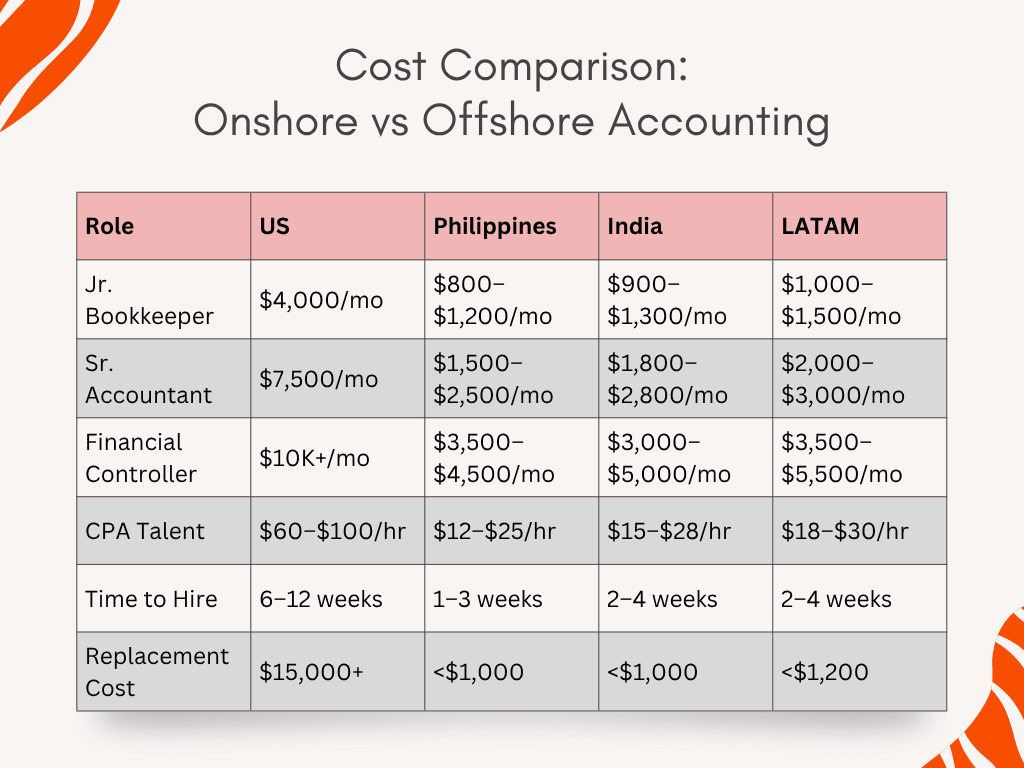
Onshore vs Offshore Accounting Costs: Decide Which Model Suits Your Business Best
Compare real-world costs to see what works for your budget and growth stage.
| Role | US (Onshore) | Philippines (Offshore) | India (Offshore) | LATAM (Offshore) |
|---|---|---|---|---|
| Junior Bookkeeper | $4,000/month | $800–$1,200/month | $900–$1,300/month | $1,000–$1,500/month |
| Senior Accountant | $7,500/month | $1,500–$2,500/month | $1,800–$2,800/month | $2,000–$3,000/month |
| Financial Controller | $10,000+/month | $3,500–\$4,500/month | $3,000–$5,000/month | $3,500–$5,500/month |
| CPA-Certified Talent | $60–\$100/hour | $12–\$25/hour | $15–\$28/hour | $18–\$30/hour |
| Full-Time Hire Setup | 6–12 weeks | 1–3 weeks | 2–4 weeks | 2–4 weeks |
| Replacement Cost (Average) | $15,000+ | Less than $1,000 | Less than $1,000 | Less than $1,200 |
The Top 10 Benefits Of Offshore Accounting That Will Help Your Startup Grow

1. Cuts Up To 70% Off Payroll & Overhead
Hiring a US-based accountant costs $6,000–$10,000/month. Offshore talent in the Philippines or India comes in at $1,200–$3,000/month, with zero added overhead for benefits, office space, or equipment. That’s a 60–70% reduction in core finance costs. For early-stage startups with burn rate pressure, this unlocks serious breathing room.
2. Fills Critical Finance Gaps Without The Hiring Headache
US accounting roles stay open for 3–6 months due to talent shortages. Offshore accounting teams fill that gap in under 4 weeks with pre-vetted CPAs trained in US GAAP, IFRS, and SEC reporting. You get a ready-to-operate hire instead of just a resume.
3. Gets Overnight Turnaround With Time Zone Handoff
Startups use offshore teams to complete reconciliations, invoice runs, and reporting while the US team sleeps. This time zone handoff shaves 24–48 hours off monthly close cycles and gives you updated dashboards before your morning coffee.
4. Scales Fast During Tax Season, Then Shrinks
Offshore accounting lets you flex headcount without long contracts or US-based layoffs. Ramp up support for tax season or audits. Cut back when things stabilize. Most offshore setups run on a month-to-month basis, so you keep control.
5. Frees Up Your Core Team To Drive Growth
Offshore accountants take recurring tasks off your plate—AP, AR, payroll, reconciliations—so your team can focus on funding rounds, customer growth, and strategic planning. One startup founder saved 20+ hours a week by offloading bookkeeping alone.
6. Grants Access To Enterprise-Grade Tech At No Extra Cost
Offshore teams often come bundled with licenses for cloud accounting tools like QuickBooks, NetSuite, or Xero. You also get automated dashboards and AI-driven financial insights without paying for implementation or maintenance.
7. It Slashes Your Recruitment & Training Costs
Hiring a new accountant in the US can cost $15,000–$25,000 after ads, interviews, and onboarding. Offshore firms front-load this work. You get someone trained, supervised, and ready to contribute from day 1, with near-zero ramp time.
8. Reduces Errors With SOPs & QA Layers
Offshore accounting setups follow strict standard operating procedures (SOPs), dual-review workflows, and built-in QA checks. This structure cuts error rates by up to 40% compared to founders or overstretched in-house teams that manage finances solo.
9. Stays Compliant Without Lifting A Finger
Regulations shift constantly. Offshore providers keep pace with US GAAP updates, IRS rule changes, and state tax requirements. Some even provide ongoing audit support. You stay compliant without having to decode the latest 200-page IRS bulletin.
10. Locks Down Your Financial Data With Enterprise Security
Top offshore firms use SOC 2-certified infrastructure, ISO 27001 protocols, role-based access, and encrypted cloud platforms. NDAs and internal access control policies come standard. You get Fortune 500-grade security even if you’re pre-Series A.
“Most think offshoring accounting is just about savings. It’s actually about building a finance engine that doesn’t slow you down.”
— Burkhard Berger, Founder/CEO of Genius
10 Real Risks Of Offshore Accounting & How To Avoid Them

Run through this list to spot where you’re most exposed. Then lock in fixes before they cost you money or time.
1. Time Zone Delays Stall Approvals & Updates
Offshore teams often work a 12–15 hour offset from US startups. Without async SOPs, things pile up. Use Slack with pre-set escalation tags, set overlap windows (2–3 hours/day), and use Loom to record requests that don’t need live feedback.
2. You Lose Track Of Who Has Access To What
Poor role-based access can turn into a security breach. Use tools like 1Password and Google Workspace access logs. Limit platform access by IP and disable auto-sharing on accounting drives.
3. Quality Tanks If Your Vetting Process Is Weak
Low-cost hires without testing give you clean resumes and messy books. Always use skills assessments, CPA verification, and a 2–4 week trial with clear benchmarks before you extend full-time offers.
4. You Get Stuck With A Black-box Vendor
Some offshore providers run without visibility. Insist on client dashboards, named account managers, and month-to-month terms. If a vendor won’t show you their team’s certifications, processes, or QA steps, it’s best to walk away.
5. Communication Breaks Down Fast Without Structure
Remote doesn’t work without rules. Define response times (e.g., 12 hrs max), use 1 tool per function (Slack for operations, ClickUp for tasks), and hold weekly reviews. Without this, one misunderstanding can delay your close cycle by 3+ days.
6. Currency Fluctuations Wreck Your Budget
Billing in local currency (INR, PHP) without caps exposes you to FX risk. Lock USD rates into your contract or use a tool like Wise Business with auto-conversion limits to avoid 10–15% surprise increases.
7. You Underestimate The Setup Effort
Even great offshore teams need 2–3 weeks of onboarding. Set up sandbox access, workflow walkthroughs, and data migration sessions before you assign full responsibility. You’ll add weeks of rework if you skip this.
8. You Miss Red Flags During Onboarding
If you don’t track early signs, like late replies, vague answers, and poor formatting, you’ll bake in problems. Set a 10-point review list for the first 14 days. Include metrics like response time, error rate, and familiarity with your tools.
9. Compliance Gaps Creep In Without Local Expertise
Foreign teams that don’t know state or federal rules leave you exposed. Make sure your offshore hires understand US GAAP, IRS rules, and have prior audit experience. Ask for past compliance cases they’ve handled.
10. You Burn Out Your In-house Team Trying To Manage Offshore Work
If you offload poorly, you just shift the headache. Appoint one offshore coordinator internally. Use SOPs and shared dashboards to split accountability cleanly so your local team doesn’t become a middle layer.
💭 Food For Thought
Businesses can save up to 40% by offshoring processes.
5 Offshore Accounting Strategies That Will Help You Beat Competitors
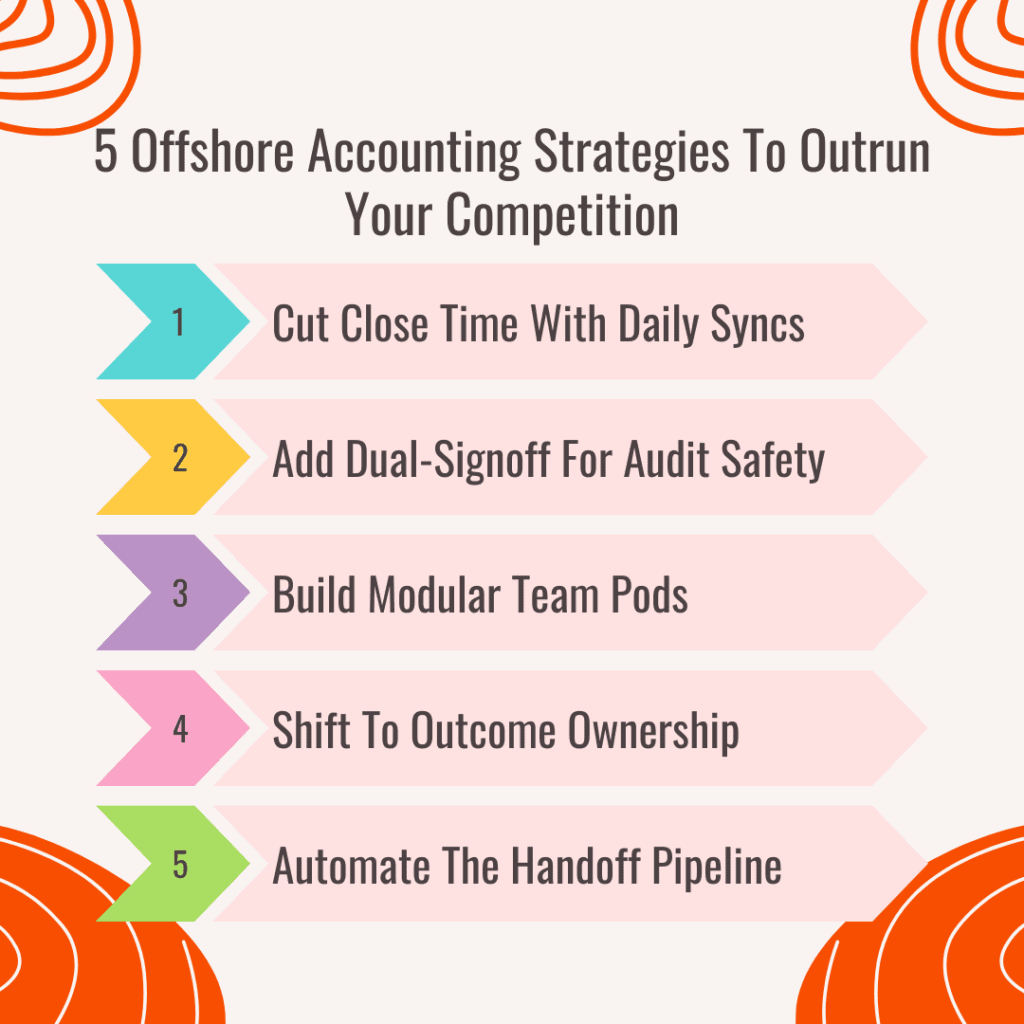
Apply these strategies to eliminate delays, cut error rates, and create real-time visibility across your finance stack.
Strategy 1: Cut Your Close Cycle With A Daily Sync Model
Don’t let offshore hours slow your month-end close. A daily 15-minute async sync can cut close time by 2–3 days per month.
- Record a Loom to explain day-prior tasks and blockers
- Sync task updates in ClickUp by EOD (end of day) offshore time
- Lock in overlap hours (1–2 hours) for critical handoffs
- Add a “Close Status” dashboard with Google Data Studio
- Use auto-tagging in Slack to route blockers to your in-house team
Strategy 2: Create A Dual-Signoff System To Prevent Audit Surprises
Layer in accountability without overloading your team. Dual-signoff stops compliance misses and closes control gaps.
- Assign 1 offshore and 1 onshore reviewer for high-risk tasks
- Set threshold-based rules (e.g., more than $5,000 = double signoff)
- Use DocuSign + Google Drive folders to archive approvals
- Audit sample 10% of offshore entries monthly
- Track approval cycle times to flag lag
Strategy 3: Use Modular Team Pods Instead Of Generalists
Split work by function, not person. Function-based pods move faster and cut error rates.
- Build 3 pods: Bookkeeping, AP/AR, and Compliance
- Assign 1 senior per pod to manage QA
- Use SOPs with metrics like TAT, error percentage, and rework count
- Give each pod its own Slack channel + shared dashboard
- Evaluate each pod quarterly based on function-level KPIs
Strategy 4: Shift From “Assigned Tasks” To “Owned Outcomes”
Don’t treat your offshore team like assistants. Give them outcomes, not tasks. This flips accountability and improves accuracy.
- Define deliverables (e.g., zero errors in invoice runs)
- Set up self-review checklists before task handoff
- Create quarterly goals per team member
- Use async performance reviews via Loom + KPI scorecards
- Reward accuracy and initiative, not just task completion
Strategy 5: Automate Your Handoff Pipeline With Pre-Set Triggers
Kill the back-and-forth. Pre-set triggers cut wait time and miscommunication.
- Auto-assign tasks based on calendar rules (e.g., AP every Wednesday)
- Use Zapier to route files from email to task folders
- Tag due dates by default in ClickUp/Asana templates
- Link dashboards to trigger email alerts when status changes
- Run a monthly audit of automation logs to catch failure points
📢 Did You Know?
For 70% of businesses, cost savings are the top reason for offshoring.
Is Offshore Accounting Right For Your Startup? Your Ultimate Decision Framework
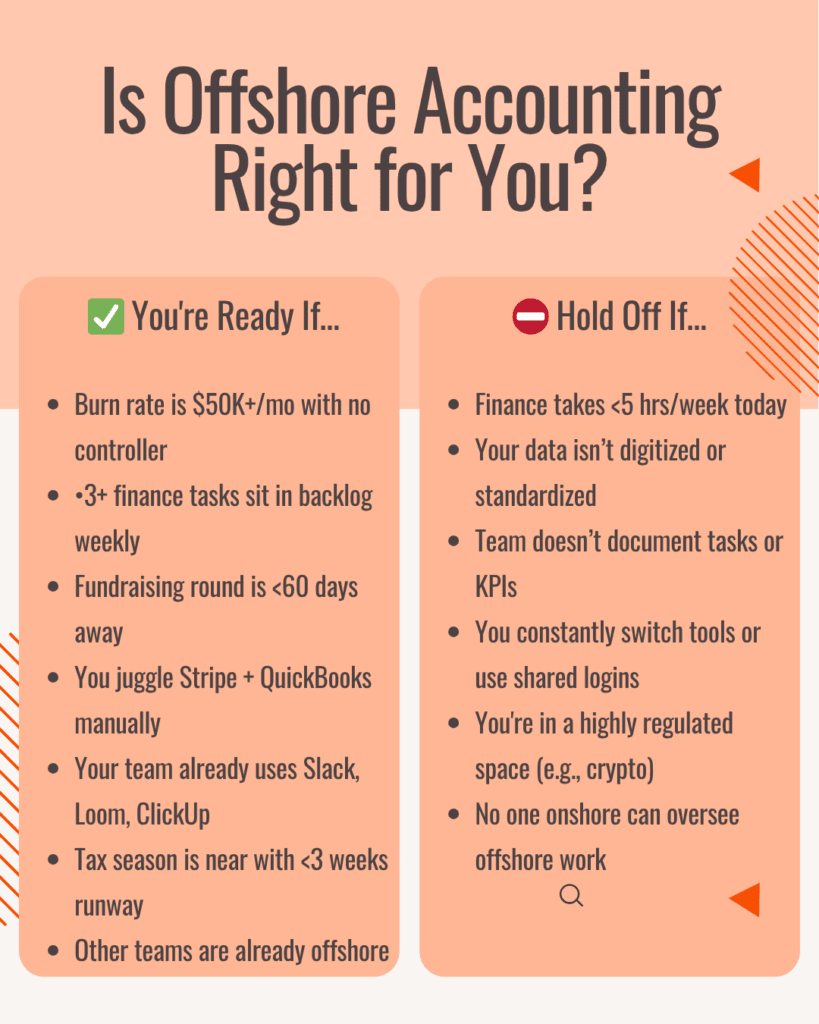
Run through the two lists below to pressure-test your readiness.
You Should Start Offshore Accounting If
- Your burn rate tops $50,000/month with no in-house controller: You’re bleeding capital while managing admin work internally instead of product or growth.
- You have 3+ finance tasks sitting in backlog each week: Bookkeeping, AP/AR, or payroll, don’t get done on time, which slows board reporting or investor updates.
- You need finance coverage before a fundraising round (within 60 days): Offshore hiring can place CPA-level talent inside 2–4 weeks vs 3–6 months locally.
- You run accounting manually across multiple tools: If you’re reconciling Stripe + Shopify + QuickBooks without automation, offshore teams help consolidate and standardize fast.
- You already use async tools like Slack, Loom, or ClickUp: Offshore accounting runs smoother when teams already work async and understand structured task delivery.
- You hit tax season or audit prep with less than 3 weeks of runway: Offshore teams can add 100+ hours/week capacity quickly without contracts or benefits costs.
- Your operations or product teams are already offshore: If other departments are distributed, finance is the next logical step; just route through the same security and task tools.
Offshore Accounting Might Not Be A Fit If
- You only spend less than 5 hours/week on finance tasks: If accounting isn’t a bottleneck yet, offshoring adds unnecessary overhead.
- Your data isn’t clean, standardized, or digitized: Offshore CPAs can’t work from shoebox receipts or ad hoc Notion docs. You need baseline hygiene first.
- Your team isn’t used to documenting tasks or tracking deliverables: If SOPs, KPIs, and Loom walkthroughs don’t exist, you’ll waste weeks setting context.
- You switch tools often or lack role-based access control: Constant platform churn or shared logins expose you to compliance and security risks that offshore teams can’t fix.
- You operate in a highly regulated niche (e.g., cannabis, crypto): Offshore firms may lack experience navigating specialized licensing, tax law, or reporting requirements.
- You don’t have anyone to oversee offshore execution: Without a dedicated point person onshore, the offload turns into rework or delay.
“Elite offshore accountants cut your cost by 70% and onboard in days, not months.”
— Christian Cabaluna, Senior Recruiter
6 Steps To Start With Offshore Accounting Without Getting Burned

Move through these 6 steps to offshore accounting without any missteps.
- Pick 1 function, not 5: Start with either bookkeeping or AP, not both. This keeps training time under 10 hours and cuts error risk in the first month.
- Ditch the marketplaces: Skip Fiverr, Upwork, or other gig platforms. Use vetted hiring firms like Genius that pre-test for US GAAP, QuickBooks, and compliance workflows. Ask for case studies and sample QA logs.
- Lock your scope into a one-page SOP: Break each task down into actions, inputs, and frequency. Include tool access, error limits, and Slack escalation rules. Review this live before day 1.
- Run a 14-day test with daily outputs: Assign real tasks with expected formats, timestamps, and accuracy targets. Check for missed instructions, math errors, and file hygiene. Don’t skip the audit.
- Build the stack before the handoff: Set up tool logins, role-based permissions, folder structures, naming conventions, and dashboards before your hire clocks in. This cuts back-and-forth by half.
- Assign one person as the traffic lead: Choose someone internal to answer questions, flag blockers, and enforce deadlines. Offshore setups without a traffic lead fail more often.
6 Offshore Accounting Success Metrics That Paint The Picture Of Future Success

Use these 6 benchmarks to track whether your offshore accounting setup is actually working.
- Error rate per 100 transactions: Count the mistakes in AP, AR, and reconciliations weekly. A strong offshore team keeps this under 2%, especially with SOPs and dual review in place.
- Time-to-close (monthly): Track the number of days from period-end to full close. If you cut this by 2–4 days post-offshoring, it shows your workflows and handoffs work.
- Forecast accuracy (cash flow): Compare projected vs actual cash position every 30 days. A deviation under 10% signals strong reporting habits and reliable inputs from your offshore team.
- Slack response time during overlap hours: Measure reply times during your shared work window. Top setups stay under 20 minutes, which keeps blockers from snowballing.
- Dashboard uptime (financial visibility): Check how often dashboards are outdated, missing data, or down. You want greater than 95% uptime on tools like Data Studio or Power BI to make fast, clean decisions.
- Audit rework rate: Track how many entries get flagged during sample audits. If more than 10% need fixing, your review layers don’t catch issues early enough.
📣 Interesting Fact
Financial services make up 19% of the offshoring market.
3 Offshore Accounting Use Cases: How Startups Like You Actually Do It

See how startups like yours implemented offshore accounting to reduce costs, address talent shortages, and enhance efficiency.
1. Assist Group: Enhancing Financial Processes With Offshore Accounting
Company Background: Assist Group is an Australian health services provider that operates across multiple states.
The problem: Their previous accounting outsourcing service failed to meet expectations, which became a financial burden. They needed a partner that could adapt to their business needs and improve their accounting processes.
The solution: They partnered with a global outsourcing firm and leveraged their expertise in finance and accounting outsourcing. The firm implemented cloud accounting software and provided professionals experienced in Australian tax laws and payroll regulations.
The outcome: Assist Group achieved real-time financial analysis, consistent on-schedule business processes, and a stronger focus on critical issues. The partnership led to significant improvements in efficiency and financial management.
Key takeaway: Select an offshore partner with relevant expertise to transform financial operations and drive efficiency.
2. Nexia Perth: Streamlining Financial Operations Through Offshore Support
Company Background: Nexia Perth is a member of Nexia International, one of Australia’s top 10 accountancy practices.
The problem: As their client base expanded, managing routine financial tasks like reconciliations, invoicing, and reporting consumed over 40 hours weekly. This workload diverted attention from high-value strategic work.
The solution: They engaged offshore accounting services and integrated a team that handled repetitive tasks and provided consistent communication. The service provider’s triple-check process provided accuracy and timely results.
The outcome: Nexia Perth’s local team regained 20-30 hours weekly, which allowed focus on strategic client work. The offshore team adapted to fluctuating demands and maintained service quality during peak periods.
Key takeaway: Offshore accounting support can reclaim valuable time for core teams, which enhances strategic focus and client service.
3. OATS: Automating Accounts Payable For Enhanced Efficiency
Company Background: Offshore Accounting and Taxation Services (OATS) is a major player in the accounting outsourcing market.
The problem: Their accounts payable process was cumbersome, inefficient, and costly. It required manual data entry and led to errors.
The solution: OATS implemented an AI-based platform to automate invoice processing. The solution included integration with Zoho via API, OCR-based data extraction, and RPA for posting entries into SAP.
The outcome: Invoice processing capacity increased from 40-50 to up to 140 invoices per day. Turnaround time reduced to 70 seconds per invoice, with improved accuracy and minimal manual intervention.
Key takeaway: Leveraging AI and automation in offshore accounting can significantly enhance efficiency and accuracy in financial processes.
Conclusion
Your day should be about growth metrics, not fixing vendor invoices at 10 pm. The benefits of offshore accounting are all about reclaiming your focus, restoring your team’s sanity, and building finance systems that actually keep up with your roadmap. When done right, offshore accounting is less about “outsourcing” and more about upgrading your entire backend.
But that only works if you start with A+ players. That’s where Genius flips the script. We screen 250+ candidates to find ONE elite offshore hire who speaks your language, syncs with your culture, and delivers like a pro from day one. You’ll get pre-vetted talent that operates like your 5th cofounder, not your 15th vendor.
Start your next smart hire without the overhead, hassle, or headcount stress. Hire with Genius today.
FAQs
What does an offshore accounting team typically include?
Most offshore teams cover core functions like bookkeeping, AP/AR, payroll, tax prep, and reporting. Mid-size setups may also include controllers, financial analysts, and audit support.
How fast can a startup build a functional offshore accounting team?
With the right setup, most startups go from kickoff to live operations in 2–4 weeks. This includes onboarding, workflow setup, and initial handoffs.
Can offshore accounting teams work inside our existing tool stack?
Yes. Most teams are trained on tools like QuickBooks, Xero, NetSuite, SAP, and FreshBooks. Just make sure role-based access and workflow guides are in place before the first day.
What industries benefit most from offshore accounting?
SaaS, eCommerce, agencies, and professional services gain the most, especially when they deal with high-volume transactions, rapid scaling, or complex cash flow.