
You are still chasing receipts while your team chokes on month-end close, and your controller just asked if they can “circle back” on payroll. Again. Meanwhile, hiring a decent bookkeeper locally feels like trying to win a bidding war with zero budget. If that sounds even mildly familiar, welcome. You are not alone, and this is exactly where the benefits of offshore bookkeepers start making sense.
This article gives you the full picture of offshore bookkeeping: the top strategic, operational, and financial advantages of going offshore, along with the exact risks that sink most first-time attempts, and how to dodge every one of them.
Benefits Of Offshore Bookkeepers & Risks To Avoid: All You Need To Know In A Minute
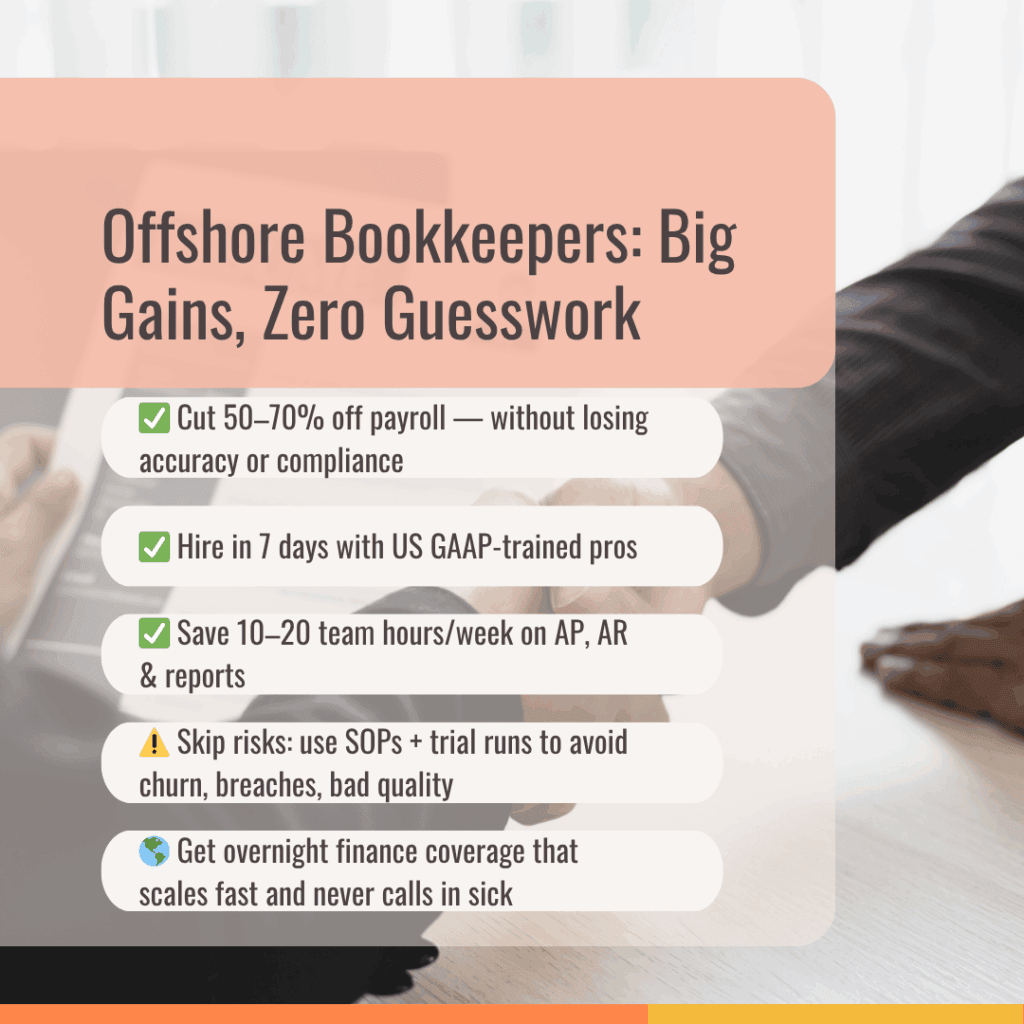
- Cut 50–70% off bookkeeping payroll without losing accuracy, speed, or compliance.
- Hire within 7 days, not 12 weeks, with embedded finance experts trained in US GAAP.
- Free up 10–20 hours/week for your team by offloading reconciliations, AP/AR, and reporting.
- Avoid hidden risks like data breaches, weak quality control, or freelancer churn with structured SOPs and trial cycles.
- Build finance coverage that runs overnight, scales by the week, and never calls in sick.
Here Are Some More Reads You’ll Like
🎯 .NET Offshore Development Services: A Quick Starter Guide
🌟 Offshore Big Data Development: Your Complete Starter Guide
💻 Offshore Android Development: A Complete Beginner’s Guide
What Are Offshore Bookkeepers & Why Hiring One Should Matter To You?
Offshore bookkeepers are remote finance professionals based in lower-cost countries who manage your business’s day-to-day accounting tasks like accounts payable, payroll, reconciliations, and tax preparation. Unlike traditional outsourcing, offshore bookkeeping builds embedded roles within your team for long-term support, instead of just project-based help.
Here’s why hiring one should matter to you:
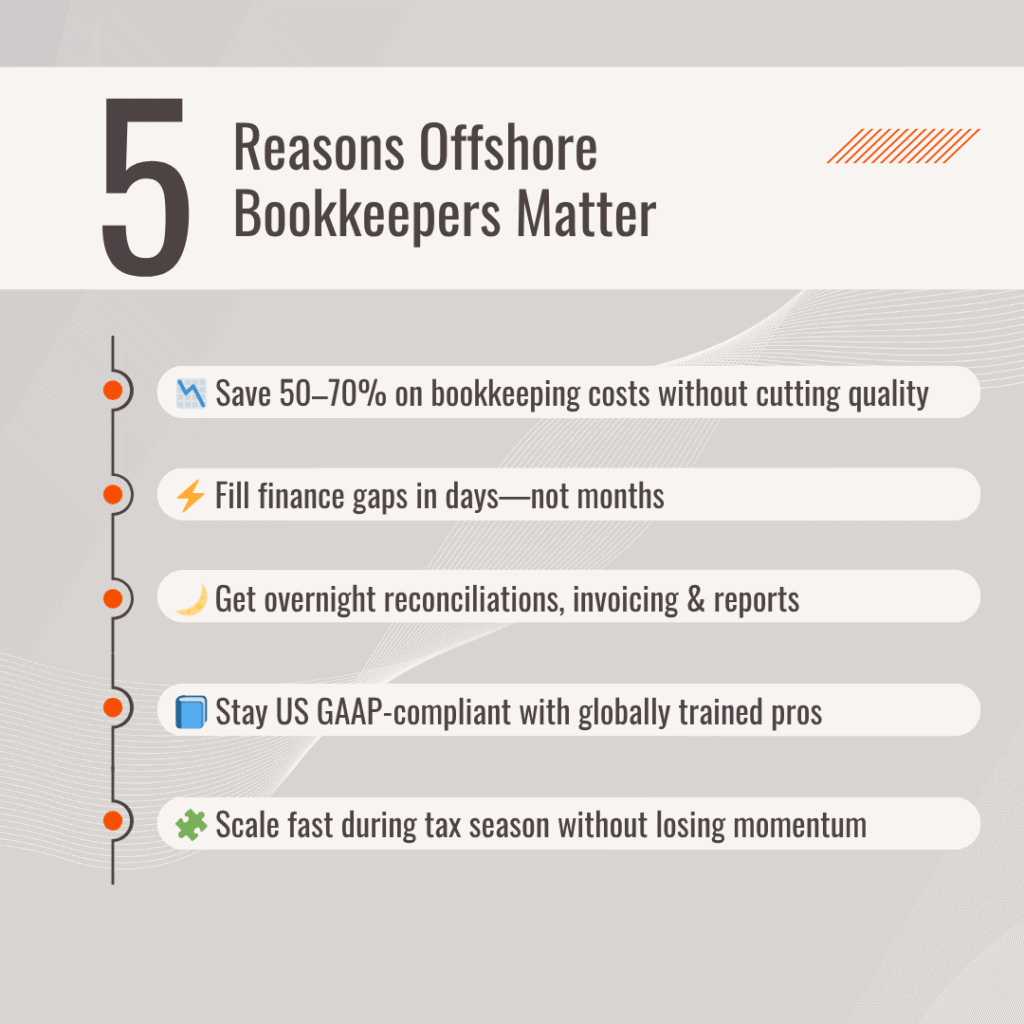
- Cut your bookkeeping costs by 50–70% without losing accuracy or quality.
- Fill accounting gaps in days (not months), especially when local hiring stalls.
- Run 24-hour cycles with overnight processing for reconciliations, invoicing, and reports.
- Get US GAAP-compliant (Generally Accepted Accounting Principles) financials from pros trained in global standards.
- Avoid losing momentum during tax season with flexible, scale-up support.
Offshore Bookkeeping vs Outsourced Bookkeeping: 6 Key Differences You Need To Know
Use this table to decide which setup fits your workflow, budget, and control needs.
| Offshore Bookkeeping | Outsourced Bookkeeping | |
|---|---|---|
| Team Structure | Embedded, long-term roles | External agency support |
| Cost Efficiency | $8–$15/hour avg (Latin America/Asia) | $50–$120/hour average (US-based firms) |
| Control Over Workflow | You manage tools, SOPs (Standard Operating Procedures), and communication | Limited control; firm owns process |
| Software Access | Works inside your QuickBooks, Xero, ClickUp | Often operates on third-party platforms |
| Scalability Speed | 3–7 days to hire and onboard | 3–5 weeks minimum |
| Ongoing Relationship | Direct daily contact with dedicated hire | Rotates staff across multiple clients |
The Top 14 Benefits Of Offshore Bookkeepers Backed By Real Data
Review these benefits of offshore bookkeepers and cross-check them with your team’s biggest bottlenecks.
Strategic Benefits Of Offshore Bookkeepers That Help You Work Smarter
1. Builds A Global Finance Backbone Without Scaling Headcount
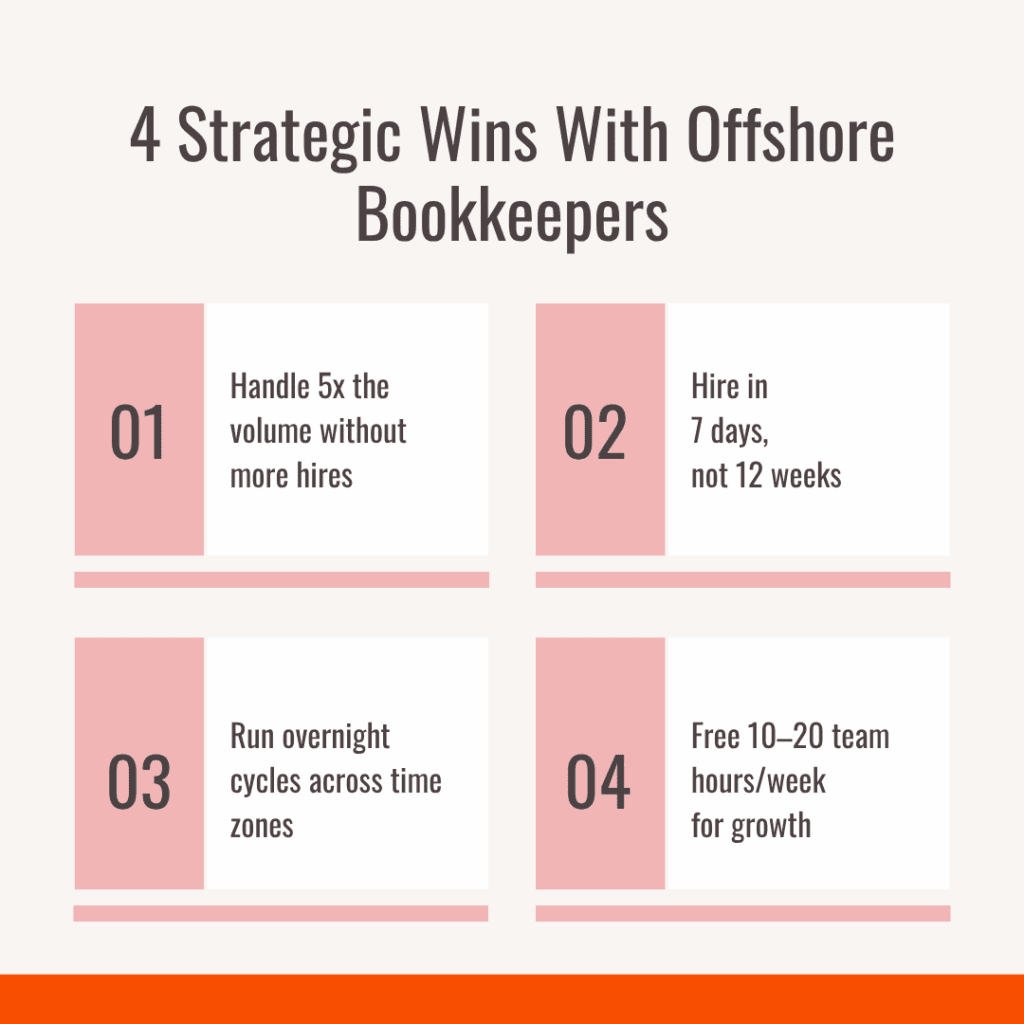
You don’t need a dozen hires to handle growth. Offshore bookkeepers help you process up to 5x the volume without expanding your in-house team. Whether it’s month-end close, reconciliations, or payroll preparation, they keep the cycle moving while your team handles strategic work. Most teams start with just 1 and expand to 3 as their workflow stabilizes. That gives you the output of a full local team at under 30% of the cost.
2. Plugs Talent Gaps Instantly Without 3-Month Hiring Delay
Offshore bookkeepers are often onboarded in 5–7 days, not 8–12 weeks. You skip recruiter delays, job post limbo, and backchannel references. Instead, you get certified professionals with US GAAP/IFRS (International Financial Reporting Standards) fluency, ready to jump into QuickBooks, Xero, or Netsuite. They’re already trained and pre-vetted, so your operations don’t stall during audits, tax season, or financial reviews.
3. Extends Your Team’s Coverage With Round-The-Clock Operations
Philippines, India, and Latin America (LATAM) bookkeepers cover the other half of your workday. While your US team sleeps, they clean up ledgers, flag issues, and prepare reports. That gives you overnight turnaround on weekly close tasks and daily reconciliations. It also keeps your finance cycle moving without the need to pay local staff overtime.
4. Frees Up Your Best People To Work On Growth
Your finance lead shouldn’t waste time fixing invoice typos or chasing approvals. Offshore bookkeepers offload everything from bank reconciliations to AP/AR (Accounts Payable / Accounts Receivable) follow-ups. That gives your in-house team 10–20 hours per week back to focus on forecasting, planning, and decision support. It also improves retention; your best talent stays engaged instead of buried in checklists.
Operational Advantages Of Offshore Bookkeepers That Remove Friction From Your Finance Cycle
5. Speeds Up Your Month-End Close By 3–5 Days
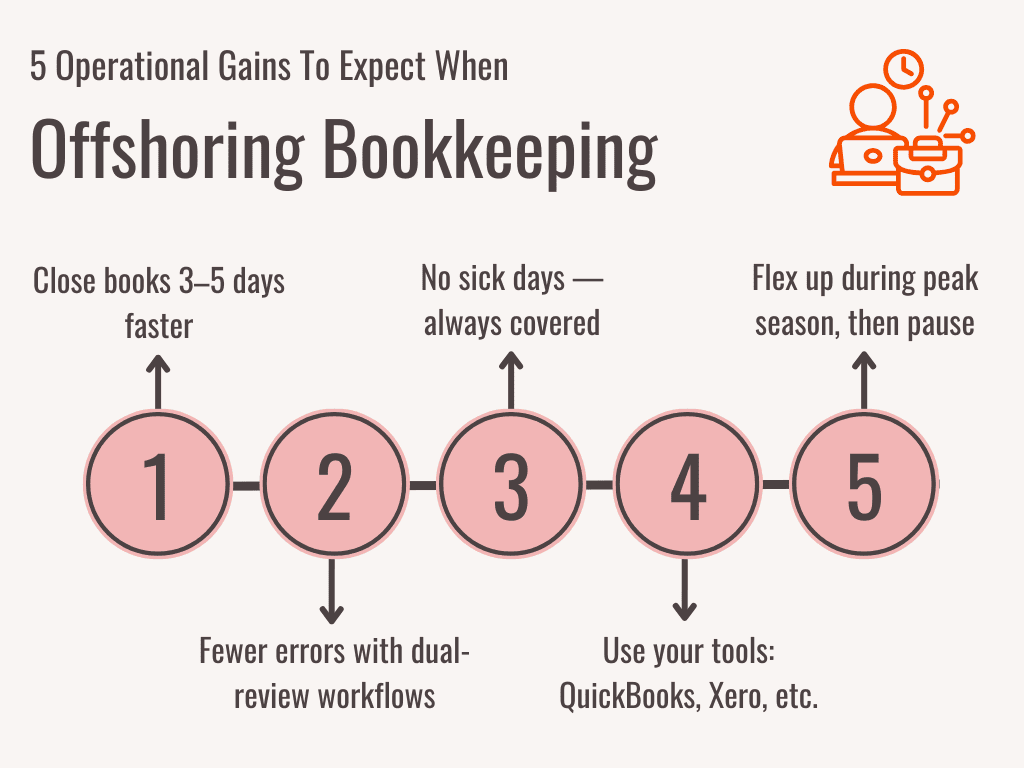
Offshore bookkeepers handle reconciliations, accruals, and invoice verifications while your US team sleeps. That trims your month-end close from 8–10 days to as little as 4–6. Many firms experience 40–60% faster reporting once their offshore team handles cleanup and preparation. This gives your CFO (Chief Financial Officer) or controller more time to analyze and act.
6. Eliminates Recurring Errors With Built-In Quality Checks
Most offshore teams follow dual-review systems: one bookkeeper inputs, another verifies. Add SOPs, and you get consistency across payroll runs, AR ledgers, and P&L (profit and loss statement) summaries. Some firms reduce their error rate within a couple of months. The process becomes repeatable and trackable; no guesswork needed.
7. Grants Bookkeeping Coverage That Doesn’t Call Out Sick
Offshore firms build redundancy into your accounts. When one team member is offline, a backup takes over using your SOPs and tools. This protects your workflow from vacation gaps, sick days, or turnover spikes. You keep your financial cycle running without disruption.
8. Lets You Use The Same Tools Without Rebuilding Your Stack
Your offshore bookkeeper works inside your existing system: QuickBooks, Xero, ClickUp, NetSuite, you name it. No need to migrate data, build APIs, or change access policies. That cuts your onboarding time down to 3–5 days and prevents version mismatch issues. They use what your team already knows.
9. Adds Flex Capacity Without Full-Time Commitment
Peak season? Tax month? Launch week? Offshore bookkeepers ramp up with 10–15 extra hours a week without long-term contracts. You pay only for what you use, and pause when you’re done. That gives you the output of a full-time team without the payroll liability.
📢 Did You Know?
92% of US manufacturing executives have considered nearshoring
Financial Pros Of Offshore Bookkeepers That Actually Move Your Margins
10. Cuts Bookkeeping Payroll By 50–70% Without Losing Accuracy
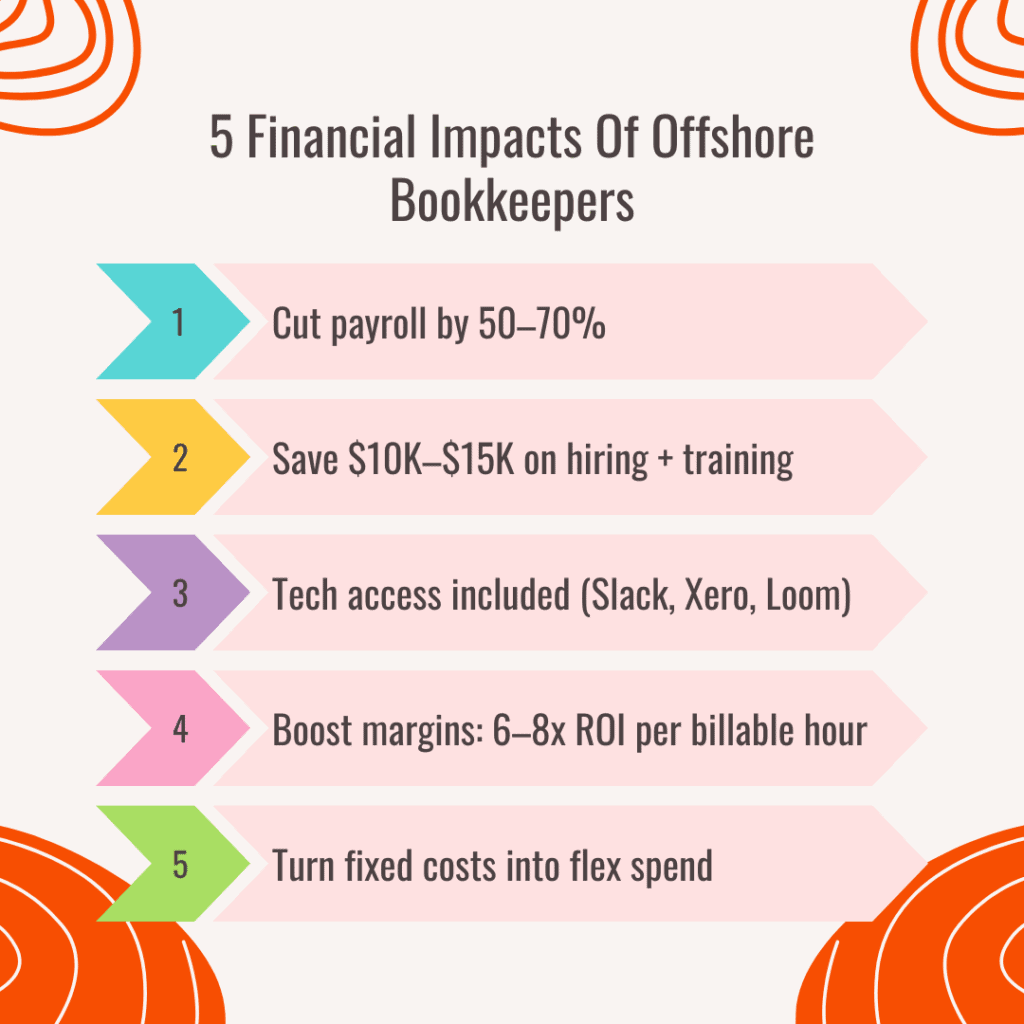
A US bookkeeper costs $50,000–$70,000/year plus benefits. Offshore talent in the Philippines or LATAM comes in at $12,000–$20,000/year fully loaded. Most work with QuickBooks, Xero, and US GAAP standards without any quality drop. You pocket the difference and reallocate it to growth instead of administrative work.
11. Helps You Skip $10,000+ In Hiring & Training Costs
You won’t spend 4–6 weeks screening, onboarding, and training new hires. Offshore teams come pre-vetted, tool-ready, and often already trained in your country’s accounting practices. No LinkedIn ads, no hiring delays, no HR overhead. That alone saves $10,000–$15,000 per hire.
12. Stretches Your Operations Budget With Built-In Tech Access
Top offshore bookkeepers often come equipped with their own software licenses: Xero, Hubstaff, Loom, and Slack. That means you won’t pay for extra user seats, new subscriptions, or device setups. Some vendors even bundle in workflow automation tools, which saves another $500–$1,200 per year.
13. Boosts ROI On Every Billable Hour
For agencies and CPA (Certified Public Accountant) firms, offshoring means more output per hour at lower input costs. You can bill US clients $100/hour and pay $10–$15/hour offshore. Even with oversight, that’s a 6–8x return on each deliverable. That drives real margin growth, not just expense cuts.
14. Turns Fixed Finance Costs Into a Scalable, Variable Model
Offshore bookkeeping lets you flex spend as your business changes. Instead of locking in high fixed salaries and overhead, you pay only for hours worked or project scope. That gives startups and seasonal businesses better cash control, especially when revenue fluctuates.
“Offshore bookkeeping is about building global finance engines that scale as fast as you do.”
— Burkhard Berger, Founder & CEO of Genius
10 Common Risks Of Offshore Bookkeeping + How You Can Avoid Them
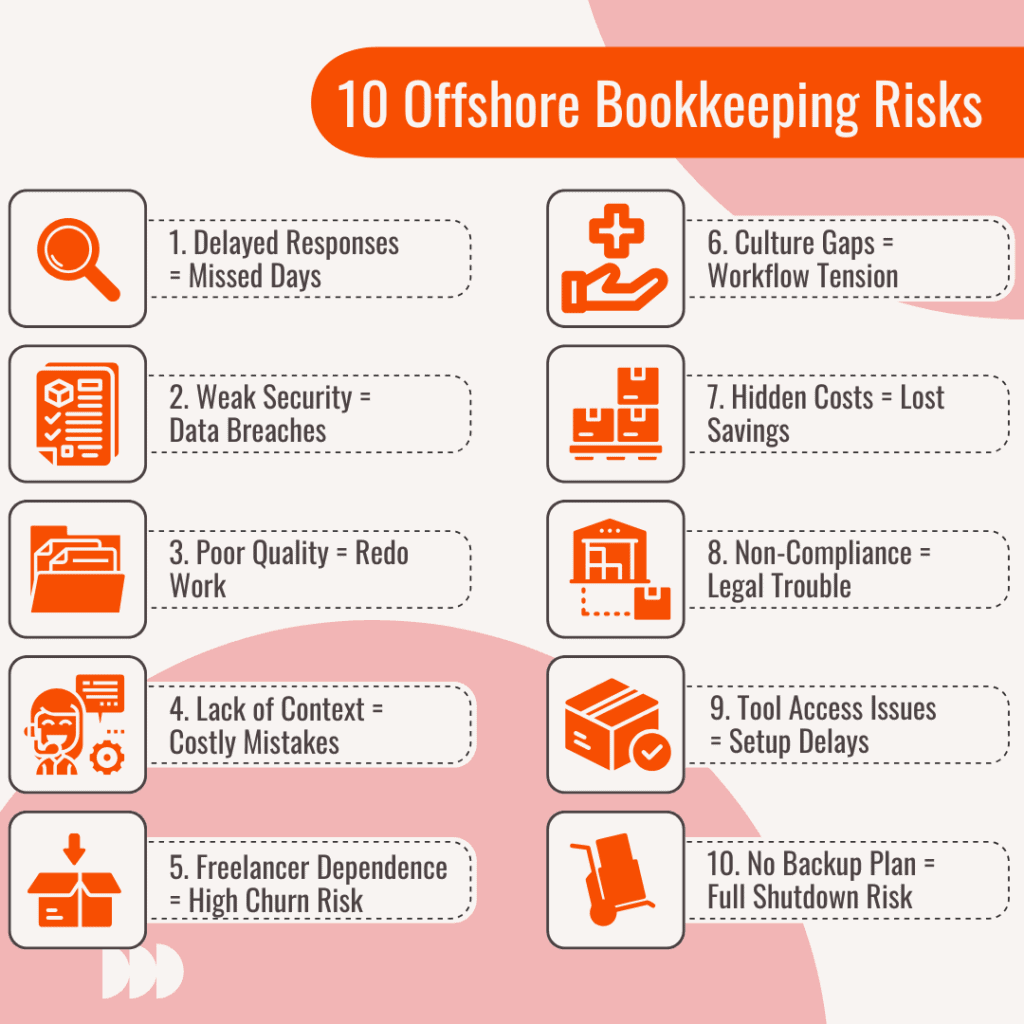
Use this list to see where the most common delays, missteps, and visibility issues happen.
1. Communication Breakdowns Slow Everything Down
Bookkeepers working 10–12 hours ahead can’t afford vague briefs or delayed responses. If messages land during someone’s off-hours, you lose an entire workday. Use async (asynchronous) tools like Loom for screen recordings and ClickUp for task tracking with timestamps and tags. Create SOPs with sample entries, expected turnaround times, and red flag scenarios. Set a standard overlap window of 1–2 hours a day for fast unblock calls.
2. Weak Security Leaves Your Financial Data Exposed
Most firms skip proper vetting and assume vendors have safeguards in place. That’s how passwords get leaked and spreadsheets go missing. Require SOC 2 (System and Organization Controls) or ISO 27001 certification (International Organization for Standardization), MFA logins (multi-factor authentication), NDAs (non-disclosure agreements), and SFTP (secure file transfer protocol).
Block personal email access on work devices. Add quarterly audits for access logs, endpoint usage, and password resets.
3. Inconsistent Quality Wastes Time & Kills Trust
You’ll spot it in late reports, missing receipts, and account mismatches. To fix it, run a one-week paid trial with real deliverables and fixed deadlines. Use dual review: one bookkeeper prepares, another reviews. Ask for KPIs like error rate per report or days to close. Build in weekly reviews with real examples of good vs poor work.
4. Context Gaps Give Way To Costly Errors
If your offshore team doesn’t know the “why” behind a task, they’ll miss critical details. Add a shadowing period where they observe a live cycle via Zoom or recorded Loom sessions. Keep a finance glossary that defines terms like “contra entry” or “accrual reversal.” Set up a living Notion document with client preferences, cutoff dates, and reporting quirks.
5. Over-Reliance On Freelancers Creates Workflow Risk
Freelancers may disappear mid-month or switch clients without notice. If you rely on just one, you risk full-cycle disruption. Instead, hire from offshore staffing firms that offer replacements, backups, and contracts. Look for guaranteed coverage hours, emergency point-of-contact, and documented ramp-up timelines. Never depend on just one pair of hands.
6. Culture Clashes Derail Team Dynamics
What feels like a tone mismatch is often just a cultural misunderstanding. Address this up front with a structured culture-fit screen: ask candidates to respond to client emails or clarify vague requests. Use async feedback tools like Hypercontext to surface concerns weekly. Share your internal communication norms, including preferred channels, tone, and response time.
7. Surprise Costs Cancel Out Your Savings
You saved on payroll but forgot to check forex fees, tool seats, and compliance charges. Request a full cost breakdown that includes exchange markups, tax handling fees, and tool license splits. Build a rate card for all roles, overtime, and holiday coverage. Confirm pricing in your currency and document scope changes in advance.
8. Compliance Risks Can Trigger Penalties
Even small bookkeeping errors can snowball into audits or late filings. Verify your offshore bookkeeper knows US GAAP and any industry-specific rules. Ask for sample reports, mock reconciliations, and audit preparation walkthroughs. Build a checklist for monthly and quarterly compliance tasks, and assign owners with deadlines.
9. Integration Friction Delays Onboarding
If the bookkeeper can’t log in, access tools, or understand your workflows, you lose weeks. Prepare a sandbox workspace where they can practice with dummy data. Share screen recordings of core workflows – report generation, invoice uploads, and AR follow-ups. Assign a one-week buddy system to field setup questions in real time.
10. No Backup Plan Means No Continuity
If your offshore bookkeeper gets sick or quits, what’s your fallback? Choose a vendor or hiring partner who offers layered coverage and skill overlap. Make sure SOPs are up to date, shared in a central system, and test recovery steps quarterly. Aim for a one-hour switchover time in emergencies.
Is Offshore Bookkeeping The Right Move For You? Your Ultimate Decision Framework
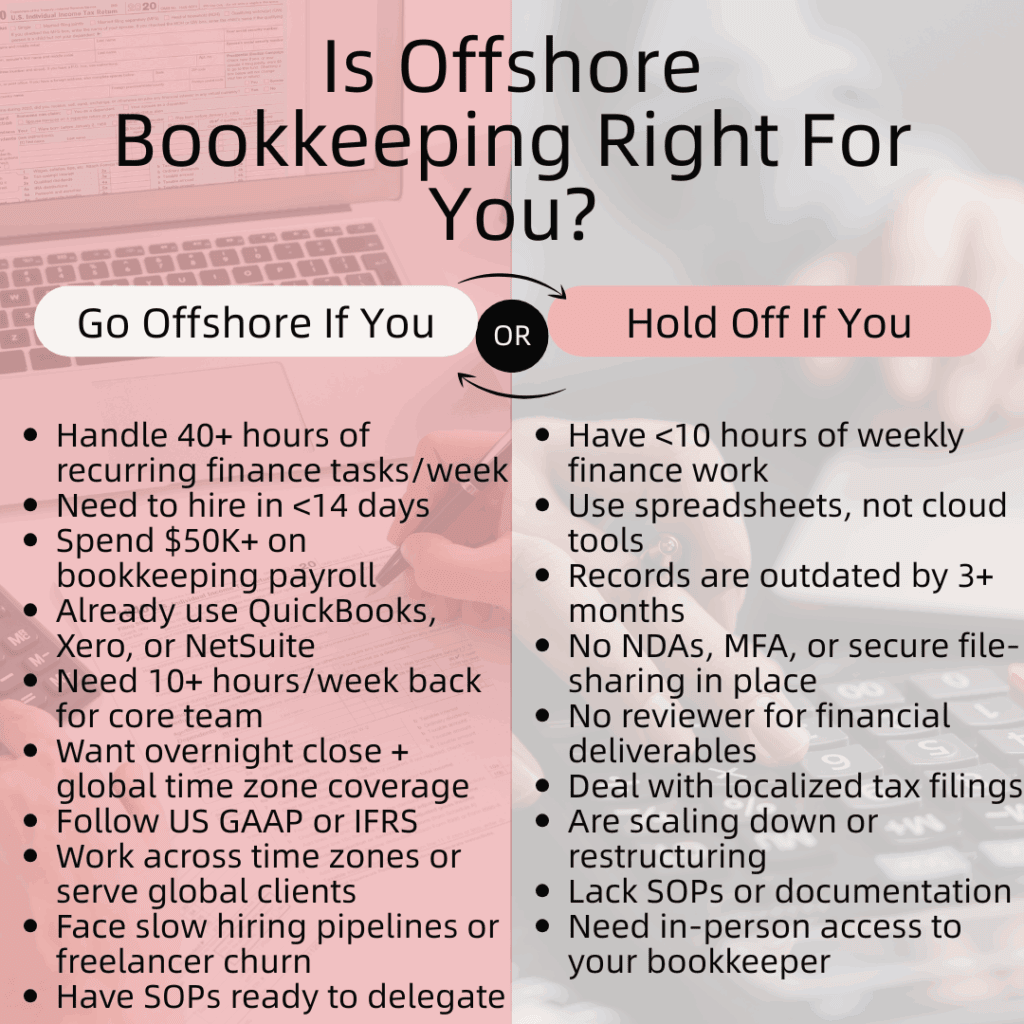
Scan this checklist to spot whether you’re ready to go offshore or need to fix gaps in your finance stack first.
When Offshore Bookkeeping Makes Sense & Pays Off Fast
- You have 40+ hours of recurring bookkeeping tasks every week
- You need to fill a finance role in under 14 days
- You’re spending over $50,000 per year on bookkeeping, or accounting payroll
- You already use tools like QuickBooks, Xero, ClickUp, or NetSuite
- Your current team spends 10+ hours weekly on reconciliations, AP/AR, and reporting
- You need overnight turnaround on daily, weekly, or monthly close tasks
- Your industry follows US GAAP or IFRS and needs standard compliance
- You operate in multiple time zones or serve international clients
- You’re tired of backlogged hiring pipelines or flaky freelancers
- You’re ready to document your SOPs and delegate with accuracy
When You Should Hold Odd Or Fix The Gaps First
- You have fewer than 10 hours of finance tasks per week
- You haven’t defined your bookkeeping workflow or system of record
- You rely on spreadsheets and don’t use cloud-based finance software
- Your records are behind by 3+ months or missing key compliance reports
- You haven’t yet secured NDAs, secure file-sharing, or MFA logins
- You lack a clear reviewer or approver for financial deliverables
- You manage highly localized tax rules or state-specific filings
- You’re scaling down or restructuring your core operations
- You have no documentation for recurring finance tasks
- You need direct in-person access to your bookkeeper
“Most of the firms we work with come in thinking they need 3 hires—then realize one offshore bookkeeper clears 80% of the backlog in a week.”
— Christian Cabaluna, Senior Recruiter at Genius
Who Actually Benefits From Offshore Bookkeeping: Use Cases + Real Cost Benchmarks
Bookmark this section and use it if your team is stuck in limbo or costs keep blocking new finance hires.
Businesses That Benefit Most From Offshore Bookkeeping
These company types unlock the most savings and speed when they switch to offshore bookkeepers:
- SaaS companies that need daily updates on accounts receivable and burn rate
- eCommerce brands with high transaction volume and multi-channel sales
- CPA firms that handle 30+ clients and need extra support during tax season
- Startups that spend $4,000+ monthly on local bookkeeping and still fall behind
- Agencies that bill by the hour and lose margin to in-house administrative time
- Franchise networks with location-level reporting, royalties, or standardized workflows
- US-based businesses with overseas clients or vendors who need multi-time-zone support
- Fast-growing companies scaling from 3 to 10 finance tasks daily, but without a full in-house team
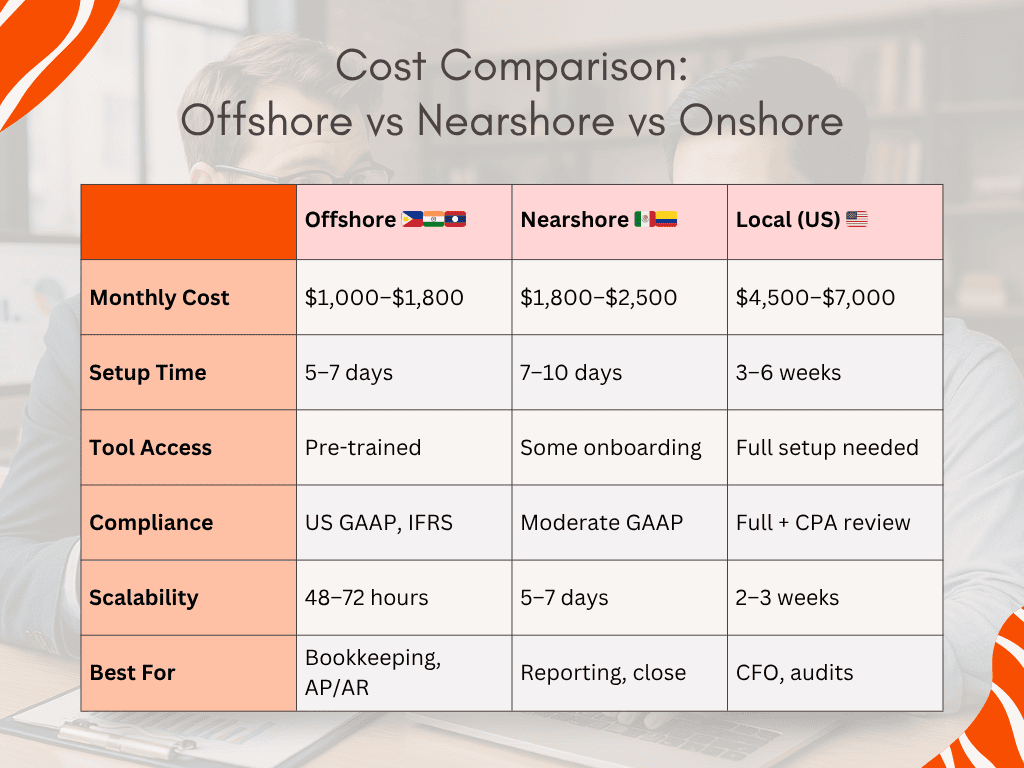
Strategic Cost Comparison: Offshore vs Nearshore vs Local Bookkeepers
Compare the cost, speed, and fit across offshore, nearshore, and local options to see what matches your current needs.
| Offshore (Philippines, India, LATAM) | Nearshore (Mexico, Colombia) | Local (US-based) | |
|---|---|---|---|
| Monthly Salary Range | $1,000–$1,800 | $1,800–$2,500 | $4,500–$7,000 |
| Setup Time | 5–7 days | 7–10 days | 3–6 weeks |
| Tool Access | Pre-trained in QuickBooks, Xero, ClickUp, and NetSuite | Similar tool access; some require onboarding | Fully onboarded, often requires system access setup |
| Compliance Knowledge | US GAAP, IFRS fluent | Moderate US GAAP experience | Full compliance; CPA oversight |
| Scalability Speed | Add new capacity in 48–72 hours | 5–7 days | 2–3 weeks minimum |
| Best Use Cases | Bookkeeping, AP/AR, payroll, reconciliations | Month-end close, reporting help | Financial planning, audits, CFO-level tasks |
How To Choose The Right Offshore Bookkeeper: A Complete Checklist
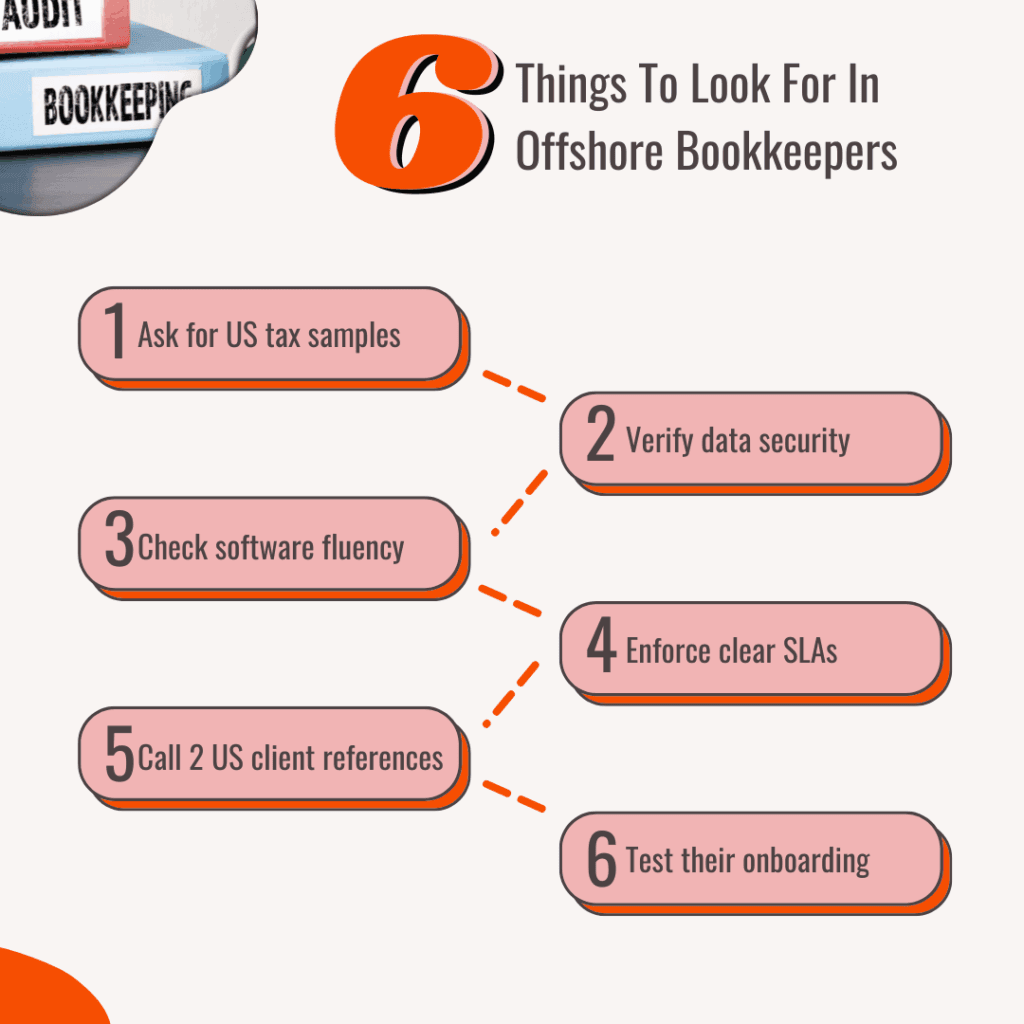
Review this list and compare these factors side-by-side before you commit to any offshore bookkeeper.
- Ask for US tax samples, not just resumes: Request mock reconciliations or past reports that show GAAP accuracy, audit preparation, and tax filing support. Skip any vendor who can’t prove US-specific expertise.
- Dig into their data access controls: Make them show how they handle file sharing, device logins, backups, and admin permissions. Look for password vaults, endpoint monitoring, and MFA with logging.
- Check software fluency upfront: Whether it’s Xero, QuickBooks, NetSuite, or ClickUp, your offshore hire must already know your stack. Ask for screenshots, sample workflows, or platform certifications.
- Make SLAs work for you, not them: Every contract should spell out task deadlines, review cycles, and error thresholds. Hold them to a daily or weekly SLA with built-in check-ins and escalation paths.
- Don’t skip the client history check: Ask for 2 recent US-based client contacts and dig into accuracy, communication, and speed. Bonus points if they’ve worked in your industry or region.
- Audit their ramp-up process: Great vendors offer a test project, buddy system, and sandbox environment before full access. If they can’t explain their onboarding process step by step, move on.
ℹ️ Interesting Fact
49% of companies using AI in outsourcing reported improved efficiency.
6 Steps To Start With Offshore Bookkeepers Without Hiccups
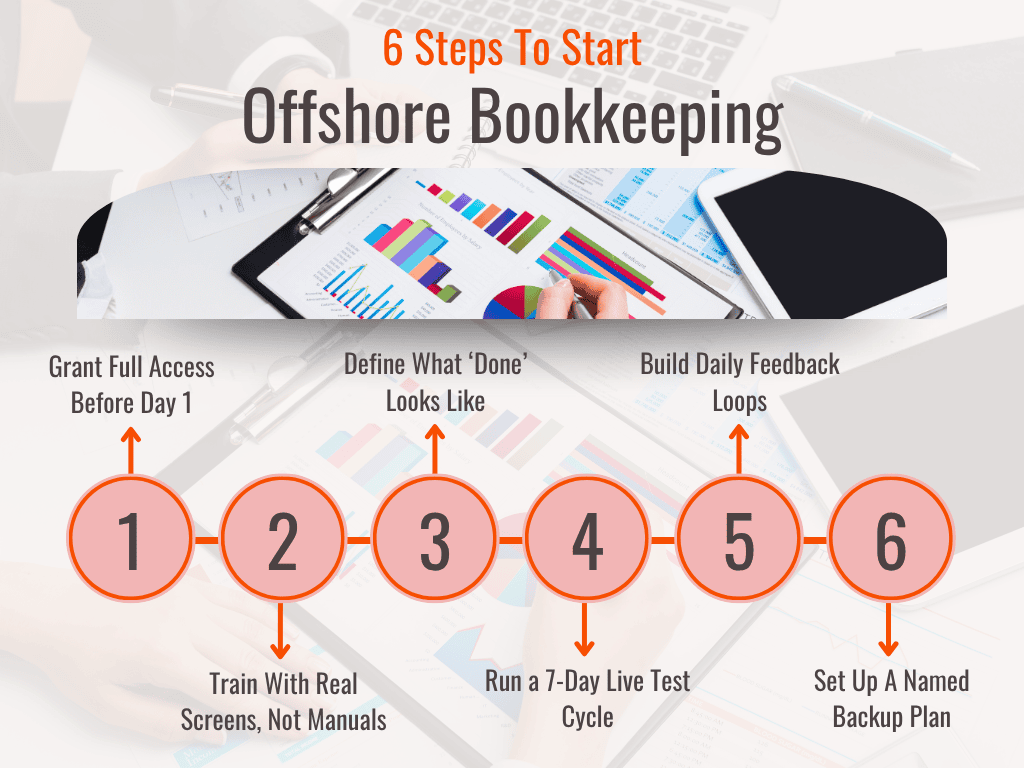
Set up this workflow to avoid bottlenecks, miscommunication, and unnecessary back-and-forth.
1. Lock In Their Access On Day One
Your offshore bookkeeper can’t get to work if they don’t have the right permissions, logins, or folders. Lock it down in advance.
- Create a checklist of access needs per tool: QuickBooks, Xero, NetSuite, ClickUp, email, password vault, file sharing platform
- Pre-approve account invites and admin roles through IT or the security lead
- Add role-based permissions by task, not title
- Set up a shared cloud folder with training files, test data, and month-end templates
- Test access before Day 1 to confirm no blockers
2. Train Them Your Way, Not The Generic Way
Skip long manuals. Show how your team works in real workflows.
- Record 4–5 key task walkthroughs using screen share tools (5–10 minutes each)
- Include voice narration to explain quirks, preferences, and red flags
- Upload all recordings in a labeled training folder, split by workflow
- Share a finance glossary that defines internal terms, vendors, and codes
- Offer a live Q&A after the video review to clarify any friction
3. Set Crystal-clear Expectations From Day One
Vague instructions kill productivity. Be specific about what “done” looks like.
- Define success metrics (e.g., one-day turnaround for reconciliations, 100% accuracy on invoice checks)
- Provide real task samples with expected formatting and structure
- Share a reporting schedule and cut-off times for weekly, monthly, and quarterly tasks
- Create a reference board with SOPs, escalation paths, and reviewers
- Add review windows directly to your task tracker
4. Run A 7-day Live Test Cycle Before Full Access
Don’t wait for real errors to find out what’s missing. Run a dry run first.
- Assign 5–10 real tasks using a test client or dummy data
- Ask them to document every question, delay, or unclear step
- Shadow the process live via screen share or async check-ins
- Review output for accuracy, communication style, and format
- Track cycle time for each task and record baseline metrics
5. Add Feedback Checkpoints Early (Not After Problems Start)
Don’t wait 2 weeks to correct a 2-minute mistake. Build daily feedback in.
- Use async tools to record short reviews (2–3 minutes each)
- Set daily check-ins for the first 2 weeks, then scale to weekly
- Log errors in a shared doc with fix instructions
- Praise what’s done right to reinforce standards
- Create a standing agenda for your weekly review call
6. Give Them A Backup Before It Becomes Urgent
You need a fallback before your bookkeeper takes leave or logs off mid-close.
- Ask your vendor for a named backup and transition playbook
- Share a copy of SOPs, task samples, and tools with the backup in advance
- Test the switch once a month to make sure the handoff works
- Document last updated date for all onboarding files
- Keep the switchover time under an hour
💭 Food For Thought
1.57 million Filipinos work full-time in BPO companies.
3 Real-Life Offshore Bookkeeping Success Stories: Outcomes That Don’t Lie
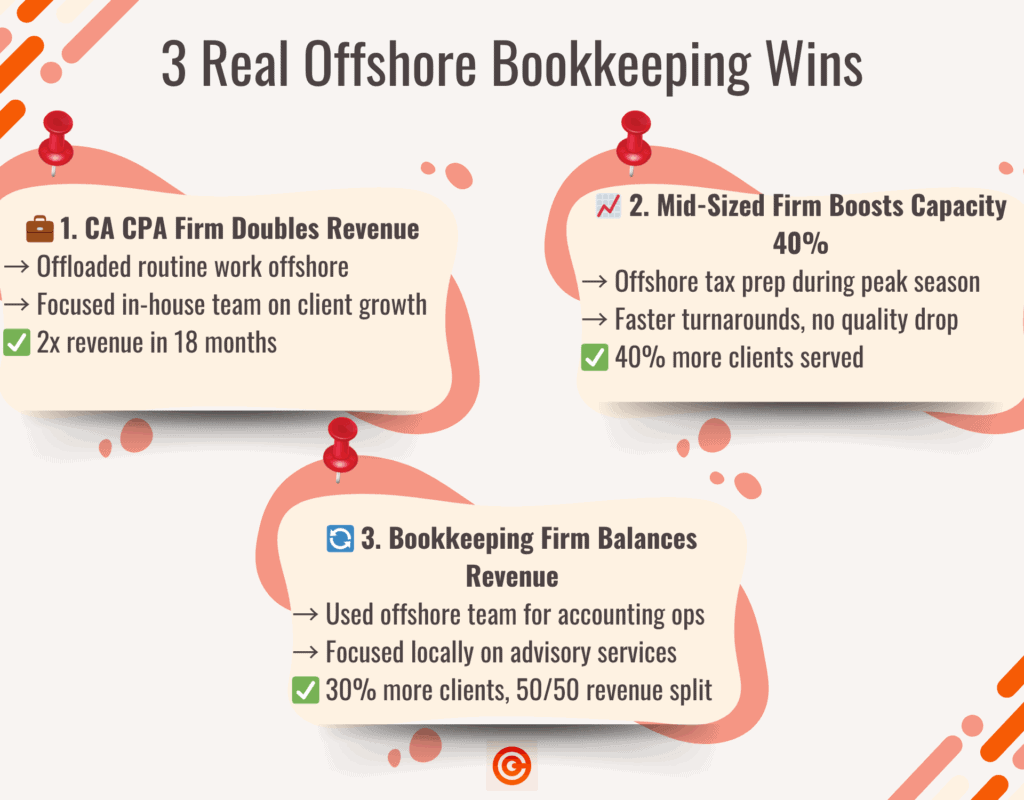
Consider these real-world examples to learn how offshore bookkeeping can streamline your operations and enhance efficiency.
1. California CPA Firm Doubles Revenue in 18 Months
Background: Oakland Financial Partners, a 5-person CPA firm in California, specializes in tax preparation and bookkeeping for small businesses.
Problem: The firm struggled with capacity constraints, which created overworked staff and limited ability to take on new clients. Manual processes and a lack of specialized expertise hindered efficiency and growth.
Solution: They implemented offshore accounting services and delegated routine tasks to a dedicated team abroad. This allowed the in-house staff to focus on client relationships and advisory services.
Outcome: Within 18 months, the firm doubled its revenue while maintaining quality and client satisfaction.
Key Takeaway: Strategically offloading routine tasks can free up resources to focus on growth and client engagement.
2. Mid-Sized CPA Firm Increases Client Capacity by 40%
Background: A mid-sized CPA firm that offers tax preparation and advisory services.
Problem: During tax season, the firm faced capacity constraints, which limited its ability to serve more clients and maintain quality.
Solution: They partnered with an offshore tax preparation team to handle routine tasks, which helped the in-house team focus on complex client needs.
Outcome: The firm increased its client capacity by 40% while maintaining quality and improving turnaround times.
Key Takeaway: Leveraging offshore resources can significantly expand client capacity without compromising service quality.
3. Bookkeeping Firm Achieves Balanced Revenue Streams
Background: A California-based bookkeeping firm with a 15-person team, specializing in small business accounting services.
Problem: Operational bottlenecks prevented the firm from scaling effectively and focusing on high-value advisory services.
Solution: They partnered with an outsourcing firm, using the Embedded Outsourcing Model to offload repetitive tasks to pre-qualified professionals.
Outcome: In 18 months, they increased their client base by 30% and achieved balanced revenue streams of 50% Client Advisory Services and 50% accounting work.
Key Takeaway: Offshoring routine tasks can help firms focus on high-margin services, which brings diversified and balanced revenue streams.
Conclusion
You already know the benefits of offshore bookkeepers are about reclaiming time, fixing broken workflows, and unlocking margins your competitors wish they had. From real-time reconciliations to overnight month-end closes, you’ve just seen how offshore bookkeepers can remove roadblocks without bloating your headcount or budget.
But most founders never see these results. Why? Because they’re stuck on job boards, sifting through half-baked profiles or hiring firms that overpromise and underdeliver. That’s where Genius can help. We’re your unfair advantage. We scan 250+ candidates to place ONE A+ hire: finance experts fluent in GAAP, tools like Xero and QuickBooks, and your time zone.
Skip the chaos. Start scaling your finance operations the smart way. Hire with Genius today.
FAQs
Which countries offer the best offshore bookkeeping services?
The Philippines, India, Mexico, and Colombia consistently top the list. The Philippines stands out for English fluency and US accounting experience, while India offers deep GAAP and IFRS talent pools. Mexico and Colombia provide strong time zone alignment for US-based firms.
How much can a business actually save with offshore bookkeeping?
Most companies cut bookkeeping payroll by 50–70%. For example, replacing a $65,000 US bookkeeper with a $15,000 offshore hire saves $50,000 annually without cutting output or quality.
Is offshore bookkeeping only for large firms?
No. Startups with at least 30–40 hours of recurring monthly tasks see major returns. Many small businesses hire just 1 offshore bookkeeper and scale as volume grows.
How do I measure offshore bookkeeping performance?
Track cycle times, error rates, and report accuracy. Use KPIs like days to close, number of corrections per report, and on-time delivery percentage. Most teams improve within 4–6 weeks.