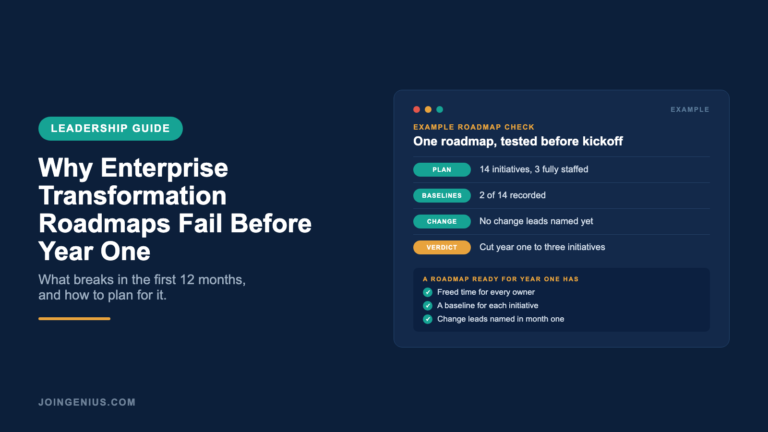
The roadmap got approved in January with 14 initiatives and a steering committee that meets every month. By October, three initiatives are live, and the CFO wants to know what the money bought. That is how enterprise transformation roadmaps usually fail. It happens inside the first year, long before anyone calls the program a failure.
Below, we stay inside those first 12 months, before a stalled program needs a recovery plan. We cover where the year breaks and why too many initiatives start at once. Then we get into early proof of value and change work. We finish with the people who should staff the roadmap.
Where An Enterprise Transformation Roadmap Breaks In Year One
A roadmap rarely fails on the day it gets approved. It fails across four quarters, and each quarter has its own way of going wrong.
Leaders Expect Results Within 12 Months
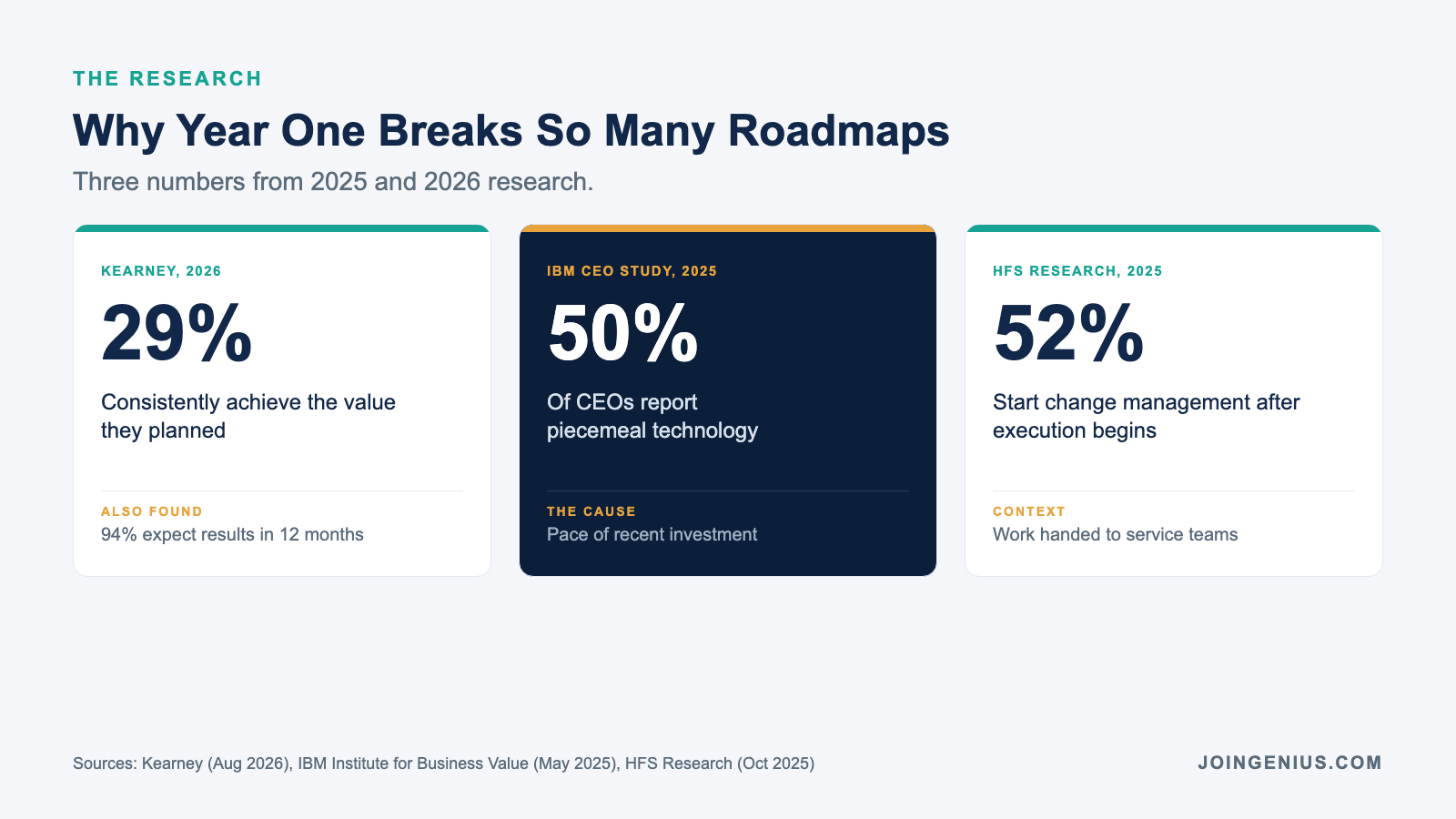
Kearney’s 2026 study of more than 100 transformation leaders found that 94% expect measurable results within 12 months. Only 29% consistently achieve the value they set out to deliver. The report’s title names the problem: most transformations fail after the strategy is approved.
The 12-month promise is usually set by the budget cycle, not by the work. Dates go into the roadmap before anyone checks which teams the initiatives depend on. A roadmap built that way has no room for the first delay, and each quarter tests an assumption the plan never checked.
What Breaks In Each Quarter
The breakdowns tend to follow the calendar, which makes them predictable. This reference table shows what usually breaks in each quarter and the warning sign that appears first.
| Quarter | What Usually Breaks | Early Warning Sign |
|---|---|---|
| Q1: Mobilize | Owners are named but keep their full workload | Initiative meetings get moved or skipped |
| Q2: First Delivery | Several initiatives wait on the same data team | Delivery dates slip by the same few weeks |
| Q3: Budget Review | Results cannot be proven without a baseline | Finance asks for savings nobody measured |
| Q4: Replanning | A new sponsor or strategy rewrites the roadmap | New initiatives get added before old ones finish |
The first two signs are the cheapest to act on. A roadmap that fixes them by the end of the second quarter still has time to show results at the budget review.
Too Many Initiatives Start In The First Quarter
An enterprise transformation roadmap is often built by listing everything the business wants and spreading it across four quarters. The calendar fills up evenly, but the number of people who can do the work stays the same.
Parallel Initiatives Compete For The Same People
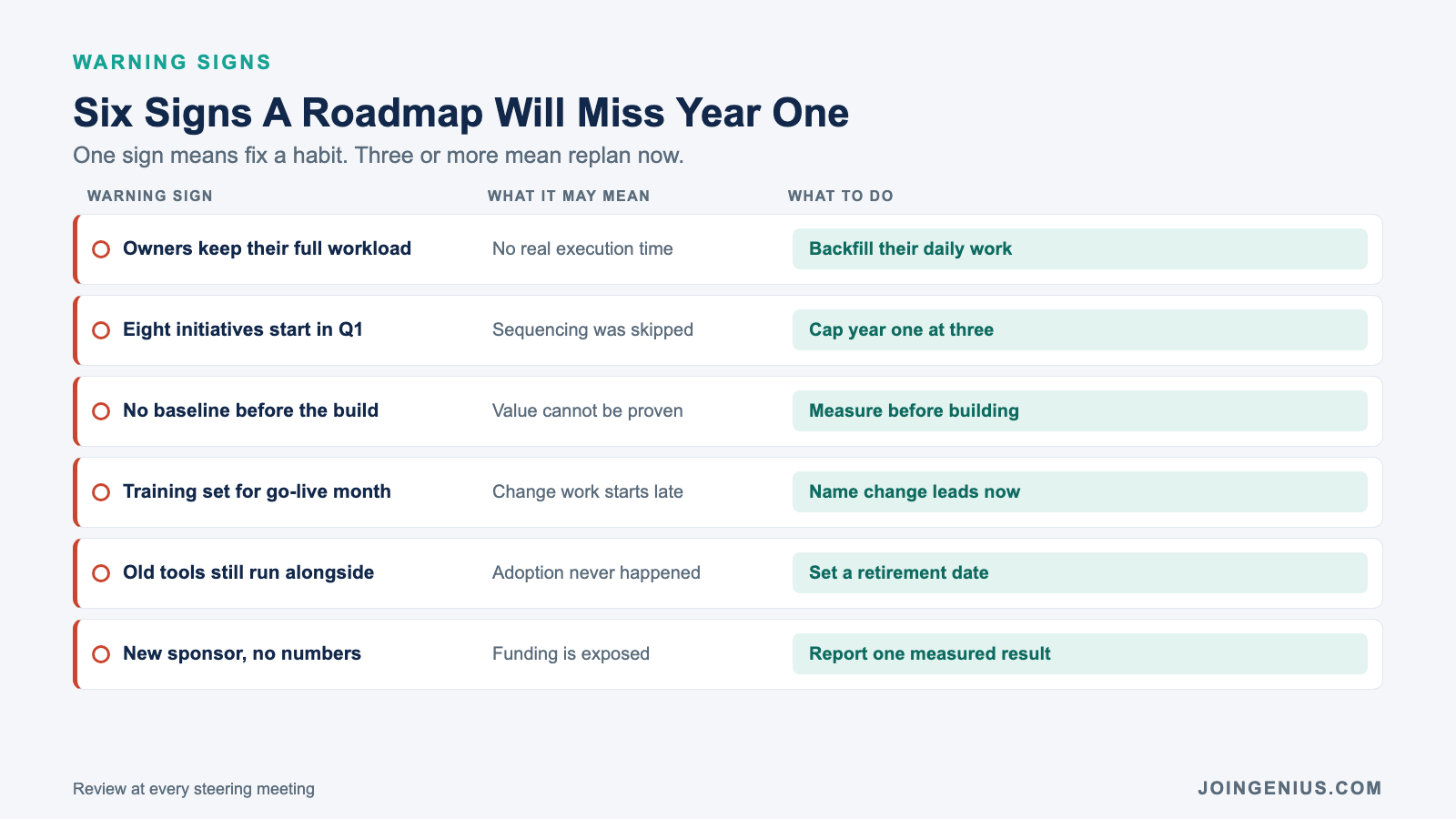
Most enterprise initiatives depend on a small group of people who understand the data and the core systems. When eight initiatives start in the same quarter, that group gets split eight ways. Each initiative then moves at a fraction of its planned speed.
Starting everything at once also shows up in the systems it leaves behind. In IBM’s 2025 CEO study, half of the 2,000 CEOs surveyed said the pace of recent investments has left their organization with disconnected, piecemeal technology. Those systems create the tool fragmentation that slows every team that later has to use them.
How To Sequence The First Four Quarters
Sequencing means deciding what has to be true before each initiative can start. It is the step most roadmaps skip, because a full calendar looks more ambitious in the approval meeting.
- Cap year one at three initiatives that do not share critical people or systems.
- Schedule data and integration work in the first quarter, before customer-facing launches.
- Start each initiative only when the teams it depends on have confirmed capacity.
- Move unstaffed initiatives to a year-two list with a named review date.
The Roadmap Cannot Prove Value By The Budget Review
Most transformation budgets face a hard review within the first year. A roadmap that cannot show a measured result by then loses funding to whatever can.
Baselines Get Skipped To Start Faster
Teams under pressure to show momentum start building before they measure the process they are replacing. Six months later, the new process may well be faster, but nobody recorded how long the old one took. The improvement is real and impossible to prove.
Budget Reviews Fund Numbers, Not Stories
Without a baseline, the sponsor walks into the budget review with a story instead of a number. The initiative that can show a measured drop in handling time keeps its budget. The one with only a good story usually does not.
The risk grows when the sponsor changes. A new CFO or business unit head reviews an inherited enterprise transformation roadmap like any other budget line, and unmeasured initiatives are the easiest to cut.
What To Measure In The First 180 Days
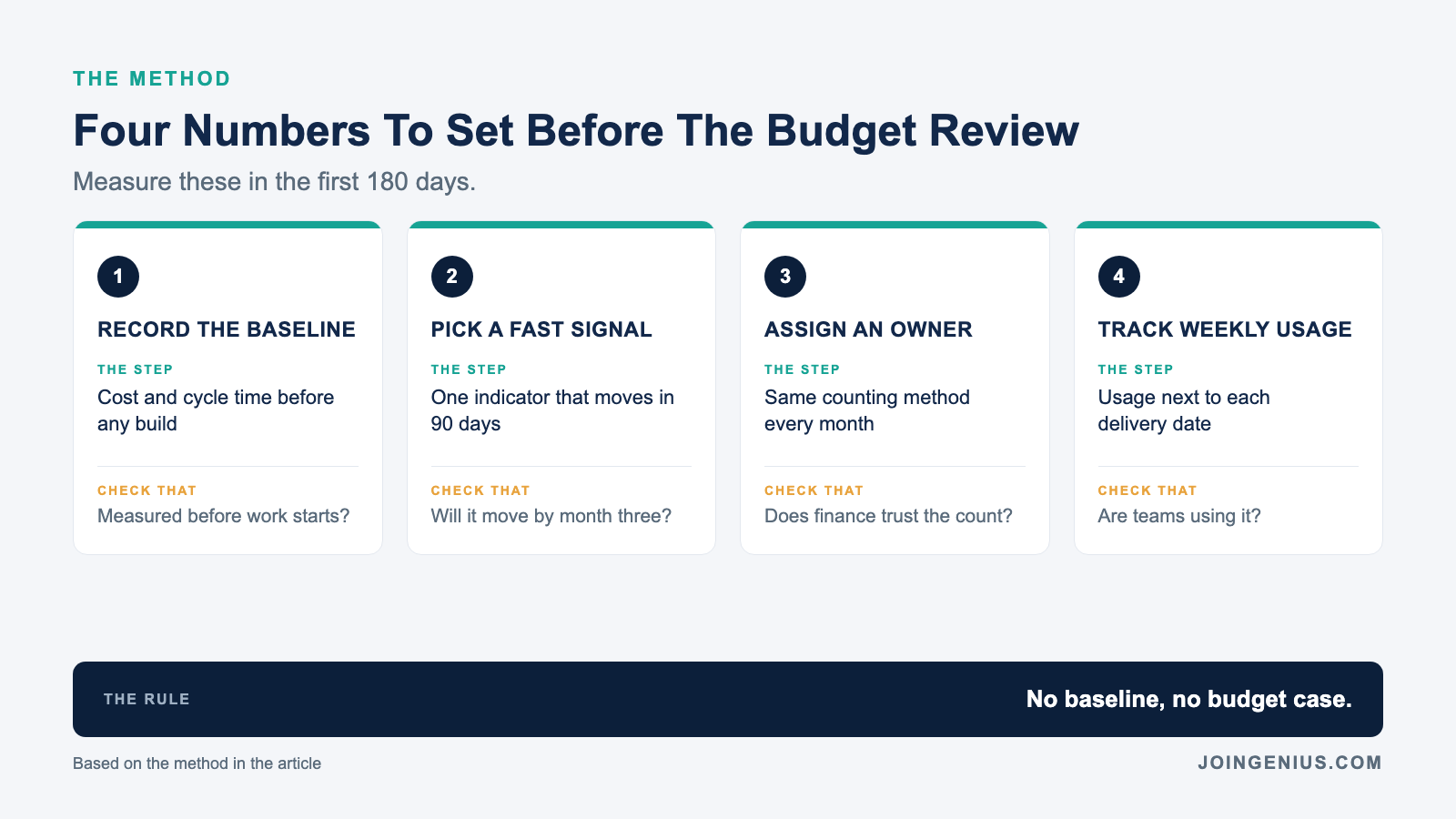
The safest numbers are ones finance already reports, like cost per transaction or days to close the books. A new metric invented for the roadmap gets argued about instead of accepted.
- Record the current cost and cycle time of each process before any build starts.
- Pick one leading indicator per initiative that should move within 90 days of launch.
- Assign one owner per number who reports it the same way every month.
- Report weekly usage of each new process next to its delivery date.
Change Management Starts Too Late
Many roadmaps book training and communication for the month before go-live. By then, the people affected have already formed a view of the change, and that view is hard to shift.
Late Change Work Shows Up As Low Adoption
The new system goes live on schedule, and usage stays low. Teams keep the old spreadsheet running next to it because nobody asked them how their work would change.
The pattern is easy to see when a roadmap moves work to a shared services team or an outside provider. In an HFS Research survey on these transitions, 52% of enterprises said change management starts after execution begins.
By the time execution starts, the decisions that affect people’s daily work are already made. Change work that begins then can only explain those decisions, not shape them.
Frontline managers feel this first. Their teams still have the same targets while they learn the new process, so any slowdown becomes the manager’s problem.
Start Change Work In The First Month
Early change work is mostly listening. The people who run the current process know where the new design will slow them down, and they will tell you if you ask before the design is fixed.
- Name a change lead for each initiative the same week you name its owner.
- Give frontline managers the rollout plan two months ahead, not two weeks ahead.
- Measure employee experience in affected teams before rollout and again at 90 days.
- Retire the old tool on a published date so teams stop running both.
Who Actually Executes An Enterprise Transformation Roadmap
A roadmap names an owner for every initiative but rarely says where that owner’s hours come from. In most enterprises, the answer is the same people who run the current operation.
Borrowed Staff Go Back To Their Day Jobs
An initiative owner who still runs a team gives the roadmap whatever time is left after the operation is covered. At quarter end, the operation comes first, and the initiative loses another month.
Consultants can cover the work for a while, but they leave with the engagement. The people who stay are the ones with the domain expertise the roadmap depends on, so their time is the one resource the plan cannot replace.
The fix is not more meetings with the same people. It is moving part of their current workload to someone else, so the time they give the roadmap is real.
Roles To Fund Before Kickoff
These roles do the work that falls between initiative owners. Funding them before kickoff costs less than finding out in the second quarter that nobody has the time.
- A program manager who owns the sequence and can say no to new starts.
- Business analysts who record the baselines and turn process changes into clear requirements.
- Data and integration engineers assigned full time to the first-quarter foundation work.
- Workflow automation specialists who rebuild the process before any new tool goes live.
What Dedicated Execution Capacity Costs
The Bureau of Labor Statistics puts the median annual wage for project management specialists at $102,320 as of May 2025. It projects employment in the occupation to grow 7% from 2025 to 2035, much faster than the average for all occupations.
Two dedicated project managers cost more than $200,000 a year in base pay at that median, before any analysts or engineers. Cost is a common reason roadmaps leave execution to borrowed staff in the first place.
Conclusion
Before you approve the next enterprise transformation roadmap, ask one question about every initiative on it: whose calendar does this come out of? If the answer is someone who still runs the current operation, fund that seat before the initiative starts. A short roadmap with staffed initiatives will still be running in month 13.
Genius can staff those seats. We place top 1% project managers and business analysts from the Philippines and Latin America for 80% less than a comparable US hire. There are no monthly fees, and every hire comes with a 6-month talent guarantee. If your roadmap needs people who can start in the first quarter, hire with Genius.